Saturday, May 26, 2012

Asylum Seekers Caned in Detention Depots as the Govt’s 6P Programme Extends Ahead

Kuala Lumpur (VOCR):  The Putrajaya government has extended the biometric system registration for the illegal migrants till April 10 despite making a public announcement in The Star news on the 11th and 15th February 2012 about the “Big Sweep” targeting against illegal migrants working in the country including asylum seekers and refugees. (Refugees are recognized by the office of United Nations High Commissioner for Refugees (UNHCR)).

So far, it is learnt that the UNHCR office is progressive in talks with the government on this critical issue which creates confusion and much fear for possible deportation among refugee communities after this round of biometric registration requires finger-printing.

Recently, up to nearly one thousand illegal migrants and asylum seekers, according to the credible sources, registered in this biometric registration have been deported to their home country.  The VOCR believes some of Myanmar ethnic refugees are also included.

Just before the public announcement was made, unprecedented small-scale round-ups were simultaneously exercised which resulted in dozens of Chin asylum seekers arrested and are currently being detained in various immigration depots.  Once being sent to immigration depots, it is uncertain how long they will be suffering from bitter detention experiences.  

Chin asylum seekers, Zing Hup Lian, Cung Cheng Thawng, Tial Cham, who were arrested on 5th December, 2011 while on the way back home from their workplace at Bukit Bintang, have been caned by the immigration authority in Kajang immigration depot and transferred again to Lenggeng immigration camp which is the most used depot for Chin refugees. Their fellow villagers could manage to meet them in detainment on 5th Feb with the prison authority’s permission. Here they discovered the guise of the detention management is extremely poor.

The caning was believed to be exercised against these genuine asylum seekers on the ground that they are illegal entrants and lack of valid documents.  It is highly speculated that more of the refugee population will be facing this indiscriminate action, when they need international protection because they escaped from severe domestic persecutions committed by the Burmese Military Regime.

In a clear preview of things to come, the situation for refugees and asylum seekers is likely to be getting worse day after day according to recent news report.

At worst scenario, the RELA (People Volunteer Corps), who are mostly used in the crackdowns, have an extensive power in raiding the illegals, asylum seekers, and refugees.

It is well noted that Malaysia does not adopt key international instruments that protect the rights of migrants as the country is not a signatory of the 1951 United Nations Convention relating to the Status of Refugees, or the 1967 Protocol relating to the Status of Refugees.  Refugee status does not exist in Malaysian law according to SUARAM, the human rights watchdog for Malaysia. Refugees are thus treated as illegal migrants except in some cases they are pardoned because refugees are recognized by the office of UNHCR which means UNHCR document holders may enjoy de facto protection at the national level (FIDH-SUARAM 2008, 9).

On the issue regarding the thoughts of the international community presuming refugees and asylum seekers can return to their mother country, the Chin communities with one voice say that it is obviously impossible to return home unless the political settlement is guaranteed in Myanmar.

Reporting by Simon

4 refugees at North Side High School in top 10 of their class


This year's graduating class at North Side High School has four young women who have come a long way to reach their graduation destination.
Two are from Burma, one from Thailand and another from Chad. Two are Muslim, and two are Christian, but despite their differences they are all sisters through their friendship and mutual struggle to overcome both the language and cultural barriers in their new homeland.
Three of the girls have been friends since middle school and met the other one when they came to North Side. For the past four years they have been inseparable, helping each other study and taking many of the same classes. All four are driven to succeed. All four are in the top 10 of their class; one is this year's valedictorian and another the salutatorian. All four want to be doctors.
In 2003 Ei Ei Oo and her family left Burma to be reunited with her father, a freedom fighter for democracy leader Aung San Suu Kyi, in Thailand where he was a political refugee. In an essay that Ei Ei Oo wrote for her English class, she described her journey to Thailand as similar to the “underground railroad.” Once in Thailand she lived in fear that their family would be deported back to Burma. Eventually with the help of the U.N. they were able to live there legally and in October 2007 they left Thailand for Fort Wayne. Like three of her classmates she struggled to learn the language, spending fifth grade at Franke Park Elementary.
Ei Ei Oo's American friends helped her to learn the language and she went on to Northwood Middle School, where she took English As a Second Language classes both years to help build her vocabulary. She said she always felt like her peers looked down on her because she didn't speak English fluently, so she worked harder to become like them. When she started ninth grade at North Side she told her parents she wanted to be the highest achieving student in her class. Her parents got her a tutor whom she met every Thursday to go over the lessons she didn't understand. She said she wants to be a doctor one day and return to Burma, where she could open some clinics and provide good medical health care.
Esther Vel, salutatorian and also a Burmese refugee, said she came from a poor neighborhood in Burma. Her father worked in Malaysia to make money for the family. She and her family lived in a house divided into two sections with her three uncles sleeping on one side, and she and her family in the other room. Eventually they moved to Malaysia and from there were resettled to the United States.
Like Ei Ei Oo, Esther Vel struggled with the language and classmates who treated her with little kindness or understanding. In seventh grade, she had a child tell her choir teacher she had lice. She had no idea what lice was but the choir teacher sent her to the school nurse. She had no lice, and to this day the incident brings tears of anger to her eyes when she tells the story.
In eighth grade she met Ei Ei Oo and Fareda Ma. They became fast friends and things became much better for her. She too shares the dream of becoming a doctor and said if it were not for her parents sacrificing so much she would not have had the opportunities she does.
Fareda Ma is a Burmese Muslim. In the civil war between Karen Burmese and Burmese Muslims, she said, there was little left for the Muslims. Many escaped to the jungles, and many, like her family, sought asylum over the border in Thailand. Fareda Ma was born there in Thailand. Her family opened a small restaurant while her father taught at an Islamic school. Her family moved to the United Sates when she was in sixth grade.
Fatima Idriss didn't meet the other girls until she was at North Side. Unlike the other three, she comes from Chad. Her family left there after her father ran into trouble with the government for speaking out about his political beliefs. The first year they were in the United States, they lived in Kendallville.
Initially, Irdiss said, her father didn't send her and her three sisters to school. It is the custom in her culture not to educate girls because their role is to stay home and take care of the house. Eventually her father realized it was against the law and sent his daughters, along with his three sons, to school.
Irdiss said her first year was very difficult. It was right after 9/11 and they were Muslims who didn't speak the language, living in a small town in rural Indiana. Her first year in school was a failure. There wasn't an ESL program in the Kendallville school system and she didn't understand the language.
At the end of the year the school encouraged her parents to move to Fort Wayne for the ESL program in Fort Wayne Community Schools. Like her three friends, once her English developed, her academics took off. Her dream is to become a doctor of obstetrics and gynecology, return to Chad and open a series of clinics to help women.
“Where I come from women are not valued,” Irdiss said.
Women do not go to doctors in Chad the way they do in the United States, Irdiss said. Instead, they see midwives. It is not culturally acceptable to have a male doctor touch a woman. This means women often go without medical attention.
Once Irdiss met the other three girls at North Side, they became inseparable. They attribute their academic success to wanting to prove to their American peers that they are as good as them, or even better. Most of them agree if it were not for the support of their families and the opportunity to come to America, they would not have been able to better themselves the way they have. They want to make their families proud of them and be able to support them.
But underneath their serious academic nature, these are just teenage girls, excited about going to senior prom and planning the color of their dresses. Every fifth word out of their mouths is “like.” The four were going to prom together, because most of their parents do not approve of them dating.
For Fareda Ma and Fatima Irdiss, half the challenge was finding a Western-style prom dress that was modest enough for them to wear. Last Saturday evening, they along with their fellow classmates gathered at the Grand Wayne Center for an evening of dancing and celebration, a rite of passage toward adulthood for most American children – and so it was for the four friends.

Reports on Current Detention Situation

BY SIMON


Kuala Lumpur (VOCR) 07 April, 2012: Taking a few assessments at Chin refugee center, The VOCR obtains an up-to-date report on dozens of Chin refugees and asylum seekers currently being detained in immigration depots. 
Also, it was learnt that even the minors who are under ten in age are included among the detainees’ list that the Chin community received originally provided by the immigration authority while recently visiting several immigration depots. 
All Chin asylum seeker detainees are known crossing the border in order to rejoin family members who had previously fled the country due to the cruel persecution and human rights violation systematically committed by the Burmese soldiers.
Most of detainees, from southern part of Chin state where persecution is known fiercest, were arrested last month at Bukit Kayuhitem checkpoint in Alor Setar city in Kedah state,­­­ soon after their successful entry into the country through the lead of the human traffickers.   
The VOCR is informed that couple of family with nine children is separately detained in Pekan Nanas immigration depot in Kedah state while the rest of their fellow are still remained held in Alor Setar jail. And many are said to be awaiting court decision which can be made in the very near future. 
Calculating the current numbers since last December, it is believed that at least more than hundreds of Chin refugees are reportedly incarcerated in several detention centers across the region, quoted also NOGs reports as saying.  
Some of young people, according to the Chin community interviewed by The VOCR, who have been recognized as refugees at the depots are widely suffering from mental disorder problem due to the detention pressure and lack of medical access. 
In matters of detention pressure which rapidly causes an increasing mental health issues, detainees at Lenggeng camp in Nageri Sembilan state and Semenyih camp in Selangor have been reported atop as the worst. Even if they are holders of UNHCR document which means recognised refugees, the processing for intervention release is taking a lengthy period of time.  
When asked the doctor, who is allowed to have detention access, regarding the mental issues among refugee detainees, the doctor stated that many feel hopeless on the ground that what is going on every day in detention camps and centers pushes them to instill a sense of hopelessness even though little are known strong enough and can cope with their plight. 
In addition, the matter between whether or not refugees and asylum seekers should be registered in the government biometric registration system in which many are reportedly revealed deported back to their home country otherwise causes an extensively widespread confusion and fear among refugee community on what should be done. 
The next round of raids planned by the government after the government hails today no longer extension on the biometric registration will surely spell a greater aspect of anxiety for all refugees living in Malaysia.

Gang-attack Rocked the Chin Refugee Community


Dilapidated shop-lot houses in Taman Maluri, Cheras.
Kuala Lumpur (VOCR) 26 May 2012: The self-protective fighting against the gang-attack left two of Chin refugees badly injured and sent to hospital in addition to paying ransom money about RM-1800 [US$ 620] for the freedom of one of community leaders kidnapped in the area of Maluri Cheras situated 10 minute drive from Jalan Imbi, the Chin refugee center according to eye-witness.
It was learnt that the young Chin refugee guy at last Sunday night was gang-attacked by three of the local gangs while texting his friend on the phone by the street in Maluri, Cheras where he is residing. When the guy was seen fleeing from the attack at the scene, he was quickly assisted fighting against the gang group in defense of the young Chin guy by two of the Chin refugee elders living in the same area.  
Having noticed that they [the gangs] are so weak enough fighting with the two Chin men, they called on their friends and dozens of them within minutes turned to the street in order to fight back with the two Chin refugee men. After the nearly one hour-long fighting, both sides are known severely wounded at the end. Many of the local gang group left the fighting as many of Chins are more and more getting involved in the fight to help their suffering fellows.
It was successfully stopped by the intervention of the authority—police. One of Chin refugee men was known knifed on his right hand and severely wounded. 
Many of them from both sides were summoned to police station, according to what sources revealed, but Chin refugees getting involved in the hour-long fight was verbally threatened if dared to lodge an official report to the police at their station with the identity of refugees whilst all of the local gangs were let go back home untouched.  
Despite the fact that it was believed that the problem was well settled at the police station, Mr. Thla Kung, one of the community leaders working at Chin Disciplinary Action Committee (CDAC) in the area was kidnapped and asked ransom money about RM-1800 for his release. It was allegedly believed that the three brother gang hobnobbing with the near-by gangsters invited the Indian-Malaysian a thug of gangsters running an internet cafĂ© at the area in connection with the incident as they fear the huge refugee population. 
Three of the gang were identified as Sabah-born Malaysian and having a development studies in the near-by college. Even so, instead of going well to college, they turned to be bad guys like big gangsters and always giving troubles to Chin refugees. 
Prior to this, they apparently at so many occasions extorted and robbed Chin refugees’ property, such as, hand-phones and money. Even worse, they are also engaged in committing attempted harassment towards Chin girls and ladies at a time when they are at night returning home from their workplace. 
Looking back to the scenario of the fight, justice and fairness for refugees cannot extensively be seen as many areas of Malaysia society is overpoweringly ruled by gangsters. 
Due to fear of the chaos, the Chins dominated refugee community in the area is advised to warn against the possibility of further violent attack from the powerful gang group and not to unnecessarily go around at night. 
Reporting by Simon

Tuesday, May 22, 2012

Obama Administration Puts Business Before the Rights of the People of Burma

We are deeply upset and saddened to report that President Obama and Secretary Clinton announced yesterday that the U.S. is lifting the financial transactions and investment ban on Burma. The Obama administration has now placed the interests of businesses ahead of human rights and democracy. This comes in direct contradiction to pressure from U.S. Campaign for Burma and other human rights organizations and a statement from Burma's ethnic leaders just last week urging the international community not to "suspend or lift the remaining political, military, financial and economic sanctions.”  The Obama administration’s decision is miscalculated and could further human rights abuses and conflict in Burma. Read our press release. 

There is no rule of law in Burma. The military continues to commit atrocities against ethnic civilians, especially in Kachin State. Moreover, over 60% of the population relies on farming, and yet there are no laws that protect land rights. In fact, last year Parliament passed a law giving the government the legal right to seize land.  For example, currently a company owned by a Member of Parliament in Burma kicked farmers off their land so he could build an industrial zone. The farmers have tried various tactics from standing their ground on the fields to filing complaints. The corruption is so thick in the country that they have had no progress. Both in and beyond Burma's conflict zones, the issue of land confiscation is a deep problem throughout the country. It is baffling that Secretary Clinton thinks under these circumstances it is a proper time to open the flood gates for investment. 

Secretary Clinton hinted that investment should not involve Burmese military businesses but when a State Department official was asked by a reporter if this would be a binding requirement on US companies, he said no.  As numerous brave human rights organizations in Burma have documented, the Burmese military continues to commit egregious human rights abuses in the name of development and investment projects.  Earlier this month, several Kachin women and girls were gang raped by Burmese soldiers and forced out of their village near a hydropower project (KWAT press release). 

Secretary Clinton claimed that U.S. corporations will act responsibly, but this is through self-regulating, not mandatory requirements. We will now have to be vigilant and watch every American company that goes in to make sure that they take no part in forcing people off their land, human rights abuses or destroying the environment. It was unsettling to hear Secretary Clinton say "our goal and our commitment is to move as rapidly as we can to expand business and investment opportunities."

Despite calls for caution, the Obama administration has rushed this process and has not consulted with enough key stakeholders. U.S. Rep Illeana Ros-Lehtinen the Chairman of the House Foreign Affairs Committee said “The Obama Administration is acting prematurely in easing sanctions on Burma. While small steps have been taken in the direction of democracy, serious questions remain about Burma’s journey toward democracy…I am adamantly opposed to rolling back the only leverage that we possess in that country.”
There is now only one sanction left, the import ban. Every year Congress has to renew the import ban before it expires at the end of July. Now more than ever, the people of Burma, particularly the ethnic nationalities, will need us to fight to keep the import ban as the last piece of leverage.  That means our members will have to give 150% this year to make sure Congress renews it. Sign up here if you want to be a State leader in this campaign. You will work side by side with our Campaigns Coordinator Myra Dahgaypaw to make sure your Senators and Representatives make human rights and democracy the number one priority. 

Other members of Congress including Congressman Joseph R. Pitts and Congressman Trent Franks and human rights organizations have expressed their outrage at the lifting of the investment ban such as United to End Genocide, Physicians for Human Rights, and Human Rights Watch.

Thanks for your ongoing support. It is greatly appreciated.
In Solidarity,
U.S. Campaign for Burma

Chin: Census Planned to Establish Accurate Figures

Chin: Census Planned to Establish Accurate Figures

A census is due to take place before the end of May, 2012 in Mizoram State, India to determine the exact number of Chin people living there following their flight from the oppressive conditions faced by them in Burma.
Below is an article published by the Chinland Guardian:
The Chin Society of Mizoram is to conduct a census of Chin people from Burma residing in Mizoram State of India this month [May 2012].
A statement issued by Aizawl-based Chin Society of Mizoram said the census would start before the end of May [2012] and that the lists would be sent to the new government of Burma as well as the UN Office in New Delhi.
A leader of the Chin Society of Mizoram was quoted as saying that the census would play an important role for those who are willing to return to Burma in the future.
An estimated 70,000-100,000 Chins are living in Mizoram State after having fled persecution and human rights violations perpetrated by Burma's successive military regimes. This figure represents more than 10 percent of the total population of Mizoram State, according to local sources.
Meanwhile, the new government of Burma has announced that it will conduct its first national census in 31 years in April 2014, with the help of the United Nations.
Salai Za Uk Ling, of the Chin Human Rights Organization (CHRO), stressed his concern over the possibility of 'distorting' the census methodology used during the process, according to the IRIN news.
He said a significant number of Chins being unable to speak their own ethnic language any longer could be mistaken for or classified as Burman.
Currently home to an estimated population of 500,000 people, Chin State has long seen mass out-migration as a result of various forms of repressive measures, pushing thousands of people to neighbouring countries including India and even as far as Malaysia, which is estimated to host around 50,000 Chin refugees.

Image of an immigration truck. — Pic by Colin Shafer
KUALA LUMPUR, May 19 — There’s an important element to remember when talking about refugees: they live in a world of fear. Of course, it is not the first time they get to taste this bitter feeling, as they are forced to seek refuge in a new, unfamiliar place. War, poverty, insurgency may have left them traumatised and forced to flee their country. The whole process is shadowed by fear. It will always agonise them as long as they don’t belong.
Currently, Malaysia is host to one of the largest refugee and asylum seeker populations in Asia. More than 90,000 registered refugees exist in the country, 92 per cent of them are Burmese. However, Malaysia is not signatory to the 1951 Refugee Convention, nor the 1967 Protocol and has continued to refuse to recognise them as refugees. There are no policy, laws, or regulations that even admit the existence of refugees. They are unable to work legally, access basic services (e.g. education or health care), let alone feel secure.
“We are repeating the same bad experience,” said Khin, a 35-year-old Burmese refugee who has been living in Kuala Lumpur for five years.
When asked why he chose Malaysia, he said it was the only option. Compared to the other neighboring countries, Malaysia is the farthest, thus a lesser chance of getting tracked down and deported back to their military government. Also, their peers had already settled in Malaysia, so they had connections.
For Yamin, another Burmese refugee I interviewed, security was her only concern. The 32-year-old briefly explained her four-year experience in Malaysia so far, “Life here is very difficult, but still we can survive basic needs.”
Most of the Burmese came to Malaysia by crossing the jungle border, where agents took them on foot. Having to go through the dangerous terrain, many lost their lives-especially children. Those who have money have higher chances of crossing the Malaysia-Thai border safely.
Those who do not could be handed over to human traffickers or sold to fishermen, brothels, or private owners.
Even though many of them made it to Kuala Lumpur in search for a better living condition, Malaysia’s extremely poor environment for refugees creates constant adversity for them to endure.
The UNHCR has contributed by providing protection and advocating for their rights, but still problems perpetuate. The so-called refugee card from UNHCR gives the necessary identification and helps them to be recognised as refugees.
A 50 per cent discount is given to cardholders for healthcare services, but only in government hospitals. Possession of the card, however, does not guarantee them freedom from arrest and detention. Once arrested, they claim that they are subjected to forced bribery, punishments (including whipping), and deportation.
Three of the refugees I interviewed admit that the UNHCR is "helpful but very limited." Despite the 50 per cent discount, many cases have been found that refugees experience substantial obstacles accessing health care in Malaysia. They are also vulnerable to forced labor by not having any work permit. The UNHCR could only do so much about it.
For instance, Yamin’s brother-in-law is a construction worker in KL. Since he works illegally, he is underpaid. His boss uses it as a reason not to pay the fair wage. After a few reports made, Yamin claims the UNHCR could only "give warnings" to the management.
The problem is that there is an absence of empathy. It is heavily needed in the core of everyone’s heart who offers help. No matter how big a name an organisation or an individual has, empathy should be the drive, otherwise, no one is affected.
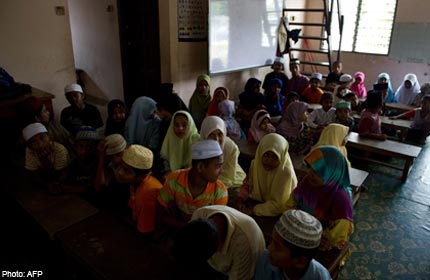
On the other hand, these refugees are making the effort. Coming from an educated background (Khin has obtained two degrees; Yamin studied theology and Amara was enrolled in a college of education for a year), all three of them now work voluntarily at a refugee school in KL as teachers. They teach refugee children, who are unable to attend public schools, up to Primary 5. The school is located on the second floor of a shop, accommodating more than a hundred students in five classrooms with its limited facilities.
However, that doesn’t stop them. “We want [children] to be always inspired to learn,” hoped Amara. The three passionate teachers understand how education could make such a big impact for the generations to come. They “give the seed” here and leave the students to keep on learning. “If they are educated, they can rise up our nation,” Amara said.
No human being is illegal. That is a contradiction in terms as Elie Wiesel, a Noble Peace Prize winner and Holocaust survivor, once said. “We just want our basic rights.” That is all they demand and they deserve it.
Yamin’s deepest hope is to be with her long-separated family back in Myanmar. Amara wants to continue her studies, attending a university.
She plans to open a school for young children if she ever got back to Myanmar. And Khin, he is eager for knowledge and wants to resettle to a third country for a better empowerment. Then, he wishes to come back to his ethnic group in Myanmar and bring them forward in any way possible.
These are people full of dreams and enthusiasm, waiting to discover something worthwhile. They have hope; and that is exactly what they need.
* Danishwara Nathaniel is a student at the Taylor's College Canadian Pre-University and a member of the Everyone Has Hope Project teaching photography the Burmese Refugee youths living in KL
(http://everyonehashope.tumblr.com)

Be The One To Empower Refugees

Dear readers,

What would become of us if only 25% of our children had access to school? What would it be like if families missed out on education for generations?

We have never had to ask ourselves these questions because we live in a day and age where access to education is a given. The refugee children in Malaysia are not so blessed. School for many of them is a privilege. Among Rohingya and Myanmar Muslim refugee children, only about 500 of a total estimated 2,500 children have access to any kind of education.

Refugees & Technology

One of our team members is a refugee and his IT knowledge is amazingly good, by any standard.

Not having access to formal education system did not stop him and others in the refugee communities from taking the effort to learn and keep abreast with IT technology. More than 40 Community IT centres were established in the last two and a half years by the refugee communities with some that are run by the refugees themselves under resource-scarce conditions.

It is through schooling that refugee children learn not only the basic reading and writing skills needed to survive in a modern world, but also knowledge of the world beyond their own home. With every day that they are denied proper education, they are denied the ability to develop themselves mentally and intellectually for their future. SPF works with refugee communities to help meet this fundamental need.

And you too can play a part, financially or in-kind, to help a refugee child go to school. Be the one to empower refugees.

support from SPF & Hartford Academy, a local institution, for the purpose of IT education. This joint venture produced some 1,400 graduates in Basic IT.

Many are learning advanced courses including in multimedia and web development. They even communicate with their loved ones in their home countries with Skype!

Technology does wonders to alleviate the pain of being lonely or depressed especially in the case of refugees!

People who want to be involved in Social Protection Fund, UNHCR to learn more!
Known as SPF, we started in July 2009. 
Our aim is to assist and promote self help and independence among the refugee communities in Malaysia. As of Feb 2012, we have provided grants to 261 community projects that are located in Penang, Perak, Selangor, Kuala Lumpur, Terengganu, Pahang, Negri Sembilan
and Johor.

The projects range from income generating projects, skills training (computer, tailoring and handicraft) and
community services and development (shelter, youth club and peaceful co-existence). These projects
benefit about 35,000 people.

We seek your support to directly sponsor some of the existing projects or new projects either financially or in kind. For more information, contact us at:

United Nations High Commissioner for Refugees
Tel: 03-2141 1322 (ext 209 @ 210)
Website: www.unhcr.org.my or
http://spfunhcr.wordpress.com or

sign up to volunteer at
www.shiftboard.com/unhcrmalaysia

We're always excited to meet new helping refugees. Contact us today

Source : SPF, UNHCR, Malaysia

Myanmar Muslims Risk Live for Better Future

Myanmar, Muslims, oppression
Muslim Rohingyas say they are deprived of free movement, education and employment in their homeland.
KLANG, Malaysia — Earning their title as the world's most persecuted minority, Myanmar’s ethnic Rohingya Muslims are risking troublesome seas and lands to flee oppression at their homeland for a meager dream of a better life.
"I could not stay (in Myanmar) anymore," Abdul Rahim Abdul Hashim, 18, told Agence France-Presse (AFP) on Monday, May 21.
“We could not go to school, I could not get any job.”
Abdul Rahim embarked on the dangerous journey south along the Myanmar, Thai and Malaysian coasts with two dozen others aboard a small boat in Bangladesh.
He crossed the border into neighboring Bangladesh last year and secured passage on a rickety boat for the perilous 3,200-kilometre (2,000-mile) sea voyage to Malaysia.
Intercepted by Thai authorities, they were detained in a jungle camp for several weeks and fed just once a day.
At last, Abdul Rahim and several others bribed their way out to go by bus and on foot to the Malaysian border.
"I was very scared," he recalled.
Rohingya Muslims are believed to be descended from Arab and other Muslim traders who traveled and settled in the area more than 1,000 years ago.
They live in the mountainous northern Rakhine state, one of the poorest and most isolated in Myanmar.
Rohingya Muslims have been denied citizenship rights since an amendment to the citizenship laws in 1982 and are treated as illegal immigrants in their own home.
Every year, thousands of minority Muslim Rohingyas flee Myanmar in wooden boats, embarking on a hazardous journey to Thailand or Malaysia in search of a better life.
While some find work as illegal laborers, others are arrested, detained and "repatriated" to a military-ruled country that washed its hands of them decades ago.
Rohingyas say they are deprived of free movement, education and employment in their homeland.
They are not recognized as an ethnic minority by Myanmar and say they suffer human rights abuses at the hands of government officials.
Sleepless Nights
Like thousands of Rohingya Muslims, Abdul Rahim could not erase the disturbing images of his life under Myanmar authorities.
He still recalls nights in which he was snatched from bed to help build roads, cut down trees and perform other hard labor at a Myanmar military camp.
"In Myanmar we can never sleep. Now we can sleep here," he said.
In 2010 elections, Myanmar invited Rohingya to vote, stand as candidates and form political parties.
But this corresponding offer of possible citizenship has never materialized, crushing the hopes of many.
"While the new government has engaged in a series of reforms toward democratization, there has been no real progress for the Rohingya, no change at the policy level and very little on the ground," said Chris Lewa, director of Bangkok-based The Arakan Project, an advocacy group monitoring the Rohingya.
"Forced labor, marriage restrictions, restrictions on movement and arbitrary arrests continue."
Without an immediate change in Myanmar discriminatory practices, there will be no future for the prosecuted Muslim minority.
"There is no change at the moment. The Rohingya still see no future," said Lewa.
As most Rohingya Muslims preferred Muslims-majority Malaysia as their final destination, others harbored dim hopes of resettlement through the UN refugee agency to a third country such as the United States or Australia.
Others decided to embark on the even longer and more dangerous boat journey to Australia via Indonesia.
"They have no hope," said a Rohingya exile who only gave his name as Yahya.
“If they die (at sea), never mind. (They may) find a better life.” 
 
Source : http://www.onislam.net

Troubles continue for Myanmar's Rohingya minority

KLANG, Malaysia — For five years, Abdul Rahim Abdul Hashim was repeatedly press-ganged into forced labour at a Myanmar military camp, until the ethnic Rohingya teenager could take no more.
Abdul Rahim crossed the border into neighbouring Bangladesh late last year and secured passage on a rickety boat for the perilous 3,200-kilometre (2,000-mile) sea voyage to Malaysia.
"I could not stay (in Myanmar) anymore. We could not go to school, I could not get any job," said Abdul Rahim, 18, of the plight of the Rohingya, a Muslim minority that alleges particularly acute repression under Myanmar's government.
The newly civilian government's moves to relax decades of military rule have been hailed worldwide and provided hope of a new era for majority Burmese and ethnic minorities who have long claimed oppression.
But refugees and activists say initial optimism is fading among many Rohingya -- whom the United Nations calls one of the world's most persecuted minorities -- as repressive practices have continued and an exodus abroad shows no sign of abating.
"I don't want to go back. There will be no change," Abdul Rahim said in the Rohingya language through a translator.
Myanmar has an estimated 750,000 Rohingya, according to the United Nations, mainly in the western coastal state of Rakhine bordering Bangladesh. Another one million or more are believed to already live in exile in other countries.
A Muslim minority in mainly Buddhist Myanmar who speak a Bengali dialect, Rohingyas claim decades of persecution by a government that they say views them with suspicion.
Activists say forced labour is common and Rohingyas face discriminatory practices including travel restrictions, limits on family size, and a refusal to issue them passports that leaves them effectively stateless.
"There is no change at the moment. The Rohingya still see no future," said Chris Lewa, director of Bangkok-based The Arakan Project, an advocacy group monitoring the Rohingya.
An estimated 7,000 Rohingya, some from exile in Bangladesh but also directly from Myanmar, risked the voyage to Malaysia since October, she said.
Many still flee to Bangladesh but Muslim Malaysia has steadily become a magnet due to its more developed economy and because authorities have closed one eye to illegal migration in recent years due to a need for cheap labour.
Malaysia has an estimated two million illegal migrants, most seeking economic opportunities, but the UN refugee agency said there also are about 97,000 legitimate refugees fleeing persecution or other hardship, mostly from Myanmar and including 23,000 Rohingya.
"The new destination country is Malaysia. This year it could be more than ever coming here," Lewa said.
Once in Malaysia, Rohingya remain vulnerable to harrassment and have limited access to services such as health care.
Lewa said Myanmar invited Rohingya to vote, stand as candidates and form political parties in 2010 elections, but adds that a corresponding offer of possible citizenship never materialised, crushing the hopes of many.
"While the new government has engaged in a series of reforms toward democratisation, there has been no real progress for the Rohingya, no change at the policy level and very little on the ground," Lewa said.
"Forced labour, marriage restrictions, restrictions on movement and arbitrary arrests continue."
Abdul Rahim embarked on the dangerous journey south along the Myanmar, Thai and Malaysian coasts with two dozen others aboard a small boat in Bangladesh.
"I was very scared," he said.
Intercepted by Thai authorities, they were detained in a jungle camp for several weeks and fed just once a day until Abdul Rahim and several others bribed their way out.
They eventually made their way by bus and on foot to the Malaysian border.
Those who make it must dodge Malaysian authorities while scraping out a meagre living through manual labour.
In a bare room in a residential neighbourhood in Klang, a port town 30 kilometres west of the capital Kuala Lumpur, scores of young Rohingya men recounted their troubles back home as they sat together after an Islamic lesson.
Abdul Rahim said he was regularly snatched from his home to help build roads, cut down trees and perform other hard labour at the military camp.
"In Myanmar we can never sleep. Now we can sleep here," he said.
Several of the men said they paid smugglers up to $1,000 for passage, yet now earn just 30 ringgit ($10) a day transporting boxes of produce at a local fishmarket.
Some harbour dim hopes of resettlement through the UN refugee agency to a third country such as the United States or Australia.
But others embark on the even longer boat journey to Australia via Indonesia.
"They have no hope. If they die (at sea), never mind. (They may) find a better life," said a Rohingya exile who only gave his name as Yahya.

Source : http://www.asiaone.com

Myanmar refugee youths depict daily life through photography

THE “Everyone Has Hope” exhibition at The Cube Gallery, Ampang, showcased photographs taken by nine Myanmar refugee youths over an eight month period.
Initiated in 2009 by Taylor’s College’s Canadian Pre-University (CPU) programme, the exhibition is an annual photography project involving these youths aged between 13 and 16 years old living in Kuala Lumpur.
This project aims to teach Myanmar refugee youths from the Alliance of Chin Refugees (ACR) Learning Centre to utilise the art of photography to document their daily lives and experiences.
The launch of the photo exhibition was well attended by members of the public, college students and staff.
Photos of life: Marina (front row, centre) with the team.
 
The guest speaker for the event, Datin Marina Mahathir, applauded the initiative and encouraged the college to continue organising more of such activities.
The photo exhibition was open for free public viewing from April 15 to 27.
More than 200 photographs were showcased at the exhibition which gave visitors the opportunity to not only view but also support these Myanmar youths by purchasing the photographs.
The opening night successfully raised a total of RM3,000 from the auction of the photographs which ranged from RM25 to RM500.
The proceeds benefited the ACR Learning Centre and used to aid with the programme’s operating costs that includes field trips, cameras and educational materials.
Inspired by the American documentary, “Born into brothels”, this photography project attempts to bring to light the realities faced by the Myanmar refugees living in transit in Kuala Lumpur.
The college’s CPU teacher and founder of the project, Colin Boyd Shafer explained that the project’s mission was to provide an avenue for self-expression through art for the Myanmar youths and, at the same time, raise awareness amongst the public of their plight as refugees.
“These youths are naturally inquisitive and creative and through this project, we want to nurture and promote these qualities.
“The exhibition features selected photographs that were unique, enlightening and offer realistic depictions of life as a refugee child in Malaysia.
“The chosen photographs served not only to illustrate the despair felt but also portray victory of humanity over harsh times,” he added.
“CPU students chose to volunteer for the project as part of their 10-hour community service requirement.
“However, once they were aware of the refugee situation, they continued helming the project in the hope of creating a difference in their lives.
“The project has provided many students with real hands on learning experience, and it has allowed local students to mix with disadvantaged youths living in this country”, said Shafer.
With the help of CPU staff and local professional photographers, students volunteered their weekends to the Alliance of Chin Refugees (ACR) Learning Centre.
Apart from helping the Myanmar youths to detail their lives through photography, the students also exposed them to different subject matters such as singing and fine art.
Other activities included field trips to well-known attractions such as the Kuala Lumpur Zoo and Batu Caves, visits to prominent photography displays such as the recent World Press Exhibition and attending a workshop by New York Times photographer Justin Mott.
Since its inception two years ago, the project has successfully raised a total of RM15,000 for the ACR Learning Centre.
For more information, call 03-5636 2641, email taylorscollege@taylors.edu.my or visit www.taylors.edu.my.

Source : TheStar

l : thesailnews@yahoo.com Humanitarian crisis looms large over Myanmar’s Muslim refugees in Delhi

Source from TwoCircles.net, 14 May 2012

With no water, food and toilet, Delhi Police have kept them in a jungle area of Vasant Kunj
New Delhi: Dildar Begum was around 13 when her parents with many others from their community and locality set out for India two years back as the cruelty of the military regime became unbearable. Miles and miles they walked on foot through the jungle on the India-Myanmar border to reach India. But two years later today, Begum, now 15, and several hundreds of the Muslim refugees of her country are still in jungle – now not on border, but in the national capital of Delhi.
The Delhi Police have kept them in a jungle area of Vasant Kunj locality on Mahipalpur Road in South-West Delhi. They have no access to water, food and toilet. There could a humanitarian crisis in a few days as the police are not allowing any relief to them.
Sucheta, Students Union president of Jawaharlal Nehru University, has been trying to provide them with some health aid. But the Delhi Police have denied them access to the refugees. “When I asked them to show the order, they just pushed us out of the Vasant Kunj Police Station,” Sucheta told TCN.
7188639952_caf65f8fb8.jpg
These Muslim refugees of Myanmar have been staying in different parts including Jammu & Kashmir of India for last several years. But a few months back they moved to Delhi collectively – they are around 3 thousand in number – to put pressure on the UN office that looks into the cases of refugees. They want official status of refugees. They have met UN officials but they are giving date after date. Next date of meeting is on 15th May.
7188640862_f3136deb7a.jpg
Naseeruddin, a young refugee, said “they (UN officers) are just holding meetings. They are not granting us refugee status.” Narrating the cruelty of the military regime in Myanmar he said: They had capture our property. They would use us as bonded labor. They took us to camps for hard labor and returned in the evening without money. When we reach home we found our women have faced their cruelty at home. In that situation we decided to leave our country.”
Dildar Begum says “not only Muslims, some other communities including Hindus have come to India, and they have been granted refugee status, but they are discriminating against us as we are Muslims.”
TCN told Naseeruddin that government is changing in Myanmar. Democracy is returning there. So he should think to return to his own country. He said: “Yes, we will go but only after the new government returns our property and all the communities who have migrated from Myanmar are ready to come back.”
Sucheta of JUN says humanitarian crisis is looming large here. “Last night when I came here I saw a woman refugee with a newborn baby was crying for help to reach hospital. I do not know whether her baby is alive or not. They have no access to water, leave alone medical facilities.” She demands the UN and Indian government that they should be given refugee status without any further delay.

Burma's Ethnic Leaders Call for Sanctions to Remain

The United Nationalities Federal Council (UNFC) is an ethnic alliance composed of a dozen ethnic armed groups, including those who have signed preliminary ceasefire agreements, like the Karen National Union (KNU), as well as those in active combat like the Kachin Independence Organization (KIO). These ethnic leaders realize that Burma's military shouldn't be rewarded for ongoing aggression and human rights abuses "It is necessary for the international community to oppose and pressure the [Burma Army] for its wrong actions.” They are calling on the international community "not to suspend or lift the remaining political, military, financial and economic sanctions." Read the full statement here. 
In a strong sign of unity, the UNFC stated its deep concern for the ongoing violence in Kachin state, and how "an attack on a member is the same as an attack on all the members." These ethnic leaders cannot see how President Thein Sein's ceasefire talks could be genuine as long as attacks continue in Kachin areas. Stay updated on conflict and human rights in Burma by following our Crisis Map.  
The UNFC have now set a deadline of June 10, 2012: If the Burma military doesn't' stop its aggression by then, the other existing ceasefire agreements will possibly be suspended.  This could lead to a complete breakdown of ceasefire talks and a widespread escalation of violence in Burma. It is through standing against the military's aggression they hope to rechart the course of Burma towards a viable durable peaceful political settlement. 


While government officials discuss ceasefire agreements with some ethnic groups, the military aggressively attacks others. The attacks against civilians in Kachin State have been ongoing. People are fleeing their homes to escape the conflict, says one displaced Kachin "When the soldiers came to our village, they separate men and women, they tortures men and rapes women, we can’t bear it anymore so we have fled." Daw Aung San Suu Kyi recently encouraged caution about being too optimistic about change in Burma, and left it up to the American people to decide about sanctions. Do you want our government to give Burma's military leaders the huge reward of lifting sanctions while they are still committing atrocities? No we must stand with Burma’s oppressed minorities.

United to End Genocide has urged its members to call Assistant Secretary of State Kurt Campbell to not allow the Obama administration to lift an investment ban on Burma this week. We need to act now to tell Assistant Secretary Campbell at the State Department to slow down the lifting of the investment ban. Can you call his office today at 202-647-9596. Click here for talking points. 


In Solidarity,


U.S. Campaign for Burma

Tuesday, May 15, 2012

Gilroyan traveling to Thailand on mission to help refugees

Aimee D’Hondt, a Gilroy native, is a missionary who is getting ready for her trip to Thailand where she will work with different ministries that combat human trafficking, protect at-risk children as well as minister to Burmese refugees fleeing genocide in their home country.
D’Hondt is hosting a fundraiser at the Gilroy Chevy’s on Thursday, May 31 to help aid her expenses for the trip. Fifteen percent of sales from 5 p.m. to 9 p.m. will go to D’Hondt
Currently, D’Hondt is living in Atlanta to work with refugee groups as she prepares for the mission.

Here’s a link to her blog: http://aimeedhondt.theworldrace.org/

About Aimee D’Hondt: She will be going to be serving in Chiang Mai, Thailand for the next two years, starting mid-August, and doing so with the Adventures In Missions (based out of Gainesville, Georgia), but will be serving with several local ministries in Thailand. A few of the organizations she’s  doing work with include (though not limited to):

Free Burma Rangers www.freeburmarangers.org

Remember Nhu  www.remembernhu.org

YWAM Lighthouse in action www.ywamthai.org/lighthouse/

Her calling: “My heart is for the Burmese people who are crossing the Thai border seeking refuge from genocide taking place in their country. The Burmese government is extremely corrupt and has basically been ruled by an abusive military regime since the 60s. The country is currently engaged in one of the longest running civil wars in history. The people have no civil rights and the ethnic groups are oppressed and treated with brutal violence. If you would like more information on Burma, its history, or the current situation, there is a blog post at aimeedhondt.theworldrace.org that is very informative and helpful.
“While in Thailand, the main contact I will be working with is the Free Burma Rangers. This organization is having a huge impact inside Burma and even in Northern Thailand where they are based. I originally met FBR while doing missions work in Thailand in February of 2011. I stayed at the home of the founder and his family, and my time with them changed everything for me. That is when my passion for the Burmese people was ignited. The next month, I worked with Burmese refugees at a UN Refugee school in Kuala Lumpur, Malaysia, and my love for them grew even more.

Source : http://www.gilroydispatch.com

Burmese business conference planned


(Mizzima) – Rangoon and Mandalay will hold a business conference combining entrepreneurs from Europe and Asia, local media reported on Thursday.
The Union of Myanmar Federation of Chambers of Commerce and Industry office. Photo: MIzzima
The fifth “Myanmar Business Conference” is scheduled for May 15, said the Voice Weekly News.


The conference for entrepreneurs from two continents will be the first one held since 1994, the newspaper said.


Businessmen from the United States, Germany, Britain, Japan, Italy, Australia, Singapore, Malaysia, Thailand and Indonesia will discuss economic, trade and investment cooperation.


The discussions will Include specialized sectors including specifically oil and natural gas, hotels and tourism, housing estates, transportation, heavy machinery and information and technology.


The conference is also open to all Burmese companies interested in developing relationships with foreign companies.
The move will help direct deals between Myanmar entrepreneurs and their partners abroad.


Most sanctions against Burma are being suspended by the European Union for a year. The U.S., Australia, Japan, Norway and other countries have also eliminated or removed some sanctions, setting off a flood of interest in the country which has a cheap labour force compared to other countries in the region.


The U.S. has lifted sanctions to allow for humanitarian investments and nongovernmental groups to work in Burma.


In January, E.U. diplomats discussed an aid package to Burma, perhaps reaching 150 million euros. The package would be aimed at health, education, agriculture and institutional capacity building.


Observers said a key requirement would probably be full access to ethnic refugees who have fled widespread fighting and are surviving on limited aid.


The E.U. has opened a representative office in Burma to manage aid programes and promote political dialogue.


Burma activists are calling for Western governments not to ease all sanctions until all political prisoners are released, more progress is made to resolve the decades old dispute with armed ethnic groups, and more democratic reforms are instituted.

Monday, May 7, 2012

Literacy Programs Take on New Challenges

Submitted by Cindy McCall
 
(Cazenovia, NY) Esther Tial was barely a teenager when she escaped from her small village in war-torn Burma in 2004. Children in Chin villages were being taken from their homes and virtually enslaved by Burmese soldiers, who forced young boys and girls to carry gear and serve them.
This brutality still goes on today according to Tial, who says the soldiers use young children as human shields as they patrol the Chin region.
After a harrowing journey through Thailand, 14-year-old Tial arrived in Malaysia, where she lived for three years with other Chin refugees. Through the sponsorship of the UN and local CNY agencies, she eventually found a safe haven in the small rural village of Cazenovia, where she’s lived for the past two years with a host family.
“Many people have helped me, and I am so grateful to them,” Tial said.
Tial attends an adult literacy program at Cazenovia Public Library that provides her with a combined tutoring program in English as a second language and preparation for the GED (high school equivalency) exam. Hardworking and determined, Esther works long hours at a local restaurant, and keeps in close contact with other Chin Burmese refugees in the CNY area. As she balances work and study, her goal is to receive her GED as well as complete training as a certified nursing assistant.
Like other small towns in CNY, Cazenovia has seen an influx of refugees and immigrants. Cazenovia Public Library literacy coordinators have been working with Syracuse-based ProLiteracy to meet the challenges presented by new learners from diverse backgrounds.
In February, ProLiteracy offered a free training workshop in Chittenango for Madison County literacy tutors, organized by Carla Zimmerman. The workshop, run by Mark Cass and Kofi Adai of ProLiteracy, was aimed at helping tutors develop cultural awareness skills as well as specific teaching strategies for better instruction in library literacy programs.
ProLiteracy has also developed a series of informational packets on refugees arriving in the Central New York community that were made available to Cazenovia Library tutors. The well-researched ethnographies provide a window into different cultures and help literacy tutors better understand the cultural background of new learners from countries such as Sudan or Burma.
More than 41,000 adults in Madison and Onondaga counties live with low literacy skills. In Madison County, 16 percent of the adult population does not have a high school diploma or its equivalent. Among other initiatives, a series of fundraisers will be held to support local literacy efforts.
Grants and donations also help, as ProLiteracy and Cazenovia Public Library programs work together to reach the underserved literacy needs in our area. For more information about literacy needs in Cazenovia and Madison County, call the Cazenovia Public Library at (315) 655-9322.

Source : http://www.madisoncountycourier.com

Thursday, May 3, 2012

Burmese ethnic Refugees share culture and traditions at event

Refugees who made their way from oppressive, militant regimes in Asia to New Bern with the help of the United Nations shared their journey Saturday with supporters of Interfaith Refugee Ministry.

The day-long event at the Christ Episcopal Church Ministry Center was a fundraiser for Interfaith Refugee Ministry that has helped about 1,200 refugees in 20 years. This year the ministry is expecting about 200 refugees, mostly from Burma but also from South America, Africa, East Europe and theMiddle East.

While seven girls from Chin, a province in Burma about the size of Switzerland, danced a bamboo dance in ethnic costume, some people walked along the “Journey Wall” that was covered with photographs depicting the plight of many of the refugees, from camps where they had lived and landmines they had to cope with, to arriving in New Bern and earning their education, citizenship and jobs.

May Way, 18, was born in a Thailand refugee camp and was there for 14 years before she and her family came to New Bern five years ago.

“You could not go anywhere and you could not find work,” Way said.

Phyllis Hoffman, a board member of Interfaith Refugee Ministry, said Way, like many refugees who come to New Bern, was facing governments bent on ethnic cleansing.

Once they arrive here through a refugee resettlement program, Interfaith Refugee Ministry, made up of 23 local churches, helps find them lodging and rebuild their lives through organizations, employers and individuals, Hoffman said.

Interfaith Refugee Ministry is an affiliate of a national refugee resettlement agency, the Episcopal Migration Ministries. Funding comes through government grants and donations.

Way, who is a junior at New Bern High School, said she likes living here.

“It’s cool,” she said. “I like the weather and I like having places to go.”

Yphu Rmah, a Montagnard fromVietnam, said he came here fleeing oppression.

“The government inVietnam has treated us bad,” he said. “We are not free. The government doesn’t believe in Christians.”

Rmah came toNew Bernin 2002. He has earned his citizenship and has a job.

“I became a citizen last year,” he said. “I was proud to become an American citizen.”

Connie Stutts, a pastor and board member of Interfaith Refugee Ministry, held a picture painted by a young Burmese of a burning village and said it pulled at her heart.

“We think we are helping them,” she said. “But they are changing our lives.”

During the Share the Journey celebration, supporters got to see dancing along with cooking demonstrations, songs and a fashion show of traditional clothing

New Interactiv​e Map: Conflict & Human Rights Abuses in Burma

New Interactive Conflict Map Shows Widespread Human Rights Abuses During Past Year of "Reforms"

Today we are launching a new interactive map which shows reports of human rights abuses and conflict since Thein Sein became President of Burma one year ago. While the world discusses positive reforms happening in the country, it is crucial not turn a blind eye to the rampant human rights abuses and atrocities happening in many parts of the country. Such incidences include a Kachin village burned down by the Burma Army on March 27th and the death of two children just last week, who were killed while their village was being shelled. To see more - go to the new map, click on the incidences, learn, and spread the word.
We have over 750 reports on the map currently, and will continually add to it as we receive new reports. However, this by no means represents all the incidences that have happened in the last year- only those that have already been made public and were released in English. These reports would have never left the country had it not been for the many brave journalists and human rights defenders who must often work in secret to do this valuable job. These organizations and activists work closely with their communities in the country to shed light on some of the world's most closed off areas.

On the map there are reports on human rights abuses, armed conflict, arbitrary arrests, as well as arbitrary taxation and extortion. You can filter the map to just see each of these categories individually. Moreover, you can also see additional layers of pipelines and dams locations, which is important as these projects are often tied with human rights abuses. If you need help figuring out how to use the map you can go here.
We hope that this map will be a powerful visual tool that vividly shows the importance of pushing for human rights and an end to conflict. The map clearly shows the differences in the rates of abuses in ethnically Burman areas in central parts of the country compared with the areas of ethnic minorities. While the EU, Canada, and other countries were rewarding Burma by suspending sanctions in return for the holding of the by-elections, heavy fighting continued in Kachin areas. We cannot let this be the future of Burma, where the issues and voices of a large portion of the population are ignored.

Zipporah Sein, the head of the Karen National Union recently told reporters last week, "Now more than ever, it's important that our voice is heard." The holding of peace negotiations is not enough. Daw Aung San Suu Kyi and the NLD winning seats in Parliament is not enough. There must be greater vigilance and action in order to ensure that peace and reconciliation can be achieved in Burma. The international community must not lift all important forms of leverage before the rights of civilians have been insured. In a hearing in the House of Representatives last week, Tom Andrews, the President of United to End Genocide said in his testimony "As much as we want to hope that the recent progress toward democracy in Burma will mark a turning point, nothing positive will last until the Burmese military stops committing atrocities and a political agreement is reached with the ethnic national states." United to End Genocide had recently returned from a trip to Kachin state where there has been ongoing conflict since June of last year. USCB's Aung Din also made it clear how "the premature lifting of financial sanctions can greatly jeopardize the fragile peace negotiations currently underway between the regime's civilian authorities and ethnic nationality groups." Learn more about crimes against humanity in Burma here.
We need your help to ensure that the U.S. is doing all it can to support human rights and an end to conflict in Burma. Please share this map today and stay tuned for further actions.

Special thanks to our interns who have helped so much on this map: Heena, Fernanda, Anne, Rashima, and Anna.

In Solidarity,
U.S. Campaign for Burma