Wednesday, May 30, 2012

To be respected as a human

AT AN age most children begin primary school, seven-year-old Mohammad Karim escaped Burma for Thailand after his family's home burnt down. An Indonesian policeman (left) assists an Afghan asylum seeker to a police station in Malang town, East Java on April 21.
AMAN ROCHMAN
 
The following is part two of our feature about Myanmar refugees Mohammad Karim and Abu Tahir, who have found freedom in Rockhampton.
AT AN age most children begin primary school, seven-year-old Mohammad Karim escaped Burma for Thailand after his family's home burnt down.
He confirmed in court the Burmese government did not consider him one of their own and denied him a passport.

He watched hundreds of his fellow stateless Rohingya people flee their country and families.
After sneaking into Malaysia at the age of 12, Mr Karim registered with the United Nations and tried to make enough money to survive.

Police often arrested the father of two and dragged him to the Thailand border when he could not cough up a bribe. Corrupt police once detained Karim for 18 months.
But his resilience kept him returning and after a few years he caught wind of a place where a thing called "respect" existed.

"I know that in Australia (you got) respect as a human," he said.
"That is why I am here in Australia. I now know the respect as a human."
Like many before him, Karim heard of Australia on the TV in Malaysia and from other refugees.

He heard they accepted refugees and he would be able to go to Australia.
Unbeknown to him, Karim, like Tahir, also paid a man in Malaysia named "Gamu" $7500 Malaysian ringgit after making him a promise of freedom.
"I got a bus and (they) took me through the jungle to where some boats were," he said
"I heard there were Burmese (on the boat) but I couldn't know because it was dark. I was on the boat for six days and then got on a second boat when it was dark."
By then Karim was 18. It had taken him 11 years to reach his final destination.
He left behind his wife and two kids, whom he has not spoken to since he left.
After more than a year in an Australian detention centre, Karim and Tahir settled in Rockhampton.

During their interview with the Australian Federal Police, Tahir provided the name and whereabouts of the man who profited from his plight.
But instead, the AFP prosecuted the driver and mechanic of the boat Tahir and Karim boarded in their desperate bid for a better life.
Both Tahir and Karim gave evidence about the two Indonesian men accused of operating the leaky vessel.
They provided an insight into the horrific treatment, neglect and suffering that drove them on a long, exhausting journey.
The two men survived similar circumstances for a similar cause and continue to lead similar lives.

Burmese refugees confront challenges, receive their diplomas from Greenwood

By JUSTIN STORY, The Daily News, jstory@bgdailynews.com
 
They came to Bowling Green three years ago with little formal education and virtually no English language skills, but on Saturday they happily walked the aisle with their classmates at Western Kentucky University’s E.A. Diddle Arena to accept their diplomas as graduates of Greenwood High School.
Ba Gay, Piang Lian and Kyaw So are Burmese refugees whose families were relocated to Bowling Green after political unrest forced them to flee their native Myanmar for refugee camps in neighboring Thailand and Malaysia.
The students, all 20 years old, confronted many challenges in their new environment, where they had to learn to adapt to the American educational system and a new language.
“We couldn’t live in Burma, we needed a better life and education,” Lian said.
There were next to no opportunities for formal schooling in the refugee camps, and the three refugees enrolled at Greenwood at an age when most students are close to graduating.
The state does not fund refugees or legal immigrants who are 21 or older and attempting to complete their high school requirements.
State Rep. Jody Richards, a Bowling Green Democrat, sponsored a bill that passed the House earlier this year that would change the practice. But Richards’ bill died in the Senate.
Shelly Towe, who teaches English as a Second Language at Greenwood, said Gay, Lian and So were put on an accelerated path to help them graduate before aging out.
In addition to the ESL and other classes the three refugees have taken, Gay, Lian and So took additional classes through the Novel Stars program, which enables students to complete classes online.
During the school year, Gay and Lian were able to earn three credits through Novel Stars in one class period, and So earned two credits in one period.
“The diploma has been very important to them, and they are all hard workers,” Towe said.
After growing up among an assortment of Burmese dialects, the students speak English well, if haltingly.
They have also mastered the English alphabet, another adjustment from the written Burmese language, which has 55 characters and is referred to as ka-lounh.
“We know English, but we’re shy,” Lian said.
The new graduates play soccer in local leagues and were part of an intramural volleyball team at Greenwood that finished second in a schoolwide tournament.
“I think Greenwood has been a very accepting community to all of them,” Towe said.
So plays guitar and sings, and Lian is proficient enough in English to act as an interpreter for the family of another Burmese student who is functionally mentally disabled.
“He is applying for an interpreter position with the school district,” Towe said.
Gay and So also hope to find jobs after they graduate, and So said he wants to be able to help his two younger brothers and younger sister through work.
They are members of a graduating class of 235 students that was awarded $4.4 million in scholarship money and features 82 honor graduates, nine Governor’s Scholars and four National Merit commended students.

Asylum role for career diplomat

ALMOST a year after the High Court ruled the Malaysia Solution unlawful, cruelling any hopes the major parties had of processing asylum-seekers offshore, the Gillard government has appointed a new ambassador for people-smuggling, career diplomat Craig Chittick. 
 
Mr Chittick, whose background includes postings in Malaysia and Indonesia -- key players in the smuggling trade -- will work with the region to stem the growing number of asylum-seekers arriving on Australia's shores.
But his tools for doing so will be very limited.
In August last year, the High Court ruled the Malaysia people swap unlawful, destroying a deal announced in May that would have involved 800 Australia-bound asylum-seekers being transferred to Malaysia in exchange for 4000 declared refugees over four years.
The ruling cast a cloud of doubt over transferring asylum-seekers to countries that are not signatories to the UN Convention on Refugees.

Over the past few years the people-smuggling ambassadorship has been one of the most dynamic roles in the Department of Foreign Affairs.
Mr Chittick's predecessor, James Larsen, was instrumental in helping to broker the Malaysia Solution and, before that, the ill-fated Timor solution.
Appointed in February 2010, Mr Larsen is now Foreign Minister Bob Carr's principal adviser.
The appointee before that, Peter Woolcott, devoted much of his time to imposing greater rigour on the Immigration Department's wildly inconsistent refugee selection process, considered by many in Foreign Affairs to be a major pull factor for the asylum boats.
Despite the High Court's ruling, the government has vowed to fulfil Australia's side of the bargain.

Last week, the Immigration Department revealed that 1126 visas had been issued to refugees in Malaysia. On average, Australia has taken about 350 refugees a year from Malaysia.
The numbers mean Australia is bound to take another 3000-odd asylum-seekers from Malaysia over the next three years.
Senator Carr said Mr Chittick would be responsible for fostering international co-operation in the fight against people-smuggling.
The collapse of any political agreement between Labor and the Coalition -- both of which support the principle of offshore processing -- has led boat arrivals to skyrocket to near-record levels.
This month 1061 people arrived by boat, a rate of arrival not seen since August 2001 when 1645 were intercepted.

Source : http://www.theaustralian.com.au

Tuning into a voice from Burma


Radio star: Tha Tha Mang Cin of Ringwood is a presenter on 3CR community radio station's Chin Radio program. Picture: Ted Kloszynski
Radio star: Tha Tha Mang Cin of Ringwood is a presenter on 3CR community radio station's Chin Radio program. 
Picture: Ted Kloszynski
 
A young woman from Ringwood is helping her community find its voice through a segment on radio station 3CR.
Tha Tha Mang Cin is one of the presenters on the community radio station's Chin Radio, a weekly program that started in June last year and covers issues of politics and culture relating to the oppressed Chin minority in Burma's north-west.
The 20-year-old has recently added radio presenter to her long list of skills. She became involved with the radio station through the Australian Chin Community, in which she acts as a youth leader to other refugees.
Ms Mang Cin, who is studying fashion design at RMIT, says she's enjoying being a radio presenter.
"This is the only Chin radio station in the world," she says. "I like it a lot and I think I'm doing pretty well. I had never even seen a radio station before. I was also very shy before I was a youth leader and before radio."
Ms Mang Cin and her family left Burma in 2006 and came to Australia via Malaysia. She graduated from Ringwood High School last year.
Although reliving difficult past experiences and discussing the tense situation in Burma is "not really pleasant", Ms Mang Cin said it was important to have a show broadcast in her native language and for refugees, "especially the younger ones", to remember where they came from.
"I see two young Chin people talking to each other and even then they don't speak in their own language. The radio station helps them to know their culture and language."
You can hear Chin Radio every Thursday from 7.30-8pm on 3CR, 855AM or online at 3cr.org.au.
3CR is hosting a radiothon from June 4-17 and is seeking donations to stay afloat. The station, which has over 400 volunteer programmers, relies on its annual radiothon to remain on air for the next 12 months. The funds raised cover bills, licence fees, equipment upgrades and administration staff. To make a donation, phone 94198377 or visit 3cr.or.au/support.

Source : 

Gang-rape in church highlights Burma Army impunity for sexual violence in Kachin conflict

The gang-rape and prolonged torture of a woman in a church near the Kachin-China border town of Pang Wa in early May show the ongoing impunity for sexual violence enjoyed by the Burma Army.

On May 1, 2012, a patrol of Burmese troops from two battalions  (Light Infantry Battalion 347 and Infantry Battalion 118) arrived at Luk Pi village, Chipwi township, northwest of Pang Wa, and found “Ngwa Mi” (not her real name) aged 48, sheltering alone in a church, after most of the other villagers had fled. About ten troops beat her with rifle butts, stabbed her with knives, stripped her naked and gang-raped her over a period of three days in the church. 
This abuse was witnessed by another villager, Yu Ta Gwi, aged 59, who was captured while caring for his paralyzed wife. He was tied up in the church compound and kicked and stabbed by the Burmese troops. After the troops had left, on May 4th, he and Ngwa Mi were found semi-conscious by some Kachin villagers and taken to Pang Wa hospital.


Ngwa Mi, a grandmother with 12 children, has been reunited with her family, but has now become mentally deranged.

KWAT is gravely concerned at this latest incident of sexual violence, committed brazenly in the sanctuary of a church. KWAT places the blame squarely on the government in Naypyidaw, where the Supreme Court recently dismissed charges against the Burmese military for the abduction and disappearance of a Kachin woman Sumlut Roi Ja in October last year.

 “The message from the Naypyidaw Supreme Court is clear: the Burmese military can rape and kill ethnic women with impunity,” said KWAT coordinator Moon Nay Li.

KWAT demands that the regime immediately stops using rape as a weapon of war, ends the offensive against Kachin.

This new incident of sexual violence took place close to the site of the planned Chipwi hydropower dam on the May Kha River, one of a series of seven planned mega-dams on the Irrawaddy and its upper tributaries. Despite the spreading conflict in northern Burma, Chinese workers, with Burmese army security, have been continuously preparing for construction of these dams.

The spread of conflict to the Pang Wa area this month has displaced thousands more villagers, heightening the humanitarian crisis facing local communities seeking to feed and shelter over 70,000 displaced since the Kachin ceasefire was broken in June 2011.

Source : kachinwomen.com

Saturday, May 26, 2012

Joint Statement on the ASEAN Human Rights Declaration

By Amnesty Int Msia on Friday, 4 May 2012 at 13:54 ·
 
In this joint statement, international human rights organizations express their concern that the ASEAN Intergovernmental Commission on Human Rights (AICHR) has yet to take the necessary steps to ensure that the process of drafting the ASEAN Human Rights Declaration (AHRD) is transparent and fully consultative with civil society organizations in the ASEAN region. This document also includes the statement released on 8 April 2012 by national and regional NGOs expressing their disappointment over the continuing secrecy in the drafting process of the AHRD.

Joint Statement
The ASEAN Human Rights Declaration: Drafts must be published and subject to meaningful consultations with local, national and regional civil society and human rights defenders
May 2nd, 2012

We, the undersigned international human rights organizations, are concerned that the ASEAN Intergovernmental Commission on Human Rights (AICHR) has yet to take the necessary steps to ensure that the process of drafting the ASEAN Human Rights Declaration (AHRD) is transparent and fully consultative with civil society organizations in the ASEAN region.

In a joint statement released on April 8th (full text below), over 130 local, national and regional civil society organizations across the ASEAN region called on AICHR to implement the following steps:

1) To immediately publicize the draft AHRD so that the public can meaningfully participate in the drafting process. Consultations will remain meaningless if the draft declaration is kept confidential and out of reach of the peoples.

2) AICHR representatives who are already conducting national consultations in their respective countries must continue to do so, and ensure that these consultations are held nation-wide and in an inclusive and more regular manner. They should further encourage other AICHR representatives that have not taken such initiatives to do the same. The AICHR should also conduct consultations both at national and regional levels, especially if national consultations are not applicable yet in particular places.

3) To translate the draft AHRD into national languages and other local languages of the ASEAN countries in order to encourage broader public participation in the region.

4) To ensure that consultation meetings of the AICHR will be inclusive of all stakeholders, especially civil society organizations and national human rights institutions.*

On 12 April, AICHR announced that it would finalize the draft of the AHRD by July 2012 and hold one consultation with civil society organizations in late June 2012. A single consultation, conducted not at the outset but rather towards the very end of the drafting process, cannot be considered consultative and transparent. In addition to being non-transparent and non-consultative, this process has been clearly rushed with little thought provided on some of the key elements that have been articulated by ASEAN civil society for decades. An instrument of this importance and magnitude needs more time for adequate deliberation and discussion.

We fully endorse the April 8th statement made by national and regional civil society organizations and strongly urge all representatives of the AICHR to fully and immediately implement these recommendations. This would ensure that the AHRD reflects the legitimate concerns of civil society and human rights defenders in ASEAN and reflects existing international human rights standards.

The drafting of the AHRD is a litmus test of AICHR’s willingness to constitute a credible, respected, and effective regional human rights body. Principles of transparency, accountability, and consultation are applied by the United Nations and all other regional bodies when they engage in human rights standard-setting and the ASEAN must not fall below well established international standards and practice.

This joint statement is endorsed by (in alphabetical order):
1. Amnesty International
2. Asian Legal Resource Centre
3. Association for the Prevention of Torture (APT)
4. Christian Solidarity Worldwide
5. Civil Rights Defenders
6. Freedom House
7. Human Rights Now
8. Human Rights Watch
9. International Commission of Jurists
10. International Federation for Human Rights (FIDH)
11. International Gay and Lesbian Human Rights Commission (IGLHRC)
12. Protection International
13. Reporters Without Borders
14. World Organisation Against Torture (OMCT)
------------------------------------------------------------------------
* These four demands are as they appear in the 8 April 2012 statement of national and regional NGOs, “Joint Statement Calling AICHR to Release ASEAN Human Rights Declaration”

Statement released on 8 April by national and regional NGOs:

Joint Statement on Calling AICHR to release ASEAN Human Rights Declaration

8th April 2012

We, the undersigned civil society organizations and networks from Southeast Asia, express our grave concern and disappointment over the continuing secrecy in the drafting process of the ASEAN Human Rights Declaration (AHRD).

The ASEAN Intergovernmental Commission on Human Rights (AICHR) is mandated under Article 4.2 of its Terms of Reference to develop an ASEAN Human Right Declaration with a view to establishing a framework for human rights cooperation through various ASEAN conventions and other instruments dealing with human rights. At the 6th meeting of the AICHR in Vientiane on 28 June – 2 July 2011, a Drafting Group was officially established by the AICHR to prepare a draft of the ASEAN Human Rights Declaration. In January 2012, the Drafting Group submitted to the ASEAN Inter-governmental Commission on Human Rights (AICHR) a draft AHRD for deliberation and debate.

To this date, the draft AHRD remains confidential while the public has been excluded from any meaningful participation in the drafting process. There has not been any substantive and broad-based regional consultation with the peoples in the region on the draft AHRD.

While we commend the representatives of the AICHR from Thailand, Indonesia, Malaysia and the Philippines for holding consultation with their civil society at national level, we are disturbed that no such initiative has taken place in the rest of the ASEAN countries.

If ASEAN’s aspiration to be “People-Oriented” is to be achieved, the AICHR that is tasked to defend the fundamental freedoms of the peoples in the region must set a good example in ensuring meaningful and substantive consultation and people’s participation in the drafting of the historic AHRD.

We therefore strongly urge the AICHR to heed the recommendation of the United Nations High Commissioner for Human Rights, Navi Pillay, that “no discussion of human rights can be complete or credible without significant input from civil society and national human rights institutions” and immediately begin dialogues and consultations with civil society organizations on the AHRD.

We further call upon AICHR to implement the following steps to ensure that the drafting process of the ASEAN Human Rights Declaration will be credible, inclusive, transparent, reflective and consistent with universal human rights standards:

1) To immediately publicize the draft AHRD so that the public can meaningfully participate in the drafting process. Consultations will remain meaningless if the draft declaration is kept confidential and out of reach of the peoples.

2) AICHR representatives who are already conducting national consultations in their respective countries must continue to do so, and ensure that these consultations are held nation-wide and in an inclusive and more regular manner. They should further encourage other AICHR representatives that have not taken such initiatives to do the same. The AICHR should also conduct consultations both at national and regional levels, especially if national consultations are not applicable yet in particular places.

3) To translate the draft AHRD into national languages and other local languages of the ASEAN countries in order to encourage broader public participation in the region.

4) To ensure that consultation meetings of the AICHR will be inclusive of all stakeholders, especially civil society organizations and national human rights institutions.

Until and unless the AICHR consults and engages with all stakeholders in a transparent, meaningful and substantive manner, the AICHR should postpone its submission of the final draft of AHRD to the AESAN Ministerial Meeting (AMM), which is scheduled to take place in July 2012.

This call is made to public as wide as possible in the ten countries of ASEAN and is endorsed by different sectors of civil society organizations such as youth organizations, women’s organizations, child rights organizations, LGBT organizations, migrant workers network organizations, labour unions, farmers organzitions, environmental organizations, human rights organizations, development organizations and some academic institutions. The joint statement is also translated into ASEAN major languages, Burmese, Bahasa-Indonesian, Bahasa-Malay, Khmer, Lao, Thai and Vietnamese to indicate our commitment to promote the basic human rights of the people that they are entitled to receive information and awareness about ASEAN and its works.

Media contacts:

Yap Swee Seng , Executive Director, Asian Forum for Human Rights and Development (Forum-Asia), +66 (0) 818689178

Aung Myo Min, Director and Founder, Human Rights Education Institute of Burma (HREIB), + 66 (0) 819925293

Ms. Pung Chhiv Kek, President, Cambodian League for the Promotion and Defense of Human Rights (LICADHO), + 885 (0) 12589091

Mr. Haris Azhar, Coordinator, KontraS, Indonesia, + 62 (0) 815-13302342

List of endorsers:
1. Aceh Human Rights Coalition of NGO, Indonesia
2. Action for Environment and Community (AEC), Cambodia
3. All Arakan Students and Youth Congress (AASYC), Burma
4. All Burma Students Democratic Front (ABSDF), Burma
5. All Burma Students League (ABSL), Burma
6. All Kachin Students and Youth Union (AKSYU), Burma
7. All Women’s Action Society (AWAM), Malaysia
8. Alternative ASEAN Network on Burma (Altsean Burma)
9. Arakan League for Democracy (Exile) Youth (ALD-Youth), Burma
10. ASEAN WATCH, Thailand
11. Asian Forum for Human Rights and Development
12. Asian Indigenous People’s Pact
13. Assistance Association for Political Prisoners - Burma
14. Back Pack Health Worker Team
15. Banteay Srei, Cambodia
16. Boat People SOS
17. Building Community Voice (BCV), Cambodia
18. Burma Issues, Burma
19. Burma Medical Association, Burma
20. Burma Partnership, Burma
21. Burmese Women Union, Burma
22. Cambodia Indigenous Youth Association (CIYA), Cambodia
23. Cambodian Centre for Human Rights (CCHR), Cambodia
24. Cambodian Confederation of Unions (CCU), Cambodia
25. Cambodian Food Service Workers Federation (CFSWF), Cambodia
26. Cambodian Independent Teachers' Association (CITA), Cambodia
27. Cambodian League for the promotion and defense of Human Rights (LICADHO), Cambodia
28. Cambodian Watchdog Council (CWC), Cambodia
29. Cambodian Youth Network (CYN), Cambodia
30. Center for Migrant Advocacy Philippines
31. Child Rights Coalition-Asia
32. Chin Human Rights Organization (CHRO), Burma
33. Chin Students Union (CSU), Burma
34. Christians for Social Justice (CJS), Cambodia
35. Coalition of Cambodian Farmer Community (CCFC), Cambodia
36. Commission for Disappeared and Victims of Violence (Kontras), Indonesia
37. Community Action Network, Malaysia
38. Community Resource Centre (CRC), Thailand
39. Democratic Party for a New Society (DPNS), Burma
40. Dignity International, Malaysia
41. EarthRights International, Burma
42. Ecological Alert and Recovery Thailand (EARTH), Thailand
43. Education and Research Association for Consumers (ERA Consumer), Malaysia
44. EMPOWER Foundation, Thailand
45. Empowering Youth in Cambodia (EYC), Cambodia
46. Ethnic Community Development Forum (ECDF-Burma)
47. FOKER LSM, Papua
48. Foundation for Consumers (FFC), Thailand
49. Foundation for Ecological Recovery, Thailand
50. Foundation for Sustainable Development, Thailand
51. Foundation for Women, Law and Rural Development (FORWARD), Thailand
52. Foundation for Women, Thailand
53. EMPOWER Foundation, Thailand
54. Highland Peoples Task force (HPT), Thailand
55. Homenet, Thailand
56. Housing Rights Task Force, Cambodia
57. Human Rights Documentation Unit, Burma
58. Human Rights Education Institute of Burma
59. Human Rights Foundation of Monland, Burma
60. Human Rights Lawyers Association, Thailand
61. Humanum, Indonesia
62. Independent Democracy of Informal Economic Association (IDEA), Cambodia
63. Indigenous People Task Force on ASEAN
64. Institute for Policy Research and Advocacy (ELSAM), Indonesia
65. International Gay and Lesbian Human Rights Commission (IGLHRC)
66. JATAM, Indonesia
67. Kachin Women’s Association – Thailand (KWAT), Burma
68. Karen Youth Organization (KYO), Burma
69. Kayan New Generation Youth (KNGY), Burma
70. Khmer Ahimsa Organisation, Cambodia
71. KIARA, Indonesia
72. KontraS (National Office, Jakarta, Indonesia)
73. Kuki Students Democratic Front (KSDF), Burma
74. Lahu Women’s Organization, Burma
75. Lao Movement for Human Rights (MLDH)
76. LPSHAM, Indonesia
77. M Plus Foundation, Thailand
78. Messenger Band (MB), Cambodia
79. Migrant Forum in Asia
80. Migrante International, Philippines
81. Mon Youth Progressive Organization (MYPO), Burma
82. My Village Organization (MVi), Cambodia
83. Naga Youth Organization (NYO), Burma
84. National League for Democracy-Liberated Area (Youth), Burma
85. Network for Democracy and Development (NDD), Burma
86. Network for Human Rights Documentation in Burma
87. Network of Eastern Democracy, Thailand
88. NGO Coordinating Committee on Development (NGO-COD), Thailand
89. Northern Development Foundation, Thailand
90. One-2-One, Cambodia
91. Pa O Youth Organization (PYO), Burma
92. Palang Thai, Thailand
93. Palaung Women's Organization, Burma
94. People’s Action for Change (PAC), Cambodia
95. People’s Defense Force (Burma)
96. People’s Empowerment Foundation
97. Persatuan Masyarakat Selangor & Wilayah Persekutuan (PERMAS), Malaysia
98. Pokja 30, Indonesia
99. Project for Ecological Awareness Building (EAB), Thailand
100. Pro Rights Foundation, Thailand
101. Pusat Komunikasi Masyarakat (PUSAT KOMAS), Malaysia
102. Quê Me: Action for Democracy in Vietnam
103. Rainbow Community Kampuchea (RoCK), Cambodia
104. Sahakum Teang Tnaut (STT), Cambodia
105. Sex Workers Organization, Thailand
106. Shwe Gas movement
107. SILAKA, Cambodia
108. Social Action for Change (SAC), Cambodia
109. Social Agenda Working Group, Social Research Institute, Chulalongkorn University, Thailand
110. Society of Transsexual Women of the Philippines (STRAP), Philippines
111. South East Asia Working Group/ Asia-Pacific Refugee Rights Network
112. South East Asian Committee for Advocacy (SEACA)
113. Southeast Asia Coalition to stop Child Soldiers
114. Southeast Asia Popular Communications Programme (SEAPCP)
115. Students and Youth Congress of Burma
116. Suara Rakyat Malaysia (SUARAM), Malaysia
117. Sustainable Agriculture Foundation, Thailand
118. Sustainable Development Foundation, Thailand
119. Ta'ang Students and Youth Organization (TSYO), Burma
120. Tavoy Youth Organization (TYO), Burma
121. Thai Committee for Refugees Foundation, Thailand
122. Thai Working Group for Climate Justice (TCJ), Thailand
123. The Cambodian Center for Human Rights, Cambodia
124. The Cambodian Human Rights and Development Association (ADHOC), Cambodian
125. The Northeastern Women’s Network, Thailand
126. Think Centre, Singapore
127. Union for Civil Liberty (UCL), Thailand
128. United Lahu Youth Organization, Burma
129. Vietnam Committee on Human Rights
130. Volunteers for Sustainable Development (VSD), Cambodia
131. Women and Children Protection Foundation, Thailand
132. Women’s Global Network for Reproductive Rights (WGNRR)
133. YLBHI, Indonesia
134. Yoma3 News Service, Burma
135. Youth for Social Change, Myanmar
136. Zomi Students and Youth Organization (ZSYO), Burma
137. KCho Ethnic People Of Burma

Mae Sot: A story of Burmese Worker in Thailand

Pictured below is a photo taken last week.
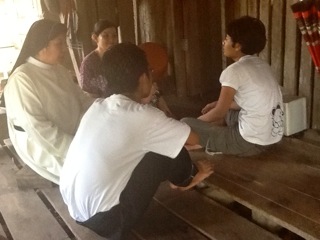
I was visiting the Holy Infant Orphanage run by the Dominican Sisters whom we support.
Sister Marcello is in charge and during the course of conversation she told me about a little boy that she had recently taken in and was not an Orphan . Further details revealed that the mother
who is Burmese could not look after her Son as she is solo Mum with three other children . She works for a Thai family who provide her with accommodation and is employed as a labourer  on a building site.
Her eldest daughter pictured here was tricked into going to Bangkok supposedly to work in a factory 4 years ago and was never heard of until recently when she was "dumped"on the street close to her Mothers house in a shocking state .There is no doubt that she had been physically mentally and sexually abused and also drugged continuously so that she had no recall of the events that took place . She could not walk and her head kept shaking and she was trembling her food intake was almost nil .
I went to her house to see what could be done in the company of Sr Marcello Br.Hilario op and a Thai lady. Hilario is Burmese and is fluent in English .
I suggested that we go to a shopping centre and supermarket to buy some essentials the Thai lady agreed to accompany them and I gave them some money to buy shoes underwear tops and pants then to buy any food that might tempt to eat at the end of this I got a very weak "thank you"
In English and also a smile which was a great reward.
It was enough to help once with a few dollars .I visited the Mae Tao clinic and spoke with Dr Cynthia and she agreed to see Khin Moe.
Mae Tao is a Hospital in Thailand which is for Burmese
and is funded by donations and staffed mainly by volunteers.
Dr Cynthia is the CEO of the hospital  and Khin Moe Kyaw has been referred to the local Thai hospital and has an appointment in about 10 days.
I asked Dr if we could do more but because Khin Moe is Burmese and has no documents there is no possibility of overseas treatment which I felt would be of value possibly in Singapore
We have given Sr Marcello some money to fund any future medical or other critical needs
Pictured here are Sr Marcello Khin Moe Kyaw her Mother and Br Hilario
I thought that this may be of interest to you even though you will be aware of similar situations as I am but it is the first time that I been directly involved .
It is a situation that too few Kiwis are aware of and in discussions with Sr Child protection for the young maturing ladies in her care is top priority
I would reccomend the holy infant website.

God bless
Don Matthews

This story is shared by Mr.Don Matthews to Myanmar Refugees In Malaysia

Burma's Rohingyas vulnerable to abuse at home and abroad

Burma's opposition leader Aung San Suu Kyi will address an International Labour Organization conference in Geneva next month, on her first trip outside Burma, in 24 years.

The ILO says Ms Suu Kyi will address the final day of the conference, which is expected to discuss the issue of forced labour in Burma.
Aid groups say while the situation has improved a little, ethnic communities like the Rohingyas of Arakan state are still at risk.

The Bangkok-based Arakan Project researches and monitors the Rohingyas in Burma.

Presenter: Sen Lam
Speaker: Chris Lewa, founder and director, The Arakan Project

LEWA: One shocking situation that the Rohingyas faced in Arakan, is that the fact that they have to apply for an official marriage permission for a couple to get married. And when they get that, they need to sign an undertaking that they won't have more than two children. And if a couple married without official permission, the husband can be prosecuted and spend five years in detention. And there are many people, for example, in Buthidaung jail, which is the main jail in north Arakan, who are imprisoned for this particular reason. Of course, the issue of marriage permission, I think that should be lifted and it's only imposed on the Rohingya population in Burma. No other community has to suffer this. And of course, citizenship. For me, that is a key right that the Rohingya should have and have the right to have, is to become recognised as a citizen in Burma. And of course, forced labour also should be eradicated. It's good there is a plan now, signed between the government and the ILO for the total eradication of forced labour in 2015. Well, I hope it will be implemented. So there are many issues, but that I think to me, are the main ones. There's been a little progress, but very very small. For example, recently, the government decided that the Rohingyas no longer needed to apply for travel permission, to go from village to village. But of course, they still need to get permission to travel from township to township, and north Arakan, where the majority of Rohingyas are concentrated, there're only three townships and basically, they're not allowed to go beyond these three townships. So, freedom of movement is not open to them, it's just slightly eased.
LAM: Hasn't the government also recently encouraged the Rohingyas in political participation? They've encourged them to stand as candidates and to form political parties?
LEWA: Well, they were allowed to vote and to participate in the elections and to stand as candidates. And they do have three representatives currently in the national parliament, but that has unfortunately, not been translated in any other concession or improvement in the situation of the majority of the Rohingyas in north Arakan state.
LAM: And neighbouring Malaysia has an estimated two million illegal migrants, and of the nearly 100-thousand legitimate refugees with papers, quite a sizeable portion are the Rohingyas. So what is the experience of the Rohingyas in neighbouring Malaysia?
LEWA: Yes, there're about 22-thousand Rohingya refugees registered with the UNHCR, but there're also perhaps ten-thousand or more who are still unregistered. Malaysia is in a way, the only country in the region who allow the Rohingya access to the UNHCR, but as with other refugees, protection is very limited because it doesn't give them the right to work, nor the right to health or education. So the Rohingyas who make it to Malaysia, especially those not registered with the UNHCR, because the process of registration is quite slow, they can face arrest any time.
LAM: And of course, that would lay them open to exploitation by potential employers?
LEWA: Exactly. And also, they don't have access to even primary education in Malaysia. And for health care, they are allowed to access government health care, but they have to pay at least half the cost if they're registered refugees, and the full cost if they're not. So the situation in Malaysia is definitely better than in Burma, but it's still very, very difficult for the Rohingya refugees and other refugees there.
LAM: And Rohingya community leaders in the US recently urged America not to ease sanctions against Burma, until minority rights are recognised. Do you agree that it's too early to lift sanctions on Burma?
LEWA: What I'm particularly concerned is mostly about the ILO, because as you may know, the ILO had imposed sanctions on the issue of forced labour, and it seems like during the forthcoming conference now, the ILO may suspend sanctions as well, but our findings are that forced labour may have reduced, but definitely has not stopped. And it's still very prevalent in the country. And in the area North Arakan which I study in particular, the issue of forced labour may have reduced in some areas, but taxes have increased instead in others. So, I am worried about those types of sanctions.
But it's true that there's a decrease over the last six or seven months, in particular, the infrastructure projects. It seems now people are being paid, which is at least progress, for example in the building of roads which are under military supervision. But the military camps, they continue to use forced labour, every day to do all the chores and the repair work and the maintenance of their camps. Villagers still have to do every night guard duty in the villages. So they still have to work at least one day and one night a week of forced labour. And in some cases, where the authorities would order the villagers to collect bamboo and logs, that seems to have reduced now, but instead, the wood and bamboo cutters have to now pay a tax. Part of their production and their collection have been confiscated instead. So I don't see that much progress in reality on the ground, and the people still have to respond to the whims and demands of the military authorities, so that they can't work for themselves to support their family.

Source :radioaustralia.net.au

Census for Chins in Mizoram to Take Place in May

17 May 2012: The Chin Society of Mizoram is to conduct a census of Chin people from Burma residing in Mizoram State of India this month.

A statement issued by Aizawl-based Chin Society of Mizoram said the census would start before the end of May and that the lists would be sent to the new government of Burma as well as the UN Office in New Delhi.

A leader of the Chin Society of Mizoram was quoted as saying that the census would play an important role for those who are willing to return to Burma in the future.

An estimated 70,000-100,000 Chins are living in Mizoram State after having fled persecution and human rights violations perpetrated by Burma's successive military regimes. This figure represents more than 10 percent of the total population of Mizoram State, according to local sources.

Meanwhile, the new government of Burma has announced that it will conduct its first national census in 31 years in April 2014, with the help of the United Nations.

Salai Za Uk Ling, of the Chin Human Rights Organization (CHRO), stressed his concern over the possibility of 'distorting' the census methodology used during the process, according to the IRIN news.

He said a significant number of Chins being unable to speak their own ethnic language any longer could be mistaken for or classified as Burman.

Currently home to an estimated population of 500,000 people, Chin State has long seen mass out-migration as a result of various forms of repressive measures, pushing thousands of people to neighbouring countries including India and even as far as Malaysia, which is estimated to host around 50,000 Chin refugees. 
 
Sources : chinlandguardian

A look at refugees' daily life

EVERYONE HAS HOPE:Taylor’s College showcases photographs taken by young Burmese refugees living in KL

a look
Datin Paduka Marina Mahathir (centre) with the Burmese refugees.
TAYLOR'S College recently held the Everyone Has Hope exhibition at The Cube Gallery, Ampang, to showcase photographs taken by nine Burmese refugee youths over an eight-month period.
Initiated in 2009 by Taylor's College's Canadian Pre-University (CPU) programme, the annual photography project involved  refugee youths aged between 13 and 16 years old living in Kuala Lumpur.

The project aimed to teach Burmese refugee youths from the Alliance of Chin Refugees (ACR) Learning Centre to utilise the art of photography to document their daily lives and experiences.

The launch of the photo exhibition was attended by members of the public,  students and staff.

The guest speaker for the event,  Datin Paduka Marina Mahathir, applauded the initiative and encouraged Taylor's College to continue organising more of such activities.

The photo exhibition was open for  public viewing recently. More than 200 photographs were displayed at the exhibition which gave visitors the opportunity to  support these Burmese youths by purchasing the photographs.

The opening night successfully raised a total of RM3,000 from the auction of the photographs which ranged from RM25 to RM500. The proceeds benefited the ACR Learning Centre.

Inspired by the American documentary Born Into Brothels, the  project highlighted the realities faced by the Burmese refugees living  in Kuala Lumpur.

Taylor's College CPU teacher and founder of the Everyone Has Hope project,  Colin Boyd Shafer explained that the project's mission was to provide an avenue for self-expression through art for the Burmese youths and, at the same time, raise awareness among the public of their plight as refugees.

"These youths are naturally inquisitive and creative and through this project, we want to nurture and promote these qualities.

"The exhibition features selected photographs that were unique, enlightening and offered realistic depictions of life as a refugee child in Malaysia.

"The chosen photographs served not only to illustrate the despair felt but also portray the victory of humanity over harsh times," he  added.

Shafer said, "Students chose to volunteer for the project as part of their 10-hour community service requirement.

"However, once they were aware of the refugee situation, they continued to helm the project in the hope of creating a difference in their lives.

"The project has provided many students with  hands-on learning experience, and it has allowed local students to mix with disadvantaged youth living in this country."

Apart from helping the Burmese youths to detail their lives through photography, the  students also exposed them to different subject matters such as singing and fine art.

Other activities included field trips to well-known  attractions such as the Zoo Negara and Batu Caves, visits to prominent photography displays such as the recent World Press Exhibition and attending a workshop by New York Times photographer Justin Mott.

Since its inception two years ago, the  project has  raised a total of RM15,000 for the ACR Learning Centre.

Sources :  New Straits Times

Foreign Workers Act needed in Malaysia

Thestar online

JAKARTA: Malaysia will explore the possibility of having a Foreign Workers Act to manage the four million foreign workers in the country.

Minister in the Prime Minister's Department Datuk Seri Mohamed Nazri Abdul Aziz said with the foreign workers making up more than 10% of the country's population, the management of their affairs could no longer be carried out at ad hoc level.

"I personally believe that we need to have the law (Foreign Workers Act). Currently, we tackle issues when they cropped up," he said when met here Thursday.

Nazri, who is leading the Malaysian delegation of the Inter-Parliamentary Union, is on a three-day visit here.

Earlier, he met the Speaker of the Indonesia's People's Consultative Council (MPR), at his residence in Menteng, Central Jakarta.

Also in the delegation are Dewan Rakyat deputy speaker Datuk Ronald Kiandee and Balik Pulau MP Mohd Yusmadi Mohd Yusoff.

Nazri, who is the minister in-charge of law and parliamentary affairs, said Malaysia had to deal with not only workers from Indonesia, but also from several other countries.

"So we must look at the experience of other countries, like the gulf states where the foreign population is more than the locals," he added.

He said resolving foreign workers' problems, like introducing the regulation on minimum salary, but not involving domestic helpers, was discriminatory.

The regulation should cover all jobs, he added.

Nazri said the proposed formulation of the foreign workers act would be discussed by the Malaysia-Indonesia Parliamentary Caucus (KPMI), which he believed would also be able to play an effective role in forging closer relations between the Malaysian and Indonesia parliamentary members. - Bernama

Youngsters mature ahead of their years

LUCY and Grace, both 15, are two refugees from Myanmar who teach at the Zomi Education Centre (ZEC) in Cheras.

.
Lucy hopes to become a dentist and dreams of going back to her country to practise

Both girls went to school in Myanmar before their families were forced to flee.
Lucy's father works in a factory. Her mother died in Myanmar.
Grace lost both her parents in Myanmar and her siblings are being cared for by her 20-year old sister.
Despite their meagre surroundings, Lucy and Grace were sent to this learning centre along with their siblings. When their teachers realised how bright they were, they recommended that the girls teach the younger children.
"We thought it would be good to help the children in our community and ease the burden of our teachers," said Grace.
It has been three months now since the girls started teaching in the mornings, and attend classes in the afternoons. They both teach English, Mathematics, Science and Zomi language to their class of 7-year-olds.
"It is easy teaching them. They listen and learn well," Lucy said.
"Sometimes, they want to just play and once in a while, we let them," quipped Grace.
They have also attended a computer course and have high ambitions, with Lucy hoping to become a doctor and Grace, a scientist.
"We also like teaching and will continue doing it," they said, adding that it was their hope that they would be able to go back to Myanmar to realise their dreams.
ZEC coordinator Khampi said Grace and Lucy were remarkable students as they only picked up English when they came to Malaysia.
The ZEC has five other learning centres and are part of the Zomi Association of Malaysia.
Khampi, who himself is a refugee, said the need to set up these education centres was overwhelming.
"No one knows how long we will be here or when we can go back to our country. The children must have basic education so that they don't get left out," he added.
The ZEC centre in Cheras, he said, was started in 2009 with about 40 students. Now the centre has about 100 students and a hostel to board some of them.
The learning centre, which cater to children from the ages of three to 16, collects RM30 for classes and RM100 for boarding from parents who can afford it.
Khampi said volunteer teachers, individuals and a few organisations had helped tremendously in running the centres.
"Our monthly rental is being paid by one of the teachers and before that, the Tzu Chi Foundation and the Czech Embassy had helped."

Burma: demand justice

Every day members of Burma’s ethnic minorities deal with the very real
threat of being forced into slave labour, murdered or raped. Meanwhile,
government forces and armed groups continue to carry out violence without
any risk of being held to account.

Watch our video and join the call for justice:
http://action.amnesty.org.uk/ea-action/action?ea.client.id=1194&ea.campaign.id=11503&utm_source=email&utm_medium=mass_email&utm_campaign=Burma&utm_content=Burma_COI_link1

Following an update in 2008, Burma’s constitution outlaws freedom of speech
and assembly, legalises enforced labour and essentially protects government
officials from prosecution for violating human rights - closing the door to
justice for victims. So while brave individuals who stand up and call for
reform are often arrested without warrant and held incommunicado, those who
commit human rights abuses are unlikely to ever face imprisonment.  Help
hold these criminals to account:

http://action.amnesty.org.uk/ea-action/action?ea.client.id=1194&ea.campaign.id=11503&utm_source=email&utm_medium=mass_email&utm_campaign=Burma&utm_content=Burma_COI_link2


The Burmese authorities have shown themselves unwilling to investigate crimes
against humanity. It is time for the international community to take a
stand. We have joined the call for a UN Commission of Inquiry into human
rights violations in Burma. Please add your voice to ours.  Act now - urge
European countries to support a Commission of Inquiry:

http://action.amnesty.org.uk/ea-action/action?ea.client.id=1194&ea.campaign.id=11503&utm_source=email&utm_medium=mass_email&utm_campaign=Burma&utm_content=Burma_COI_link3


Thank you for your support,

Verity Coyle
Campaign Manager

Rohingya Appeal to Suu Kyi

BANGKOK—An exiled Rohingya activist last night appealed to MPs and to National League for Democracy (NLD) leader Aung San Suu Kyi to assist the almost 2 million Rohingya living in Burma and elsewhere.
“I would like to ask our beloved Daw Aung San Suu Kyi to speak out of behalf of Rohingya people, and ask for the return of our lost rights, the rights our forefathers had,” said Maung Kyaw Nu, the president of the Burmese Rohingya Association of Thailand.
The Rohingya are a Muslim ethnic minority living mostly in western Burma’s Arakan State where they are denied Burmese citizenship, and subjected to various forms of discrimination: they generally have to wait two to three years for permits to marry; are usually prohibited from leaving the village where they live; and are subject to human rights and other abuses by local civil and military authorities.
When Rohingya couples do receive permission to marry, they must sign an agreement that they will not have more than two children. If a couple marries without official permission, the husband can be prosecuted and spend five years in detention—with Buthidaung jail in northern Arakan State thought to hold prisoners in this category.
However, the Rohingya say they were promised equal rights by Burma’s colonial-era independence heroes, including Aung San Suu Kyi’s father, Gen. Aung San, in return for their support in the struggle against British rule.
“In 1946 General Aung San visited my area,” said Maung Kyaw Nu. “He said to our people ‘I give you a blank cheque, please co-operate with me.’”
All told, around 750,000 Rohingya live in Burma, mostly in Arakan State in the country’s west, with an estimated 1 million more living in exile in Bangladesh, Malaysia, India and elsewhere—an exodus prompted by decades of human rights violations and discrimination.
Rohingya endure squalid and dangerous conditions in camps in Bangladesh and third countries, such is the oppression they face at home, say activists. Some Rohingya undertake a perilous sea journey to Thailand, where in 2009 Thai authorities were accused of pushing Rohingya boats out to sea and leaving the refugees to their fate on the open waters. Other Rohingya attempt get to Indonesia or Australia in search of a new life, including a group of 26 who were almost shipwrecked en route to Australia from Indonesia, subsequently helped to land in Timor-Leste by local fishermen.
The push factor could be increasing, according to Human Rights Watch Asia deputy director Phil Robertson, who says relations between the Rohingya and the majority Buddhist Rakhine in the western region are deteriorating, even as Burma continues a recent glasnost. “While there are now some Rohingya MPs, some Buddhist Rakhine in the state assembly are raising issues for the Rohingya,” he said.
Phil Robertson says Burma’s treatment of the Rohingya and the country’s 100-plus other ethnic minorities is a litmus test for the government’s reform credentials. “Is there a place for the Rohingya in Burma?” he asked.
Thai photographer Suthep Kritsanavarin has visited the region. “Between the Rakhine and the Rohingya there is always tension,” he said, speaking at the Foreign Correspondents Club of Thailand, where his exhibition “Stateless Rohingya: Running on Empty,” is on display.
Burma is scheduled to host a meeting of the Asean human rights commission from June 3-6. It seems unlikely that the Rohingya issue will be discussed at the get-together, as according to Phil Robertson, the Rohingya were not discussed during the commission’s last meeting in Bangkok.
“So far, Asean has been ducking this issue,” he said, asking: “Can Asean grapple with a fundamental regional problem, and solve it?”

Source : http://www.irrawaddy.org

Chin Children Refugees' struggle for education in Malaysia

NewStraitsTime

LEARNING TO COPE: Some 4,000 refugee children are studying in about 100 learning centres nationwide. The centres have survived on the goodwill of charitable organisations and volunteers. Elizabeth Zachariah visited two learning centres and this was what she saw NESTLED in the heart of the city, in Jalan Imbi, is a "school" on the top floor of a shoplot. It caters to about 25 children, aged 4 to 17, who study in small, dingy rooms formed by thin partitions.

This is no ordinary school for the students here are refugees and they are being tutored by volunteers and older refugees who had "graduated" from this school.

It is not called a school but a learning centre, which operates from Monday to Friday, from early morning till late afternoon.

There are about 4,000 refugee students studying at more than 100 learning centres nationwide. These 4,000 students make up only 35 per cent of the number of refugee children of school-going age.

And unlike local schools, which are funded by the government, these learning centres are run by the refugees and funded by caring locals and non-governmental organisations.

The children who are lucky enough to have access to education attend either education projects run by the United Nations High Commissioner for Refugees (UNHCR) in collaboration with NGOs or learning centres, which are organised by the refugee communities with the support of non-refugee volunteers.

UNHCR external relations officer Yante Ismail said the refugee community recognised the importance of education and had set up informal learning centres to equip their children with basic reading, writing and arithmetic skills.

"Because they are denied proper education, the communities have done a remarkable job in setting up the learning centres even with limited resources," Yante said.

"However, the projects and learning centres are not formal education so the children cannot get into universities or further their education."

The UNHCR, Yante said, was concerned with the fact that the lack of basic education among refugee children would create a generation of illiterate, unskilled and not self-sufficient people.

There are seven education projects run by the UNCHR in Kuala Lumpur, Johor, Selangor and Penang. The teachers in the project use Malaysian school textbooks to teach English, Math, Science and Bahasa Malaysia.

"Only about 1,000 children attend education projects while the rest attend learning centres," Yante said.

The community-based learning centres are informal classes which are run by volunteers from the refugee community, faith-based groups and the private sector.

They are set up wherever there are refugee communities with a large number of school-going children. The number of students in each learning centre varies from 15 to as many as 100.
A typical learning centre consists of several classes with children of similar ages grouped together to form a class. Classes normally start at 9 or 10am and would last for about two hours. Some schools have morning and afternoon sessions to accommodate the large number of students.

The lack of resources, including qualified teachers and funding, restrict the scope and reach of these classes. Classes, which are usually held in rented flats or shophouses, are overcrowded and lack basic teaching equipment like stationery.

Yante said there was a growing need for volunteers to help with teaching and administration as well as skill-building training for the teachers.

"Besides that, these learning centres are in dire need of funds for transportation of children, rental and utility bills and meals."

To meet the costs, the learning centres collect a minimal fee of RM10 to RM30 from each child who can afford it.

Refugee community organisations also help pool funds to support the basic needs of rental and UNHCR provides a monthly stipend for a limited number of teachers, textbooks, stationery, school bags and first-aid kits.

Yante said the UNHCR also trained the teachers and coordinates in areas like curriculum and examinations and had a small grant called the Social Protection Fund, where refugees could apply for funding to help with projects, including education.

Faith-based organisations, civil society groups and individuals are known to contribute to the learning centres in a variety of ways, including donating furniture, food and space for the classes to be held.

"Malaysians have been so generous in so many ways.

"There are many who volunteer as teachers and cook for the kids," Yante said, adding that there were about 500 volunteer teachers registered with the UNHCR.

There are currently 96,300 refugees and asylum-seekers registered with UNHCR in Malaysia, with 82 per cent from Myanmar and the others from Sri Lanka, Somalia, Afghanistan and Iraq.