Friday, November 2, 2012

Myanmar gov't pleads for end to ethnic strife

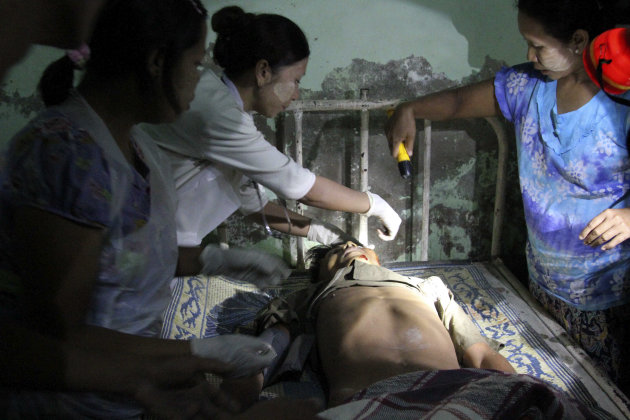
Associated Press/Khin Maung Win - In this Oct. 25, 2012 photo, a Rakhine refugee receives medical treatment at Kyauktaw hospital in Kyauktaw, Rakhine State, western Myanmar. At least 56 people have been killed

SITTWE, Myanmar (AP) — Myanmar's government has appealed for peace in the western state of Rakhine, warning that ethnic violence there that has taken at least 56 lives in recent days risks harming the country's reputation as it seeks to install democratic rule.
The mob violence pitting the Buddhist Rakhine community against the Muslim Rohingya has seen entire villages torched and has drawn international calls for government intervention.
"The army, police, and authorities in cooperation with local people will try to restore peace and stability and will take legal action against any individual or organization that is trying to instigate the unrest," said a statement from the office of President Thein Sein published Friday in the state-run Myanma Ahlin newspaper.
Since Sunday, 25 men and 31 women have been reported dead and 60 men and four women injured in the violence in four Rakhine townships, state government spokesman Win Myaing said Thursday. He did not break down the casualties by ethnic group.
The government said 1,948 houses and 8 religious buildings had been destroyed through Wednesday.
"As the international community is closely watching Myanmar's democratic transition, such unrest could tarnish the image of the country," the presidential statement said.
In June, ethnic violence in the state left at least 90 people dead and destroyed more than 3,000 homes. About 75,000 have been living in refugee camps ever since.
Curfews in place in some areas since then have been expanded due to the latest violence, but tensions have stayed high in part because the government has failed to find any long-term solution other than segregating the communities.
The long-brewing conflict is rooted in a dispute over the Muslim residents' origin. Although many Rohingya have lived in Myanmar for generations, they are widely denigrated as intruders who came from neighboring Bangladesh to steal scarce land.
The U.N. estimates their population in Myanmar at 800,000. But the government does not count them as one of the country's 135 ethnic groups, and so — like neighboring Bangladesh — denies them citizenship. Human rights groups say racism also plays a role: Many Rohingya, who speak a Bengali dialect and resemble Muslim Bangladeshis, have darker skin and are heavily discriminated against.
A statement issued late Thursday by the office of U.N. Secretary General Ban Ki-moon described the latest violence as "deeply troubling."
"The widening mistrust between the communities is being exploited by militant and criminal elements to cause large-scale loss of human lives, material destruction, displaced families as well as fear, humiliation and hatred affecting the people from all walks of life," it said.
Ban called on Myanmar authorities "to take urgent and effective action to bring under control all cases of lawlessness."
"The vigilante attacks, targeted threats and extremist rhetoric must be stopped. If this is not done, the fabric of social order could be irreparably damaged and the reform and opening up process being currently pursued by the government is likely to be jeopardized," said Ban.
In Washington, State Department spokeswoman Victoria Nuland said the U.S. was deeply concerned about the reports and urged restraint.
An Associated Press photographer who traveled to Kyauktaw, one of the affected townships 45 kilometers (75 miles) north of the Rakhine capital of Sittwe, said he saw 11 wounded people brought by ambulance Thursday to the local 25-bed hospital, most with gunshot wounds.
One was declared dead after arrival. All the victims being treated were Rakhine, but that could reflect an inability or unwillingness of Rohingya victims to be treated there.
A volunteer at the hospital, Min Oo, said by telephone that five bodies, including one of a woman, had also been brought there. He said the injured persons were brought by boat from Kyauktaw town 16 kilometers (10 miles) away.
Accounts by Rakhine villagers in the area suggested great confusion and tension. The villager said that when groups of Rakhine and the Rohingya had a confrontation, government soldiers shot into a crowd of Rakhine, even though, according to his claim, it had been dispersing. The villager would not give his name for fear of violent reprisals.
"We feel very unsafe because soldiers are not protecting us but protecting the Muslim villages. They shot the Rakhine people when people got near Muslim villages," said Aung Than, a resident of Kyauktaw township, 74 kilometers (46 miles) north of Sittwe.
There have been concerns in the past that soldiers were failing to protect the Rohingya community, but the Rakhine villager's account hints that Myanmar's military may have been defending the Rohingya in this case.
The crisis has proven a major challenge to Thein Sein's government and to opposition leader and Nobel peace laureate Aung San Suu Kyi, who has been criticized by some outsiders as failing to speak out strongly against what they see as repression of the Rohingya.

Associated Press writer Matthew Pennington in Washington contributed to this report.

There's more than one way to make a difference

Mary Strange could have spent a beautiful Saturday morning doing just about anything she wanted. She's retired, after all.
She chose, though, to spend it in a small apartment on the city's Southside, wrapping donated mattresses in bedsheets for a family of Burmese refugees.
"I had the time to do it, so I decided to do it," Mary said with a slight shrug. "USA Weekend was really touting Make A Difference Day and I decided I'd get involved."
Indeed, that's what the day is all about.
USA Weekend magazine, owned by Star Media's parent company, Gannett, created Make A Difference Day in 1992. Over the years, participation has grown to about 3 million people, making it a national holiday of sorts for volunteering.
In Indianapolis, though, Make A Difference Day is still fairly new.
Star Media employees, for example, participated for the first time this year. Nearly a hundred volunteers spent the day cleaning up Riverside Park.
Meanwhile, dozens of volunteers with Keep Indianapolis Beautiful planted trees on the Southside and helped residents with prep work for a rain garden on the Near Northside.
But it wasn't all rosy.
The Julian Center and My Sister's Place, two groups that had anticipated taking part in Make A Difference Day, had to cancel their plans because not enough people signed up. Indy Reads Books had fewer volunteers than expected and even Exodus Refugee Immigration, which got Mary's attention, ended up a bit short staffed.
Point is, not every company can be Eli Lilly and put 8,000 employees on the street to volunteer for a single day. Sure, it's awe-inspiring -- I mean, how many companies can shut down an interstate to plant trees? -- but maybe we shouldn't expect that.
This is the Indiana of 2012, not 1995.
We don't have as many Fortune 500 companies based here as we once did. In fact, we have six -- one of which, cellphone distributor Brightpoint, might be taken over by a California rival. If that happens, it will be the sixth out-of-state takeover since 1998 of an Indiana-based Fortune 500 company.
We've also had a number of smaller companies minimize their presence in Indianapolis in various ways in recent years. Among them, Steak n Shake, Hat World and scores of banks.
Why does all of this matter?
Because companies tend to be committed to the cities that are home to their headquarters. They tend to donate to local charities and can convince their employees to volunteer en masse.
To adapt and maintain the level of volunteering Indianapolis needs, maybe we should look more to models such as Make A Difference Day.
Gannett isn't based here, but Star Media is. The partnerships forged with local non-profits could provide a network of volunteer opportunities for Hoosiers.
It worked for Mary.
It also worked for Gail Nellis, who also heard about Make A Difference Day in The Indianapolis Star. Both women raved about the experience.
"I'd do it again before next year if they'll let me," Gail said.
Outside, near the moving truck of furniture for the Burmese family, Megan Hochbein, a volunteer coordinator for Exodus Refugee Immigration, echoed her sentiments.
"I think we'll probably do it every year now that we know it exists," she said.

There's more than one way to make a difference.

http://www.indystar.com

Making a difference

By LUWITA HANA RANDHAWA , TheStar
educate@thestar.com.my

<b>Seizing opportunities:</b> Maria (left), Htain Lin and Pan Ei (right) have gained pivotal skills such as cooking and learning a new language. Seizing opportunities: Maria (left), Htain Lin and Pan Ei (right) have gained pivotal skills such as cooking and learning a new language.
 
HELP University in collaboration with the United Nations High Commissioner for Refugees (UNHCR) has set up a pioneering educational and vocational project for young refugees in Malaysia.
Known as Project Self-Help, the aim was to provide educational opportunities for refugees in Malaysia aged 15 to 24 by offering courses in marketable skills at the varsity.
A total of 174 students from the project have successfully graduated in English courses and either Information Technology (IT) or Culinary Arts courses.
Among them was fifteen-year-old Pakistani Maria Ayub who studied English for six months and IT for five weeks.
“Before this, I could not speak English at all and now I can speak it well,” she said, adding that she was thankful for the opportunity given.
Hnin Pan Ei, 20, and Htain Lin, 16, are siblings from Myanmar who have been refugees here since 2008.
Having studied English and Culinary Arts, Pan Ei really enjoyed learning how to make cakes and pizzas.
“I feel like I can do whatever I want and continue my studies with confidence,” she said.
Htain Lin has made many new friends and likes Malaysia because “the weather’s good and the people are friendly and warm.”
He hopes to be able to study Engineering one day.
Malaysia is home to 95,000 refugees and asylum-seekers under the UNHCR.
Project Self-Help, which started last September, seeks to eventually benefit 20,000 of them who are of high school or college-going age.
“We are giving them an opportunity to gain skills and competency that they can bring with them when they are relocated to a new country.
“Regardless of whether it’s Australia or the United States, they can then gain employment and make a living,” said the project’s director Adam Chan.
UNHCR representative Alan Vernon feels that giving them an education is akin to providing them a strong foundation for a better future.
“The reality is that for young refugees who have to leave their homes, their education is stopped or delayed,” said Vernon.
“It’s very important that we try to create opportunities for them to study and I think that’s what we have here with Project Self-Help.
“We have a model of a good programme that teaches valuable skills to these young people,” he said.
Students of Project Self-Help’s Phase Three are currently attending classes and Phase Four is due to commence shortly.
Given the success of the project’s first two phases, HELP University and UNHCR are looking into other educational opportunities for the refugees.
“The students loved it and a lot of them don’t want to leave.
So now, we are trying to see what more we can do for them,” said Chan.

In Madison County, Burmese refugees build a new home

It’s early October in Madison County, and the oak leaves have barely begun their transformation from green to yellow to red to brown.
At best, a slight jonquil hue has emerged in every other tall timber surrounding a treeless patch of land off Highway 22 just outside of Comer.
But it’s enough for Eh Kaw Htoo to build a simile.

“In the fall, the leaves are like different people, just like the U.S.,” said Eh Kaw, a refugee from Myanmar (formerly Burma), who will celebrate his fifth year living in the U.S. this February.
He pointed at the distant tree line, remarking on the cultural diversity found in America as he leaned on the trunk of the car that drove him and two journalists down the gravel road that leads to The Neighbor’s Field, a plot of arable land farmed by refugees from Myanmar living in Madison and Oglethorpe counties.
After 20 years living in refugee camps in Thailand along the Myanmar border, and seven years before that dodging the guns of a military dictatorship in his home country, life in America, even rural America, offers all the culture he’ll need from now on.

“I don’t feel like I have to go to Japan to see Japanese people,” he said. “Or to Africa to see Africans.”

Eh Kaw and his family — a wife and three children — as well as his father, mother and his two brothers’ families, are part of a refugee community living in Madison and Oglethorpe counties that numbers at least 100.
At The Neighbor’s Field, the community grows its own food and raises its own goats and chickens, and builds structures from felled and foraged trees.
In rural Georgia, Eh Kaw has replicated the rural existence he would have lived if not for 50 years of oppressive military dictatorship.

On a recent Saturday morning, two generations of refugees harvested slim hot peppers, roselle and young daikon radishes — integral vegetables in the Myanmarese diet. Some drove all the way from Clarkston, the DeKalb County city that’s home to thousands of refugees from all over the world. The pepper plants came up chest-high to the teens walking among them. At The Neighbor’s Field, more food grows than the part-time farmers who tend it ever could eat.

Eh Kaw’s people farm this way for a reason: to feed friends and strangers, anyone in need.
Just over the tree tops is Jubilee Partners, an intentional Christian community whose mission includes welcoming newly arrived refugees, and the place that first housed Eh Kaw and his family when they moved to Comer from the Atlanta apartment that aid agencies had provided. The Neighbor’s Field sits on Jubilee’s land.

Refugees from Myanmar are found in all 50 states, especially Georgia. Outside of metro Atlanta, no county has welcomed more refugees than Madison.
In Oglethorpe County, refugees congregate at Vesta Baptist Church, attending English morning services with locals and praying as a people in the afternoon.
A faithful community in place. A job at a chicken processing plant. Neighbors he can trust. Eh Kaw now knows well the “free and safe society” he’d hoped to find in the U.S.
“I never had a home. I never had a country,” he said when asked how he now explains his identity. “I always had to flee. I feel like I’m not a citizen of any country.”

If anything, he said, “I’m American.”

A FORGOTTEN STORY, A ‘SECRET GENOCIDE’

Eh Kaw is Karen, a now predominantly Christian people in a country of 135 distinct ethnicities. For the past 50 years, the Karen have fought a losing battle against a brutal dictatorship run by the majority Burman ethnic group. Although the Karen were British allies during World War II, once the imperial power left the country, the Burman usurped total control in a coup.
The Karen are rural at heart, Eh Kaw said, and don’t think politically; the Burman are more cunning than the Karen.
Among all the ethnicities, the Karen have waged the longest running counterinsurgency, making their civilians targets of junta aggression.
Unlike other refugees who flee to escape becoming collateral damage, the Karen and other ethnicities are targeted as part of a strategic plan by the junta to, at best, quell rebels and, at worst, wipe the Karen out of existence. If you ask Eh Kaw what he thought of the army’s tactics, having lived through what he lived through, it’s impossible not to take it personally.
“Secret genocide,” Eh Kaw said.
Eh Kaw left Myanmar at age 7, fleeing with his family for camps in Thailand. But political geography did little to stop the Burmese Army from chasing refugees like them across the border.
Troops hunted down refugees, burning whatever temporary bamboo structures they found. Eh Kaw recalls never living in the same house, the same camp, for more than three months at a time. The forests provided their only permanent safety, as long as they fled with speed.
“If you are fast enough, you will be safe,” Eh Kaw said. “If you have weak legs, you won’t survive.”
Still, memories from life in Myanmar never fade.
Male villagers would climb trees to keep watch for approaching troops, Eh Kaw remembers. A mere child at the time, he often would play in those trees, swinging from lower branches.
As troops descended upon the village, the sentry cried out.
The warnings sent men scrambling into the forests. At the time, women and children were safe from the troops’ violence — forced labor, imprisonment, death.
Eh Kaw assumes the soldiers saw him drop down from the tree and run back to his mother’s home. As they entered the village, a soldier pulled him aside and stuck a gun barrel to his forehead.

“Why did you warn the others?” he remembers him asking.

Eh Kaw’s mother pushed the soldier down, grabbed her son and convinced the troops to leave them be.

Sitting on the laminate floor in his sparsely furnished rented house in downtown Comer, Eh Kaw and his brother Eh Kae Doh, who lives in Vesta, clearly have more brutal stories to tell. Eh Kaw hints at burned bodies and gruesome deaths. Eh Kae points to his heart and says that’s where his stories will remain — for now.

“Forgive is easy, but forget is not easy,” Eh Kaw said. 

If the dictatorship falls, maybe they’ll return home to visit.
Do their memories haunt them?

“No,” Eh Kaw said. “It’s over.”

US invites Myanmar to joint military drills

The United States has invited Myanmar to the world's largest multi-national military field exercise, a powerful symbolic gesture toward a military with a grim human rights record and a milestone in its rapprochement with the West.

Myanmar was invited to observe Cobra Gold, which brings together thousands of American and Thai military personnel and participants from other Asian countries for joint annual maneuvers, officials from countries participating in the exercises told Reuters on Friday.

"It's a significant and symbolic gesture that shows the rapprochement is gathering momentum," said Christopher Roberts, a security expert at Australia National University.

The invitation is part of a carefully calibrated re-engagement with Myanmar's military under the umbrella of humanitarian dialogue, the sources said, constituting one of the boldest rewards for Myanmar's new semi-civilian government after 49 years of direct military rule.

It is also seen as a first step towards US-Myanmar military-to-military ties, cut off after 1988 when soldiers opened fire on pro-democracy protesters in a crackdown that killed or wounded thousands and led to the house arrest of democracy champion Aung San Suu Kyi.

The invitation came after intense lobbying by Thailand, co-host of the exercises, the sources said.

It could prompt charges that Washington is moving too quickly in seeking to rehabilitate a military accused of continued human rights violations in ethnic regions such as Kachin State where tens of thousands of people have been displaced in 16 months of fighting.

War crimes

Refugees fled forced labour, killings, rape and torture by the Myanmar military, reported Human Rights Watch in June.

"Burma's military continues to commit war crimes and crimes against humanity. It is shocking that the United States would invite them to military exercises," said Mark Farmaner, director of advocacy group Burma Campaign UK.

The invitation follows a visit this week by a delegation led by Michael Posner, the US State Department's top human rights official, to Naypyitaw, the capital of Myanmar, also known as Burma.

The US team also included Vikram Singh, the deputy assistant secretary of the US Defense Department, and other US military officials.

The talks on the Myanmar side were led by Aung Thaw, deputy minister for defence commodore .

Myanmar state media reported that the "two sides held talks on levels and operations of defence institutions of Myanmar and US and exchanged views on future dialogue and bilateral cooperation".

US officials in Bangkok and Washington declined to comment.

The invitation is another illustration of the Obama administration's pivot this year from Iraq and Afghanistan to focus national security resources on the Asia-Pacific region.

Military presence

Cobra Gold, which began in 1980, take places in Chon Buri, a province east of Bangkok where the United States built up a massive military presence during the Vietnam War.

Last year, about 10,000 US military personnel took part, along with about 3,400 Thais.

Five other countries participated - Indonesia, Japan, Malaysia, Singapore and South Korea. And nine countries sent observers, including China.

"In the past, Myanmar has always been unhappy about this Cobra Gold, thinking that it was directed against them and was like a step towards invasion," said Dr Tin Maung Maung Than, a senior fellow at the Institute of Southeast Asian Studies in Singapore and expert on Myanmar's military.

Even when it was a dictatorship, Myanmar sent more officers to the United States than to any other country.

More than 1,200 officers trained there between Myanmar's independence from Britain in 1948 and General Ne Win's military coup in 1962, according to Maung Aung Myoe, author of "Building the Tatmadaw: Myanmar Armed Forces since 1948".

Ne Win's coup ushered in nearly half a century of isolation and misrule, but the United States maintained military ties as a bulwark against the spread of communism from neighbouring China.

Some 255 Myanmar officers graduated from the US from 1980 to 1988 under the International Military Education and Training programme, more than from any other country, said Maung Aung Myoe.

The programme was halted, and US sanctions were imposed, after the junta crushed the 1988 uprising and refused to honour the results of a general election won by Suu Kyi's party two years later. 

http://world.myjoyonline.com

HUMAN TRAFFICKING : 40 MYANMAR REFUGEES RESCUED FROM WAREHOUSE

BUKIT KAYU HITAM: It was a sad sight when police rescued 40 Myanmar nationals, believed to be victims of a human trafficking syndicate, from an abandoned warehouse in Bukit Tangga here on Wednesday night.

Five children, who were among the foreigners rescued during the operation, were sleeping on the floor inside the dusty warehouse, located about 5km from the main road.
The children had only an old newspaper to use as their "mattress" when the raiding party, led by Inspector Mohd Nasrul Faiz from the state police's secret societies, gambling and vice (D7) division, raided the premises about 8pm.
A man, believed to be a member of the syndicate, managed to evade arrest as the police team arrived at the scene.
Initial checks showed the foreigners, including nine women, had been granted refugee status by the United Nation High Commissioner for Refugees.
It was learnt that the refugees had previously worked at a tomato farm in Cameron Highlands, Pahang, before they were sold to the syndicate, who in turn would supply them as workers to a fruit orchard.
State police D7 unit chief Assistant Superintendent Shaari Yaakob said preliminary investigations revealed the foreigners had been staying at the warehouse for about a month.
"We believe the warehouse was a transit point for the refugees."
 
Police rescued 40 Myanmar refugees from a warehouse in Bukit Kayu Hitam, Kedah last night. 

They were found caged and had been forced to work at a fruit farm without pay.

The 29 men, 9 women and five children were rescued in an operation dubbed Ops Pintas.

According to Kedah Gambling,Vice and Secret Societies chief ASP Shaari Yaacob the refugees were previously working at a tomato farm in Cameron Highlands before they were sold to the fruit farm owner.

He said the refugees had been deprived of proper meals, clean water and other basic needs.

They were sent to the Kubang Pasu district police headquarters and handed to the state UNHCR representative.

The case is being investigated under the Anti Human Trafficking and Anti-Smuggling of Migrants Act 2007.


Five-year refugee wait in Malaysia: Morrison

Scott Morrison. (AAP)

Source: AAP
Opposition MP Scott Morrison's assertion that asylum seekers should stay in offshore detention for five years came from his discussions with refugees.
The opposition's suggestion that asylum seekers should spend five years in detention came from immigration spokesman Scott Morrison's discussions with refugees in Malaysia.
The government says asylum seekers sent to Nauru or Papua New Guinea for processing would be treated according to a no-advantage principle to ensure they didn't arrive in Australia sooner than if they had stayed in refugee camps.
But it has not detailed how long asylum seekers could expect to be detained for.
On Friday, Mr Morrison said the government was being "mealy mouthed" in explaining what the no-advantage policy actually meant.
"If you come to Australia and you come by boat, you will go to Nauru and you should expect to spend a long time there and that period of time is around about five years," he said.
He said on Monday he had just been trying to clarify the government's policy.
"The five years originally came from my discussions with refugees and asylum seekers living in Malaysia," he told ABC's Q&A program.
"These timeframes have been confirmed again to me most recently up in Indonesia talking about what the processing time is in Indonesia which from the UNHCR (is) about two to three years and Malaysia can be up to three times that."
Labor minister Peter Garrett said the five-year timeframe was "basically a figure that he (Mr Morrison) has come up with" and had been presented in a way to give people the impression it was government policy.
"How long it is that people will be detained will be a matter which will have to be worked through pretty carefully," he told the Q&A audience.
Mr Morrison was also quizzed on whether he had specifically discussed with Indonesian Foreign Minister Marty Natalegawa the coalition's policy of turning back asylum seeker boats.
"It's a private discussion which would follow, I think, textbook diplomacy," he said.
"I'm not about to risk that relationship ... that the government that I would be part of would need to get this job done and to stop people risking their lives."

Downtown store a hub for rising number of Burmese immigrants


Fifth in a series of stories highlighting the diversity of the Cedar Valley.
WATERLOO, Iowa --- The city may not have a refugee office, but for the last few months, Burmese newcomers have been able to find assistance for various needs.
At Lucky Brothers Asian Food Mart, people can find leads on housing, transportation and keys to day-to-day tasks.
"Most speak very little English," said Zaw Min Thant, owner of Lucky Brothers. "We have to help each other."
Waterloo has become home to hundreds of Burmese refugees since 2010. Most move here from refugee camps in other areas of the U.S. to take jobs at the Tyson Fresh Meats plant in Waterloo.
Thant first arrived in Iowa to work at JBS Swift & Co., a meat processor in Marshalltown. Last fall, he moved to Waterloo to open an Asian food store.
"Most of the Burmese, they are not familiar with American foods," he said. "They don't know what to buy."
The store offers more than familiar foods, Thant said. People new to the area can learn where city services are or get help finding an apartment or a car. Sometimes help goes beyond getting information. For customers who lack transportation, Thant will deliver groceries to their homes for no extra charge.
"I want to help my people," he said. "But I don't have much money. So I try to help in this way."
Since the 1990s, thousands of political dissidents and Karen and Chin ethnic minorities have fled Myanmar, as Burma is now called by its military government.
Thant first arrived in the U.S. in May 2010 from a Burmese refugee camp in Malaysia. In Marshalltown, Thant befriended Win Kyaw, the owner of Golden Land, an Asian food store there. The two saw a new business opportunity with the continuing influx of Burmese workers into Waterloo. With Kyaw's help, Thant opened Lucky Brothers in November last year.
The store is the first Burmese business to open since refugees began moving to Waterloo. For at least one neighboring business, it has been a welcome addition. Banjong Wachakit, owner of My Thai Cuisine, can find ingredients she needs on short notice there. Thailand and Myanmar are neighboring countries. Thant gets new vegetable shipments every Tuesday. Most customers, including Wachakit, visit shortly after the shipment comes in, Thant said.
Thant said he would like to introduce Americans to Burmese food.
"The problem is I don't speak English fluently," he said. "So it's difficult to describe things to them."
Thant said he plans to expand his store to include room for people to sample or order prepared food.
Thant said he is seeing more Burmese who originally located to other states moving to Waterloo. He said he wants to help them get established here and build a thriving Burmese community in the Cedar Valley.
"Maybe by next year we'll have 1,000 people from Burma (living here)," he said.

Australia to take more refugees from priority regions in the Middle East, Africa and Asia

AUSTRALIA will accept an extra 6,250 refugees in 2012/13 from source and transit countries, as part of the government's plan to discourage irregular boat arrivals. 
 
The Gillard government announced in August it would increase Australia's annual humanitarian intake from 13,750 to 20,000, and to 27,000 within five years.
Immigration Minister Chris Bowen says the extra resettlements will come from priority regions in the Middle East, Africa and Asia.
"The increase in places target those in most need, including those vulnerable people in camps around the world," he said in a statement.
"We are providing more opportunities for vulnerable and displaced people to pursue safer resettlement options in Australia as part of an orderly humanitarian program."
This would reinforce the government's "no-advantage" policy by showing that no special treatment would be given to those arriving by boat.
Mr Bowen, who has been visiting refugee shelters and camps in Lebanon this week, said the decision will change the lives of people languishing in camps and other places around the world.
"As I witnessed in Lebanon, countries in the region bear a significant burden, generously providing protection space to refugees," he said.
With the humanitarian program increased by more than 40 per cent, Australia is now the second largest resettlement country in the world behind the US, Mr Bowen said.
The increase in resettlements will include up to 2000 African refugees, 3800 Iraqis from Syria, Turkey, Jordan and Lebanon, and 2000 Afghans from countries in the region.
The Opposition said in response that the government is expanding the humanitarian program to give more permanent visas for people arriving by boat.
"The increase in refugee visas under Labor will be so people coming on boats, not those waiting in dire need across the world who come through the front door, are still given permanent visas,'' immigration spokesman Scott Morrison said in a statement.

The people smugglers' product was still firmly on the table, he said.

http://www.perthnow.com.au

Myanmar steps up security after sectarian clashes kill 50

Bangkok, Thailand (CNN) -- More than 1,000 homes have been set ablaze amid sectarian clashes between Buddhists and Rohingya Muslims in Myanmar's volatile west as security forces struggle to bring some semblance of order to the countryside.
In an effort to clamp down on the unrest, authorities sent extra security forces to the state of Rakhine, where at least 50 people have been killed and dozens more wounded, state officials said Thursday.
Overnight curfews, in effect since a severe outbreak of communal violence during May and June, have been lengthened in several townships, said Myo Than, manager of the state government's information department.

From Kocha Olarn, CNN

An injured Buddhist man lies in a hospital in Sittwe, capital of Myanmar's western Rakhine state on October 23, 2012.
An injured Buddhist man lies in a hospital in Sittwe, capital of Myanmar's western Rakhine state on October 23, 2012


Religious clashes devastate Myanmar
Myanmar erupts after rape, murder report
 
Rakhine is home to the Rohingya, a stateless Muslim minority who say they have been persecuted by the Myanmar military during its decades of authoritarian rule. Myanmar does not recognize them as citizens.
The clashes between the majority Buddhists and the Rohingya minority during the summer killed at least 88 people -- mostly Rohingya -- according to state-run media.
The violence in May erupted after police detained three Muslim men on accusations they raped and killed a Buddhist woman. Clashes spread, prompting the government to deploy the military to restore order.
Hundreds of Rohingyas tried to cross the border into neighboring Bangladesh, but were turned back.
Bangladesh said it already had too many Rohingya refugees, estimating that about 300,000 live in the country.
Even after the killing stopped, simmering tensions remained in Rakhine, as shown by the resumption of violence this week.
Those who lost their homes have had to live in refugee camps. About 75,000 people were displaced, according to the U.N. Office for the Coordination of Humanitarian Affairs in Myanmar.
Myo Than said the government is aiming to return the situation to normal by organizing negotiations between the two sides and increasing security.
State officials say they have sent medical teams accompanied by military personnel to two of the remote townships hit by unrest to offer treatment to Rohingya people too scared to go to a hospital.

Journalist Phyu Phyu Zin in Yangon, Myanmar, contributed to this report.

Myanmar rocked by ethnic strife


IOL pic oct26 myanmar clashes
Reuters

Men hold banners as they protest in front of the US embassy in Bangkok on Wednesday. A group of Rohingyas living in Thailand gathered outside the US embassy, demanding security for Myanmar's Rohingya people, and called for international intervention after clashes in Myanmar's Rakhine state.
Kyauktaw, Myanmar - Fifty-six people were killed and nearly 2 000 homes destroyed in the latest outbreak of ethnic violence in western Myanmar, a government official said on Thursday.
The 25 men and 31 women were reported dead in four Rakhine state townships in violence between the Buddhist Rakhine and Muslim Rohingya communities that flared up again on Sunday, local government spokesperson Win Myaing said.
He said 1 900 homes had been burned down in fresh conflict, while 60 men and four women were injured. It was unclear how many of the victims were Rohingya people and how many were Rakhine.
In June, ethnic violence in the state left at least 90 people dead and destroyed more than 3 000 homes. Tens of thousands of people remain in refugee camps.
The United States called for Myanmar authorities to take immediate action to halt the violence. The United Nations appealed for calm.
An Associated Press photographer who travelled to Kyauktaw, one of the affected townships 45km north of the Rakhine capital of Sittwe, said he saw 11 wounded people brought by ambulance to the local 25-bed hospital, most with gunshot wounds.
One was declared dead after arrival. All the victims being treated were Rakhine, but that could reflect an inability or unwillingness of Rohingya victims to be treated there.
A male volunteer at the hospital, Min Oo, said by telephone that five bodies, including one of a woman, had also been brought there. He said the injured persons were brought by boat from Kyauktaw town 16km away, and taken from the jetty by the ambulances.
An account by a Rakhine villager in the area suggested great confusion and tension. The villager said that when groups of Rakhine and the Rohingya had a confrontation, government soldiers shot into a crowd of Rakhine, even though, according to his claim, it had been dispersing. The villager would not give his name for fear of violent reprisals.
There have been concerns in the past that soldiers were failing to protect the Rohingya community, but the Rakhine villager's account hints that the military may have been defending the Rohingya in this case.
Curfews have been in place in some areas since June, and been extended to others due to the recent violence.
Tensions still simmer in part because the government has failed to find any long-term solution to the crisis other than segregating the two communities in some areas.
The United Nations called for calm Thursday in response to the new violence.
“The UN is gravely concerned about reports of a resurgence of inter-communal conflict in several areas in Rakhine State - which has resulted in deaths and has forced thousands of people, including women and children, to flee their homes,” UN Resident and Humanitarian Coordinator in Myanmar Ashok Nigam said in a statement.
Nigam said the United Nations was appealing for “immediate and unconditional access to all communities in accordance with humanitarian principles”.
The statement said large numbers of people fleeing the new violence were headed for already overcrowded refugee camps currently housing about 75 000 people previously made homeless.
“Short term humanitarian support and action towards long term solutions are urgently required to address the root causes of the conflict,” said the statement.
In Washington, State Department spokesperson Victoria Nuland said the US was deeply concerned about the reports of increasing ethnic and sectarian violence in Rakhine state and urged restraint.
The unrest broke out days after the US held what it described as an encouraging human rights dialogue with Myanmar - the latest sign of diplomatic re-engagement with the former pariah state, which has also seen the easing of sanctions to reward it for democratic reforms.
The unrest is some of the worst reported in the region since June, after clashes were set off by the alleged rape and murder of a Buddhist woman by three Muslim men in late May.
The crisis in Myanmar's west goes back decades and is rooted in a dispute over where the region's Muslim inhabitants are from. Although many Rohingya have lived in Myanmar for generations, they are widely denigrated as foreigners - intruders who came from neighbouring Bangladesh to steal scarce land.
The UN estimates their number at 800 000. But the government does not count them as one of the country's 135 ethnic groups, and so - like neighbouring Bangladesh - denies them citizenship. Human rights groups say racism also plays a role: Many Rohingya, who speak a distinct Bengali dialect and resemble Muslim Bangladeshis, have darker skin and are heavily discriminated against.
The conflict has proven to be a major challenge for the government of President Thein Sein, which has embarked on democratic reforms since a half century of military rule ended in 2011.
It also poses a dilemma for the opposition New Light of Myanmar party of Nobel peace laureate Aung San Suu Kyi, which has been reluctant to go against the tide of popular anti-Rohingya sentiment. Suu Kyi has been criticised by some Western human rights advocates for failing to speak out strongly against what they see as repression of the Rohingya.
Buddhist monks have been spearheading anti-Rohingya protests, and on Thursday staged their latest one in Yangon, the country's biggest and most important city. More than 100 staged a peaceful protest at the historic Sule Pagoda. - Sapa-AP

Burma refugees find home in Czech Republic

By Laura Stevens 
Burma refugees find home in Czech Republic
Courtesy Photo

The NGO Burma Center Prague has focused on training newly arrived Burmese refugees in everything from job skills to negotiating the Czech language and handling culture shock.
Proudly pinned to the young woman's wall, the diploma understatedly sums up what has been a long and life-changing journey: "The mayor of the municipality would like to award this certificate for being one of the best pupils [in her school]. Her home country is Burma."
The recipient of the diploma is one of roughly 90 refugees from Burma (Myanmar) who have fled the strife-worn South Asian country in search of a better life in the Czech Republic. For the younger refugees, the transition has been easier. For their parents, however, starting a new life in a foreign land has proved daunting and difficult. 
Fleeing a military government, ethnic conflict and poverty, 17 Burmese families have so far made the Czech Republic their home. The trend began in 2008 when the United Nations High Commissioner for Refugees (UNHCR) designated the Czech Republic as a resettlement country. Since then, two groups of Burmese refugees have been settled here following a six- to eight-month stay at an integration center. More families are due to arrive within the year.
One family that has settled outside Prague speaks candidly of the culture shock they have faced in their first year.
"The language is very difficult. It is not similar at all," says one. "The climate is also very different, and one big change is the culture. Burma is very poor, and the Czech Republic is very rich."
Weather, housing, food and most critically, the language, are all completely new. Many basic skills need to be relearned from scratch.
Sabe Soe, director of the NGO Burma Center Prague, spoke of having to teach the refugees to lock doors, for example. "We had to teach them to close doors. In the refugee camps, everyone knew everyone and besides, there was nothing to steal."
Burma Center Prague provides support for the ethnic minority, helping refugees find housing and work on their language skills. It also provides courses to assist the refugees with finding a job.
"Many are skilled, but they do not have the proper qualifications," Soe said. "They cannot be hired above a basic level without proper certification, but they cannot just attend a Czech training course. It has to be tailored for the Burmese community."
Most refugees over the age of 18 try to find work in low-paying jobs like cleaning or gardening. However, this is frequently short-term employment and competing with native Czech speakers makes landing and keeping a job difficult.
Despite the setbacks, Soe said many are doing well thanks to support from friendly teachers and neighbors. Community involvement, he said, has proved critical in ensuring integration. Having the children immersed in the Czech school system also helps link families to their new country.
"The children find it so much easier," Soe said. "They speak Czech at school and learn it naturally. For the parents, social and cultural differences make many reluctant to take the first step toward learning the language."
He said the situation has led to a generation gap. For the most part, the children do well academically and are socially immersed in Czech life through their school friends. On the other hand, many parents long to return home.
"My country is still the best country I know," said one father.
Although homesick, most parents say they understand the importance of education. "If we return to Burma, the girls will be left here to study," said one father.
For the Burmese, separation is not uncommon. One father tells of having to flee Burma for Malaysia and leave his family behind after the army imprisoned him and forced him into hard labor. He bribed his way out and fled, leaving his wife and two girls. Women and children were often raped by soldiers, he said.
He said he remained in Malaysia for three years until he could earn enough money to be united with his wife and children. Another refugee family said they left one by one with the father going first to earn money to pay a smuggler to bring his wife across. Later, they smuggled out their 10-year-old son.
Such stories are common among the Burmese refugees. Since overthrowing the government in 1962, the army has been firmly in charge of the country. By the end of the 1980s, Burma, once known as the "rice bowl" of Asia, had become one of the poorest and most isolated countries in the world. Protests demanding freedom and basic human rights were brutally suppressed. In 1988, demonstrations led to the deaths of thousands of people; protests in 2007 led to a similar result.
The longtime face of democracy in Burma is Aung San Suu Kyi, the leader of the National League for Democracy, who spent 15 years under house arrest despite strong support both at home and aboard.
Recent years have seen an easing of government rules, including Suu Kyi's release and changes to the Constitution. The United States recently restored formal diplomatic ties with the country, which is now known as Myanmar. Still, Lewis Emmerton, a Burma Center Prague project coordinator, points out that "the majority of ethnic groups in Burma, particularly those living in the border regions, have not witnessed this change."
A 2011 UN report on Human Rights Practices backs up Emmerton's analysis. "Government security forces were responsible for extrajudicial killings, rape and torture," the report stated.
The relationship between the Czech Republic and Burma goes back to shared socialist governments. Czechoslovakia maintained diplomatic, cultural and economic ties to the country. Soe also stressed the importance of former President VĂ¡clav Havel's personal interest in the country. "Havel was a great admirer of Aung San Suu Kyi. Since 1991, Burma was, and has remained, one of [the Czech Republic's] priorities."
That history has led to the presence of the Burmese population in the Czech Republic. Only 1 percent of refugees worldwide are resettled each year, and the Czech Republic is able to offer relief to just some of the roughly 200,000 registered Burmese refugees around the world.
"The numbers may not be great," Soe said, "but that isn't what this is about. It is a sign of solidarity."

Burmese men, survivors of land mine and torture, killed in wrong-way I-10 crash

The other wives slept through the night, but she was always awake by 3 a.m., ready to greet her husband as he arrived from his trek from a chicken processing plant in Live Oak.
On this morning, he hadn’t come home at 3. At 4 a.m., there was still no word.
Say Ku Paw, panicked and in tears, awakened other women: What’s happened to our husbands? Where are they?
Two of the husbands would never make it home.
At 2:28 a.m. on Oct. 12, a car driving the wrong way on Interstate 10 in Baker County struck a minivan heading east.
Inside the minivan were 10 recent refugees to the United States, nine from Burma, one from Bhutan. All were on the way to their homes in Jacksonville, on the return leg of a 190-mile round-trip to jobs at the chicken processing plant.
Say Ku Paw’s husband, Kaw Lay, 37, had survived stepping on a land mine near a refugee camp in Thailand. But he was killed in the I-10 crash.
Ta Nu, 47, was a rice farmer who survived four days of torture by Burmese soldiers who beat and bound him. He too was killed in the crash.
Nu’s daughter, 20-year-old Nge Thay, was driving the minivan. She remembers seeing bright lights headed toward her, remembers the impact.
She tears up telling how she saw her father in the front seat next to her, once the crumpled van came to rest in the median. She thought — hoped — that he was unconscious.
Elaine Carson of World Relief, a refugee resettlement agency, said the city’s Burmese population crash is reeling from the crash.
This, she said, is what they’re saying: “We came here, left behind such a dangerous situation, our lives were at risk. We came here, worked hard, did everything we could, and this is what happened. There is no such thing as safety, total, absolute safety, no matter where we live.”
This week, Paw, 36, sat cross-legged on the floor of her apartment on St. Augustine Road, giving most short answers through interpreter Merry Wah.
She and her husband met in a refugee camp in Thailand and came to America two years ago. “To get a better life,” she said.
She has four children. The youngest is 5, the oldest are 8-year-old twins. She’s taking classes in English, but has stayed home with the children. Her husband supported them at the chicken processing plant: It was a good job, she said.
And her children? “They’re good,” was all she said.
When asked if she knows what she will do next, Paw simply shook her head: No.
At the Old Kings Road apartment where Ta Nu lived, his 8-year-old son, Gee Lay, returned home from school on Monday with two Burmese friends, one 7, one 9. They plopped down on the floor and began doing their homework, high-spirited but quiet. When they spoke, it was in perfect English.
Gee’s mother said her son had taught her some of the language, but she had a hard time remembering what she has learned.
In 2001, Htah Kon and her husband, Nu, fled their home in a riverfront village in Burma after soldiers killed and tortured some of the men. They ended up in a sprawling refugee camp in Thailand.
“Burma was not a safe place,” Kon, 45, said through interpreter Irene Emi. This Sunday will mark her family’s second anniversary in America.
Her husband liked to chew betel nuts and drink with his friends, but he didn’t do that much after the children — now 8 to 20 — came along.
At the chicken processing plant, he worked deboning chickens. His daughter, Thay, worked there too, in the packing department.
Thay was driving the minivan, as usual, the night of the crash. She had a seat-belt on and suffered just minor injuries. Her father, too, was wearing his seat belt, though that didn’t save him.
Seven other men in the van were injured. One, Hla Sein, is still hospitalized.
The driver of the car, a 47-year-old Ocala woman, was injured but survived. Capt. Keith Gaston of the Florida Highway Patrol said no charges have been filed as the investigation continues.
Nu liked America, his family said. He liked that he didn’t have all the rules here that he had in the refugee camp. His children could go to school. He could make money and buy things he liked or needed.
Emi, the interpreter, listen as Nu’s widow told how she wants to stay in America. She would like to go back to visit Burma, Emi said, but has plans before that: “She wants her children to grow up here.”

matt.soergel@jacksonville.com, (904) 359-4082
 
 Jacksonville.com

UN says plan is needed to move refugees

100,000 still live in camps along border

Bangkokpost

The United Nations High Commissioner for Refugees (UNHCR) has urged stakeholders to start preparing for the repatriation of more than 100,000 refugees living along the Thai-Myanmar border.
James Lynch, UNHCR's regional representative, yesterday highlighted the need to start discussing legal, socio-political and logistical issues regarding repatriation, even though the return of refugees to Myanmar is yet to materialise.
"This is the first time for the refugees to think of the possibility of returning home," Mr Lynch said. "Conditions for the repatriation may not be in place," he said, raising issues such as landmines, shelters and a lack of a peace agreement among the region's many ethnic groups.
"But we still should think about the preparations," he said, adding that refugees will return to their original countries.
At present, there are 84,000 registered and 67,000 unregistered refugees in nine refugee camps along the Thai-Myanmar border. Some 78,000 people have been resettled to a third country, mostly to the United States, since the resettlement programme began in 2005.
Mr Lynch said he hoped the UNHCR would be able to outline repatriation pre-requisites with the Thai and Myanmar governments by next year.
He said the Mae Fah Luang Foundation, which signed an agreement to gather basic information about the displaced people, will begin their documentation later this year at Tham Hin camp in Ratchaburi, one of the nine temporary shelters.
He expects the Tham Hin profiling to be completed by April or May. The information gathered will include a census of refugees' origins, skills and education.
Myanmar officials should also come to Thailand to speak to refugees about their return, he said.
Mr Lynch said peace and reconciliation in Myanmar is the key to successful repatriation. He has been in contact with the Myanmar government, opposition leader Aung San Suu Kyi and ethnic leaders.
Myanmar has set aside areas inside Kaya (opposite Mae Hong Son), Kayin (opposite Tak), and Mon (opposite Kanchanaburi) states for internally-displaced persons as well as refugees, he said.
Myanmar authorities have also established garment factories to provide employment opportunities, he added.
"They also issue a citizen scrutiny card for the returnees," he said. "It's a voluntary repatriation."
The political process would need to ensure the safety and dignity of the returnees, he said.
Despite the UNHCR's optimistic assessment, the Myanmar exile community in Thailand remains sceptical about the chances of a speedy repatriation.
"The international community is too optimistic about the situation inside Myanmar," said Bangkok-based scholar Zin Linn.
The Karen National Union (KNU) and Kachin Independence Organisation are learning from each other and they will not easily strike a deal with the Myanmar government until they receive a political solution they want, Zin said.
"Nothing is certain for the refugees if they return home _ accommodation, education, healthcare or employment," he said.
"The KNU-Myanmar peace talk only started because of a big push from the Thai investment project in Dawei. It cannot be realised without concessions being made by the KNU and the government. But the prospect of refugee repatriation remains bleak."

UN official calls for plan to repatriate Burmese refugees

 Mizzima News

Aid groups should start preparing for the voluntary repatriation of

more than 100,000 Burmese refugees living along the Thai-Myanmar
border, the United Nations High Commissioner for Refugees (UNHCR) said
on Thursday.

James Lynch, the UNHCR's regional representative, said legal,

socio-political and logistical issues regarding repatriation should be
discussed, even though the return of refugees to Burma has yet to
begin, according to an article in The Bangkok Post.

“This is the first time for the refugees to think of the

possibility of returning home,” Lynch said.

Among key issues to be considered are landmines, adequate, temporary

shelter in Burma, and a lack of an effective cease-fire and peace
agreements among some of the region's many ethnic groups.

Lynch said he hoped the UNHCR would be able to outline repatriation

pre-requisites with the Thai and Burmese governments by next year.

He said the Mae Fah Luang Foundation, which signed an agreement to

gather basic information about displaced people, would begin their
documentation later this year at Tham Hin camp in Ratchaburi, one of
nine temporary shelters.

He said the Tham Hin profiling could be completed by April or May,

and the information gathered will include a census of refugees'
origins, skills and education.

Burmese officials should also come to Thailand to speak to refugees

about their return, Lynch said, according to the Post.

He said Burma has set aside areas inside Kaya (opposite Mae Hong

Son), Kayin (opposite Tak), and Mon (opposite Kanchanaburi) states for
internally displaced persons as well as refugees.

Burmese authorities have also established garment factories to

provide employment opportunities, he said.

At present, there are 84,000 registered and 67,000 unregistered

refugees in nine Thai refugee camps along the Thai-Burma border. Some
78,000 people have been resettled to a third country, mostly to the
United States, since the resettlement programme began in 2005.

The political process would need to ensure the safety and dignity of

the returnees, Lynch said.

Mizzima reported in September that a Thai National Security Council

official said the Burmese government had raised hopes that a
repatriation process will take place, although the exact date is
unknown.

One of the encouraging signs is that the Burmese government “is

clearing landmines along the borders, preparing to build shelters and
other infrastructure... to be ready within one year,” the NSC said
in a statement, citing its Secretary-General Wichean Potephosree.

Wichean, who visited Naypyitaw in September, discussed the issue with

Aung Min, a minister in the President's Office, who said the Burmese
government will provide training and jobs for the returning refugees.

The Thai-Burma Border Consortium, a nonprofit group that provides

shelter and food to around 120,000 Burmese refugees, recently visited
Burmese officials to discuss the prospects for establishing an office
in Burma, in preparation for a repatriation process at some future
date.

The Thai statement also said Burma wants the Thai business community

“to invest in building industrial estates” in Burma to employ the
tens of thousands of potential returnees.