Wednesday, June 19, 2013

Don't deport Rohingya refugees to face certain persecution & suffering - LFL tells M'sia


Following the reported violence in Kuala Lumpur between Myanmar nationals, the Malaysian government has sternly warned them that they could face deportation back to Myanmar in the wake of the violence.
Lawyers for Liberty urge the Malaysian government not to proceed with the deportation especially those from the Rohingya community as they are refugees fleeing persecution in Myanmar.
The deportation of the Rohingya will be inhumane and cruel as they have been systematically persecuted in their homeland and remain one of the most vulnerable communities in the world.
They are stripped of their citizenship thus making them legally stateless and subjected to all kinds of serious discriminatory practices including on movement, marriage, birth, education, health care, employment, civil documentation and subjected to arbitrary detention, violence and forced labour.
Since June last year, there had been a serious series of coordinated attacks against the Rohingya and other Muslim communities in Myanmar causing untold number of deaths, injuries and destruction to their homes.
We call on the Malaysian government to deal with the violence as a law and order issue and in accordance to our obligations under international law.
By deporting the Rohingyas, the Malaysian government is as good as signing their death warrant or at the very least complicit with the Myanmar authorities in continuing their persecution and suffering.

Rohinya love Malaysia,and  Malaysia loves  Rohinya, why not giving some more citizenships of Malaysia!

Eric Paulsen
Co Founder and Adviser
Lawyers for Liberty

Photography project pays tribute to refugees in Malaysia

When 36-year-old Shaim a fled from Iraq with her husband and four children, she took with her many practical and valuable items including important douments and education records.
But she sheepishly showed her set of car keys and house keys as her most prized possessions. “I know it’s stupid. My car is stolen by now, my house is looted and seized by the authorities. It is no longer my house. But I couldn’t help taking these keys,” she said.
“They remind me of my life, the life I want to go back to. I desperately want to go home again, and to go back to my old life,” said Shaima who thinks often of her family in Iraq, and wishes to see them again.
They had a comfortable life working in the corporate sector before troubles began for them and they were forced to flee. “ I want to start a new life in safety. My husband has diabetes and I want to be somewhere where he can get proper treatment. And I want my children to get the education they need to succeed in this new society.”
Today is World Refugee Day, and a photography project pays tribute to the indomitable spirit and courage of the refugees in Malaysia by documenting their untold stories.
WHAT’S it like to be a refugee? To lose everything you value - family, friends, your home - and be forced to flee in order to save your life? Refugees usually travel hundreds of miles, on foot through dense jungles, and in leaky boats across dangerous seas to seek safety.
People often misunderstand who a refugee is, thinking that they are migrants looking for economic opportunities. The truth is refugees had no choice but to run, and are unable to return home safely.
In Malaysia, as of June 2013, there are some 101,000 refugees and asylum-seekers registered with the UN Refugee Agency (UNHCR). The majority of them are from Myanmar, but many are also from other countries around the world including Sri Lanka, Somalia, Iraq and Afghanistan.
Most of these refugees flee on a moment’s notice, bringing only what they can carry, and sometimes with nothing more than the clothes on their backs. What they chose to carry with them, or what they were left with after their arduous journeys, become their most precious possessions.
For World Refugee Day this year, UNHCR ran a global campaign entitled “The Most Important Thing” to tell the stories of refugees and the most precious item they carried with them when they fled. In Malaysia, UNHCR collaborated with photographer Ted Adnan to tell the stories of the refugees here. The photography project introduces a part of the refugee story that is often overlooked – the difficult decisions made by refugees when they decide to leave their homes and countries.
Rubba and her family had to suddenly flee from Sri Lanka following threats to her husband’s life in 2006. With barely time to pack, Rubba grabbed what she thought was important for a future she could not anticipate. The most important items she brought with her are her husband’s and her university degrees and her children’s school report cards because she felt that education was the most important thing that anyone could possess (cover pix).
“I brought the report cards to remind my children how well they did in Sri Lanka, to give them hope, and confidence that they have the capability to achieve success again,” said Rubba, 42.
They are waiting to go home when it’s safe for them, but they also hope to find a new home in a third country. In the meantime, Rubba works with a Sri Lankan refugee organisation and her children continues their studies in refugee learning centre.
“The Most Important Thing” photo exhibition will be held at the KL Sentral Station this Saturday from 10am – 4pm in conjunction with World Refugee Day.
Visitors will also be able to enjoy a bazaar and performances by refugees. Admission is free.
Pin your thing
Malaysians can also join in and add their voices to this global campaign at the UNHCR Most Important Thing page on Pinterest (Pinterest.com/refugees/The-Most-Important-Thing). They can post photos of themselves with what they would bring if they had to flee, and read posts from people all over the world

MAI to fly migrants home half price

Myanmar-Airways-International-MAI
Myanmar Airways International (MAI) will fly migrants home from Malaysia for half price starting on June 12 due to the “troubles” many are experiencing in that country, said Daw Aye Mara Thar, the MAI marketing manager, speaking toMizzima on Tuesday.
“This incentive is primarily for workers in Malaysia who are facing troubles. The prices of air ticket will be discounted by 50 percent for these people,” she said.
The Myanmar/Malaysia ticket price from MAI is generally 310 Ringgit per passenger or 93,000 kyat. The new ticket price, one way to Yangon, will cost returning migrants just 46,500 kyat ($US50).
 
Reports from sources in Selayang, the northern Kula Lumpur suburb where attacks have been taking place, say that either six or seven Myanmar nationals have been killed in what is thought to be an escalation of religious violence seen recently in central Myanmar and in Rakhine State.

Tin Latt, the Myanmar Ambassador in Malaysia, said last week in an interview that more than 400,000 Myanmars are working in Malaysia, some 300,000 of whom are legal, 40,000 illegal, and the rest refugees

Migrants without passports can come home too, says Immigration chief

Ko Tun Maw Thein, who was injured in an attack in Malaysia, is pictured arriving at Yangon Airport on June 17, 2013. Some businesspersons and a private hospital have promised to help with his travel and medical expenses. (Photo: Hein Htet / Mizzima)

Ko Tun Maw Thein, who was injured in an attack in Malaysia, is pictured arriving at Yangon Airport on June 17, 2013. Some businesspersons and a private hospital have promised to help with his travel and medical expenses. (Photo: Hein Htet / Mizzima)

Myanmar’s Immigration Department Deputy Director Kyaw Myint said on Sunday that migrants in Malaysia will be permitted to travel home even if they do not have passports.
He said that travel to Myanmar would be allowed provided the migrant worker can prove his or her Myanmar citizenship with an ID certificate issued by the embassy in Kuala Lumpur.  
“But if someone tries to qualify with a fake passport, we will have no choice but to charge him or her according to the law,” said Kyaw Myint.
It has been reported that 167 Myanmar migrants returned home from Malaysia on Saturday, June 15, after national carrier MAI said it would provide half-price flights to migrants who wanted to leave Malaysia where a series of violent attacks—either conducted by Malaysians on Myanmar nationals or between Myanmar gangs of different religious groups—have occurred in the Kuala Lumpur suburb of Selayang in recent weeks.
Between three and eight people have been killed in the attacks.
A list from the Immigration Department at Yangon International Airport showed that some 3,400 Myanmar nationals have returned home from Malaysia since the violence broke out on May 30.

One Myanmar killed, 2 injured, in Malaysian gang attacks


One Myanmar migrant worker has been killed and two injured in separate attacks by one or more gangs of Malaysian youths in the northern suburbs of the capital, Kuala Lumpur, over the last week.

Speaking on Myanmar state TV on Sunday, Myanmar Ambassador to Malaysia Tin Latt said, “On the morning of May 30, a Myanmar worker who works at a vegetable shop in Selayang Market was on his way back home when he was attacked by a gang of unidentified motorcyclists. He was taken to the Selayang Hospital.

“At about 10 pm on the night of May 31, another Myanmar worker was attacked in similar fashion. And on the same day, a Myanmar national living in western Selayang was killed by a gang.” 

Fearing further attacks, about 30 Myanmar workers have taken refuge at a Myanmar Buddhist monastery in Kuala Lumpur hosted by senior monk Ashin Sandika.

The Ambassador said that the embassy has contacted all Myanmar consuls, the police and relevant organizations in Malaysia.
 
There are more than 400,000 Myanmar migrant workers in Malaysia, according to Tin Latt. About 300,000 are legal workers, he said, while about 40,000 are illegal and about 90,000 are in various processes of refugee status, he said.

Govt looks to bring refugees home from Malaysia

A group of Myanmar refugees, living in very basic conditions in the forest, not far from KL.
A group of Myanmar refugees, living in very basic conditions in the forest, not far from KL. Photo: Richard & Jo 
The Myanmar government discussed bringing Myanmar refugees in a Malaysian camp backhome during a meeting in Naypyitaw on Monday following talks with the Malaysian Ministry of Home Affairs.
“There are 10,000 Myanmar workers at Putrayjaya City in Malaysia. We have discussed with the Malaysian authorities to transfer the detained Myanmar workers and to tell us if there are Malaysian people detained in Myanmar,” said MaungMyint, the Myanmar Minister of Labor,Employment and Social Security.
Currently, there are 80,000 illegal Myanmar workers in Malaysia. The Minister said that the Malaysian government is providing an ID certificates to Myanmar people who want to returnhome. So far, 9,886 Myanmar workers have received the certificate.
The Minister has asked job agencies to stop sending Myanmar workers to Malaysia.
There are more than 400,000 Myanmar migrant workers in Malaysia. About 300,000 are legal workers, while about 40,000 are illegal and about 90,000 are in various processes of refugee status
Between three and eight people have been killed in attacks on Myanmar people in Malaysia since violence broke out on May 30

Fifty Myanmar nationals charged with entering country without valid UNHCR refugee passes


    SEPANG: Fifty Myanmmar nationals were charged in the Sessions Court here with entering the country without valid United Nation High Commission for Refugees (UNHCR) passes.
    The men, aged between 18 and 55 years old, claimed trial to the charge after it was read to them before Judge Norhayati Mohamad Yunus on Monday.
    They were charged under Section 6(1)(c) of the Immigration Act which provides for a fine of up to RM10,000, imprisonment of not more than five years and whipping, if convicted.
    The men later told the Court that they had valid UNHCR passes and the court fixed July 1 for mention pending confirmation by the Immigration Department.
    Meanwhile, Myanmmar national Win Thay, 42, was jailed four months while Bangladeshi Md Shahadat Hossain, 36, was sentenced to two months' jail after they pleaded guilty to overstaying.
    Both were charged under Section 15(1)(c) of the same act.
    Kuala Lumpur Immigration Department prosecuting officer Seipul Anwar Amat prosecuted while the men were unrepresented.
    Before proceedings, Seipul Anwar said 52 men were carrying improper documents when they were picked up from the Selayang wholesale market on June 7.
    "50 out of the 52, were found with faked UNHCR passes and we will charge them under Section 6(1)(c) of the Immigration Act for not carrying proper permits," he said.
    He said the accused could have entered the country illegally.
    He also added that another 137 Myanmar nationals would be charged for the same offence here Tuesday.
    UNHCR legal advisers were seen attempting to meet with the detainees outside the court complex, but they were not allowed access.
    The organisation said that they had not been given access to them since their arrests, and wanted to verify if they had legitimate refugee claims.
    Immigration Department senior prosecuting officer Abdul Latiff Hamzah said the group should have done it earlier at the Department's headquarters in Jalan Duta.

    Dept probes how Myanmar nationals got fake UNHCR cards

    A policeman keeping an eye on Myanmar nationals rounded up at the Selayang market.
    A policeman keeping an eye on Myanmar nationals rounded up at the Selayang market
    KUALA LUMPUR: The Immigration Department is investigating how 307 people, who were among 1,054 Myanmar nationals rounded up here last week, had fake United Nations High Commission for Refugees (UNHCR) Malaysia cards and documents.
    Its Kuala Lumpur enforcement chief James Musa Singa said officers were interviewing them to ascer­­-tain the source of the forged documents.
    “We want to know who are involved. Investigations are still in the early stages, I can’t say more.
    “The findings will be forwarded to the Attorney-General’s Chambers in two weeks,” he said, adding that the matter would come under theCriminal Procedure Code.
    On Friday, 1,000 Myanmar nationals were picked up by a police task force following clashes between Myanmar Muslims and their Buddhist counterparts.
    It was found that 196 of them did not have proper documents while 57 held fake UNHCR Malaysia cards.
    On Saturday, police detained another 54 Myanmar nationals in Cheras, Brickfields and Sentul.
    UNHCR spokesman Yante Ismail said it was cooperating with the police in its investigations but clarified that some of those who carried fake documents could still have a valid refugee claim.
    “If they are in need of international protection but have not registeredwith us, UNHCR will still advocate on their behalf against arrest and deportation for immigration offences until their refugee claims can be verified,” she said.
    Kuala Lumpur deputy police chief Senior Asst Comm Datuk Amar Singhsaid the conflict between the ethnic groups had ended after talks between their leaders. “Things are quiet for now after we warned them to stop fighting. We are closely monitoring the situation,” he added.
    Rohingya Society of Malaysia deputy president Abdul Ghani Rahmanconfirmed that the conflict had eased, urging the opposing group, which he called the “969” movement, to respect the rule of law.
    “We have no problem with them and we have no heart to fight. I hope they can see this problem and heed the police advice to abide by the law,” he said.
    Myanmar Ethnic Rohingya Hu­­man Rights Organisation Malaysiapresident Zafar Ahmad Abdul Ghani urged the authorities to take further steps to ensure the safety of Myanmar nationals in the country.
    Seven clashes were reported involving Myanmar nationals in Kuala Lumpur and parts of Selangor between May 30 and June 4

    UNHCR told to speed up Myanmar resettlement process to third countries

    KUALA LUMPUR: Malaysia wants the United Nations High Commissioner for Refugees (UNHCR) to speed up the process of resettling Myanmars to third countries.
    Deputy Home Minister Datuk Dr Wan Junaidi Tuanku Jaafar said Malaysia had allowed Myanmars with UNHCR cards to remain in this country on compassionate grounds pending resettlement.
    "However, Malaysia would like UNHCR to seriously look into expediting the resettlement process of Myanmar UNHCR card holders to third countries," he said in a statement.
    The statement came in the wake of the series of violent incidents involving Myanmar nationals over the last two weeks.
    Wan Junaidi said the Home Ministry and the Myanmar Embassy in Kuala Lumpur had agreed to work together to overcome the problem during his meeting with Myanmar's deputy foreign minister, U Zin Yaw and Labour,Employment and Social Security deputy minister, Daw Win Maw Tun in Putrajaya.
    He said the police would monitor the locations where groups of Myanmars had been known to be staying or working, in order to prevent clashes.
    Since early this month, several fights had been reported at the Selayang market and Kampung Baru Ampang due to the Muslim-Buddhist religious conflict in their homeland.
    Last week, Kuala Lumpur deputy police chief Amar Singh Ishar Singh warned Myanmar nationals not to create tension due to their political affiliation in their country of origin.

    UNHCR: Only 10pc of refugees in Malaysia resettled last year

    PETALING JAYA: The process to resettle refugees takes years given their huge numbers and limited places for resettlement, said United Nations High Commission for Refugees (UNHCR) spokesperson Yante Ismail.
    There are 10.5 million refugees worldwide and only about 80,000 get resettled each year. Some 10,000 refugees from Malaysia were resettled to third countries last year.
    “This number is based on the availability of places offered by third countries,” Yante said.
    As of April, there are 103,010 refugees and asylum-seekers registeredwith the UNHCR in Malaysia. Almost 95,000 of them are from Myanmar.
    Yante said that refugees in Malaysia were resettled to countries such as Australia, Canada, Czech Republic, Denmark, New Zealand, Sweden and the United States.
    “Given the size of the population of refugees, and the limited number of resettlement places, this process could take several years,” said Yante.
    ”Resettlement is made available to refugees who cannot return home orcontinue to stay in the host country, but it is not a right or an automatic solution for all refugees,” she added.
    Yante was responding to Deputy Home Minister Datuk Dr Wan Junaidiwho urged the UNHCR to seriously look into expediting the resettlement process of Myanmar UNHCR card holders to third countries.
    His statement came in the wake of violence involving Myanmar nationals in Kuala Lumpur, which left three people dead and a few others injured.
    TheStar

    4,400 Burmese Migrants in Malaysian Immigration Detention Centres for undocumented migrants

    Why are the Burmese migrants returning to Malaysia? Is it because there have been several incidents, where Burmese migrants have been victims of violence and even death? Or is it because of the new crackdown by the Malaysian police where over 1,000 Burmese migrants have been arrested? Who is committing these violence  is unclear? Is it locals or foreigners? Is Malaysia using the 'ethnic clashes' in Burma as a justification for a selective crackdown on Burmese migrants in Malaysia? We have not heard of the status of the police investigations.... And, is it not odd that people (possible witnesses or suspects) are being send back to Burma before the investigations are completed and the alleged perpetrators are brought to justice
    Are the Burmese migrants returning of their own free will - or are they really being 'deported'? How many documented migrants have returned - that would be an indicator as to why they are returning? For the undocumented migrants who have been arrested and in detention, leaving to go back to Burma speedily at this time when Myanmar government is supporting, and there are people offering free flight home, many would grab this opportunity rather than continue to languish in the Immigration Detention Centres for undocumented migrants. At present, there are 4,400 undocumented migrants in Malaysia's Immigration Detention Centres for undocumented migrants... that is really a very large number...

    Sadly, even alternative media that reports seem to be biased in their reporting when it comes to this issue? Their 'independence' may be affected possibly by personal reasons or bias when it comes to this issue... After all, the Burmese Muslim groups have come out and stated that they are not involved...


    “We don’t know who did these attacks,” says San Win, chairman of the Malaysia Myanmar Free Funeral Service, a Kuala Lumpur-based group that assists Burmese migrants. Flicking through gory photos of roughly stitched victims of the violence, he adds, “but we think it could be the Rohingya people.”

    The president of the Myanmar Ethnic Rohingya Human Rights Organization Malaysia (MERHOM), Zafar Ahmad Abdul Ghani, disputes this speculation.

    “This is not correct,” he says, citing previous attacks by Buddhists on Muslims in Burma, which he says did not prompt sectarian reprisals in Malaysia. “We have to respect Malaysian law and if any Rohingya breaks the law, we don’t support it,” Abdul Ghani adds. - The Irrawaddy, 13/6/2013, Burmese Migrant Community in Malaysia Simmers after Attacks

    Some believe that  Rohingya are getting more organized and stand stronger after Malaysia had organized International Conference for Rohinya in Burma.  

    Monday, June 17, 2013

    Church, food bank and nonprofit work together to feed children

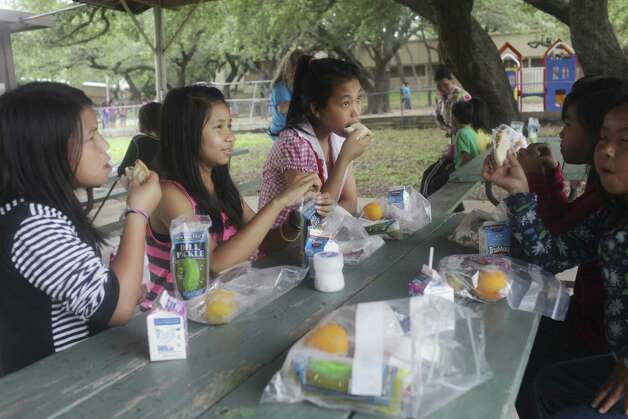
    Children of refugee families from Thailand have lunch outside St. Francis Episcopal Church on Friday.  Photo: Abbey Oldham, San Antonio Express-News
     
    Children of refugee families from Thailand have lunch outside St. Francis Episcopal Church on Friday.
    Photo: Abbey Oldham, San Antonio Express-News        
     
     
    Children streamed out of the van, talking and laughing as they went to get their lunch.
    Regardless of their race, gender, native language, country of origin or religion, all of them came together at St. Francis Episcopal Church on Bluemel Road to enjoy a free meal during the summer when most schools are closed.
    The church, in partnership with the San Antonio Food Bank and Eagles Flight Corp., is offering lunch on Wednesdays, Thursdays and Fridays during the rest of June and part of July for children 18 and under.
    The program is a continuation of the free and reduced-priced school lunches for low-income students during the regular school year, said Pam Espurvoa-Allen, who started the program and is a co-founder of Eagles Flight. The children who participate in the program, whether they're the children of refugee families or Americans, all qualified for the school lunch programs.
    The children of refugee families are particularly at risk since their parents do not speak English, and they are trying to assimilate into American culture, she said.
    Some of the children come from far-off places including Liberia, Somalia, Iraq, Burma and Thailand, said Michelle Autry, parish administrator at St. Francis.
    Although the program is aimed at children, adults are welcome. “We don't turn anybody away,” she said.
    The lunches, from 10:30 a.m. to noon, are staffed by eight volunteers: six from the church and two from Eagles Flight, a recently formed advocacy group that seeks to “ensure each child with a disability receives an appropriate education,” according to its Facebook page.
    There are enough lunches for up to 125 children, Espurvoa-Allen said. For the first week of the program, they had as many as 75 people per meal.
    One difficulty the organizers have encountered is getting the word out, she said. They could not advertise in English because most of the parents will not understand it; they could not advertise in the parents' native language because many of them are illiterate. Often, the children act as translators for the parents.
    “I am learning about so many different cultures that I never would have learned about if I wasn't in this position,” Autry said.
    As for the children, they said they enjoyed the lunch.
    Nga Meh, who was born in Thailand and moved to the U.S. in 2009, said she liked playing with the other children after eating.
    Cieloa Almazan, 9, said she liked the food. Friday's lunch was a peanut butter and jelly sandwich, a slice of cheese, a pickle, an orange and milk.
    The children are not the only ones who benefit from the meals.
    Carolyn Riley, a volunteer, said she was “blessed” to be helping.
    “Being here and seeing the faces of these children, seeing them smile, it's been such a joy,” she said.
    jrubio@express-news.net

    189 to be charged with illegal entry into Malaysia

    By Nicholas Cheng The Star/Asia News Network
    Monday, Jun 17, 2013


    The 189 Myanmar nationals will be charged for illegal entry into Malaysia and deported to their home country.
     
    KUALA LUMPUR: Fifty Myanmar nationals are expected to be charged at the Sessions Court in Sepang today for illegal entry into Malaysia.
    Some 139 others will be charged tomorrow over the same offence, under Section 6(1)(c) of the Immigration Act 1959/1963, which carries a jail term as well as a fine of up to RM10,000 and whipping of up to six strokes upon conviction.
    All the 189 Myanmar nationals will be deported to their home country, said Kuala Lumpur Immigration enforcement chief James Musa Singa.
    The police had rounded up 1,000 Myanmar nationals on June 7, following factional clashes between them.
    However, only those who were suspected of holding fake United Nations High Commission for Refugees (UNHCR) cards or had improper documents were detained.
    "We talked about charging them separately but there's no point pushing around here and there. Our laws are quite straight forward and their offence is quite severe.
    "So, we will charge them and send them home," said James Musa.
    UNHCR spokesman Yante Ismail said the organisation would send its legal advisers to speak to the detainees and verify if they have legitimate refugee claims.
    "Since their arrest, UNHCR has not yet had access to the Myanmar nationals with fake UNHCR documentation.
    "If they are found to be in need of international protection, our legal representative will mitigate their sentence to prevent caning and deportation.
    "In accordance with our standard procedure, if they are in need of international protection, but have not yet been registered with us, UNHCR will seek their release so that their refugee claims can be verified," Yante said in an email

    Sunday, June 16, 2013

    Criminal refugee plan 'illegal'

    Criminal refugee plan 'illegal'
     
    A coalition policy to send criminal refugees back to countries where they may be in danger has been slammed as illegal.
    The federal coalition on Sunday announced that asylum seekers and other foreigners convicted of serious crimes, punishable by more than one year in jail, would have their visas cancelled and deported.
    Under the proposed changes, people who have had their visas cancelled will also lose their right to appeal the cancellation decisions.
    Shadow attorney-general George Brandis says the changes are aimed at protecting Australians from foreign criminals.
    He says Labor's failed border policies had made Australian streets less safe.
    'The coalition is concerned about the link between illegal immigration and crime, and we propose to do something about it,' he told Network Ten.
    Asked whether approved refugees would be deported, even if there was a presumption that they faced danger, Senator Brandis said: 'We would rescind the visa.'
    International law forbids asylum seekers from being returned to countries where they may be persecuted.
    Deputy Opposition Leader Julie Bishop insisted the coalition wouldn't breach international law under the plan.
    Asked where a coalition government would send asylum seekers if they couldn't be returned to the place they fled, Ms Bishop replied: 'We would send them back to the place where they came from.'
    Immigration Minister Brendan O'Connor dismissed the plan as being part of Opposition Leader Tony Abbott's 'cynical campaign to raise fear in the community'.
    Australian Greens senator Sarah Hanson-Young said sending refugees back to regimes that are likely to harm them is illegal.
    'Tony Abbott knows this but because his appetite for fear mongering can't be satisfied, he will do anything to drag the national debate to a new low,' she said in a statement.
    Mr O'Connor will in the remaining two weeks of parliament urge the coalition and the Greens to support the government's Malaysia people swap deal.
    'The recent tragedies at sea are a confronting reminder that the parliament must now steel itself and accept ... the Malaysia arrangement,' Mr O'Connor said.
    Opposition immigration spokesman Scott Morrison says Labor has so far failed to secure Malaysian government support for any changes to the deal, as recommended by the expert Houston panel on asylum seekers.
    'As a result, the arrangement does not exist in any form that could be even considered, let alone progressed,' Mr Morrison said

    Saturday, June 15, 2013

    Tension simmers in KL's 'Little Myanmar'

    Myanmar workers taking a break from sorting and packing vegetables at a wholesale market. Many of them, especially those who are Buddhists, are said to be hiding out of fear of being targeted by their Muslim countrymen. -- ST PHOTO: YONG YEN NIEAT THE
     
    Kuala Lumpur wholesale market on a busy Saturday morning, workers loading boxes of vegetables onto trucks can be heard hollering at each other in the Myanmar language, drowning out the chatter of their Chinese bosses.
    Outside a row of shophouses nearby, women hawkers from Myanmar have set up stalls to sell betel nuts under the scorching sun.
    The appearance of normalcy at the market in Selayang and its surrounding areas, which have become something of a "Little Myanmar", belies the simmering tension in the community since several Myanmar workers were killed or injured in clashes in recent weeks.
    Malaysian police have linked the violence here to sectarian clashes back in Myanmar, where several hundred people have been killed and thousands more displaced as a result of conflict between Buddhists and the Muslim Rohingya minorities.
     
    Reports in the Malaysian media further suggested that the Myanmar nationals who had been targeted were Buddhists who were singled out by their Muslim countrymen seeking revenge.
    Myanmar's sectarian conflict has also spilled into Indonesia. Last month, Indonesian anti-terror police nabbed several militants suspected of plotting to bomb the Myanmar Embassy in retaliation for the attacks against Muslims in Myanmar.
     
    To prevent further clashes, Malaysian police have since rounded up over 900 Myanmar nationals. City deputy police chief Datuk Amar Singh Ishar Singh told The Straits Times yesterday that the situation is now under control with no fresh arrests made in the last two days.
     
    But interviews with Myanmar migrant workers suggest that tension is still running high in the community.
    Many workers, especially those who are Buddhists, are said to be hiding in fear.
    Those without documentation are worried that they have a higher chance of being caught given the authorities' heightened vigilance.
    "My Buddhist friends have not been coming to work for days as they are in hiding until things have calmed down," a 28-year-old worker who wants to be known only as Adam, a Myanmar Muslim from Mawlamyine.
    He added: "I don't understand why the religious clashes would hit us here, as we are all from Myanmar and so, we understand each other's difficulties and should not fight with each other."
    The recent spate of violence has also affected the Chin community, people from a Christian minority in Myanmar
     
    About 20 Chins have fled their homes and slept at my flat in the past few nights as they are worried for their safety," said Mr Ricky Kap, a Myanmar refugee and chairman of the Alliance of Chin Refugees.
    It is unclear what, if anything, the Myanmar community plans to do to ease tension. When approached, many chose to evade the issue altogether.
    The issue, however, is unlikely to fade away anytime soon given the size of the migrant worker population from Myanmar. Malaysia is one of the largest recipients of Myanmar migrant workers in the region, many of them refugees.
    The United Nations High Commissioner for Refugees said there are almost 95,000 refugees from Myanmar in Malaysia, who are mainly Muslims. The Malaysian government said, as of 2011, there are some 137,784 registered migrant workers from Myanmar.
    But the Myanmar embassy estimates that Malaysia might have more than 400,000 documented and undocumented workers from Myanmar.
    Some migrant workers insist that such bouts of violence are rare, and that the majority just want a peaceful life.
    "We are not here to create trouble as we just want to work and earn money, whether we are Buddhists or Muslims," said an illegal migrant worker who wants to be known only as Saiful.
    Their employers are unfazed, for now. A vegetable supplier, who wanted to be known only as Sze Ling, said she would not fire her three Myanmar workers unless they were involved in violent clashes.
    "They are cheap labour and generally work hard," she said. "We have grown to trust them as they have been with us for years."
     
    The Malaysian government has attempted to legalise some of the undocumented migrant workers here under a programme called 6P in 2011. But many are hesitant to come forward as they are concerned that their whereabouts would be monitored.
    Some of them also don't want to go through the hassle as they don't intend to live here.
    Adam said he is working hard to save money earned from transporting vegetables at the market so that he may open a shop in his hometown someday.
    "I dream of returning home every day," he said. "I know it is a far-fetched dream, but I hope that day will come."
    This story was first published in The Straits Times on June 10, 2013 
    To subscribe to The Straits Times, please go to http://www.sphsubscription.com.sg/eshop/
    Background story
    SHOULDN'T BE OUR FIGHT
     
    I don't understand why the religious clashes would hit us here as we are all from Myanmar and so we understand each other's difficulties and should not fight with each other.
    - Adam, a Myanmar Muslim
     
    FOCUS ON WORK
     
    We are not here to create trouble as we just want to work and earn money, whether we are Buddhists or Muslims.
     
    - An illegal migrant worker who wants to be known only as Saiful 

    Friday, June 14, 2013

    Violence in Malaysia Has Some Burmese Heading for Exits

    Aung Myo Oo, a Burmese migrant who was attacked by unknown assailants on June 3, 2013, lies in a hospital bed in Kuala Lumpur recovering from his injuries. (Photo: The Irrawaddy)
     
    A week after a series of violent attacks that has left five Burmese migrant workers in Malaysia dead, and as local authorities talk of deporting thousands arrested in connection with the violence, many Burmese in the country are considering leaving voluntarily—if they can.
    “Many migrants who obtained work permits want to leave Malaysia now because they are very afraid. They no longer want to stay here,” said Myat Ko, a Burmese migrant living in Kuala Lumpur.
    According to Myat Ko, who is a member of a network of Burmese migrant workers in Malaysia, 18 Burmese nationals left the country on Thursday, and many more are expected to return to Burma in the coming days. Among them, he said, are around 800 who have overstayed their visas, making them vulnerable to the police sweep that has ensued in the wake of a series of attacks from May 30 to June 7.
    The attacks, carried out by unknown assailants, and apparently targeting Burmese Buddhists, have raised fears of further violence to come, despite assurances from the Malaysian government that it has the situation under control.
    On Friday, Burmese state-run media reported that a total of five people had died as a result of the attacks, up from previous reports of four fatalities. Several others have been hospitalized.
    In response to the panic among some Burmese in Malaysia, several of Burma’s richest businessmen, including Aung Ko Win, chairman of Kanbawza Bank, Zaw Zaw, the managing director of the Max Myanmar Group, and Tay Za, founder of the Htoo Trading Company, have pledged to help those wish to return.
    “Some will get a free ticket, while others will get a 50 percent discount to fly back to Burma,” said Myat Ko, who is also involved in fundraising efforts.
    However, lack of return airfare is not the only obstacle for some who don’t want to stay in Malaysia. Many say that bureaucratic red tape at the Burmese embassy, where they are expected to submit ID certificates and other documents before they are permitted to return, is another problem. Others say that their Malaysian employers won’t let them leave unless they pay a 1,000- ringgit (US $320) fine.
    On Thursday, Malaysia’s Deputy Home Minister Wan Junaidi Jaafar said after a meeting with a visiting Burmese delegation led by Deputy Foreign Minister Zin Yaw that his government is seeking Burmese cooperation in repatriating Burmese nationals.
    “We have 4,400 Myanmars detained in immigration detention centers now, and we have invited the Myanmar authorities, especially the embassy, to… bring them back,” the Malaysian minister said, according to a report by Agence France-Presse.
    He also called on the UN refugee agency UNHCR to expedite processing of Burmese refugees who feel they can’t return to Burma.
    There are an estimated 95,000 Burmese refugees living in Malaysia. They are allowed to stay in the country, but are not granted legal status.
    There are believed to be a total of 400,000 Burmese nationals living in Malaysia, including many undocumented migrants and holders of fake UNHCR registration cards

    Burmese refugee coping with seizures, struggling with finances

    Published: Sunday, May 12, 2013
    TruGreen employee Eh Nay Say lays down pine straw in the Westport Community of Leland Thursday, May 2, 2013. Say is a seasonal employee who worked for the company in the fall and was rehired again in March of 2013.
    Buy Photo Photo By Matt Born
    Stress is the first sign of trouble for Eh Nay Say.
    It is worst at night when his mind won't let him stop worrying about money or if he even should have dragged his family thousands of miles from the refugee camps in Thailand to Wilmington. He can't sleep and then a scar on his head starts to hurt, a sure sign that a seizure is next.
    And then it happens.
    He usually doesn't remember much about the seizure. It is a blank spot in his memory. The last time, about two months ago, a friend found him and called 911. Paramedics took him to the emergency room where he was treated and given medicine to control the seizures. He woke up in the New Hanover Regional Medical Center emergency room.
    Say had his first seizure in his 20s when he was at the camps in Thailand. He was on medication, but left the camp almost a year ago without medicine. He always knew at any time the seizures might come back. But he'd also heard a rumor in the camp that if you're sick, you can't go to the United States. Once in Wilmington, he didn't want anyone to know about the seizures.
    "If I let them know I was sick, I'd lose my job and they'd send me home," Say said.
    And he didn't want to go home.
    The Says are Karen, the Burmese ethnic group that the country's government has oppressed for more than a half century. For more than a decade, the family lived in a refugee camp on the Burma-Thailand border. In July, after a 10-year wait, the Says arrived in Wilmington to start a new life. No longer confined to a refugee camp, the Says are slowly finding their way

    Refugees face uncertain future as Myanmar opens

    DENIS D. GRAY
    Associated Press
    In this photo taken April 12, 2013, Saw Pa Taw, left, a former Karen fighter who lost both his eyes and hands, during fighting with Myanmar soldiers talks as and son Ta Ye Thu, 13, listens during an interview at Mae La refugee camp in Ta Song Yang district of Tak province, northern Thailand. Karen refugees are now facin a future that will dramatically change their constricted but secure, sometimes happy lives. With the end of 50 years of military rule in Myanmar, aid groups are beginning to prepare for the eventual return of one of the world's largest refugee populations, some 1 million in camps and hideouts spread across five countries. (AP Photo/Apichart Weerawong
     
    MAE LA REFUGEE CAMP, Thailand (AP) -- Since the day she was born, 20-year-old Naw Lawnadoo has known almost nothing of the world beyond the fence and guard posts that hem her in with 45,000 others -- ethnic minorities from Myanmar and those like her who were born and raised in the Mae La refugee camp in neighboring Thailand.
    School, family, friends, shopping and churchgoing -- many of the refugees are Christian -- have all been confined to a valley of densely packed bamboo-and-thatch huts huddled under soaring limestone cliffs.
    Now, she and other camp residents face a future that will dramatically change their constricted but secure, sometimes happy lives. With the end of 50 years of military rule in Myanmar, aid groups are beginning to prepare for the eventual return of one of the world's largest refugee populations -- some 1 million people in camps and hideouts spread across five countries.
    For thousands like Naw Lawnadoo, it is "repatriation" to a country they have never known, where their parents suffered under a military regime that suppressed ethnic insurgencies with brutal tactics, and where ethnic tensions continue to erupt in bloodshed despite some democratic reforms. More than half the population of the camps in Thailand is under 19.
    "We are prepared to go back, but we don't know what the real situation there is like," says Naw Lawnadoo of the country previously known as Burma. "We can't speak Burmese. We have no identification cards. And I don't know what kind of a job I could get."
    Just when they will have to leave remains uncertain, but Thailand, which hosts many of the camps, is eager to close them.
    "We're coming to the endgame," says Sally Thompson, executive director of The Border Consortium, the main agency providing aid to a string of Thailand camps, where you can find four generations living under one roof.
    Some may melt into Thailand, joining the 2.5 million migrant workers from Myanmar. A few may be resettled in third countries, though the United States is ending a program under which it has taken 80 percent of the 105,000 settled so far. With shrinking options, most will likely have no choice but to return.
    While camp life is hardly cosmopolitan, some of the young can meet foreigners, have access to the Internet and occasionally slip out to a nearby town, or even the shopping malls and bright lights of Bangkok, Thailand's capital. For them, the prospect of planting rice in isolated villages to which they would probably go holds little attraction.
    Naw Lawnadoo for one is seemingly confused. The young woman, dressed in neat slacks and a blouse embossed with a teddy bear, has heard the stories of how her parents fled Pea Ta Ka village in Karen state as Myanmar soldiers moved in to pillage, burn houses and kill.
    At one moment she says she would like to go to Australia, where her father's three sisters and mother are settled, after finishing her studies at a Baptist college in the camp.
    Later, she talks about returning to her mother's village in Myanmar as a medic or Christian missionary, thinking that perhaps she could adjust to life there. "If our neighbors could live like that, we could too," she says.
    She and her parents had an opportunity to go to Australia earlier, but decided against it because her maternal grandmother still lives in Myanmar. "My mother didn't want to go. She said we would be even farther from her mother than we are now, and my father gave in to her," Naw Lawnadoo says with a distinct note of regret.
    "I've never ridden a train or an airplane," she says. Her longest trip and only one to a city was to Chiang Mai in northern Thailand.
    The majority of the refugees, including Naw Lawnadoo, belong to the Karen ethnic group. Others include the Karenni and Pa-o. Many of the older ones, who fled fighting in their homelands, hope to return one day but say the time is not yet right.
    Myanmar remains a nightmare for Mu Pro, a 42-year-old woman. She still dreams about running, running, trying to flee the grasp of her pursuers who finally catch and torture her.
    "No more Burma army. No more torture. No more killing. No more suffering," she says. "I don't want to go home. Since I was young, I have always been running away from Burmese soldiers."
    Her aging father, like many in the war-torn regions, was forced to be a porter for the army and shot when he could not carry his load. When her husband, also shanghaied, never returned she fled her mountain village. She sent two of her sons to Thailand, while she and three younger children became internal refugees -- like some half a million others in eastern Myanmar -- for 11 years. Always on the move, they hired themselves out to feed pigs and plant rice