Showing posts with label UNHCR. Show all posts

Sunday, April 10, 2016

Refugees Plant The Seeds Of A New Community In Kansas City


Beh paw Gaw is a New Roots graduate and a Karen refugee from Myanmar. Now she has her own three acre farm which she runs with her sister Pay lay, who is also a graduate of the New Roots program.Oluwakemi Aladesuyi/NPR

Farming is nothing new to Kansas. But now it's drawing in a new community that's trying to bridge the divide between life in another country and one in the United States.

i


New Roots for Refugees encourages refugees to become independent through farming.Courtesy of Cultivate Kansas City

In the midst of boxy yellow and brown public housing, beyond the highway and past empty grain elevators, sits Juniper Farm. It's spread over nine acres on the Kansas side of Kansas City.

As their children play on the grassy knoll behind us, four women sit at a plastic picnic table speaking in Karen, a language spoken in parts of Myanmar.

They're students at a program called New Roots for Refugees. The program aims to teach the basics and business of farming to refugees over the course of four years. At the end, many of the graduates are ready to start farms of their own.

It's a joint effort between Catholic Charities and Cultivate Kansas City, a nonprofit that encourages locally-grown food and urban agriculture.

"It is like practical education here. So I love it very much," says Dhan Rai, a first-year farmer from Bhutan.

Many of the men and women at New Roots come from Myanmar or Bhutan. Some were farmers in their homelands. But farming on the outskirts of Kansas City is different: the land, the crops and even the weather.

i


Sisi Cho is a third-year farmer at New Roots and a refugee from Myanmar. She was the first New Roots farmer to sell produce this year at the KC Eat Local and Organic Expo in early April.Lily Siebert/Courtesy of Cultivate Kansas City

As a train passes, Sisi Cho plants zucchini seeds and baby heads of kale in her quarter-acre plot behind the greenhouse. Before this she was living in a refugee camp in Malaysia.

"America government is good. No separate color or race. Everything good," she says.

Earlier this month she sold spinach, spring garlic and radishes at a local farmers market. She's the first New Roots farmer to sell produce this season.

The refugees here fled ethnic violence and military oppression that made their people victims of torture, systemic rape and forced labor. In addition to Bhutan and Myanmar, refugees from Somalia, Burundi and Sudan have taken part in the program.

For some, escape meant enduring years in cramped refugee camps. Entire families shared one room shelters, covered with roofs made of plastic sheeting.

Many who've come here are happy to have escaped violence. But adapting to life in a new country, with a different language and customs, is still difficult. Many refugees struggle economically.

So the New Roots program aims to teach refugees more than just farming.

Sam Davis is a site manager at the farm. He teaches refugees how to farm, how to manage a small business, and how to navigate other obstacles of integrating into American society.

Sam Davis is a site manager at Juniper Farm. He sits in the greenhouse, where the refugees learn how to get an early start on the growing season.Oluwakemi Aladesuyi/NPR

"Mr. Sam," as the students call him, says he can understand feeling out of place. His family moved here from Arkansas about 60 years ago. "We were Americans coming to Kansas ... but it was like going to another country. You had to fight your way to school, you had to fight your way home," he laughs.

Fitting in was hard for Davis because he spoke a different dialect. It's one way he relates to the refugees. "The language I don't understand. The expression most of the time I understand," he says. "But that's actually how I communicate with them. And I don't give up."

It's that spirit that encourages August Gaw. She's 25 years old and often translates for her mother, Beh paw Gaw, who graduated from New Roots a few years ago. "Even if they don't know the English that much, when they speak, Sam will understand my mom," she says.

August used to come here to help her mother. But now Beh paw has her own 3-acre farm which she runs with her sister. Last year the operation made more than $10,000. The potential to make money is important; many refugee families live below the poverty level.

Davis says New Roots benefits more people than just the farmers. "They can keep doing what they did in their homeland," he says. "And if they get enough land it continues to go on. It feeds back into the community, the neighborhood."

And creating that sense of community, of establishing "new roots," is another goal of the program.

"My mom came to work here and then she met other people here," says August Gaw. "And we feel very close to each other and much better."

www.npr.org

This is the best opportunity for New Comer Refugees to the State. 

Thursday, October 1, 2015

Thailand seizes assets of officials suspected of human trafficking


Internally displaced Rohingya boys shiver in the rain in a makeshift camp for Rohingya people in Sittwe, Myanmar. (File, AP)

Bangkok - Thai authorities seized over $1.5m in assets from officials charged with human trafficking, the government said on Tuesday.

The assets included homes, boats, cars and land belonging to officials charged in absentia with trafficking, the government's public relations department said.

One of the missing suspects had turned himself in, it said. The army captain was wanted on charges of trafficking Rohingya refugees from Myanmar to Malaysia using Thailand as a transit point.

More than 150 warrants have been issued against officials suspected of involvement with the trafficking ring to date, with 89 detained including a general.


The trafficking network came to light earlier this year after investigators discovered mass graves of refugees at a trafficking camp in southern Thailand.

The ensuing outcry and crackdown stranded thousands of migrants in boats off Thailand, Malaysia and Indonesia, as traffickers refused to land.

The Rohingya Muslims say they suffer discrimination in predominantly Buddhist Myanmar, which does not recognise them as one of the country's official ethnic groups, and considers them illegal Bengali immigrants. 

In August, the Anti-Money Laundering Office seized saving bonds, land deeds and cash totalling $1.1m from the same smuggling ring.

For these scouts, "camping" means coming home


29 September 2015

© UNHCR/K Suntayodom

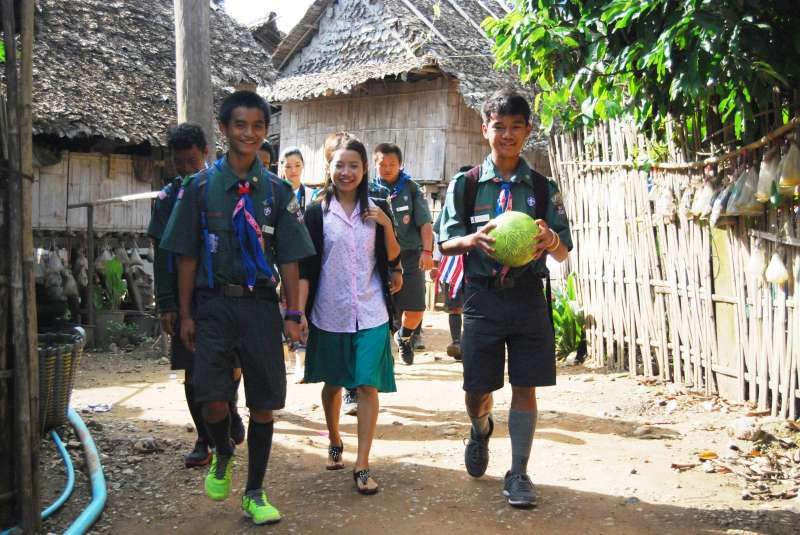
Reunited after seven years, resettled refugees Lwel Say (left), Lwel Gay Htoo and their aunt Tha Dah Wah stroll through Mae La camp where they were born and bred.

MAE LA CAMP, Thailand, Sept 29 (UNHCR) – They live by the motto, Be Prepared, as members of the Utah Boy Scouts of America Troop. But nothing could have prepared them for the rush of emotions that greeted them in Mae La refugee camp.

The 18 Myanmar refugee boys had flown with their scout leader from Salt Lake City in the United States to Japan for the World Scout Jamboree before arriving in Bangkok for a seven-hour bus ride to reach this camp in western Thailand's Tak province. They were visibly tired but excited as they scoured the crowd for familiar faces – loved ones they had not seen since leaving the camp in UNHCR's resettlement program almost 10 years ago.

The faces of Brothers Lwel Say, 16, and Lwel Gay Htoo, 14, lit up when they found their aunt, Tha Dah Wah, 24. "I'm very excited, very happy and I want to cry," she said. After seven years apart, the boys were now taller than her, but the younger one still clung to her hand as they walked through the camp.

The brothers have come a long way – not just in terms of distance but also experience. Born in exile, Mae La camp was the only world they knew. Daily life revolved around school, play and evening lessons with their teacher-mother. They wore old clothes full of holes and considered themselves lucky to wear flip flops where other kids ran around in their bare feet.

"We used to ask our parents – how will our future be? They always said they didn't know," said Lwel Gay Htoo.

Back then, ethnic conflict in south-eastern Myanmar seemed intractable and the refugees faced the prospect of spending a lifetime in Thailand's camps. In 2005, UNHCR started a group resettlement program to give some of them a new lease on life.

"My parents decided to register for the resettlement program because they hoped for better education for me and my brothers and sisters, so we would have better lives," said Eh Nay Ler, 17, another member of the visiting team.

© UNHCR/P Tonjunpong

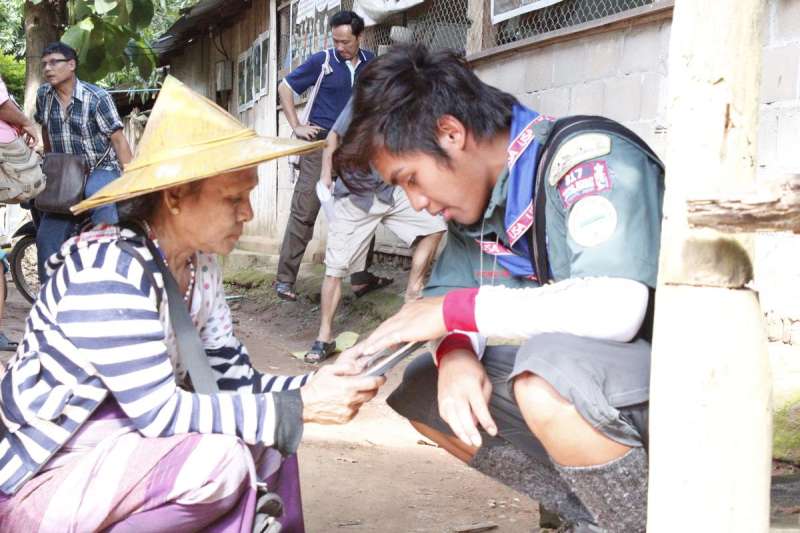
Resettled refugee Eh Nay Ler shows his grandmother in Mae La camp photos of his life in the United States.

Life in the United States was not easy at first. Many struggled with the new environment, culture and language. The Lwel brothers improved their English by watching cartoons while Eh Nay Ler persisted by listening to his teachers. These young men eventually joined the Utah Boy Scouts – comprising some 100 resettled Myanmar refugees – through which they volunteer weekly and help the homeless in their new community.

"Resettling in America gave is a new, fresh start in life. It's given us freedom, rights, better education and welfare that would have been impossible if we still lived in the camp. Without the resettlement program, I could have married early or gone bad," said Lwel Say, who admitted to being "totally stubborn" and "spoilt" in the past.

Eh Nay Ler agreed: "I am very thankful for the life I've been given. Without support from UNHCR, the resettlement country and donors, I would probably be picking corn for a living with my grandmother."

Despite their gratitude, the boys clearly missed the relatives they left behind, including grandparents who felt they were too old to travel and extended family members who had either opted to stay or were unregistered and thus not eligible for resettlement under Thai regulations.

The Lwel brothers' aunt chose to stay for a university scholarship in Thailand, after which she plans to teach in the camp.

This spirit of giving back is not lost on the resettled boys. Lwel Say hopes to come back to Mae La to be a teacher when he graduates from high school in two years.

Fellow Scout Hay Soe, 16, waxed nostalgic when he visited his old school in the camp: "One day I will come back here and be a teacher. I will teach math or science because I love these subjects and I want to work for refugees in Thailand."

Nearly 100,000 Myanmar refugees have been resettled to third countries such as Australia, Canada, Denmark, Japan and the United States since 2005. Some 110,000 remain in nine camps along the Thailand-Myanmar border.

By Korapin Suntayodom & Pathamawan Tonjunpong,

In Mae La camp, Thailand

Sources : UNHCR

Wednesday, September 16, 2015

Volunteers help refugees from Burma create community


She thought she made a mistake. Takwae Htoo was in her 20s, a single mother in an unfamiliar place after her home country had been ravaged by civil unrest. “We had nothing,” she said. “It was just me and my baby alone. I did not speak English. I did not know anybody.” Takwae Htoo is a refugee from Burma, renamed Myanmar by the current government, a country that has been ruled by a military junta since the 1960s. She was originally placed in Texas a decade ago. Now, she calls Chapel Hill home. She is a housekeeper at UNC, attends English classes through the Orange County Literacy Council and works part time at a farm run by refugees and volunteers. She married another Burmese refugee who settled here too, and her children go to school in Carrboro.

Sey Mor practices identifying the President and Vice President at a citizenship class at the Refugee Support Center of Carrboro. Sey Mor is a refugee from Burma living in Carrboro. By Stephanie Lamm The U.S. Committee for Refugees and Immigrants has placed more than 4,000 refugees from Burma in North Carolina. Fewer than 300 were originally placed in Chapel Hill and Carrboro; however, more than 1,000 refugees from Burma have since found homes here, according to the Refugee Support Center in Carrboro. Refugees from Burma belong to many different ethnic groups, including Burmese, Karen and Chin. They speak a variety of languages, most commonly a dialect of Karen.

Many refugees placed around the country move to Orange County due to the area’s wealth of refugee assistance organizations — most run by volunteers. Volunteer organizations assist refugees in gaining citizenship, learning English and finding work and housing. When the honeymoon ends Eh Paw came to Carrboro from a refugee camp in Thailand three years ago with her 3-month-old son who was having seizures every day. While searching for a job and taking care of her two older children, she traveled to and from UNC Hospitals daily to take care of him. “My baby is very sick,” Eh Paw said. “They sent me to America so he could receive medical care that is better than in the camp.” Eh Paw now considers herself lucky — she understands English, her son’s condition is under control and her husband joined her in Carrboro six months ago. Most importantly, she can move about freely. Raised in a refugee camp, Eh Paw had to ask the camp supervisor for permission to leave. Eh Paw works as a translator at the Refugee Support Center in Carrboro, which helps refugees from Burma with everything from applying for public housing to filing for child support. Flicka Bateman is the director of the center, which relies on volunteers to help refugees with legal services, language skills and a variety of other needed programs.

She said her organization provides long-term support. “It’s hard to explain exactly what we do because we do so many different things,” Bateman said. “If you think of it as a hierarchy of needs, we usually step in after the placement organization meets the families’ most basic needs. We work with public housing, we place them with jobs, help them set up a bank account, find schools for their kids and connect them with other resources in the community.” Refugee placement organizations like the Lutheran Immigration and Refugee Services and Church World Service provide support for the first three to six months, but after that, refugee families must turn to a variety of organizations to meet their needs. “We usually meet people once the honeymoon period ends and they become anxious and start questioning whether refugee placement here was a good idea,” Bateman said. Takwae Htoo was originally placed in Texas, but Orange County’s community of volunteer-based organizations has provided her with a more stable life. “They paid rent for six months. After that, nothing,” Takwae Htoo said. “Things are not as hard here. 

We have people to help us.” Learning the language Takwae Htoo said of the challenges refugees face, learning English is the greatest. Takwae Htoo’s oldest child, now a junior in high school, was 5 years old when they came to the U.S. She said she is proud of how quickly he picked up English, but she is disappointed she cannot help him with his homework. At East Chapel Hill High School, students founded the Refugee Outreach Club, which tutors refugee children. Elsa Steiner, a sophomore at UNC and one of the founding members of the Refugee Outreach Club, said teachers often do not have the time or resources to make sure refugee children succeed in school. “When teachers assign homework, especially in the lower grades, sometimes they assume that the parents can help, but that’s not the case for many of these children,” Steiner said. Casey Smith, another founding member, said the Karen and Burmese communities face a lack of resources within the schools to learn English, and she and other co-founders took on the challenge of providing support where the school system could not. “It’s not like Spanish or even Arabic where there are translators and resources for people who want to work with the Karen community,” said Smith, now a junior at Wesleyan University. “Unless they learned in the camps or unless they were very young when they came here, it could take many years before they speak enough English to get by on their own.” Smith’s mother, Lori Carswell, teaches Takwae Htoo’s English class through the Orange County Literacy Council. “I didn’t expect to become so involved, but when it’s something like this, it’s so rewarding to watch them grow,” Carswell said after teaching a recent session of her English class at the Chapel Hill Public Library. Cultivating Community On her days off, Takwae Htoo and her husband work a small plot of land at Transplanting Traditions, where 28 refugee families are given plots of land to grow and sell crops for supplementary income. 

Customers for Transplanting Traditions prepay for food grown by the farmers before the harvest season. Crops are also sold at the Chapel Hill and Carrboro Farmers’ Market, teaching farmers how to market their goods. Kelly Owensby, director of Transplanting Traditions, said the organization expects to bring in $60,000 by the end of 2015 — money that will go directly to the refugee farmers. All of the farmers at Transplanting Traditions worked as farmers back in Burma. Steiner, who volunteered with the organization, said it’s empowering for refugees to find work in an industry they are familiar with. “Transplanting Traditions makes them feel like they can provide for their family without having to learn a new skill,” said Steiner. “This is something they knew how to do back in their country. They can take on leadership roles and collaborate with other families. There are numerous mental health benefits in addition to providing them with a livelihood.” Owensby agreed that the benefits of the program include far more than supplementary income. “We’ve seen a decrease in stress and better mental and physical health in the families we work with,” Owensby said. Transplanting Traditions is entirely run by volunteers. The organization also offers educational and enrichment programs for teenagers and children — for example, its cultural preservation initiative, which records the stories and cultural traditions of refugees. “Our goal is to improve refugees’ lives through food security and supplemental income,” Owensby said. “But we also try to take a holistic approach to serving the community. Transplanting Traditions plans to expand the farm by 50 percent — to 7.5 acres — by next summer. And Transplanting Traditions recently partnered with People Offering Relief for Chapel Hill Carrboro Homes, which provides 111 refugee families with $100 in fresh produce each month. The farm donates $1,000 worth of food grown by its farmers, including specialty produce typically grown in Southeast Asia, to PORCH, which is a volunteer-based hunger relief organization. Debbie Horwitz, the founder and director of PORCH, said the Food for Families program, which began in 2010, was designed with these refugee families in mind. Most families are referred to the program by a school social worker. “We found that local pantries often weren’t meeting the needs of the refugee community,” Horwitz said. “They aren’t used to the food grown here. It’s important that they have access to fresh produce native to where they are from. With our partnership with Transplanting Traditions, we can provide that for them.” About half of all Burmese and Karen refugee families in Chapel Hill and Carrboro are served by PORCH, including more than 300 children. Food donated through PORCH is delivered by volunteers. 

They also deliver clothing, books, computers, strollers, mattresses and other donated items as they are available. “It forms a bond between our volunteers and the refugee community,” Horwitz said. “When people see how gracious our families are they often want to find new ways to help. You can’t just see the need these people are in and walk away without wanting to donate more of your time.” Steiner, who has continued her work with the refugee community since high school, said it’s important that volunteer organizations pick up where government services leave off. “People who work with refugees talk about how there’s a bell curve of resettlement,” Steiner said. “When people first come over they are overjoyed, and they thought the worst was over. Then they begin to realize that they will probably live in poverty the rest of their life, but at the same time they don’t want to seem ungrateful. Eventually things get steady and they find the support they need, but things are really hard for a while.” For Takwae Htoo, the hard times are over. She’s found success in her new home through the help of volunteer-based organizations. “We love it here,” she said. “We’re free here.”

Thursday, August 27, 2015

Eyes Wide Shut: The challenge of humanitarian biometrics

The use of biometrics clearly has a role to play in humanitarianism. The challenge, says IRIN columnist Paul Currion, is to protect the disadvantaged, whose identities may be vital for accessing government services, while preventing powerful states and private companies who may seek to experiment or exploit.
By Paul Currion 


An Afghan policeman looks into a biometric eye scanner

BELGRADE, 26 August 2015 (IRIN) - Biometrics, for those of you who haven't spent the last 10 years swearing at the automated passport gates at Heathrow, is the use of human measurements for identification. The most familiar biometrics are fingerprints, but the computer-powered scanning of eyes and faces is being implemented in a growing range of contexts. The origins of modern biometrics lies in the identification of criminals, but it was the war on terror that turned biometrics into the $13.8 billion industry it is today.

As a result the technology has leapt ahead in recent years – and leapt into some surprising places. You might use your fingerprint to access your smartphone, but everybody gets fingerprinted now, including schoolchildren. Facebook can recognise you even if it can’t see your face, but even music festival organisershave decided that facial recognition technology is a good bet. Despitelongstanding concerns about privacy, biometrics clearly have their uses, and a growing range of sectors have been implementing them – including the humanitarian industry.

Biometrics in the humanitarian context are ostensibly focused on preventing identity fraud, but the basic dynamic was captured in this 2006 report from the UN’s refugee agency, UNHCR, in Malaysia:

“Nang Piang, a refugee from Myanmar, placed his finger tentatively on the biometrics scanner... ‘I don't know what it is for, but I do what UNHCR wants me to do,’ he said... ‘This is an important step for UNHCR Malaysia as we strengthen the security of our registration system to prevent fraud,’ said Volker Türk, head of UNHCR in Malaysia, ‘Such a security measure will certainly enhance the credibility of UNHCR's registration system in the eyes of the Malaysian government...’”

This statement makes clear that biometric registration is driven by the interests of national governments, technology companies and aid agencies – in that order. 

UNHCR's biometric system was initially funded by the EU and the US (specifically recommending funding “for early UNHCR use of mobile fingerprint technology developed by [the Department of Homeland Security]”). A number of companies have since been involved, including PA Consulting, who previously helped the UK government develop its border control biometrics, and one of whose former employees now works for the UN, overseeing global deployment of the system.

Critics of the industry focus on two concerns. Security is one: in 2008, for example, PA Consulting lost 84,000 biometric UK prisoner records – not through an act of cyber-crime, but because they were left on an unencrypted USB stick in an unlocked drawer in an unsecured office. Privacy, the second issue, is sometimes even more critical from a humanitarian perspective, because the privacy of vulnerable communities and individuals – many of whom may already be fleeing conflict or persecution – may be critical for their protection.

UNHCR has argued that biometric registration improves protection for refugees, but the question is clearly not settled. A recent study by Katja Lindskov Jacobsen pointed out that – while biometric registration may help to mitigate some vulnerabilities – the creation of the “digital refugee” may also create new vulnerabilities. These arrive precisely because this data can be shared between different actors for more than one purpose; to address problems faced by refugees, yes, but in a different context to frame refugees as the problem.

Government assurances of privacy are no guarantee. The European Commission promised that its EURODAC database of asylum applications would be protected, right up until 2012 when it agreed to allow Europol and other law enforcement agencies access to it. UNHCR expressed concerns about this, but the Commission went ahead anyway. UNHCR plunged on towards a global and centralised Biometric Identity Management System (BIMS) while only adopting adata protection policy in May 2015 – a policy that explicitly states that UNHCR “may transfer personal data [of refugees] to third parties.” That policy has safeguards built in, but the security of your data is only as secure as the weakest link in your chain – and, as noted above, that link might simply be somebody who forgets their USB stick.

This fits with a wider and more worrying pattern in the field of biometrics: it'smarginalised groups who are used as guinea pigs for new biometric applications, always with claims that it's for their own benefit. Privacy International has identified that in countries where democratic processes – such as parliamentary oversight and the rule of law – function more effectively, biometric schemes have been repeatedly challenged and rolled back by informed citizens. The real issue here is accountability – or lack thereof – precisely because humanitarian biometrics are being implemented in countries where those factors are weak to non-existent.

For example: one of the earliest uses of humanitarian biometrics dates back to 2003, helping UNHCR to establish that only 0.5% of Afghan returnees from Pakistan were trying to game the Afghanistan refugee return programme. Current President Ashraf Ghani promoted biometrics as the foundation for his country's social policy in his 2006 book “Fixing Failed States”, and the Afghan authorities have made it their goal “to fingerprint, photograph and scan the irises of every living Afghan.” This has made Afghanistan the most biometrically identifiable country in the world – although UNHCR and the Afghan government have both invested heavily in biometric databases, the US military has been the real driving force.

The use of biometrics clearly has benefits. The Centre for Global Development has given cautious and context-specific support to the broader principle of incorporating biometrics to bridge what they refer to as the identity gap – on the basis that the vulnerable and marginalised are usually required to submit to biometric registration to enable them to access government services. TheColumbia Human Rights Law Review comes down on the side of the legality and efficiency of biometric ID cards for refugees, if privacy concerns are fully addressed.

Photo: J. Ose/UNHCR Ethiopia
A member of a Somali family is fingerprinted by UNHCR staff

Yet it seems obvious that the individuals being registered are unlikely to be fully aware of the implications: a UNHCR article quotes Congolese refugee Olivier Mzaliwa saying: “I can be someone now. I am registered globally with the UN and you’ll always know who I am.” Even assuming that Olivier has been well-informed about the possible downsides of his registration (which seems doubtful, since it's not clear that UNHCR field staff themselves will be aware of these issues), he no longer has any control over this data about himself – and it is doubtful he has any means to regain that control, or even to find out how the data is being used. There is still a massive accountability gap.

Depending on where you lie on the political spectrum, registration of your identity is either an invaluable tool in the fight against poverty or an additional chapter in Seeing Like A State – although it’s probably both. Either way, the use of biometrics is only going to increase, particularly as we move towards mainstreaming cash distribution, where registration and verification are critical to ensure effective targeting and monitoring. Given this trend, we have an obligation to avoid using the bodies of the poor as experimental subjects, subject to an implicit assumption that they are all criminals – if not now, then at some unspecified point in the future.

We’ve seen in this article how biometric systems design has privileged the point of view of humanitarian organisations or national governments. Is it possible to develop a new design approach for managing identity, one that isn't a second-hand solution from companies looking to expand their market?

World Vision has explored one alternative in developing its Last Mile Mobile Solutions, making its concerns about biometrics clear. Building on this and other efforts, and incorporating the principles of participatory design, our starting point should be designing from the point of view of refugees, rather than our own organisations. Unfortunately the humanitarian community consistently fails to engage with that perspective, but this debate is more critical than ever, and not just for biometrics. The debate around design imperialism has died down, but it hasn’t disappeared, and digital design is becoming increasingly important.

So next time you’re swearing at the biometric passport scanner at the airport, remember that although your passport gives you the freedom to travel, that freedom is subject to surveillance and control. You might have more in common with refugees like Olivier Mzaliwa than you think; but unlike Olivier, at least you can choose your queue at the airport.

Sources : http://www.irinnews.org

Sunday, January 4, 2015

More action needed to tackle IDP issues: UN

Special to Myanmar Eleven January 5, 2015 1:00 am

More action is needed to deal with internally displaced persons (IDPs) in Myanmar, particularly in Rakhine, Kachin and Shan states, said the United Nations High Commissioner for Refugees (UNHCR).


In its updated operations profile for 2015, the UNHCR said fresh displacement was witnessed in 2014, with continued clashes between the Myanmar national army and non-state groups in Kachin and northern Shan states.

A crucial source in humanitarian aid to the people, the agency noted that significant numbers of IDPs in Kachin and Rakhine states continue to live in camp settings. 

In the coming year, the agency will focus its attention on people without citizenship, IDPs, refugees, returnees and host communities.

In 2012, violence in Rakhine State forced around 140,000 people to flee their homes. The majority live in government-designated IDP camps near the state capital, Sittwe, and in surrounding townships.

In Kachin State and northern Shan State, more than 100,000 IDPs are displaced and in need of continued humanitarian assistance. They are living in camps in both government-controlled areas and those under the control of non-state actors.

In Rakhine State, space in IDP camps is severely limited, and efforts to provide basic relief services have met severe challenges. The situation for most IDPs deteriorated in 2014, particularly in the areas of health coverage and non-food items distribution. The premises and warehouses of the UN and many other international NGOs were attacked and ransacked in early 2014.

"The inter-agency response in Rakhine State has repeatedly emphasised the need for durable solutions for IDPs. At present, there is a continued policy by the government to physically separate the conflicting communities, which limits reconciliation efforts and space for supporting coexistence," the agency noted.

Rakhine State is home to a large Muslim community. Tensions between Buddhist and Muslim communities have affected hundreds of thousands of families since violence between the two erupted in 2012.

Meanwhile, more than 100,000 IDPs live in Kachin State and northern Shan State. The UNHCR has seen the budget for its operations rise since 2012, when a ceasefire between the Myanmar army and the Kachin Independence Organisation (KIO) broke down.

"Continued clashes between the Myanmar national army and non-state actors in Kachin and northern Shan states in 2014 led to more displacement and a need for an emergency response. The inter-agency response relies on permission from the Myanmar government to access IDPs in areas under the control of the Kachin Independence Organization (KIO). As a result, only ad hoc missions are undertaken to these areas, limiting the response," the agency said.

It added that protection activities would continue for both Kachin and Rakhine states this year, depending on the conditions of the operational areas, particularly the level of access.

Home returning 

The agency is now working on sending refugees back to Myanmar. 

"In the southeast of Myanmar, UNHCR continues to perform return monitoring to identify the destination of refugees settling back in Myanmar. The aim is to build a profile of areas where interventions can be planned if the scale of returns increases, enabling the Office to respond once spontaneous returns increase. Planning for return is ongoing, including consultations with Myanmar refugees on the Thai border," the UNHCR said.

Residents of Kayin State fled to the Myanmar-Thailand border and overseas due to clashes between the Myanmar government troops and the Karen National Union (KNU). At present, there are about 100,000 refugees. Most of them live in any of the nine refugee camps along the Myanmar-Thailand border built by the UN and INGOs.

"We have to clear land for their living, and the relocation process will go forward only if the programmes to support them are planned. There are civic and social organisations involved, but we still need to include organisations related with the army," said Pahdo Saw Hla Tun, a central committee member of KNU.

Following the military coup in Thailand, there was a move to repatriate up to 120,000 Myanmar refugees living in temporary camps in Thailand. Many of the refugees have been in the camps for years, and an entire younger generation was born and raised in them.

General Prayuth Chan-o-cha, chief of Thailand's National Council for Peace and Order (NCPO), said that returning the refugees was one of the issues discussed during his meeting with Myanmar Armed Forces chief Senior General Min Aung Hlaing on July 4 in Bangkok. 

The UNHCR noted that increased interest among refugees in returning to Myanmar requires budget estimates that cover potential activities, should conditions be deemed conducive.

"Significant financial support may be needed in 2015 to support shelter repair and maintenance in Rakhine and Kachin states. Given the above, the 2015 budget for Myanmar is set at US$67.8 million," the agency said. 

The agency is planning support for around 20,000 potential returnees in 2015, although conditions are not yet sufficient to support any organised voluntary return.


Planning figures in 2015 

Type/origin/January/December 

Returnee arrivals (ex-refugees) /Myanmar/10,050/40,500

Internally displaced/Myanmar/587,000/514,000

People in IDP-like situations/Myanmar/35,000/35,000 

Returnee arrivals (ex-IDPs)/Myanmar/55,000/78,000

Stateless/stateless/810,000/810,000

Total/ 1,497,050/1,477,500 

Source: UNHCR

Saturday, December 14, 2013

: UNHCR : Group Resettlement of Thai Border Refugees to End Early 2014


MAE HONG SON, Northern Thailand — The final deadline for eligible applicants for UN group resettlement to third countries for Burmese refugees on the Thai-Burma border will be sometime in late January 2014, according to the UN High Commissioner for Refugees (UNHCR).

Vivian Tan, the spokeswoman for the UNHCR in Asia, told The Irrawaddy that eight years after the program began in 2005, and with the departure of tens of thousands of refugees to the United States since then, the number of eligible refugees is dwindling.

“The number of refugees expressing interest in this program has decreased in recent years, signaling a natural end to the program,” Tan said.

The United States first announced to camp residents in January 2013 that the group resettlement program for registered refugees would begin wrapping up this year, and a camp in Mae La, Thailand, stopped taking new applicants months ago. The announcement was made at different times in different camps, and each camp was given different deadlines for eligible applicants.

There are more than 130,000 Burmese refugees, mostly ethnic Karen who abandoned their homes in eastern Burma and fled to live in refugee camps on the Thai-Burma border in provinces such as Mae Hong Son, Tak and Sangklaburi. Many refugees have been living in these camps for more than 20 years.

Since the installation of a quasi-civilian government led by President Thein Sein in 2011, peace talks between the government and more than a dozen ethnic minority rebel groups have been a priority of the Thein Sein administration. The peace push has yielded results, with the government signing ceasefire agreements with all but two of the country’s major ethnic armed groups.

But the “peace dividend” for refugees on the Thai-Burma border has taken the form of decreasing humanitarian support amid a growing call by some for the refugees to be repatriated to their homelands.

Tan, however, said that even after the group resettlement program comes to an end, eligible refugees will still be able to express interest in individual resettlement to the United States and other third countries. “Thus, this is not the end of resettlement per se, just the end of the group resettlement program to the US,” she added.

“Eligible refugees are given several months to decide if they wished to avail of the group resettlement option. The US authorities have said the program will continue until they have processed every application received by the deadline for each camp,” said Tan.

However, the US Embassy in Rangoon denied the discontinuation of any resettlement program. According to an official at the embassy, the refugees’ admission program is ongoing and there is no halt to the processing of Burmese refugees.

“In fact the continuation of this program was specifically highlighted, as Burmese refugees continue to constitute one of our largest groups being resettled in the United States,” said the official, who asked for anonymity and did not specify whether the program referred to involved group or individual resettlement.

The official said that for the 2013-14 fiscal year, US President Barack Obama authorized the admission of up to 70,000 refugees from around the world. The top five nationalities resettled to the United States in 2013 were Iraqi, Burmese, Bhutanese, Somali and Cuban.

The United States is one of several countries participating in the program, which according to the UNHCR has so far resettled 80,000 refugees to the United States, Canada, Australia and several European countries as well as Japan.

The Border Consortium (TBC), a non-profit organization that has been providing food aid and shelter to the Burmese refugees for more than 20 years, also expressed concern over the reduction in financial support from international donors.

Mike Bruce, a spokesman for the TBC, said funding for humanitarian assistance has been reduced, with the impact of this manifested in recent ration changes.

“Rice rations are being revised in refugee camps in Thailand following reductions in funding for humanitarian food aid and a transition to needs-based and community-managed humanitarian relief,” said Bruce.

Households in refugee camps on the Thai-Burma border are now categorized as “Most Vulnerable,” “Vulnerable,” “Standard,” or “Self-Reliant.” Standard categorized households have seen a change in the rice provided for adults, and Self-Reliant households no longer receive food assistance for adults over 18 years of age, according to the officer.

In talks with more than a dozen refugees on the Thai-Burma border, The Irrawaddy was told that the shrinking financial support had made day-to-day life more difficult, between the rations cuts and a reduction in construction materials used to repair makeshift homes of bamboo and straw.

Refugees are scrambling to apply for group resettlement ahead of the program’s anticipated termination, they said.

Resettlement in third countries was the most appropriate option for them, refugees said, with uncertainty over what they might return to in Burma making that option less appealing, and their continued existence in the refugee camps made more challenging by dwindling financial support.

Wednesday, June 19, 2013

Don't deport Rohingya refugees to face certain persecution & suffering - LFL tells M'sia


Following the reported violence in Kuala Lumpur between Myanmar nationals, the Malaysian government has sternly warned them that they could face deportation back to Myanmar in the wake of the violence.
Lawyers for Liberty urge the Malaysian government not to proceed with the deportation especially those from the Rohingya community as they are refugees fleeing persecution in Myanmar.
The deportation of the Rohingya will be inhumane and cruel as they have been systematically persecuted in their homeland and remain one of the most vulnerable communities in the world.
They are stripped of their citizenship thus making them legally stateless and subjected to all kinds of serious discriminatory practices including on movement, marriage, birth, education, health care, employment, civil documentation and subjected to arbitrary detention, violence and forced labour.
Since June last year, there had been a serious series of coordinated attacks against the Rohingya and other Muslim communities in Myanmar causing untold number of deaths, injuries and destruction to their homes.
We call on the Malaysian government to deal with the violence as a law and order issue and in accordance to our obligations under international law.
By deporting the Rohingyas, the Malaysian government is as good as signing their death warrant or at the very least complicit with the Myanmar authorities in continuing their persecution and suffering.

Rohinya love Malaysia,and  Malaysia loves  Rohinya, why not giving some more citizenships of Malaysia!

Eric Paulsen
Co Founder and Adviser
Lawyers for Liberty

Thursday, September 27, 2012

Myanmar: UN refugee agency 'seriously concerned' over returns from China

The United Nations refugee agency is “seriously concerned” over reports that China has sent back from its Yunan province groups of Myanmar nationals who sought safety there from violence in neighbouring Myanmar’s Kachin state.
“UNHCR is urging the Government of China to offer temporary protection to those who fled the fighting, to respect their humanitarian needs and not send them back to a situation where their safety and livelihood could be at risk,” a spokesperson for the Office of the UN High Commissioner for Refugees (UNHCR), Adrian Edwards, told a news briefing in Geneva.
“We stand ready to support China in assisting these people until the situation stabilizes in their home areas,” he added.
The UN estimates that some 75,000 civilians have been displaced within Kachin and Myanmar’s northern Shan states since fighting broke out between Government troops and rebels last year, with more people continuing to flee insecure areas every day.
Mr. Edwards said that some 5,000 ethnic Kachins who had fled fighting between Government troops and rebels that broke out in Kachin state in June last year have been returned from China since mid-August, and were living in makeshift camps in border areas of the Myanmar state.
The spokesperson noted that more than 3,400 returnees are now staying in camps for internally displaced people in Kachin state because their homes were destroyed in the fighting and they are afraid to return to their villages. “They desperately need food, medicine, shelter and other relief items,” he added.
Despite repeated requests to the Chinese authorities, the refugee agency has not been able to reach or assist Kachin groups living along the Chinese side of the border, but recently a UNHCR team travelled to the town Lwe Je on the Myanmar side to provide aid and assess the needs of the returnees.
Some of those interviewed said that local authorities in China pulled down their shelters, and others reported that plainclothes policemen put them on a truck, loaded their belongings on another truck, and drove them to a border crossing point.
Staff of a local non-governmental organization saw what happened and arranged for trucks to take the returnees to the nearest camps in Myanmar, according to Mr. Edwards, who also noted that local groups say they expect more people to be sent back from China.
UNHCR has distributed relief items to the 1,200 returnees in the four camps for internally displaced persons in Lwe Je, including tarpaulins, blankets, mosquito nets, kitchen sets and basic toiletries. On Thursday, the agency’s team completed a second visit to the town to deliver aid and to assess the returnees’ needs in a more comprehensive way.

Friday, June 29, 2012

Refugees continue to face uncertain future in our region — Gerhard Hoffstaedter

JUNE 26 — World Refugee Day yearly draws attention to the plight of over 40 million people who are either refugees, internally displaced or seeking asylum and the 800,000, who are newly displaced across borders in 2011. This global population almost twice the size of Australia’s population demands more efforts to support them.
Globally the main source countries of refugees and asylum seekers are Afghanistan, Iraq and Somalia, together accounting for over five million according to the just released UNHCR Global Trends Report 2011. Regionally Myanmar/Burma remains the largest issue with hundreds of thousands residing in regional neighbouring countries such as Thailand, Bangladesh, India and Malaysia.
Australia has been a major resettlement country for our regional neighbours for a long time, perhaps most visibly starting with the resettlement of Vietnamese refugees n the 1980s. However, the current yearly scheduled intake of around 13,750 refugees (2010-2011 figures are 13,799) is paltry compared to most other Western industrialised nations. Alone UNHCR resettlement figures show Australia doing its bit with over 9,200 places in 2011 mainly from regional UNHCR offices.
The Bali Process and other regional instruments have hitherto been mainly deployed to shore up Australian efforts to keep asylum seekers and irregular migrants at bay, i.e. trapped within the borders of our neighbours. Yet, a regional solution to what amounts to a regional refugee crisis is paramount.
Such a regional solution will invariably involve sharing the burden of our neighbours and not just the financial burdens. This will involve increasing the yearly intake for resettlement from the region, particularly Malaysia, in exchange for tighter and more coordinated border security efforts with especially Indonesia.
Even though the ‘swap deal’ with Malaysia did not come to fruition, the attention it has cast upon the situation for refugees and asylum seekers there has to be maintained. Malaysia is home to an ever-increasing population of forcibly displaced people, most are from Myanmar/Burma. Aung San Suu Kyi has aptly warned of too much optimism about the political situation in her home and Australia’s move to lift its sanctions regime is unduly rewarding the Myanmar government for minor reform steps.
Thousands continue to flee ethnic and religious tensions, suppression, forced labour and a myriad of other human rights abuses by the Burmese military and a systematic process of marginalisation of ethnic groups, especially Christian groups such as the Chin, Kachin and Karen peoples.
Many of them come to Malaysia via Thailand to seek protection. However, “The Search: Protection Space in Malaysia, Indonesia, Thailand, The Philippines and Cambodia in Practice,” a report released by the Jesuit Refugee Services Asia-Pacific shows that protection spaces in Southeast Asia are insufficient, forcing many to keep moving in search for more adequate and safer refuge.
Malaysia now houses one of the largest urban refugee populations in the region. Some figures place as many as 60,000 in the sprawling city of Kuala Lumpur alone. Many Myanmar minority ethnic groups such as the Chin, a Christian group from Chin state in Northwest Myanmar/Burma, are waiting patiently to be registered by the UNHCR in Kuala Lumpur. This is the most pressing issue for asylum seekers in Malaysia and the region, as the UNHCR card they receive will give them some recognition and protection from the police and immigration officials.
Registration was suspended in early 2010 and funds are urgently needed for the UNHCR and its community partners to resume the mammoth task of registering tens of thousands of asylum seekers in Malaysia alone. Registration is just a first step, but an indispensible one, for it gives refugees recognition and freedom of movement. Those without cards risk arrest and detention, some do not leave the house out of fear.
Once they are registered they have another long wait ahead of them for resettlement to a third country, mostly the United States of America, some European countries and Australia. While some can achieve this transition and resettlement within three years, many have waited a lot longer. Some have been in Malaysia for over 10 years. In this time they have to hold down jobs to survive, some have married and started families — all long for a future in which they can take their destiny in their own hands.
In the current limbo they inhabit they face exploitation, harassment and the challenges of everyday life in a country that does not want them and barely tolerates their existence. Yet, things used to be even worse. Detention, whipping for immigration offences and raids by immigration officials have all decreased and there is a cautionary sense of calm amongst some refugee communities.
A critical US report on its human rights situation and the ‘Australia-Malaysia swap deal’ caused the Malaysian government to reconsider its treatment of refugees and asylum seekers. With concerted Australian support and pressure on the Malaysian government and funding of strategic partners such as the UNHCR and community and civil society partners asylum seekers can get better protection. Now is the time to build on the positive improvements and keep the attention and resources focused on those who need it most — refugees and asylum seekers in our region. — Anthropolitics.wordpress.com

Source : http://www.themalaysianinsider.com

Australia rescues 123 refugees from capsized vessel


Australia rescues 123 refugees from capsized vessel

At least 123 people were rescued on Wednesday after a boat carrying asylum seekers capsized some 100 nautical miles north of Australia's Christmas Island. Up to 90 people died last week when another vessel went down in the same area.

By News Wires (text)
 
AFP - Rescuers plucked 123 people from the ocean Wednesday after an asylum-seeker boat sank en route to Australia, barely a week after another vessel went down in the same area, killing up to 90.
The rickety ship capsized 107 nautical miles north of Christmas Island in the Indian Ocean and then sank, an Australian Maritime Safety Authority spokeswoman said.
Prime Minister Julia Gillard said between 123 and 133 people were on board, revised down from earlier estimates of 150.
"As we speak my best advice is that 123 people have been rescued," she told parliament as the pressure was turned up on Australian politicians to break their deadlock on how to deal with the arrival of asylum-seekers.
The incident comes just days after another boat with around 200 people on board went down in the Indian Ocean as it made its way to Australia.
Rescuers managed to save 110 people and 17 bodies were recovered from Thursday's capsize, but no other survivors have been found.
Three merchant vessels, including the MV Bison Express, a Philippines-flagged livestock carrier, were on the scene of Wednesday's disaster, which happened in Indonesian waters.
AMSA said two Australian navy ships and a spotter aircraft capable of dropping liferaft were also helping with the rescue effort in conditions described as "fair, not ideal".
In a statement, Australian Customs and Border Protection said police received a satellite phone call early Wednesday from the vessel.
AMSA "initiated an immediate response to the report and continues to coordinate the search and rescue effort".
Details were passed to the Indonesian search and rescue authority Basarnas, which said it received a report that the generator was broken and the boat was taking on water.
A photo from the MV Bison posted on the AMSA website showed a small, basic-looking boat crowded with people on its decks, apparently taken before it capsized.
The Australian Broadcasting Corporation said most of the passengers were believed to be Afghans and there were women and children on board, though this could not be confirmed.
The accident is the latest in a series of refugee boat disasters in recent years, as unseaworthy, overloaded vessels packed with desperate migrants struggle to reach Australia.
Most boats originate in Indonesia, but there has been a recent spike in attempts from Sri Lanka.
Though they come in relatively small numbers by global standards, asylum-seekers are a sensitive political issue in Australia, dominating 2010 elections due to a record 6,555 arrivals.
Both sides of Australian politics support offshore processing of asylum-seekers but differ on where it should be conducted.
Canberra clinched a deal last year to send 800 boatpeople to Malaysia in exchange for 4,000 of that country's registered refugees in a bid to deter people-smugglers from the dangerous maritime voyage to Australia.
But Gillard's fragile coalition government was unable to pass the required legislation through parliament without the support of the opposition, amid concerns Malaysia was not a signatory to UN refugee conventions.
Opposition leader Tony Abbott, who supports processing on the Pacific island of Nauru and turning boats back when possible, again ruled out the Malaysian solution Wednesday.
In response, Gillard pushed for a private members bill by independent MP Rob Oakeshott which would allow an immigration minister to designate any nation as an "offshore assessment country" if it was party to the Bali Process.
The Bali Process is a regional cooperative framework for dealing with asylum-seekers involving more than 40 countries.
Gillard offered, as a gesture of compromise, to re-open a detention centre on Nauru while pressing ahead with her Malaysia deal if the opposition agreed to vote for the Oakeshott bill.

Source : http://www.france24.com

Saturday, June 2, 2012

MALAYSIA : EMPOWER REFUGEES

From The Editor’s Desk


Who are refugees?

“A refugee is a person who, owing to a well-founded fear of being persecuted for reasons of race, religion, nationality, membership of a particular social group or political opinion, is outside the country of his nationality and is unable or, owing to such fear, unwilling to avail himself of the protection of that country.”

~ 1951 Convention Relating to the
Status of Refugees, Article 1(a) (2)

Dear readers,

We are the Social Protection Fund team of the UNHCR office in Kuala Lumpur and welcome to our inaugural newsletter. Wait, don’t go away. We are just about to tell you that this newsletter, unlike any other is not selling you anything, only seeking your compassion.

In Malaysia, there are some 96,000 refugee men, women and children who struggle every day to rebuild their lives safely and in dignity. They are mostly Mothers with courage!

Being a refugee and single mother in a foreign land with different language and culture can be a nightmare. UNHCR works with many refugee single mothers from Myanmar, Sri Lanka, Somali and Afghanistan living in Malaysia. Most of them live in poverty and it’s extremely difficult to get a decent paid job.

At times they have very young children and it hinders them from any employment. Sometimes, the older children have to sacrifice their education and care for the younger from Myanmar, but there are also refugees from other countries like Sri Lanka, Somalia, Iraq and Afghanistan.

They need your help. Refugees work hard every day to support themselves and each other in so many different ways – education, livelihoods, healthcare,
community development and many other areas. What they need is our understanding and support so that they are better able to help themselves.

You can help them to help themselves. Be the one to empower refugees.

siblings while their mother at work.

Some mothers face eviction when they can’t afford to pay their room rent. These mothers often ignore their health until it becomes intolerable!

Throughout the month of March 2012, SPF team met with many such MOMS of various age – despite all these challenges none of them sounded as though they have given up on life!

Instead some of them decided to start Day Care Centers to help other
mothers.

Refugee Community Clean-up activity @ ‘gotong-royong’ in Setapak & Imbi, KL
Peaceful Co-Existence

A smile from a neighbor would make our day, not a grim face or a blank stare!!

Being a refugee, that smile is hard to earn. We found a way….

In October 2011, SPF (UNHCR) team launched a community clean-up competition. Refugee groups from 23 locations in Kuala Lumpur and Selangor took part. The result was gratifying. Smiles from neighbors, policemen, and people on the street. This revealed to us the importance of the co-existence activities for a more harmonious environment.

We took a step forward. Since the year started, we approached:

Refugee communities - to organize such competitions to sustain the good values.

o State assemblymen’s offices in Kota Damansara and Kajang in Selangor,
and Prai in Penang for joint venture projects among refugees and local people – it looks promising.

o Non-profit institutions like VTOC and Soroptimist International for integration projects – they are keen.

o We believe the peaceful co- existence program would enhance the local community’s acceptance of the refugees in Malaysia.

Special Message

In a very real way, the SPF programme places
the decision-making control in the hands of
refugees in determining what works best for
their own communities and what works best in
implementing these ideas. Concrete benefits of
the SPF programme

Capacity building - it enhances skills and
education of the refugee community
regardless of their age, gender and
ethnic. Their quality of life improves.

o Enhance community mobilization and unity through
projects such as community centers, recreational and
support programs.

 
o Peaceful co-existence among the refugee communities and with local communities via various joint activities.

o Be the one to empower refugees….
 
1. Full financial sponsorship of a project 

2. Partial financial sponsorship of a project

3. In kind support for a project


Social Protection Fund, UNHCR

Known as SPF, we started in July 2009. Our aim is to
assist and promote self help and independence among the refugee communities in Malaysia. As of Feb 2012, we have provided grants to 242 community projects that are located in Penang, Perak, Selangor, Kuala Lumpur, Terengganu, Pahang, Negri Sembilan and Johor.

The projects range from income generating projects, skills training (computer, tailoring and handicraft) and community services and development (shelter, youth club and peaceful co-existence). These projects benefit about 35,000 people.

We seek your support to directly sponsor some of the existing projects or new projects either financially or in kind. 

For more information, contact us at:

United Nations High Commissioner for Refugees
Tel: 03-2141 1322 (ext 209 @ 210)
Website: www.unhcr.org.my or
http://spfunhcr.wordpress.com or
www.facebook.com/unhcr.spf