Saturday, May 23, 2015

Community-building calls for humanitarian action


IT is surreal, is it not, that here we are talking about an Asean community, and yet are unable to address in concert the wave of Rohingya refugees arriving in Indonesia, Malaysia and Thailand from the Arakan coast of Myanmar, or are being turned back into the Andaman Sea to suffer an uncertain fate.

That changed a little when Prime Minister Datuk Seri Najib Tun Razak gave the humane instruction to the navy and maritime agency to not push them back and to in fact pick up those bobbing about in the sea.

(The last time Malaysia faced this kind of boat people crisis – involving the Vietnamese in the 1980s – then Prime Minister Tun Dr Mahathir Mohamad – threatened to shoot them; Foreign Minister King Ghaz attempted to explain this away by saying his prime minister said “shoo them” – but nobody was fooled).

Anyway, back to the present crisis. While there is some progress from the meeting in Putrajaya last Wednesday among the foreign ministers of Indonesia, Malaysia and Thailand, it is as nothing against the enormity of the humanitarian calamity and depth of the problem. Even then, Thailand was not able to agree NOT to push back to sea the refugees arriving in rickety boats, despite a cap on the numbers based on an estimation of those out at sea, and the caveat that those accepted onshore will be housed until resettlement in third countries within one year.


The elephant NOT in the room, of course, is Myanmar, from where most if not all of these refugees originate. The Malaysian foreign minister flew there on Thursday to engage Naypyidaw. Interestingly Myanmar which has been adamant about not attending any meeting to discuss the crisis originating from its shores, has relented a bit, largely because of international pressure to do so.

Hopefully some basic mechanism to stem the problem can be found. The deeper issue of the treatment of the Rohingya in Myanmar’s Rakhine state – in which everyone has been complicit, businessmen looking for opportunity since Myanmar’s opening up in 2011, right up to Nobel Peace Prize winner Aung San Suu Kyi – is however a long way from being addressed.

There are also the cruel and callous human traffickers taking advantage of people trying to escape persecution and poverty. They need to be tracked down in the countries from which they operate. There is finger pointing between Malaysia and Thailand on this, but let us not forget Bangladesh is also in the equation.

The problem is thus not an easy one to resolve. Even in high standard-setting Europe, there is an inability to handle the refugees arriving in Italy from North Africa. Navies are turning them back. There is no agreement on quotas among European Union (EU) member states for resettlement. There is therefore no cause for a European holier-than-thou attitude when inveighing against what is happening in South-East Asia.

However, there are some significant differences which make South-East Asia look bad in comparison. At least the EU members are talking to one another. Here in Asean, not only does Myanmar deny any responsibility for the Rohingya refugee problem, the rest of the member states are reluctant to tell it squarely and openly: look here mate that is absolute nonsense and let us get rid of this fiction.

What is it about Myanmar that Asean falls over itself to shield that recalcitrant state? Asean molly-coddled it when most of the rest of the world isolated the country. Indeed the regional grouping welcomed the country as a member state in 1997, saying contact not isolation will make the country’s leaders change. When change came in 2011, Asean celebrated with “I told you so”.

Last year Myanmar was awarded grand recognition when it became the chair of Asean. What has Myanmar given Asean in return? Isn’t it about time it did so?

That question should be the sub-theme of a regional conference that must be held soon to discuss the Rohingya sea people problem. It is not about reprimanding Myanmar, but about its taking responsibility to resolve the regional problem it has mainly caused – without even going into the R2P (responsibility to protect) obligation in respect of the Rohingya in Myanmar’s Rakhine state, which must ultimately be resolved.

Less than a month ago, on 27th April, Asean issued the Kuala Lumpur declaration on a people-centric Asean at the end of its summit. How good is the declaration – and Asean – when even before the ink has dried there is this violation of people for all the world to see?

Asean is diminished. At precisely the time it is about to pronounce establishment of a community at the end of the year, its credibility is undermined. Can Asean peoples have a sense of belief in what their leaders grandly commemorate when lives so wretched are so openly lost without effective regional attention?

In this crisis, Thailand calls for a meeting, Myanmar refuses to attend, Malaysia calls for a meeting but only among states at the receiving end – no Myanmar – and Thailand is missing from the podium and flag at the press conference at the end of it. The Thai foreign minister goes off after telling his counterparts his country cannot commit to accepting the sea people even temporarily because of “domestic laws” but does not meet the press to say so. Then his Prime Minister says Thailand will not accept the refugees.

Next the Malaysian foreign minister flies to Myanmar (the mountain coming to Mohamad). Then Myanmar relents a bit, largely because of international pressure. There is effort, but at sixes and sevens.

In this crisis so far, only the decisions of Malaysian Prime Minister Najib and Indonesian President Jokowi can be recognised as positive (not to forget also that of the Turks, from almost the other side of the world, who have quietly sent a ship to our regional – Asean – waters, to do the humanitarian task of picking up those who are dying at sea).

If Asean wants to be called a community – and an allegedly people-oriented one at that – it should at least have a clear structure of meeting and decision-making when there is a crisis and lives are at stake. It has many somnambulistic bodies and contradiction-in-terms task forces which never swing into action in a timely manner because clear decisions are never made.

It is not clear where the decision-making lies. It is the Asean way to leave it vague. That does not work in a crisis. As Asean chair, Malaysia should have the leaders address this issue of acting in a crisis, instead of just acting in well-choreographed events and summits.


Tan Sri Dr Munir Majid, chairman of Bank Muamalat and visiting senior fellow at LSE Ideas (Centre for International Affairs, Diplomacy and Strategy), is also chairman of CIMB Asean Research Institute.

Refugees and our meaningless celebration of hijrah


Abdar Rahman Koya works for The Malaysian Insider. He considers himself to have all the qualities of an ordinary Malaysian, a practising Muslim, and an incorrigible cynic.


Published: 23 May 2015

So it took several days, and probably several funerals at sea, before Asean leaders realised the value of human lives.

While the decision to rescue thousands of Rohingya refugees starving in their rickety boats in the middle of the ocean is welcome, the whole affair brings to question so-called Asian values, once trumpeted by leaders in this region, including the late Lee Kuan Yew, who is now venerated almost to Orwellian proportions as the saint of Singapore.

It is also interesting to note that until the Najib government finally decided to save human lives, all Islamic rhetoric coming from suspicious groups dressed in Islamic attire was mute. But when they did protest, it was not helpful at all, one group even reinforcing the hate between Rohingya and other Myanmarese with a call on Malaysia to expel all workers from Myanmar.


The undeniable fact is that among the first to call for action to protect the hapless men, women and children, all Muslims, were those groups which the authorities have demonised, using such misunderstood terms as pluralist, secularist, liberal and anti-Islam.

Here were thousands of people risking their lives sailing for hundreds of miles, thinking that this Muslim government, which has made so much noise about the plight of the Palestinians and other persecuted Muslims at the other end of the world, would accept them, at least to have a temporary refuge, so that mothers could breastfeed their infants and toddlers could sleep in peace.

Their expectations were not unrealistic. After all, about two decades ago, this country flew in thousands of blue-eyed, silver-haired Muslims, gave them refuge, scholarships, jobs, even husbands and wives, many of whom ended up as citizens, others preferring Western countries. And they didn’t even have to be practising Muslims. They were nominal, the majority of them hardly able to read the Quran or perform Islamic rituals.

Whether or not the same humanitarian zeal was extended to the Rohingya without hesitation is anybody’s guess.

It was shameful that the leaders actually had to discuss it before they did what any human beings would do when hungry women and children cry for help at their doorstep.

Contrast this with the Libyan refugee crisis faced by Italian authorities. No one waited for top officials to meet before deciding to rescue thousands of refugees who had ventured out into the sea.

Oh, but we must be careful of setting a precedence. We cannot open the floodgates, so goes the clichéd argument to push them back to sea. Such false pragmatism has no place when it comes to saving innocent lives, and certainly would not have been shown had the babies crying in the middle of the ocean been their nephews and nieces.

The fact that people from Libya, a victim of European colonial brutality, would confidently seek better lives from their former oppressors shows how much better and more civilised Western countries are about protecting refugees.

The fact that some of their governments are engaged in launching deadly drones does not negate the fact that they place more value on displaced and stateless people when they come crying for help, to live a life with dignity away from war and poverty.

Malaysians in general still suffer from insecurity over a group of people from an underdeveloped country coming in to build their lives here.

The argument against recognising and helping refugees can be summed up like this: our humanitarian gesture could set a bad precedent and undermine the country’s sovereignty. It is the same argument we hear from Malaysians who are so used to treating non-tourist, non-Caucasian and non-Arab foreigners as second class.

Crimes, street begging and social ills are some of the key words used, and politicians from both sides of the divide feed into such xenophobia, no matter how loud the noise they make about domestic human rights. 

Only recently, I stumbled upon one such call from a little known PKR vice-president, Darell Leiking, who blasted his email complete with pictures to all media, calling for action against some Pakistani-looking foreigners, all because they were running sundry shops in his constituency!

We have also heard overzealous calls to expel the thousands of foreigners who have been given citizenship in Sabah using questionable methods. Never mind that their locally born Malaysian children had no role in this illegal exercise, or that they would be forced to leave their “tanah tumpah darah” and become orphans if their parents were expelled, all in the name of sovereignty.

It is like sending children born out of wedlock to the forests because their parents committed adultery and their birth in this world did not follow “proper procedures”.

As a nation claiming to have developed status in five years’ time, this anti-refugee sentiment is shameful. As a nation governed by Muslims and backed by some of the loudest Islamic rhetoric in the Muslim world, it is detestable.

For 15 years, the United Nations has been celebrating June 20 every year as World Refugees Day.

But for 1,500 years, Muslims have unknowingly been honouring refugees, even recognising the act of migration by a group of early Muslims, so much so that it has become the basis of the Islamic calendar.

Prophet Muhammad was probably the most prominent Muslim refugee. At Islam’s infancy, a group of Muslims who were persecuted by the elites of Mecca fled to Abyssinia and sought refuge with a Christian king called Negus, whose kindness is narrated in every story about Muhammad’s prophethood.

Some years later, Muhammad himself set out to venture from his birthplace of Mecca, with hundreds of others, secretly departing to seek refuge in a land faraway, Medina. This was called hijrah, or emigration, and the incident is commemorated till this day on the Islamic new year, or Awal Muharram.

There is a lesson in both stories. In the first, giving protection to refugees transcends religion and race. Here is a Christian king giving refuge to a set of Muslims who are out to propagate a religion that does not believe in his version of Jesus.

In the second, God shows us that no nation is superior. The more “refined” Medinans readily accepted the Meccans, whose character and physical complexion reflected the scorching hot Meccan climate.

Yet, the Medinans offered to share their crops and land and even divorced wives for the Meccans to marry, the highest act of generosity in pre-Islamic Arabia.

The lessons from Negus and the Medinans, which we repeat every year to our children whenever we celebrate Awal Muharram, are lost in wasteful ceremonies.

Every year, we dish out the “Maal Hijrah Award” to individuals for their contribution to society. Not one of these has gone to the men and women who championed the refugees, the same people who engineered the hijrah.

Consider, for example, the treatment meted out to the late Irene Fernandez, who risked her freedom to fight for the rights of migrants and refugees. She was instead prosecuted, indeed persecuted with the longest court trial. Her death didn’t get even a line of condolence from the same people lecturing every year about the hijrah.

Migration and migrants will continue to shape the world, and Malaysia is no exception. But many among us take for granted that Malaysia’s demographical evolution has been completed, never mind the fact that all around the world, some of the most established countries continue to evolve demographically, accepting alien cultures and pushing race to irrelevance, forever changing their definition of national identity and nationhood.

We must stop thinking that only our grandparents who ventured from mainland China, the Arabian peninsula, Thailand, Indonesia and the Indian subcontinent deserved to be given citizenship.

Indeed, it is time Malaysians stop thinking that their so-called social fabric is threatened by emigrants who come here with their culture and enterprise. Because human populations will continue to evolve, and so must we. – May 23, 2015.

* This is the personal opinion of the writer or publication and does not necessarily represent the views of The Malaysian Insider.

- See more at: http://www.themalaysianinsider.com

Police to ensure refugees don’t threaten national security


Police were extra alert during refugee documentation process and have enhanced security patrols in Malaysian waters.


IPOH: Police are being more vigilant to ensure that the influx of 7,000 Rohingya refugees does not threaten national security, said Inspector-General of Police, Khalid Abu Bakar.

He said this was imperative as the force did not have any records on the refugees.

“The police are extra alert during the documentation process (of the refugees) with the Immigration Department to make sure the nation’s security will not be affected,” he told a press conference after attending an assembly of civilian staff with the police here today.

Also present were Crime Prevention and Community Policing Department director Acryl Sani Abdullah Sani, Perak Police chief Osman Salleh and Cuepacs president, Azih Muda.

Khalid said police were also enhancing security patrols in Malaysian waters in collaboration with the Malaysian Maritime Enforcement Agency and the Royal Malaysian Navy in light of the influx of refugees from the Indian sub-continent and Myanmar.

Khalid also said the location for temporary shelters to accommodate the refugees had yet to be determined.

“We are still waiting, I think the National Security Council will hold a meeting with the relevant agencies to discuss a suitable location.

“I think the location could be in the northern region as it will be easy to move the refugees. Probably the government can consider Penang in facilitating the agencies to manage the shelters,” he said.

In KOTA SAMARAHAN, Immigration Department director-general Mustafa Ibrahim said the department was ready to place Rohingya refugees at its detention depot in Belantik, Sik, Kedah if instructed to do so by the government.

However, he said so far, there had been no instruction to place these refugees either in detention depots or other temporary placement centres.

Speaking to reporters after presenting Certificates of Excellence to 101 Immigration Department personnel in Sarawak here today, Mustafa said the department would assist in providing human resources as well as placement in the depots as well as documentation.

In KLANG, Angkatan Belia Islam Malaysia (ABIM) vice-president, Mohamad Raimi Ab Rahim proposed that Asean revise its policy of non-interference as a solution to the Rohingya migrant crisis.

He said Malaysia and other Asean nations must intervene in the Rohingya issue as well as pressure the Myanmar government to recognise their rights and give them citizenship.

He was speaking to reporters after a ceremony to hand over food and cash aid from the Muslim Charity United Kingdom (UK) to about 150 ethnic Rohingya families at the Rohingya Education Centre here today.

-BERNAMA

Malaysia : Only half of 7000 refugees need temporary shelter, UNHCR rep says


Richard Towie speaks during the GMM-Proham roundtable discussion ‘The Asean Humanitarian Crisis in the Seas of Southeast Asia: What are the Durable Solutions?’ in Kuala Lumpur today. — Picture by Choo Choy MayKUALA LUMPUR, May 22 — In an attempt to allay fears that temporarily housing refugees would deplete Malaysia’s resources, the United Nations’ (UN) refugee agency said today that only half of the 7,000 refugees needed shelter.

Richard Towle, a representative of the UN High Commissioner for Refugees (UNHCR), said about half of the estimated 7,000 people abandoned by human traffickers are Bangladeshis who were tricked into getting on boats to leave their homes; leaving only the remaining half in need of refugee status protection.

“We are not talking about a tidal wave of people that is going to swamp the resources of any particular country in the region.

“It is not a volume of people that will fundamentally alter the demographics of the country like we’ve seen from Syria into Jordan, Lebanon and Turkey today.

“Those volumes are truly altering at an existentialist way, the composition, features and status of those particular societies and those countries put out their hands wilfully to accept millions of people without complaint,” he said during the GMM-Proham roundtable discussion “The Asean Humanitarian Crisis in the Seas of Southeast Asia: What are the Durable Solutions?” at the GMM office here.

Towle said that although signing the refugee convention can be a symbol, much like a gold star for a chief but he said he preferred that Malaysia did not sign and do the right thing according to its ability.

He stressed the importance of treating refugees and migrants as victims instead of illegal immigrants.

There is also a greater need to clamp down on the human traffickers but this will require high cooperation among the law enforcement in the region.

Of the 150,000 refugees in Malaysia, 93 per cent are from Myanmar and there are probably up to another 40,000 Rohingyas here that are not registered with the UNHCR.

“If you allow people who are going to be here anyway, give them the right to work, you will flush them out of grey economy and they will be more dignified contributors to Malaysia,” Towle said.

So far, about 100 “boat people” have reached Langkawi and are currently being processed by the government.

- See more at: http://www.themalaymailonline.com/malaysia/article/only-half-of-7000-refugees-need-temporary-shelter-unhcr-rep-says#sthash.N8rD5Vsm.dpuf

Malaysia : In Penang, a display of solidary with refugees


A group of Penang non-governmental organisations (NGOs) and members of the public gathered at Esplanade in George Town this evening to show solidarity for survivors of human trafficking in Malaysia.

There was a candle light vigil, youth lying on the grass covered with sheets playing dead to highlight the suffering and deaths of refugees, song performances and speeches by various leaders highlighting the plight of the oppressed and discriminated foreigners.

James Lochhead of Penang Stop Human Trafficking Campaign said they stood in solidarity with newly-arrived refugees in Malaysia and mourn those who had lost their lives over the years due to abuse and trafficking while they searched for refuge.

"We never want the deaths and trauma to be repeated. The real criminals are the unscrupulous governments and criminal syndicates and a world dominated by big business that put profit far above people.

"Let us call governments and businesses to account, where oppression and exploitation are to be found... let us protect the vulnerable and hunt down and bring to justice human traffickers, people smugglers, criminal syndicates and modern day slavers.

"Let us say to the Myanmar government that it has breached its duties to its citizens and to humanity... Let us say not on our watch and stop the horrors of human trafficking and exploitation of the people," he said to the crowd of more than 30 people.

Last week, thousands of refugees from Myanmar and Bangladesh tried to enter Malaysia illegally by sea. Some were caught and detained by the Malaysian immigration while others were pushed back.


Participants at the vigil in Esplanade, George Town, pretending to be Rohingya who died while seeking asylum abroad. – The Malaysian Insider pic by Hasnoor Hussain, May 22, 2015.After criticism and pressure, as well as further deliberation with its neighbours, Malaysia and Indonesia agreed to house the refugees for a year until the people were resettled by the international community.

Aliran, Citizens International, Persatuan Sahabat Prihatin Pulau Pinang, Penang Stop Human Trafficking Campaign and Suaram Penang appealed to all parties at all levels, including the state and federal authorities, to treat all the survivors, including those who have newly arrived with respect and humanity.

"As victims of political circumstances, who are fleeing to save their lives and those of their children by seeking the safety of Malaysian shores, they should be met with basic humanitarian principles of refuge and protection.

"Many of those coming off the boats and swimming ashore are Rohingya asylum seekers from Rakhine, Myanmar, who had faced extreme violence and persecution there. 

"Many will have suffered at the hands of human traffickers and other criminals as well. They should not be treated or labelled illegal immigrants or wrongdoers, as they have no choice but to try and find safety until there is lasting peace, without persecution or discrimination, in their homeland," the group said in a joint statement.

The groups also welcomed the initiative taken by the Thai, Indonesian and Malaysian governments to discuss with Myanmar towards resolving the conflict in Rakhine and to tackle the problem of human trafficking and people smuggling.

They said a lasting peaceful solution to the present conflict was crucial for the elimination of the mass exodus of people, which had led to human trafficking over the years.


Participants hold placards advocating for Rohingya refugees. – The Malaysian Insider pic by Hasnoor Hussain, May 22, 2015.Solving the problem would also contribute to peace and stability in the region, they said.

"An Asean solution to eliminate human trafficking is urgently needed, to be dealt together with the international community."

With Malaysia being the present chair of Asean and a non-permanent member of the United Nations (UN) Security Council, the group said Putrajaya must take the lead in confronting the issues in Myanmar and in the region which have given rise to the present situation.

The group also renewed calls for Putrajaya to ratify the 1951 UN Refugee Convention and its 1967 Protocol and recognise the right of people to seek asylum enshrined in Article 14 of the Universal Declaration of Human Rights. – May 22, 2015.

- See more at: http://www.themalaysianinsider.com

Burma military chief claims refugees pretending to be Rohingya to get aid

Min Aung Hlaing says many of the migrants arriving by boat in Malaysia and Indonesia have fled neighbouring Bangladesh and are not Rohingya Muslims


A Rohingya woman and a child from Burma are photographed during identification procedures at a newly set up confinement area in Aceh province in Indonesia after hundreds of migrants from Burma and Bangladesh were rescued by Indonesian fishermen off the waters of the province on 20 May. Photograph: Romeo Gacad/AFP/Getty Images


Burma’s military commander-in-chief said some “boat people” landing in Malaysia and Indonesia this month are likely pretending to be Rohingya Muslims to receive UN aid and that many had fled neighbouring Bangladesh, state media reported on Friday.


The remarks are sure to spark concern after the United States lambasted Burma this week for failing to address the cause of the crisis, which observers say stems from the country’s refusal to recognise the Rohingya, an ethnic minority group living in western Burma, as citizens.

Most of the 1.1 million Rohingya are stateless and live in apartheid-like conditions. Almost 140,000 were displaced in deadly clashes with Buddhists in the western state of Rakhine in 2012.

UN agencies have urged regional governments to protect thousands of migrants stranded on boats in the Bay of Bengal and the Andaman sea with dwindling supplies.

Hundreds of migrants, including Rohingya from Burma and Bangladeshis fleeing persecution and poverty at home, have been pushed back out to sea by Thailand, Malaysia and Indonesia this month. Many now face sickness and possible starvation.

Senior General Min Aung Hlaing “hinted that most victims are expected to assume themselves to be Rohingya from Myanmar in the hope of receiving assistance from UNHCR” during a meeting with the US deputy secretary of state, Antony Blinken, on Thursday, the state-backed Global New Light of Myanmar newspaper reported.

He cited reports that the “boat victims” were from Bangladesh.

“He stressed the need to investigate their country of origin rather than to accuse a country,” the newspaper reported.

Blinken had stressed the need for Burma to address the causes of the migration, “including the racially and religiously motivated discrimination and violence“.


Many Rohingya have long complained of state-sanctioned discrimination in Burma and are denied citizenship. Burma denies discriminating against the group and has said it is not the source of the problem.

Malaysian Prime Minister Najib Razak on Thursday pledged assistance and ordered the navy to rescue thousands adrift at sea, and a Thai official said Myanmar had agreed to attend an emergency conference on the crisis.

Malaysia and Indonesia have also said they would let as many as 7,000 migrants on the seas now to come ashore temporarily, but no more.

Both countries have also said that temporary shelters would be set up to house the migrants, but Thailand, a traditional transit point for those trying to reach Malaysia for work, said it would not follow suit.

Myanmar Navy Rescues More Than 200 Boat People

myanmar-rakhine-sittwe-police-may21-2015.jpg

Myanmar will house more than 200 boat people its navy rescued off its shores on Friday in a village in the western part of the country, as authorities work to determine the refugees’ nationalities, according to local officials.

The navy found two boats, one with passengers and another nearly empty but containing some food, said Shwe Than, a police officer in Rakhine state where the refuges are being kept.

“So far, most of the ones we have checked are from Bangladesh,” he told RFA’s Myanmar Service. “They said the Bangladeshi navy found them and tried to arrest them. They entered Myanmar’s sea territory while they were running to avoid arrest by the Bangladeshi navy.”

The rescued refugees were taken to an Islamic school in Maungdaw district where immigration officials and border police are determining their status, he said, adding that human traffickers planned to send the migrants to Malaysia.

The refugees—mostly men in their 20s and 30s who appeared weak—said they had been at sea for two months with limited food as they were headed to Malaysia to find work, Shwe Than said, adding that some of them did not speak Burmese.

“We still need to check where they are exactly from,” he said. “Whenever we have found several boats in this area during the last few years, they all have been from Bangladesh.”

In addition to the more than 200 refugees, 17 boat hands were on board along with two others who appeared to be human traffickers, Shwe Than said. It was not clear what authorities had done with those 19 people.

Maung Maung Ohn, chief minister of Rakhine state and Vjay Nambiar, United Nations Secretary General's special adviser on Myanmar, will visit the boat people on Saturday, he said.


The Rakhine state government has provided the refugees with 100 boxes of noodles and 50 bags of rice and already arranged places for them in refugee camps, Maung Maung Ohn told RFA.

“We are collaborating with the United Nations and international NGOs to assist them,” he said, adding that only four or five of the refugees appeared to be from Rakhine state, where most of Myanmar’s Muslim Rohingya live.

Of the Bangladeshis among the refugees, he said: “We have to send them back to their country. We will work on it together with the government of their own country."

‘Pretending to be Rohingya’

The rescue of the boat people came following a comment by Myanmar’s military chief General Min Aung Hlaing that some of the boat people who recently landed in Malaysia and Indonesia were pretending to be Rohingya so they could get U.N. aid.

It also came a day after a top U.S. diplomat had urged President Thein Sein to stem the crisis by helping the thousands of persecuted Rohingya who have fled Rakhine state and are still stuck at sea.

Myanmar’s government refers to the 1.1 million Rohingya who live there as “Bengali” because it views them as illegal immigrants from Bangladesh, although many have lived in the country for generations.

The U.N. estimates that 130,000 ethnic Rohingya have fled Myanmar by sea since a violent and deadly clash with majority Buddhists in mid-2012. Others, who were displaced by the violence, remain housed in camps in Myanmar.

Those who have fled by sea have fell victim to human trafficking in the Bay of the Bengal after paying smugglers to transport them to other countries, only to be intercepted by traffickers who have held them captive and demanded ransom for their continued passage.

“We don’t accept what other countries have accused us of such as that we have discriminated against and ignored Muslim refugees in our country,” Maung Maung Ohn said. “Some even have said we are committing genocide.

“We have even helped refugees from other countries, and we are doing our best for them. I have brought all international representatives to Muslim camps in Rakhine state to show them how we have been taking care of these refugees."

Reported by San Maw Aung and Zin Mar Win for RFA’s Myanmar Service. Translated b y Khet Mar. Written in English by Roseanne Gerin.

Wednesday, May 13, 2015

Malaysia says it will turn away migrants stranded at sea unless boats are sinking

In the last three years, attacks by Buddhist mobs have left 280 people dead and forced 140,000 others from their homes. They now live under apartheid-like conditions in crowded camps just outside the Rakhine state capital, Sittwe.


A crisis involving boatloads of Rohingya and Bangladeshi migrants stranded at sea has deepened as Malaysia said it would turn away any more of the vessels unless they were sinking.

The waters around Malaysia’s Langkawi island – where several crowded, wooden vessels have landed in recent days carrying more than 1,000 men, women and children – would be patrolled 24 hours a day by eight ships, said Tan Kok Kwee, first admiral of Malaysia’s maritime enforcement agency.

“We won’t let any foreign boats come in,” Tan said on Tuesday. If the boats are sinking, they would rescue them, but if the boat are found to be seaworthy, the agency will provide “provisions and send them away”, he said.


Fears up to 6,000 asylum seekers are trapped at sea off south-east Asia

Read more

South-east Asia is in the grips of a spiralling humanitarian crisis as boats packed with Rohingya and Bangladeshis are being washed ashore, some after being stranded at sea for more than two months. 


As many as 6,000 asylum seekers are feared to be trapped at sea in crowded, wooden boats, and activists warn of potentially dangerous conditions as food and clean water runs low.

The crisis appears to have been triggered by a regional crackdown on human traffickers, who have refused to take people to shore. It reached a tipping point this weekend, when some captains and smugglers abandoned their ships, leaving migrants to fend for themselves.

One boat sent out a distress signal, with migrants saying they had been without food and water for three days, according to Chris Lewa, director of the nonprofit Arakan Project, who spoke by phone to people on the boat.
Advertisement


“They asked to be urgently rescued,” she said, adding there were an estimated 350 people on board, and that they had no fuel.

In the last three days, the 1,158 people landed on Langkawi island, according to Malaysian authorities, and 600 others in Indonesia’s westernmost province of Aceh. With thousands more believed to be trapped in vessels at sea, that number is expected to climb, said Phil Robertson, deputy director of Human Rights Watch’s Asia division. Malaysia’s announcement comes a day after Indonesia also turned back a ship, giving those on board rice, noodles, water and directions to go to Malaysia.

The migrants aboard the boat that sent a distress signal described an approaching white vessel with flashing lights while she was on the phone, Lewa said. One minute they were cheering because they thought they were about to get help, she said, and the next they were screaming as the boat moved away.

“I can hear the children crying, I can hear them crying,” she said.

Lewa has tracked about 6,000 Rohingya and Bangladeshis who have boarded large and small trafficking boats in the region in recent months, but have yet to disembark. Based on her information, she believes the migrants and the boats are still in the Malacca strait and nearby international waters.

The UN High Commissioner for Refugees, the US, Australia and other governments and international organisations, meanwhile, have held a string of emergency meetings to discuss possible next steps.

They are worried about deaths, but also the looming refugee problem. In the past, most countries have been unwilling to accept Rohingya, a Muslim minority fromBurma who are effectively stateless. They worry that by opening their doors to a few, they will be unable to stem the flood of poor, uneducated migrants.

Malaysia’s home ministry said in a statement that of the 1,158 people who landed on Sunday on Langkawi island, 486 were Burmese citizens and 672 were Bangladeshis. There were 993 men, 104 women and 61 children.

A government doctor said many survivors were being treated for diarrhea, abdominal pains, dehydration and urination problems.

The Association of Southeast Asian Nations – a regional group that brings together all of the main stakeholders, from Burma and Thailand to Indonesia and Malaysia– has a strict stance of non-interference in member affairs.

At annual Asean meetings – the most recent, ironically, on Langkawi – Burma has blocked all discussion about its 1.3 million Rohingya, insisting they are illegal settlers from Bangladesh even though many of their families arrived generations ago.

For most part, member countries have agreed to leave it at that.

Labeled by the UN one of the world’s most persecuted minorities, the Rohingya have for decades suffered from state-sanctioned discrimination in the Buddhist-majority Burma, where they have limited access to education and adequate healthcare.

Malaysia will not sign UN convention on refugees, says minister


KUALA LUMPUR, March 12 — Malaysia does not intend to become a signatory to a United Nations convention on refugees and migrant rights as the country has its hands full dealing with “problems” brought by refugees here, a minister said today.

Minister in the Prime Minister’s Department Datuk Seri Shahidan Kassim told Parliament that Malaysia has been lenient all this while by allowing refugees to eke out a living, but claimed that the situation has gone out of hand.

“Too many problems brought by them (refugees) in Cameron Highlands and Perlis especially because of their rough attitude,” Shahidan said during question time in response to a supplementary question by Dr Mansor Abdul Rahman (BN-Sik).

“On humanitarian grounds, we let them run businesses in pasar malams (night markets), but they are giving problems to locals and we now cannot handle this type of people as our local businesses are also feeling threatened by them.

“Now the most popular restaurant is Thai restaurants,” he added.

Owing to the situation, Shahidan said Putrajaya will not sign the Convention Relating to the Status of Refugees (1951) and the Protocol Relating to the Status of Refugees (1967).

Shahidan said that he has also asked the UN if the organisation intends to stop giving out refugee identification cards.

“Now they are no longer refugees but economic migrants,” he added.

To another supplementary question earlier by Dr Siti Mariah Mahmud (PAS-Kota Raja), who had asked if the government would consider signing the two conventions which would allow migrants and refugees to find jobs, Shahidan said the government’s bigger concern is to address the growing number of unemployed locals.

“In my view, the bigger issue that has to be addressed is how to give jobs to locals who are jobless. Let outsiders be dealt with accordingly.”

He added that Malaysia does not intend to become a signatory to the said conventions as the government would be unable to execute its necessary duty pertaining to refugee issues.

“If we become a signatory, the implication is that we will encourage more foreign workers to come in as refugees and asylum seekers and this will increase the number of illegal immigrants, foreign labourers and refugees.

“Malaysia will also become a transit for refugees because of our strategic geographical position,” he said, adding that this will also give rise to socio-economic problems.

Shahidan said that at present, there are 151,838 refugees and asylum seekers in the country.- See more at: http://www.themalaymailonline.com

UNHCR: No refugee status for those who commit crimes


PETALING JAYA — The United Nations High Commission for Refugees (UNHCR) insists that asylum-seekers in Malaysia are screened thoroughly before they are granted the status. 

The UNHCR Kuala Lumpur spokesman Yante Ismail said a detailed interview and investigation would be carried out on the applicant to determine a person’s eligibility for refugee status. 

“The asylum (application) process assesses whether a person is in need of protection and also when required, whether their conduct would exclude them from protection,” she said. 

“Because of the thoroughness that is required, and for high profile and complicated cases, a longer time is needed to process an individual.”

Concern over who were getting the refugee status was raised after it was reported last week that 15 out of 17 Myanmar men detained to assist police investigations into the brutal murders in Penang are UNHCR cardholders who have been resident in Malaysia for up to 14 years. 

Yante said refugee protection was not extended to individuals who have committed serious crimes or acts contrary to the purposes of the United Nations. 

“Given the seriousness of these issues, a close and full examination of all facts would need to be undertaken.”  

She said because investigations were on-going, the commission was unable to comment on the arrests of the Myanmar detainees, including those who have UNCHR cards. 

“If there are allegations of crimes committed in Malaysia by refugees, UNHCR expects that they be given full due process under the law like any individual,” she said. 

“All refugees and asylum-seekers must respect the national laws of the countries in which they seek asylum in.”

Yante said UNHCR has contacted the Malaysian authorities to offer its assistance. 

From March until November, the country has seen an influx of about 6,000 refugees from Myanmar.

As of November,139,200 Myanmar refugees were registered with UNHCR, with 150,460 asylum-seekers from other countries in Malaysia. 

The Myanmar refugees comprise of 50,620 Chins, 40,070 Rohingyas, 12,160 Myanmar Muslims, 7,440 Rakhines and Arakaneses, and other ethnicities.

The other 11,260 refugees from other countries include 4,200 Sri Lankans, 1,200 Pakistanis, 1,120 Somalis, 970 Syrians, 860 Iraqis, 580 Iranians, 450 Palestinians, 390 Afghans, 360 Yemenis and 140 Sudanese.

In March, the total number of Myanmar refugees was 133,070 and the overall total of refugees in Malaysia from other countries was 143,435. 

The UNHCR believed there were about 35,000 unregistered asylum-seekers in the country and UNHCR is progressively working to register them.

- See more at: http://www.themalaymailonline.com

Refugee status being sold for up to RM3,500 in Malaysia, claims Al-Jazeera reports


KUALA LUMPUR, ― There is an alleged market for securing refugee status through illegitimate means in Malaysia, with United Nations High Commissioner on Refugees (UNHCR) cards being sold for thousands of ringgit, according to an Al-Jazeera investigation report.

Steve Chao, senior presenter for Al-Jazeera’s Asian current affairs programme 101 East who carried out a covert investigation claimed refugee communities in the country have paid anything from RM1,700 to RM3,500 for each card, allegedly brokered by UNHCR officials in Malaysia.

“UNHCR’S head Richard Towle says he has heard of such illegal activities, and that if a complaint is brought forward, it is investigated by an independent body out of Geneva,” Chao told Malay Mail Online in an email interview last night.

“Sources inside the UNHCR office in Malaysia tell us that an investigation has been conducted specifically looking at fraudulent activities of UNHCR staff. Towle also confirmed that for a period this year, all resettlement of refugees was suspended in Malaysia due to the investigation into fraudulent practices,” he added.

Chao ― whose exclusive “Malaysia's Unwanted” first aired on the Qatar-based news broadcaster’s channel on Astro earlier this morning ― had gone undercover to visit the immigration detention centre in the national capital, posing as a priest to check on the abysmal conditions that refugees and asylum seekers have to endure.

Chao claimed that aside from the sale of UNHCR cards, there was also fraud involving some 3,000 asylum seekers who allegedly used false identities to jump the queue and gain early interviews with UNHCR staff to determine refugee status.

“About 1,000 of them, we understand have been resettled in countries like the US, Canada and Australia,” he said, while adding that the refugees interviewed knew that UNHCR services were supposed to be free of charge.

Chao said Towle had told him that “he has heard of such illegal activities”, and that resettlement of refugees has been suspended in Malaysia due to investigations into fraudulent practices.

The Malaysian authorities also acknowledged that they were aware of the “scandals” involving UNHCR in the country, urging the refugee agency to be “more transparent” and share information on refugees recognised by the UN, he added.

Contacted separately by Malay Mail Online, UNHCR Malaysia spokesman Yante Ismail said the refugee agency has a “zero tolerance policy” on corruption involving any of their processes or individuals or organisations working with it.

She stressed that they “take allegations of corruption very seriously”, which are investigated thoroughly if proven to have any credible basis and appropriate action taken if proven to be true.

“UNHCR is aware of some allegations of fraud arising from its operation in Malaysia. These are being treated with the seriousness they require under the organisation's rules and procedures,” she told Malay Mail Online in an email interview yesterday.

Yante noted that refugees are constantly reminded that UNHCR services are offered free of charge, and encouraged them to immediately report any allegations of fraud.

Yante added that the UNHCR is saddled with a “large and unregulated” number of refugees and asylum seekers in Malaysia, raising numerous challenges in providing them the necessary protection.

“UNHCR is in regular discussions with the Government to see how the protection of refugees can be improved and strengthened.

“(In) particular we believe the protection of refugees is best achieved through closer cooperation between UNHCR and the Government of Malaysia, particularly to find viable alternatives to detention,” Yante said.

- See more at: http://www.themalaymailonline.com

Stop pretending refugees don’t exist here, Putrajaya told


KUALA LUMPUR, May 13 ― Putrajaya can no longer afford to ignore the rising influx of foreigners seeking refuge in Malaysia and must assume greater responsibility to assist with relief efforts currently undertaken by the United Nations High Commissioner for Refugees (UNHCR) as well as NGOs, a DAP lawmaker has said.

Damansara Utama state lawmaker Yeo Bee Yin said that the onus in on the federal government to look into reforming legislation to address the matter, pointing out that its current policy does not recognise the rights of refugees as Malaysia did not sign the 1951 UN Convention on Refugees or the 1967 Protocol.

Refugees coming to Malaysia are usually sent to countries like Australia, Canada, Czech Republic, Denmark, New Zealand, Norway, and the United States for resettlement.

“The 'can’t see can’t hear' system is framed in such a way as if the refugee don’t exist in the country,” Yeo said in a statement here.

“The question now is can Malaysia refugee policy remain status quo in the face of the rising number of refugees? Should we recognise the status of refugee and their rights?

“What cross-boundary solutions should we advocate? How can we get the funding from the international community to help with refugee management in Malaysia?” the Selangor lawmaker asked, adding that the government has a responsibility to ensure that the female refugees are not sexually exploited and that their children are not deprived of a formal education.

Yeo proposed that the government form form a non-partisan refugee committee comprising of representatives from both sides of the political divide, relevant NGOs and international organisations such as UNHCR to discuss ways to reform the current legislative and administrative framework to deal with issues related to refugees.

Yesterday, the Home Ministry classified the over 1,000 Bangladeshis and Rohingya who recently arrived at Langkawi are classified as illegal immigrants because Putrajaya does not recognise any refugees- even if they come from countries in conflict.

Deputy Home Minister Datuk Dr Wan Junaidi Tuanku Jaafar said the 1,058 nationals from Bangladesh and Myanmar will be held at the Belantik detention centre in Kedah over the next one to three months before they are sent back to their home countries.

“As far as Immigration is concerned, everyone is an immigrant,” Wan Junaidi told Malay Mail Online yesterday.

“We’re not a signatory to the United Nations’ Refugee Convention. We are not recognising anybody coming to our country as refugees; it doesn’t matter if the country is a country of conflict. So we classify them as illegal immigrants,” he added.

Out of the 1,058 migrants, there are 993 men, 104 women and 61 children, according to Wan Junaidi. There are 486 Rohingya and 672 Bangladeshis.

UK news website BBC reported on Monday the International Organisation for Migration (IOM) as saying that the recent discovery of dozens of bodies in a mass grave in south Thailand, believed to be of migrants from Myanmar and Bangladesh, has prompted a Thai crackdown that is deterring people smugglers from landing.

BBC said the Bangladeshis and Rohingya, whom the United Nations views as one of the world’s most persecuted minorities, are usually brought by people smugglers to Thailand and detained until they can raise money to continue their journey to Malaysia and beyond.

US news channel Al Jazeera America reported Sunday that some 1,600 Rohingya and Bangladeshi refugees have landed in Malaysia and Indonesia, apparently after human traffickers abandoned ship and left them alone.

Langkawi deputy police chief Jamil Ahmed reportedly said that most of the migrants were weak and thin, with one of them saying that they have not eaten for three days.

- See more at: http://www.themalaymailonline.com/malaysia/article/stop-pretending-refugees-dont-exist-here-putrajaya-told#sthash.QDmGwpSd.dpuf

Refugees are human beings!


In just two days, about two thousand asylum-seekers from Bangladesh and Myanmar, many of whom are Rohingyas, one of the world’s most persecuted minorities, landed in Indonesia and Malaysia. Thousands of them are believed still trapped at sea in crowded boats with limited or no fuel, water and food.

The issue of asylum-seekers and refugees, especially those fleeing from Myanmar is not something new. According to UNHCR, as of end February 2015, there are some 152,570 refugees and asylum-seekers registered with UNHCR in Malaysia – 141,570 are from Myanmar. As Malaysia is not a signatory to the 1951 Refugee Convention and does not intend to be one as according to Minister in the Prime Minister’s Department Datuk Shahidan Kassim, refugees are treated as the same as illegal immigrants. They will be arrested and detained and are often subjected to torture and abuse.

Stop producing refugees

As Indonesia and Malaysia now feel ‘burdened’ by the influx of these migrants where Indonesia even irresponsibly and inhumanely turned away a boat “full of people in dire conditions”, it is time for the Asean countries especially Indonesia, Thailand and Malaysia to step up the pressure on Myanmar. This problem will certainly not able to be solved unless Myanmar is willing to stop ‘producing’ refugees.

It is time for us to tell Myanmar to stop persecuting the minorities. Myanmar should stop violating and abusing human rights for enough is enough!

Aung San Suu Kyi, speak up!

It is also time for Aung San Suu Kyi who is vying for the post of President of Myanmar to speak up. Being a potential President of Myanmar, who is also a Nobel Peace Prize laureate and who was once a victim of persecution, there is no reason for Aung San Suu Kyi not to speak up. Her silence is deafening.

The Lady should pledge to solve this issue if she and her party come into power. When Aung San Suu Kyi was being persecuted, the whole world stood up for her. And it is now time for her to stand up for her own countrymen especially the minorities who are being persecuted. Once a victim of persecution, The Lady should understand better than anyone else the plights and feelings of those persecuted. Aung San Suu Kyi should use her influence to be the voice of the voiceless and the defender of the defenceless.

Stop persecuting the already persecuted

Malaysia on the other hand should stop persecuting the already persecuted. We should save these refugees who are fleeing from persecution and human rights abuses and give them necessary protection. Refugees are not the same as illegal economic migrants. They are here not to seek for better employment opportunities but to escape persecution and to survive.

Malaysia being the chair of Asean and a member of the United Nations Security Council should lead by example in helping these refugees and upholding human rights. We should not subject them to further abuse and persecution.

Refugees commit no crime. The only ‘wrongs’ that they have committed were probably that they were being born in the wrong country, wrong ethnicity or having and believing the ‘wrong’ religion.

In this 21st century, when we are talking and shouting about our rights and freedom, these refugees are denied the most basic and fundamental rights – the right to life, liberty and to live with dignity.

Human rights are for all human beings. Human rights should be something that all human beings are being entitled, regardless of nationality, ethnicity, religion, sex and status. And even if there is no such thing as ‘human rights’ for all human beings, there should be at least humanity, empathy and love.

Refugees are human beings. They are just like each and every one of us. They are not criminals. They are not terrorists. They are not here to harm us. They are here to survive.

I hope and pray that sanity and humanity will prevail. – May 13, 2015.

* Tan Zhong Yan reads The Malaysian Insider.

* This is the personal opinion of the writer or publication and does not necessarily represent the views of The Malaysian Insider.

- See more at: http://www.themalaysianinsider.com

Monday, March 16, 2015

China threatens 'decisive' response after Myanmar bombing


BEIJING (Reuters) - China's military will take "decisive" measures if there is a repeat attack by Myanmar forces on its territory, a senior military officer said after a bomb from a Myanmar aircraft killed four people.

Myanmar government forces have been battling rebels on the border with China since last month and China has urged Myanmar to "lower the temperature".

But Myanmar denied that any bomb from its forces had fallen in China and said the rebels might have fired into China to create "misunderstanding". The rebels do not have aircraft.

China's air force has dispatched planes to patrol the border and step up protection of its airspace. Beijing has also summoned Myanmar's ambassador to complain about the bombing.


Fan Changlong, who is a deputy head of the powerful Central Military Commission, said Myanmar air force aircraft had crossed the border "many times" recently, China's defence ministry said in a statement late on Saturday.

"The Myanmar side must recognise the seriousness of the issue, seriously deal with this incident, punish those who caused the trouble, apologise and pay compensation to family members, and explain themselves to China," Fan was cited as telling Myanmar's military in an emergency telephone call.

Myanmar must take strict steps to rein in its armed forces to ensure no repeat of such incidents, he said.

"Otherwise, China's military will take resolute and decisive measures to protect the lives, property and security of China's people," Fan said, without elaborating.

Speaking at his annual news conference on Sunday, Chinese Premier Li Keqiang said that the government had the ability and responsibility to "firmly defend" the stability of the border.

Tens of thousands of people, many of them ethnic Chinese, have fled the fighting in northeastern Myanmar's Kokang region into China.

Myanmar has said Chinese mercenaries were fighting with the rebels, and it has urged China to cooperate to prevent "terrorist attacks" being launched from Chinese territory.

China has denied that any attacks into Myanmar have been launched from its territory.

The rebels are from a group called the Myanmar National Democratic Alliance Army (MNDAA), which is led by ethnic Chinese commander Peng Jiasheng.

The MNDAA was formed from remnants of the Communist Party of Burma, a powerful China-backed guerrilla force that battled the Myanmar government until it splintered in 1989.

The group struck a truce with the government which lasted until 2009, when government troops took over their region in a conflict that pushed tens of thousands of refugees into China's Yunnan province.

China and Myanmar share a 2,000 km (1,250 mile) border, much of it remote and hard to access.

(Additional reporting by Jason Subler and Michael Martina; Editing by Robert Birsel & Kim Coghill)

Malaysia pledges to step up Myanmar worker protection


KUALA LUMPUR: Malaysian Prime Minister Najib Razak pledged to improve protection for migrant workers from Myanmar during talks with the country’s President Thein Sein on Friday.

Hundreds of thousands of migrants from impoverished Myanmar are estimated to be working — many of them illegally — in more-developed Malaysia.

“Malaysia acknowledged the contribution of Myanmar labour force in Malaysia’s economic development and agreed to expand and improve the cooperation,” the Malaysian government said in a statement after the talks.

It will issue memorandum of understanding to formalise its intention to “safeguard the rights and interests of Myanmar workers in Malaysia”, the statement said.

It did not provide any further details.

The talks were held on the second day of Myanmar president’s two-day trip to Malaysia, his first state visit to the country.

Tens of thousands of workers in Malaysia are Muslim ethnic Rohingya who have fled what they describe as decades of oppression in majority-Buddhist Myanmar.

The Rohingya exodus has gained pace since Muslim-Buddhist bloodshed erupted in 2012 in the western Myanmar state of Rakhine.

Police say that a number of killings in Malaysia last year involving Myanmar nationals are linked to the ethnic strife back home.

Muslim-majority Malaysia has no laws to protect refugees though it accepts them temporarily. Those who are un-registered face arrest and languish in detention unless granted coveted UN refugee status.

Activists have complained that low-wage foreign workers are conned by recruitment agents and mistreated at work, with little recourse for legal action.

The two nations also agreed to cooperate on other sectors include bilateral trade, oil and gas, tourism and education.

Myanmar is only Malaysia’s 38th-largest trading partner globally, and seventh-largest within ASEAN, according to Malaysian data.

Total bilateral trade in 2014 reached $864 million, based on current exchange rates.

But Malaysian officials have said the nascent trade relationship is growing fast and have expressed a desire for Malaysian firms to take advantage of Myanmar’s opening-up by moving into its markets.

Myanmar is gradually emerging from decades of authoritarian rule and has embarked on democratic reforms that have won praise abroad, though some observers warn they appear to be stalling.

- AFP

Dewan Rakyat: Malaysia Urge UNHCR To Expedite Refugee Migration Process


KUALA LUMPUR, March 12 (Bernama) -- Malaysia wants the United Nations High Commission for Refugees (UNHCR) to expedite the resettlement process of refugees in Malaysia, especially from Myanmar, to other countries.

Minister in the Prime Minister's Department Datuk Seri Dr Shahidan Kassim said speeding up the process of the migration to other countries was necessary since their presence has raised a number of social, economic and security problems that has threatened the peace and harmony.

"We have also urged UNHCR to review the status and eligibility of the UNHCR card holders since some individuals do not fit into the refugee status.

"Some have come here as migrants to enhance their economic status," he said when replying to a question by Dr Siti Mariah Mahmud (PAS-Kota Raja) who wanted to know the number of refugees registered with UNHCR and their rights in the country.

Shahidan said based on UNHCR statistics, there are 151,838 applications for refugee status until Jan 31, 2015.

Shahidan said from the total 52,788 had applied to seek asylum while 99,050 were refugees.

He pointed out that Malaysia was not a signatory to the 1951 Refugee Convention which this meant such persons are not recognised by Malaysia as refugees and are allowed to enter the country solely on humanitarian grounds.

Shahidan said during their stay in Malaysia, these refugees were free to move around the country without any restriction but must abide by the country's law and order.

He said the children of refugees were given free vaccination and education.

-- BERNAMA

KUALA LUMPUR: There is a total of 151,838 registered refugees and asylum seekers in the country, Parliament was told.

Minister in the Prime Minister's Department Datuk Seri Shahidan Kassim said of the total, 99,050 are refugees while the remaining 52,788 were asylum seekers from various countries registered here as of Jan 31.

Of the total, Myanmar nationals make up a majority of the refugees and asylum seekers with 140,590.

Other nationals include Afghanistan, Bangladesh, Cambodia, China, Egypt, Indonesia, Iran, Iraq, Pakistan and Somalia.

"The government does not recognise their status as Malaysia is not part of the Convention relating to the Status of Refugees (CRSR) and the 1967 Protocol Relating to the Status of Refugees.

"However, on humanitarian reasons, these group of people are given freedom and will not be detained unless if they have violated Malaysian laws. They are not denied rights to medical assistance and education here," he said in responding to a question by Siti Mariah Mahmud (PAS- Kota Raja) on the number of refugees (by country of origin) who have registered with UNHCR the rights and protection they are entitled to while staying in the country.

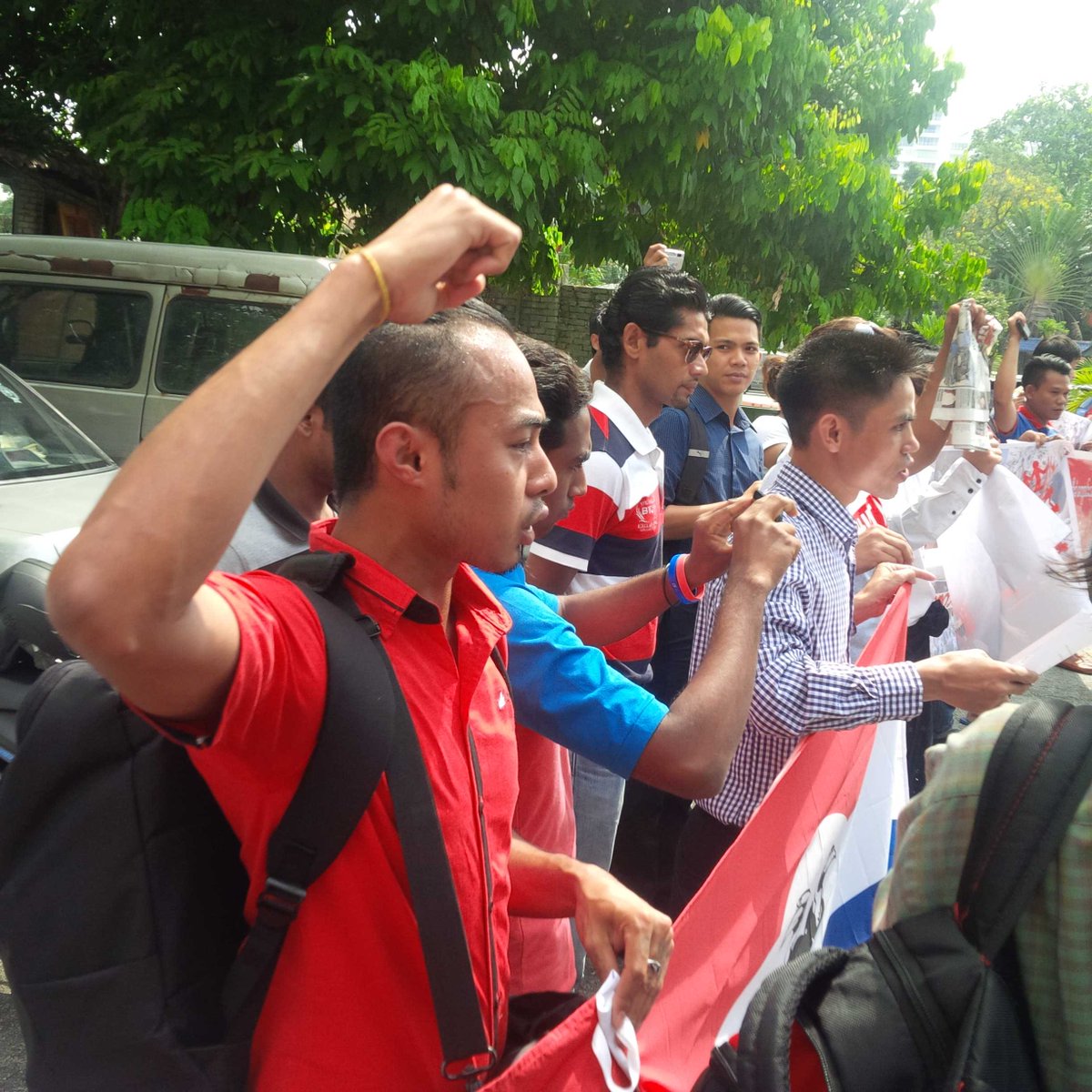
Myanmar groups in Malaysia protest against Letpadan crackdown


Myanmar Buddhist activists staged a protest alongside Rohingya Muslims in Kuala Lumpur, calling for an immediate end to the violent crackdown against student protesters in Myanmar

View image on Twitter

KUALA LUMPUR: Scores of Myanmar Buddhist activists have staged a protest alongside Rohingya Muslims in the Malaysian capital.

The Buddhist activists were calling for an immediate end to the violent crackdown against student protesters in Myanmar. This comes just a day before Myanmar President Thein Sein is scheduled to arrive for a two-day state visit.

Rohingya Muslims and the Myanmar Buddhist community do not usually mix in Malaysia where both groups have sizable numbers in residence. That is why the police and special branch were taking no chances when both groups decided to protest and hand over memoranda to the Myanmar government.

The Chin National Front group and the 88 Generation leaders' representatives were demanding an immediate release of the students taken into detention after clashes with police in central Myanmar. Over 100 students fighting for educational freedom were arrested in Letpadan as a result of violent clashes with the police.

"If (Thein Sein) could hear us, he should make the situation in Myanmar positive, and not handle it like in a dictatorship," said Alfred Aung Myin Myint from the Chin National Front.


The Rohingya community, too, was condemning the use of violence. There are some 80,000 Rohingya Muslims in Malaysia, mostly refugees. President Thein Sein will visit Malaysia on March 12 and they will be using the opportunity to call on him to recognise their basic human rights.


Mohammad Sadek, program coordinator for the Rohingya Arakanese Refugee Committee Malaysia, said: "We are part of Myanmar and we must have voting rights to support the government for the democratic process."

According to the United Nations High Commissioner for Refugees (UNHCR), there are over 130,000 Myanmar refugees in Malaysia and regardless of their ethnicity, many do not feel safe in Malaysia.
"We are not safe at all here, because we are foreigners, we are not documented people," said Alfred Aung Myin Myint.

Mohammad Sadek added: "We are also afraid of Malaysia's enforcement law. The Malaysia immigration penal code does not allow anyone to escape any country."

It is a plight that many in the Myanmar diaspora can relate to. They feel that Thein Sein’s self-styled reformist government is now letting the country's reforms slip backwards.

Many, like Yaw Han, the Chairman of the Chin National Front, still believe in pro-democracy leader Aung San Suu Kyi is their only hope. "We trust in her than anyone else in Myanmar because she is Aung San's daughter and we trust him alone." 

- CNA/by

Thursday, March 5, 2015

BRITISH PARLIAMENT ASKED TO HELP REFUGEES ON THAI BURMA BORDER


A delegation, advocating on behalf of refugees and displaced people from Burma took their cause to Britain’s Parliament in an attempt to highlight the affects of funding cuts on services to people in camps on the Thai side of the Burma border.


“As refugees, we are under tremendous pressure in the camps. There have been many reductions in services including cuts to healthcare, education, shelter, and food. We feel we are being forced to choose between being hungry in the camps or being forced to return and be abused in Burma. We desperately want a better choice”, said Naw Ta Mla Saw, Joint Secretary 1 of the Karen Women's Organisation.

The Karen Women's Organisation is a community-based organisation with over 49,000 members that provides its communities with education, health and social welfare. The KWO provides assistance for refugees and IDPs along the border areas.

In a media statement the delegation said it had met and spoke in Parliament with the All-Party Parliamentary Group for Democracy in Burma – “a unique opportunity for British Parliamentarians to hear directly from refugees on the border and organisations working on the ground providing assistance for these refugees.”

In its media statement the delegation said it planned to meet with “the Department for International Development Minister Desmond Swayne MP, officials from the Foreign and Commonwealth Office, Parliamentarians, NGOs, the Burmese community and members of the UK media.

Other members of the lobbying delegation included Ms Sally Thompson, executive director of The Border Consortium (TBC) and Luiz Kaypoe from the Karenni Refugee Committee (KnRC).

The delegation pointed out in its media statement that “it is important that refugees are not forgotten.” The delegation stated that the Burma’s peace process is still fragile and that despite ceasefires between the government and the ethnic armed groups conflict is still happening in parts of the country.

“At the moment, shifting donor focus away from the border is perceived by refugees as a form of coercion to return prematurely,” the delegation said in its media release.

A member of the delegation, Luiz Kaypoe, Secretary of the Karenni Refugee Committee said in the media statement.

“Our ethnic people want peace, but the Burmese government use peace to twist and kill our people. Sadly, the international community focuses only on the situation in Rangoon and Nay Pyi Daw, and ignores what’s going on in ethnic areas. We want our ethnic people’s voice to be heard”.

The KnRC is a grassroots organization that provides support to Karenni and other ethnic minority refugees from Burma currently residing in two camps in Thailand.

Ms Sally Thompson, the executive director of The Border Consortium said that it was important that funders stay committed to the refugees and displaced people along the Thai Burma border.

“We want donors to commit to stay with refugees through a sustainable return in the future.”

The TBC provides food, shelter, camp management and livelihood support for 110,000 refugees in Thailand and 120,000 Internally Displaced Persons (IDPs) in Burma.

www.bnionline.net