Friday, July 11, 2014

Why Malaysians should be worried about human trafficking


The sordid exploitation behind trafficking is not only morally unbecoming but is also a crime against humanity, says Syerleena Abdul Rashid.

Domestic workers – Photo credit: freemarket.my

Every year, on 20 June, the world celebrates Refugee Day – a day that commemorates the awareness of issues relating to the struggles and advocacy of refugee rights worldwide.

This year, on the same day, the United States government decided Malaysia was not living up to its promise to improve issues relating to human rights and downgraded our nation to ‘Tier 3′ status and subsequently, blacklisted Malaysia. Our country now joins the ranks of North Korea, Iran, the Democratic Republic of Congo and Gambia – a membership to a club no one desires and no one can be proud of.

The recent demotion also means that our country could face possible sanctions at a time when we really need robust policies to help drive our economy because at present, we are aware of how unhealthy things are, even if we are being told otherwise. In addition to the spate of negative press already highlighted in the international media, this recent testimony solidifies Malaysia as a human rights outcast, which is a huge embarrassment to everyone living on this soil and a great insult to the forefathers who created the Federation.

While most Malaysians appear to be apathetic about socio-political issues, the issue of upholding the basic values of humanism is extremely important as this can influence the outcome of our nation – whether we are able to develop ourselves and compete in an increasingly globalized world or if we are to regress and embrace tribalism as a way of living while our economy lies in ruins.

A majority of Malaysians still mistakenly equate human trafficking to prostitution, amongst other things, and this misconception was brought to light during a sex trafficking seminar held in Penang, earlier this year. Hence, it can be assumed that our government’s inactions may be a result of the very same misconception that the public seem to have.

Though it is not entirely clear why our government and other relevant policy makers fail to abide by international laws (relating to human rights to prevent human trafficking), one thing is clear. The attitudes towards human rights and civil liberties have been miscomprehended, intentionally or otherwise.

Human trafficking is best defined as a form of human trade in which people are unwillingly bought and sold for a number of depraved activities. People who are highly susceptible usually come from the lower income group, are illiterate or have very little education; trafficked victims may be women, men or children. But there is a growing trend towards targeting refugees.

The issues that surround trafficked individuals are not as clear cut as some might want you to believe. Situations that lead people into such horrific positions vary from a promise of better economic opportunity, political or religious persecution and even abduction. The results are usually dreadful, and the victims find themselves completely helpless and terrified.

This vicious cycle of abuse is worsened when there are no clear regulations to strengthen legal frameworks, no helpline or assistance once victims find themselve thrown into a system full of apathy and suspicion. Industries that go unchecked are unregulated and untraceable; they are therefore able to financially support a variety of debasing activities such as money laundering, drugs, prostitution and terrorism, to name a few.

Malaysia has been scrutinised in the past, and this led to the signing of the Asean Human Rights Declaration in 2012. This move, whether sincere or superficial, came during a tumultuous period of heavy criticism regarding the way the Malaysian government and authorities handled human rights involving trafficking survivors, undocumented foreigners and refugees. Victims of the country’s poor human rights record also included fellow Malaysians whose only ‘crime’ was that of holding different political beliefs.

Although the declaration promotes an impartial handling of individuals regardless of race, religion, political beliefs or nationality, there is a clause that allows leeway for a nation to implement policies based on whatever and however the governing elite sees fit.

Our country is a source of demand for cheap labour. Because fair labour audits are not widely practised and there are very minimal employment inspections, most companies are able to exploit human capital. For example, we sometimes see advertisements for hourly domestic maids, but many of us fail to see the harsh realities that go hand-in hand in this often exploitative sector. Most of these hourly domestic workers work more than the hours permitted by labour laws and are subjected to harsh working environments with very little rest or access to basic amenities.

Cheap labour affects the economy and influences the job market. The demand for cheap labour from unscrupulous companies (construction sites, massage salons, food and beverage outlets, etc.) may give rise to traffickers who want to profit from this and subsequently, will be able to supply such demand.

Traffickers who collaborate with agents may lull unsuspecting workers with ‘better’ job opportunities abroad and then take away their passports once they have arrived at their destination. Thus, funfortunate migrant workers fall into forced labour and servitude. They are forced to work for a measly amount to pay off their debts and are unable to free themselves from deplorable conditions because they fear that their lives may be in danger.

As a result, skilled and qualified Malaysians are often replaced by unskilled, cheap labour which is counter-productive to our country’s growth. Furthermore, with no proper background checks on past employment history or personal backgrounds, the origins of these workers (where they come from and how they got here) are unclear.

It seems more apparent these days that the idea of embracing human rights has been brushed aside by those who should be supporting it the most. In Malaysia, supporters who advocate such beliefs are labeled as infidels and ungodly and are thus subjected to conditions that guarantee the suppression of any forward-thinking opinions. This idea has also been drilled into the minds of our fellow countrymen and women; hence, we witness never-ending disputes and name calling.

Reports claim that at present, human trafficking generates an estimated profit of US$150bn a year, though one can safely assume that the actual figures are much higher. Additionally, the UN recognises human trafficking as the “second fastest growing criminal enterprise, behind only drug trafficking”.

Human trafficking destroys the legitimacy of commerce and undermines honest commercial institutions. Malaysia’s ‘wholesome’ image as a family-friendly tourism destination and as a credible location for businesses to invest is jeopardised as our country can no longer guarantee fair labour practices or civil liberties – two important pillars that underpin healthy progress.

The sordid exploitation behind trafficking is not only morally unbecoming but is also a crime against humanity. Pro-active policies and convincing methods must thereforce be implemented wholeheartedly to combat human trafficking if we are serious about salvaging our nation’s dignity and integrity. The horrors of human trafficking are limitless and no man, woman or child should ever be made to experience such horrific ordeals.

Travel Restrictions Tighten for Burmese Refugees in Thailand


By SAW YAN NAING

RANGOON — The Thai junta, which has been ruling the country under martial law since May 22, has reportedly stepped up restrictions on the movement of more than 120,000 Burmese refugees living in camps along the Thai-Burma border.

Speaking with The Irrawaddy on Tuesday, Saw Honest, chairman of the Mae La refugee camp, said those restrictions included a general ban on travel outside the camps and a curfew.

“Refugees are banned from leaving the camp to seek jobs. Refugees are banned from leaving their homes from 6 pm to 6 am,” he said. “Only those who have special conditions such as medical treatment or other emergency cases can travel, but need to seek official permission.

“Respective Thai security units at every camp informed us about the regulations. We are not allowed to go outside the camp, refugees have been warned not to engage in logging and drug dealing,” added Saw Honest, who oversees the administration of Mae La, the largest Thai border camp, where some 40,000 Burmese refugees reside.

“Those who violate the rules will be punished. And for those who repeatedly violate the rules, their names will be deleted from refugee camp [registries], and they will no longer be allowed to live in the camp, and they may even be deported back to Burma,” he added.

Saw Honest said refugees with special circumstances requiring travel outside the camps, such as for education or health reasons, were required to seek official permission from the respective Thai security units at the camps before traveling beyond their confines.

“We have a problem with the restrictions,” Saw Honest said. “But we can’t do anything now as it is the order of the Thai army. We may sort it out to ease the restrictions later because it is not a good time to do it now.”

He said the restrictions had been communicated to refugees after a meeting between local Thai authorities and community-based organizations in Mae La and other camps on Tuesday.

“We held a meeting and informed the refugees about the rules. The plan just started today. But we don’t know how long it will last, as they didn’t tell us. I think it might last until next election,” Saw Honest said. The Thai junta, which has branded itself the National Council for Peace and Order, has said it plans to hold an election in October of next year.

The orders come amid an ongoing reform program enacted by the junta that has included a sweeping crackdown on undocumented migrant workers that has forced more than 200,000 Cambodian laborers to return home. Hundreds of Burmese migrant workers have also been scrutinized, detained and deported back to Burma since early June.

The latest development is likely to affect daily life for tens of thousands of Burmese refugees, some of whom have lived in the camps for 25 years—a span during which Thailand has seen three coups. There are nine refugee camps spread across the Thai-Burma border.

Duncan McArthur, partnership director of The Border Consortium (TBC), a nongovernmental organization that has been providing humanitarian aid to the Burmese refugees for more than 20 years, told The Irrawaddy on Tuesday that Thai authorities were applying restrictions already on the books.

“TBC understands that the Thai district authorities have been ordered to enforce existing regulations more strictly, which will include restricting refugee movements outside of camps. Refugees with special circumstances will still be able to apply for permission to travel.

“District authorities in Tak province have called a series of meetings with UNHCR [UN High Commissioner for Refugees] and NGOs this week to clarify the situation,” McArthur said. “However, we understand that there will be no change in policy relating to the provision of humanitarian assistance to refugees.”

He said the TBC was not aware of any plans for Thai authorities to conduct identity checks at the camps. “Refugee status determination procedures have essentially been suspended since 2005, and we are not expecting official screening processes for unregistered refugees to resume any time soon,” according to McArthur.

But Ye Min, a Burmese refugee at the Nu Po border camp, claimed that screening, official or otherwise, would be taking place.

“They [Thai army] want to know how many people are real refugees and how many people illegally came to stay in the camp and lack proper documents,” he said.

Ye Min added that there were fears among the refugee population that those without proper documents, such as UN registration cards recognized by the Thai government, would be deported. Rumors were circulating that even UN cardholders would be subject to deportation or would have their status as a recognized refugee revoked if found traveling or residing outside the camps, Ye Min claimed.

Meanwhile, the UNHCR held a meeting on June 27 with Karen community-based organizations including the Karen Refugees Committee, Karen Women’s Organization, Karen Youth Organizations, and Karen Office for Relief and Development (KORD), seeking opinions from refugees about the ongoing peace process between the Burmese government and ethnic armed groups.

Asked about claims of impending refugee screenings, UNHCR spokeswoman Vivian Tan told The Irrawaddy on Tuesday that the UN refugee agency had not been informed of any such plan.

Led by Thailand’s Internal Security Operations Command (ISOC) and attended by representatives from four provinces including Tak, as well as NGOs, the UNHCR and other Thai authorities, a three-day meeting was held from June 17-19 in Mae Sot, Thailand, to discuss repatriation plans for refugees on the Thai-Burma border.

Over the last three years, the Burmese government and most ethnic armed groups have signed bilateral ceasefire agreements. Now, amid ongoing negotiations for a nationwide ceasefire accord, discussions among Thai authorities and aid groups on the border have turned to the eventual return of Burmese refugees to their homeland.

Thai authorities’ previously stated policy on the refugees is that they would be allowed to return to Burma on a purely voluntary basis.

McArthur said TBC was not aware of any change regarding that stance.

“TBC’s independent assessment remains that the conditions are not yet conducive for a voluntary return of refugees nor their sustainable reintegration in safety and with dignity,” he added.

TO BE RUN BY NGO, GOVT WON'T CARE! Soon a secondary school for stateless & refugee kids in M'sia


Secondary school education will soon be a reality for refugees and stateless children in Malaysia when the Institute for Democracy and Economic Affairs (Ideas) opens its academy in Kuala Lumpur by the end of this year.

To be called the Ideas Academy, the school is in collaboration with a Dutch NGO, Stichting Young Refugee Cause, and aims to provide high-quality education to youths aged 12 to 20 using the International Canadian Syllabus, for a minimal fee.

"We want to make education accessible to everyone. No matter what their situation is, we want to make it available for them," said Ideas Academy's general manager Trine Engskov.

"And we have to offer a programme that really matters. So when they come out, they will have something that really matters, that will work for them.”

The idea of the academy came about in December last year, after Ideas found there was a need to set up a secondary school for stateless and refugee children.

"There are many refugee community learning centres and they only offer primary education. So when they reach a certain age and level, they have nowhere to go.

"So we are trying to fill in the gap," Engskov said.

She said that the Canadian syllabus was being used as it was the most comprehensive one, without being "nation-specific".

"We're going to have students from many different countries. There will be Malaysian students and there will be refugee students who come from a wide range of countries and continents.


Ideas Academy's general manager Trine Engskov

"As it will be an international setting, the language in the school will be English. If possible, we will also be on the road for international accreditation," the Danish national added.

She said the biggest challenge in setting up the school was finding an appropriate building in the designated area, Pudu, leading to delays in opening the school.

"One of our biggest challenges is finding the perfect building for the school. Once we have that, we are set to go. And then, there is the finances part," Engskov said.

The Ideas Academy already has about 20 students waiting to sign up and it is expected to grow to 100 students in its first year.

"It is a four-year course, so our capacity will be about 400 students.

"We have been working closely with the UNHCR (United Nations High Commissioner for Refugees) and other NGOs to spread the word about the school and round up students," said Engskov, adding that they were in the midst of recruiting full-time teachers for the school.

"Because we are teaching Canadian syllabus, we are hoping to have some Canadian teachers who are Ontario-qualified and we are also looking for some local teachers," she added.

Besides regular education curriculum, the school would also organise programmes for the youths such as outings, workshops, movie nights and parties.

"We want to give them everything that other children have... that is normal for other children. So why should they be denied these things?

"We want to create a platform for students to be safe and be young. That is important for their confidence," she added. –TMI


Over 4,200 Lankans on UNHCR list in Malaysia

There are 4,280 Sri Lankan refugees and asylum-seekers registered with the United Nations High Commissioner for Refugees (UNHCR) in Malaysia.

They comprise about 3% of the 145,025 foreigners who have UNHCR cards as of May.

Most UNHCR cardholders in Malaysia are from Myanmar (134,430) while the rest are from Somalia, Syria, Iraq, Afghanistan and other countries. About 70% are men and 30% women.

Inspector-General of Police Tan Sri Khalid Abu Bakar said that of the 14 LTTE members arrested this year, seven were using UNHCR cards.

UNHCR spokesman in Kuala Lumpur, Yante Ismail, said the organisation was unable to comment on suspected Tamil Tiger leaders with UNHCR cards, adding that it was the body’s policy not to publicly comment on individual cases involving asylum-seekers and refugees.

“In principle, refugee protection is for those who are in genuine need of international protection when they have been forced to flee their countries.

“Refugee protection is not extended to individuals who have committed very serious crimes,” she said yesterday.

Yante said any enquiry into refugee status would involve a careful assessment of all relevant facts, through a fair process, to decide whether protection was required.

According to UNHCR Malaysia, registered refugees and asylumseekers could move freely as they were not in camps.

The organisation said refugees were unable to work legally, but had access to the informal work sectorand opportunities for self-reliance.

Refugees normally share living spaces in groups of 40 people or more in low-cost flats or housing areas.
Many also live near the construction sites or plantations where they seek employment.

According to a social worker who declined to be named, the Sri Lankan Tamil refugees started arriving in droves here some 10 to 15 years ago, seeking to move to other countries.

However, he added that they were made up of different “groups” who would snitch on each other to the authorities.(The star Online)

Burmese refugees banned from leaving camps in Thailand


By DVB 9 July 2014

Thailand’s authorities have banned Burmese refugees living on the Thai-Burmese border from leaving their camps, while they conduct a census to determine the exact number of refugees living in the country. There are nine refugee camps along the border and aid agencies say they provide relief to no less than 120,000 people.

Saw Honest, leader of Mae La, the biggest refugee camp in Thailand, said authorities have strictly warned its residents not to leave the camp and said they would punish those who do.

Anyone found in violation of the travel ban may face a series of punishments ranging from a week of labour or ration cuts to having their refugee status revoked, he said.

Residents who are staying outside their camps, including students and those working in nearby towns, have been ordered to return for the population count.

On Tuesday, a team of military officials and police officers began the census in the Umpiem refugee camp, which lies 90 kilometres south of Mae Sot.

“Officials have begun work to verify the number of people living in the Umpiem camp,” said camp chairman Saw Wahtee. “They came there at around 7am on Tuesday and gathered residents in one area together. Then they issued some papers to each person and told them to walk through a gate to another zone.”

“The Thai authorities said they just wanted to know the exact number of refugees in the country,” he said.

Recently, donor funding to the refugees has been cut and resettlement programmes terminated.

In June, a meeting was held in Mae Sot between the Thai army’s Internal Security Operations Command, regional commanders of border provinces, and NGOs that provide assistance to the refugees, to discuss whether it is time to begin preparing for the refugees to be repatriated.

No official decision was made.

Thailand and Burma Agree to Return 130,000 Border Camp Refugees 'To Their Homeland'


PHUKET: Thailand and Burma have agreed to ''facilitate the safe return'' of 130,000 displaced persons to their homeland, General Prayuth Chan-ocha said tonight. 

He also said the issue of the Rohingya boatpeople had been discussed with Myanmar's Commander in Chief of Defence Forces, General Min Aung Hlaing, in Bangkok this week.

''The gist of the meeting is that Thailand and Myanmar (Burma) will cooperate in helping displaced persons from fighting in Myanmar,'' the general said in his weekly national telecast.

He took charge of Thailand in a coup on May 22.

Details are likely to emerge in the next day or two about precisely what the two countries plan for the large number of refugees from Burma now living in Thailand.

''These people have been staying in temporary shelters with certain restrictions for a long time,'' the general said. 

''This has been a protracted problem. There are up to 130,000 displaced persons in nine temporary shelters in our country.

''Thailand and Myanmar will facilitate the safe return to their homeland.

''Additionally, other areas of cooperation include the nationality verification of the Rohingya, demarcation of borders in undisputed areas, not supporting resistance groups in their respective territories, as well as cooperation in energy development.''

He added that Myanmar officials had been grateful for ''measures to ensure the safety and better work environment for Myanmar workers in fishing vessels.''

It's not clear as yet what the general means in terms of returning the Burmese now living in border camps. 

Movement of the people living in the camps was restricted earlier this month. Some have lived in the camps for up to 25 years. 

The use by General Prayuth of the word ''Rohingya'' may prove controversial inside Burma where the Muslim minority does not have citizenship and are referred to as ''Bengalis.'' 

Violence in Burma - labelled ethnic cleansing by many - has driven an estimated 80,000 Rohingya to put to sea since mid-2012. 

Many of them are abused by human traffickers in jungle camps on their way to Malaysia. How so many Rohingya land in southern Thailand without being detected and intercepted remains a mystery.

Monday, May 12, 2014

Thailand as a regional haven for human trafficking


Kavi Chongkittavorn

The Nation May 12, 2014 1:00 am


Throughout the past five months, a total of 426 asylum-seekers from Central Asia landed in various parts of Thailand. These new arrivals were unusual and different from the Rohingya arriving in boats from the Andaman Sea, a pattern set over the past few years.

Thai authorities were perplexed by the Turkic-looking undocumented visitors, who were detained in Songkhla, Chiang Rai and along the Thai-Cambodian border. Last year, 88 were detained at Bangkok's immigration office. Just a few days ago a dozen more were apprehended. 

Various reports identified them as Uighur Muslims originating from Xinjiang, China. They had been smuggled overland to northern Thailand through a labyrinth of networks arranged by international traffickers. From Kunming, they were transported to the borders with Myanmar, Laos, Vietnam and Cambodia, attempting to enter Thailand. All would have a rendezvous in Songkhla, southern Thailand, before their journey would have ended with a border crossing to Malaysia, from where they hoped to go to Turkey. 

The recent influx of Uighurs to Thailand has been due to two unrelated developments. The exodus to Thailand is a new one, which comes about due to tighter border administration among members of the Shanghai Cooperation Organisations, especially those bordering China such as Kazakhstan, Tajikistan and Kyrgyzstan, which literally sealed off the traditional trafficking route.

Secondly, after the Malaysia Airline MH370 tragedy and suspicion of strangers, the Malaysian government has cracked down on foreign Muslim refugees, forcing them to flee into Thailand.

Among human traffickers, Thailand is known as a haven due to its easy access, the weak law enforcement and border controls. Authorities working in collusion with traffickers near and far ensure that their victims' illegal entries are carried out in systematic ways in various parts of Thailand. Prior to their arrival in the Kingdom, transit countries normally turned a blind eye to avoid future complications of having to deal with these asylum-seekers.

Those who have shown up in Songkhla, according to local officials, comprised women and children - each family has parents along with three-four children. Diplomats from the Turkey's and China's embassies recently met and talked with them, trying to determine their backgrounds. At the moment, they are under the care of the Thai government, pending confirmation of their identities. Thailand has sought assistance from the International Organisation of Migration, which has been helping the Rohingya refugees stranded here. 

Influx of the Uighur 

Muslims and other displaced persons in the South cannot be viewed in isolation because some have crossed over from Malaysia, where the demand for labour is very high. Human traffickers have used the porous Thai-Malaysian border to repatriate undocumented migrant workers from Myanmar, Bangladesh and Central Asia to the Thai border. Once they are found inside Thailand, they continue to be subject to exploitation by local officials and international human smugglers. Only the asylum seekers from North Korea receive better treatment. Once they arrived at the Thai border in Chiangsaen, Chiang Rai, they would immediately come under the care and protection of the South Korean government, which would accept their resettlement. As the Uighur Muslims continue to make their way to Thailand, the battle with human traffickers has taken a new twist. The US government will issue its annual Trafficking in Persons Report (TIP) in June with an assessment of the country's efforts to fight against human trafficking, especially involving the Rohingya Muslims from Myanmar. 

Last week, major human rights and refugee organisations urged Washington to punish Bangkok for not doing enough to combat human trafficking. Worse, they cited evidence of complicity between local authorities and traffickers.

Currently, Thailand belongs to the "Tier 2" watch list since the past four years. The pending report could have a devastating outcome if it is downgraded to Tier 3, with possible sanctions from the US government. In past years, Thai authorities have strengthened law enforcement and pursued trafficking cases vigorously.

Last year alone a total of 483 persons were prosecuted out of 386 trafficking cases, compared to 64 persons out of 38 cases in 2010. To Thailand's critics, it was too little too late.In addition, the ongoing domestic political turmoil rubs salt into the wounds because the Thai government has to cope with multiple external pressures in taking care of thenew arrivals and pressure for their forced repatriation. 

However, the plight of the Rohingya dominates the discourse on human trafficking internationally for the time being. Besides Thailand, Malaysia and Indonesia also suffer greatly from the influx of Muslim asylum seekers. Attempts to forge a regional approach with Myanmar and Bangladesh have failed. 

Since the 1970s Thailand has had a long history of settling nearly 3 million refugees and displaced persons from Vietnam, Laos and Cambodia. Now it hosts more than 4 million migrant workers, most of them illegal. Even though Thailand is not a party to the 1951 Refugee Convention, it cooperated with various UN agencies and foreign countries in those difficult decades. The time has now come for Thailand to sign the convention. Concerned Thai authorities, in particular the Ministry of Interior, are still hung up with a myth that such a deal would increase the influx of refugees.

The truth is displaced persons and refugees will continue to come to Thailand nonetheless. International criticism often targets Thailand for the unhealthy conditions and inhuman exploitation that illegal immigrants face, ignoring the refugee-producing countries. 

Thailand, like Pakistan and other developing countries, has to host large numbers of refugees relative to its economic base. The 1951 convention enables UN agencies and foreign governments to help defray unfair criticism and to determine the status of refugees and assist in repatriation and settlement. As of now, with increased asylum-seeker arrivals, Thailand should take more responsibility for determining the status of refugees.


WASHINGTON (Reuters) - Thailand should be liable to potential U.S. sanctions for failing to crack down on trafficking in migrant workers, a group of human rights and labour organisations said on Friday.

In a letter to U.S. Secretary of State John Kerry, 19 organizations, including Human Rights Watch and the American Federation of Labor, said Thailand "does not meet the minimum standards of the Trafficking Victims Protection Act, nor is it taking real steps to meet those standards."

As such, Thailand, although an important U.S. ally, should be downgraded to Tier III of the State Department's 2014 Trafficking in Persons Report, the letter said.

Such a downgrade would make Thailand liable to sanctions, which could include the withholding or withdrawal of U.S. non-humanitarian and non-trade-related assistance.


It would also mean that Thailand could face U.S. opposition to assistance from international financial institutions such as the International Monetary Fund and World Bank.

The letter to Kerry noted that Thailand had been placed on the Tier II watch list in the 2013 Trafficking in Persons Report, which cited "pervasive trafficking-related corruption and weak interagency coordination" that "continued to impede progress in combating trafficking."

"Nothing about this system has changed significantly in the course of the last year, and the government continues to be at best complacent, at worst complicit, in the trafficking of migrant workers from neighbouring countries to provide inexpensive labour for export industries," the letter said.

It cited a December 2013 Reuters report that showed Thai government officials sold hundreds of Rohingya refugees from Myanmar to human traffickers.

"The United States should make very clear its concern about the systematic abuse of migrant workers in Thailand, who produce products destined for the U.S. market," the letter said.

"Far from making credible efforts to fight trafficking, the Thai government has perpetuated policies that foster trafficking of migrant workers within its borders and deny them access to protection and redress," it said.

Last month, U.S. lawmakers called on the Obama administration to punish countries that do too little to fight human trafficking, including Thailand and Malaysia, and said Myanmar should not receive a waiver to avoid possible sanctions over its record.

Countries on Tier 2 for two years are downgraded to Tier 3 unless they receive presidential waivers, available for two additional years.

(Reporting by David Brunnstrom; Editing by Tom Brown)

Saturday, May 10, 2014

CROSSROADS: VIDEO STORIES OF MIGRANTS & REFUGEES IN MALAYSIA

Crossroads is a video advocacy project aimed at developing and strengthening the advocacy and documentation capacity of migrant workers, refugees, stateless persons, and their support organisations in Malaysia. It is a collaboration between EngageMedia and Citizen Journalists Malaysia.

Malaysia has the highest numbers of migrant workers in Southeast Asia. According to government statistics from July 2013, the country has 2.1 million registered migrant workers and an estimated 1.3 illegal migrant workers within its borders. This means one in three workers comes from outside Malaysia.

Workers without valid documentation are considered illegal and are often subjected to various forms of abuse – ranging from illegal withholding of salaries, to engagement in bribery, and rape. However, the reality of the workers’ situations are not widely known or reported in the media. Various negative stereotypes exist in a hostile climate in the host community.

EngageMedia believes that by supporting migrant workers to take the lead in telling their own stories through video, Malaysians will gain a better understanding of their personal experiences, in order to correct the stereotypes and foster a climate of tolerance. The workers will also have the necessary skills to use video for evidence and documentation as aid in advocacy. 


In the past year, we organised a total of 12 workshops in Klang Valley, Selangor, and Kota Kinabalu, Sabah. For the 15 participants which included Indonesians, Nepalis, Malaysians, and Burmese, we provided skills in storytelling, video advocacy, storyboarding, video shooting and editing, online/offline video distribution, and online subtitling with Amara.


A young migrant worker describes the challenges of living in Malaysia as an undocumented worker. Cupin, as he is fondly known by his friends, now lives in constant fear.


Cupin's Tale: Even Chickens Listen


Our participants came from various backgrounds, such as Karmadi (pictured top-right), who is an Indonesian migrant in Malaysia working in the construction sector. He made the time to attend all the training sessions despite his difficult work schedule, and recently purchased Malay-language books on photography to continue practicing around his various job-sites. He hopes that he “can use his new video and photography skills to do more than construction work”. In the video, Karmadi explains the hardships experienced by undocumented workers:

The authorities are not interested to know why the migrants are undocumented. They just want to punish them. No one wants to be an undocumented worker, but due to poor laws and enforcement, it gives agents a lot of opportunities to deceive desperate migrant workers.

The final videos produced by Karmadi and the other particpants were compiled into a DVD toolkit featuring 12 videos organised in five chapters according to the theme of migration they touch upon, namely, The 6P Programme, Support Systems for Migrant Workers, The Role of Law Enforcement Authorities, Seeking Protection, and Protecting Children. It also includes a Study Guide designed to give context to these videos for use in educational and advocacy purposes.


Bapak Petrus starts a school for children of migrant workers, building the house himself and using a syllabus of education that is similar to the one from their country of origin, Indonesia.


School of Hope


On 15 December 2013, a launch screening was organised in Kuala Lumpur, Malaysia, in collaboration with Tenanganita, a migrant rights NGO. The event was graced by its founder, the late Dr. Irene Fernandez, who reminded the 200 migrant worker guests of their fundamental human rights and stressed the importance of using video, among other means, as tools for evidence and documentation.


As project lead, I learned as much from the participants as I shared with them. These are not only stories of struggle in a foreign land, but also of resilience and hope for a better future. All the videos from the project and a PDF version of the Study Guide can be viewed and downloaded here.

Thailand ! Burmese Refugee Couple Allegedly Murdered by Thai Employee

Thailand, Myanmar, Burma, Mae La, refugees, crime

CHIANG MAI, Thailand — A Thai employer has been accused of murdering two Burmese refugees—a married couple—who were working on his farm in Thailand’s Tak Province.

The couple were owed three months of wages when they were killed on Wednesday night inside a hut in the cornfield where they worked, according to security officials at the Mae La refugee camp, where they lived.

Saw Hla Htay and Naw Paw Mu, ethnic Karen refugees from Burma, were owed more than 10,000 baht (US$300) for their labor on the cornfield in Kar Klo village, Tha Song Yang District.

Their bodies were buried on Thursday, as Thai police officers arrested and detained the suspect, according to Saw Shi Sho, a camp security official.

“The employer attacked them at about 9 pm. But two of the couple’s children were able to escape. They said their father’s face and their mother’s head had been badly hacked,” he said.

“The Thai police have arrested the murderer and detained him in Kar Klo village. The Thai police will pursue the case in accordance with Thai law. We need to let them handle it.”

The Mae La refugee camp houses more than 40,000 refugees and is the biggest Burmese refugee camp in Thailand. Many residents leave the camp to find employment outside in nearby towns, risking extortion or arrest by Thai authorities.

Murders have been reported inside and outside camps, but in many cases Thai authorities have failed to take action against suspected criminals. Family members of victims say they have not received compensation and have been ignored because they lack legal status in Thailand.

In September last year, a Karen refugee woman, Shwe Hla Aye was found dead outside Mae La camp after disappearing for two days. She was found wearing only a bra. Her body was buried without a proper investigation into the cause of her death.

Wednesday, May 7, 2014

Migrant workers worse off here than back home, say Asian MPs


BY JENNIFER GOMEZ
APRIL 16, 2014


(From left) Malaysian member of parliament Charles Santiago; Sabiha Nazir from the National Assembly of Pakistan; Cambodian member of parliament Phirum Keo; Malaysia Bar Council member Datuk M. Ramachelvam; and Zakir Hussain, member of Constitutional Assembly of Nepal, during the Advisory Committee for Asian Inter-Parliamentary Caucus on Labour Migration held at Petaling Jaya today. – The Malaysian Insider by Afif Abd Halim, April 16, 2014.An Asian parliamentary caucus on labour migration has called on Putrajaya to reveal details of MoUs it signed with nations who send their citizens to Malaysia for work, following reports of abuse and exploitation of migrant workers in the country. 


Nepal MP Zakir Hussain said his embassy officials told him that one Nepali death was recorded at detention camps in Malaysia every week due to starvation and limited access to healthcare. – The Malaysian Insider pic by Afif Abd Halim, April 16, 2014.


Nepal MP Zakir Hussain said his embassy officials told him that one Nepali death was recorded at detention camps in Malaysia every week due to starvation and limited access to healthcare.

"A total of 346 Nepalese nationals died here last year, with 52 deaths in detention camps.

"What I don't understand is how Malaysia has adequate laws on migrant labour but practises low standards of human rights," Zakir said at a press conference today.

The caucus, which is on a fact-finding mission to Malaysia, also accused Putrajaya of being a stumbling block to the finalising of the Asean Framework Instrument on the Protection and Promotion of Human Rights of Migrant Workers which has been in the works since 2007.


Klang MP Charles Santiago, a member of the caucus, said there is no reason for the MOUs signed between Putrajaya and participating countries to be shrouded in secrecy. – The Malaysian Insider pic by Afif Abd Halim, April 16, 2014.Klang MP Charles Santiago, who is a member of the caucus, said the government has signed MoUs with Bangladesh, Nepal and Indonesia, among others, but details of these were unknown.

"It appears that those who are familiar with the content of the MoUs are labour brokers, who use it to manipulate migrant workers. This is the common complaint among the embassies and workers themselves.

"There is no reason for these MoUs to be shrouded in secrecy," Santiago added.

One of the recommendations of the caucus is for Putrajaya to have a government-to-government approach in the recruitment of migrant workers in order to minimise recruitment costs and exploitation by outsourcing to companies and labour brokers.


The caucus’s findings said that in addition to violation of labour rights including poor wages and long working hours, migrant workers in Malaysia continue to live in poverty, leading Pakistan MP Sabiha Nazir to say that in some instances, the workers are worse off than they were before in their country of origin. – The Malaysian Insider pic by Afif Abd Halim, April 16, 2014.The caucus also found that in addition to violation of labour rights including poor wages and long working hours, migrant workers in Malaysia continue to live in poverty.

"In some instances, they are worse off that they were before in their country of origin," said Pakistan MP Sabiha Nazir.

According to Santiago, the Malaysian Labour Department declined an invitation from the caucus to attend the three-day meeting which ends today.


Mariquit Melgar, a representative from the Philippines, also called on the Malaysian government to practice fair play, saying that Filipinos working in Malaysia since the 1970s have contributed to the development and economy of Malaysia. – The Malaysian Insider pic by Afif Abd Halim, April 16, 2014.Mariquit Melgar, a representative from the Philippines, also called on the Malaysian government to practice fair play, saying that Filipinos working in Malaysia since the 1970s have contributed to the development and economy of Malaysia.

"In a session with our workers last month, they told us that they are not here to create trouble, and that they are doing their best, working long hours.

"They are not terrorists, they are not robbers, they just want better treatment and fair wages, is that too much to ask for?" she said.

In calling for recruitment of migrant workers to be conducted on an inter-governmental basis, Santiago said this would protect them from being exploited by outsourcing companies and labour brokers who were practicing "contract substitution".

"The Pakistan MP revealed that workers from her country had signed agreements with high wages and wonderful terms in Pakistan, but when they got here, these outsourcing companies would substitute their contracts, where they would end up with poor wages and bad living conditions.

"The MP said that workers she met here yesterday were practically crying over allegations that they had been cheated by these middlemen," Santiago said.

Bar Council's chairperson for migrants and refugees Datuk M. Ramachelvam said that what was needed was another amnesty programme following the failure of the previous 6P programme by the government, which was aimed at regularising undocumented migrant workers.

"In one 6P processing centre in Wangsa Maju, the agent was collecting about RM2,000 from each migrant worker and there were about 8,000 there applying, which means the agent collected about RM16 million.

"But not one of them got their documents," he said.

He called on Putrajaya to take charge of both the recruitment and amnesty programme to prevent migrant workers from being fleeced by third parties.

The Asian parliamentary caucus representing 15 countries also called on Putrajaya to practise strong political will in restructuring the management of migrant workers. – April 16, 2014.

Saturday, May 3, 2014

Teaching Filmmaking to Burmese Refugee Students Was An Eye-opening Experience


Azmina Karim - Bangladesh

We achieve success at Connecther.org when our stakeholders achieve success. Azmina Karim, a young woman from Bangladesh who is passionate about uplifting the voices of women and girls in her country, is one such stakeholder. The winner of last year's People Choice award for Connecther's Girls Impact the World Film Festival, she is also one of Connecther's first international fellows and she received a grant to travel to help uplift the voices of Burmese refugees in Thailand. The opportunity to help advance Azmina's dream to be a social advocate is beyond exciting. I admire her courage to fight for gender equality in her country and am so grateful that we can provide opportunities for her and our other fellows to thrive. Lila Igram, Founder, Connecther

Teaching Filmmaking to Burmese Refugee Students Was An Eye-opening Experience

By Azmina Karim

Edited by Elaine Robbins

It has been an exciting year since my short film, Because I Am a Girl, won the People's Choice Award at the Connecther's Girls Impact the World Film Festival in 2013. Supported by a grant from Connecther, a communication and crowd-funding platform that works to advance women and children globally, I taught filmmaking to migrant Burmese students at Minmahaw School. The school is in Mae Sot, Tak province, western Thailand, on the border with Myanmar, where 30,000 school-age Burmese migrant students live. The project enabled me to make an impact by sharing the voices of young refugees--a marginalized group who rarely have their voices heard.

Azmina (in green) spends her final day with Burmese migrant students in Thailand

My film was about domestic violence in Bangladesh, so I thought I knew something about fear and oppression. Alas, nothing prepared me for the heartbreaking stories I heard from my students as they wrote about their lives in their journals for my creative writing class. One student expressed the anger he felt at the Burmese military when he described how his village was burned and people lost their homes. Another recalled how she and her mother had to sell bread everyday and walk for miles to nearby villages, so they could earn enough money to buy food. "Sometimes I couldn't walk any further, she wrote, "because I was hungry and starving to eat something. But I had to; otherwise, my family wouldn't have enough money to buy their meal."

Working with co-teacher Jonathan Birtwell, we asked the students to investigate the most pressing issues affecting Burmese migrants. They came up with several topics: selling of young daughters, child marriage, and a lack of educational opportunities and health facilities faced by Burmese migrants living in Mae Sot (films can be seen here: Burden or Boon, Out of the Frying Pan & Sex-trafficking, Modern Day Slavery in Thailand). To follow up, we conducted interviews with young Burmese girls who got trafficked along the Thailand-Myanmar border. Most of the girls we talked to revealed that they had been given false promises of getting a decent job with a high salary.

When they arrived in Mae Sot, however, they were forced to work as sex workers. Due to the social stigma associated with sex workers, they were reluctant to go back to their families and lived miserable lives for years. The students also learned about the lives of Burmese migrants in Thailand, especially those living in the refugee camps. On a positive note, they found organizations that work for the betterment of refugees, and one group of students focused their work on an organization that helps Burmese women living with HIV.

As I got to know my students better, I started to understand more about the reality of their lives as refugees in Thailand. They lived in constant fear and could not move around easily because getting caught by the police would mean having to pay a huge bribe to be set free. Once, a sex worker we interviewed asked us to take her to the hospital because she was having severe shoulder pain. However, on the day we showed up, she refused to go with us to the hospital for fear that she might be arrested without an ID card.


In the end, our students produced three revealing documentaries about sex trafficking and the plight of Burmese immigrants in Thailand. This project was particularly very challenging for the students, as this was their first time to conduct interview and field research work. It offered an opportunity for them to actualize what they had learned in the classroom and use it to give back to their community.

For me, getting to know these students was the most eye-opening part of the experience. Despite the hardships they carried in their hearts every day, they were always full of life, and they displayed warmth that melted my heart. Their positivism seemed to lighten their suffering. They asked me many questions about the world and were so appreciative about my effort to teach them something new. When I spent time with them, life seemed just right. While my students found their voices, I found a new appreciation for life.

Azmina's short film Because I Am a Girl, a powerful indictment of domestic violence in Bangladesh, won the People's Choice Award at Connecther's Girls Impact the World Film Festival 2013. She is a research study coordinator at the Asian University for Women, where she is currently working along with other principal investigators researching the effects of women's education and employment on gender relations in the family in South and Southeast Asia, a project funded by the Ford Foundation.

The Girls Impact the World Film Festival is an initiative of Connecther, co-sponsored by the Harvard College Social Innovation Collaborative and co-directed by Ara Parikh, Kerry Hammond and Lila Igram.

Tuesday, April 29, 2014

Myanmar refugees in Malaysia: confronting inhumanity – Rama Ramanathan


Mankind’s capacity for acting inhumanely has been much on my mind.

Refugees are asylum seekers, people who flee persecution in their own lands. Why do so many flee Myanmar? The International Rescue
Committee’s report “In Search of Survival and Sanctuary in the City: Refugees from Myanmar/Burma in Kuala Lumpur, Malaysia December 2012” gives the reasons:

Forced labour/portering (25%); human rights abuses (15%); to escape arrest (12%); lack of work opportunities (8%); violence/attacks by the government (8%); to join family/get married (6%); other reasons (26%). 

One refugee summarised:

“The reason we leave is because of human rights abuses. All of our belongings are taken away from us by the government; we are forced to porter for the army; our women have been raped and forced into marriages; our villages have been burned and our people killed. The government has taken everything from us. We have nothing.” [Page 8]

Other responses explain what is meant by “we have nothing”:

“Before the soldiers arrive, everything belongs to the village; but after the soldiers come, everything belongs to them. They take everything.” [Page 39]

“The government took our land to expand their military barracks in Arakan. Without our land, we could no longer farm. They told us we had to work for them to build their camp. We were forced to work until we completed the project. If we could not work, they forced the women in our family to work.” [Page 39]

When the hardships they were subjected to in Myanmar became intolerable, when their lands, homes and businesses were taken from them and they just couldn’t take it anymore, they decided to risk their lives and undertake the journey to Malaysia.

The top 3 ways they came to Malaysia were: by foot (28%), by car (20%) and by boat (16%). Their journeys were arranged by "agents", and they didn’t know the details of the route, despite paying between RM1,500 to 5,000 per person. [Page 41]

When they arrived in Malaysia, was their situation better? The research found:

“Just over 30% of the sample reported experiencing an abuse in the workplace, with non-payment and partial payment of wages being the most frequently reported problem.

Out of 311 respondents, 80% reported not receiving wages for work completed or only receiving partial wages.

The second most frequently reported problem was verbal abuse (42%), followed by on-the-job injury (15%), dismissal without reason
(15%) and physical abuse (6%).”

When the respondents were asked what they most needed, the top 3 responses were:

Information on resettlement and registration (40%), especially the UNHCR (United Nations High Commission for Refugees) Card which confers a variety of benefits including lower likelihood of being arrested and higher likelihood of being treated humanely by employers.

Assistance when they are abused (15%). Food, particularly to address malnutrition of children.

I am a sceptical reader and listener. For instance, outrage welled up within me last week when an “expert” Kundalini Yoga instructor
authoritatively claimed on BFM radio that our bodies take one day to digest vegetarian food, but take three days to digest meat.

I have spent much of my career assessing research for the purpose of making claims. I will vouch for this IRC report. Because of the
research methodology which was adopted, and despite the limitations inherent to conducting surveys in the informal sector of any society, I believe the research findings are reliable.

Despite the share of voice the Rohingya have in the media – and I don’t mean to underplay the neediness of the Rohingya – it is worth noting the ethnic composition of Myanmar refugees in Malaysia:

“... the sample generally followed the targeted proportions for each ethnic group, with the ethnic Chin comprising roughly 45% of the sample; Burma Muslim, Karen, and Kachin altogether comprising roughly 40% of the sample; and Arakan, Karenni, Mon, Shan, and Rohingya comprising 15% of the sample.” [Page 35]

Ah, yes. Ethnic composition. This is one of the most troubling things about human nature. Our grasping at our ethnicity for our identity poses great challenges for creating a nation, especially one like Myanmar where there are upwards of 135 ethnic groups. Each group values its history and wants to maintain its identity, even as refugees.

In Myanmar, citizenship depends upon ethnicity. This is article 3 of the Burma Citizenship Law (1982):

“Nationals such as the Kachin, Kayah, Karen, Chin, Burman, Mon, Rakhine or Shan and ethnic groups as have settled in any of the
territories included within the State as their permanent home from a period anterior to 1823 AD are Burma citizens.”

Members of other ethnic groups may aspire only to the status of “associate citizens” or “naturalised citizens”. Persons with such status – some of whose roots in Myanmar go back several centuries – have limited access to freedom of expression and educational and electoral rights (International Bar Association. Rule of Law in Myanmar: Challenges and Prospects, page 27).

Since Chin, Kachin, and Karen are entitled to full citizenship in Myanmar, why are they fleeing Myanmar? Note the religious identification of the 1003 refugees in the sample:

“In terms of religion, the majority of the respondents are Christian (65%) with a minority belonging to the Buddhist (18%) or Muslim (16%) faiths.” [Page 35]

Many flee Myanmar because of the challenges of ethnicity: except for the Rohingya, the other ethnic groups in the list all have their own insurgent armies. Estimates of their troop sizes range from 600 to 30,000, with a total of 45,000 “insurgents” (see Medha Chaturvedi, Myanmar’s Ethic Divide: The Parallel Struggle). They flee because they don’t want to be "Burmanised" and “Buddhicised.”

What happens when a refugee becomes sick or is among the 5% (!) who are injured at work? One refugee who was treated for a broken leg said that when the hospital discovered he couldn’t pay, they removed the pins they had put in.

Muslim refugees experience higher rates of emotional distress. This is probably because they are excluded from resettlement: they were supposed to be integrated into Malaysian society, but this has not happened and seems unlikely.

The report reveals much more, eg the cramped and dangerous places the refugees live in; the problems of youth and children; how they organise to help themselves; how they avoid detention by the authorities (some police have learned to say “give me money” in
Burmese); their average income; their passion for sending money home; Malaysian and other groups who seek to help them, etc.

I encourage you to read the full report – and the Messiah’s story of the Good Samaritan.

Inhumanity is everywhere. But there are also those who respond humanely. – April 28, 2014.

* Rama Ramanathan blogs at write2rest.blogspot.com.

Saturday, April 19, 2014

Committee formed for UNHCR card upgrade


ALOR GAJAH: A high-powered committee has been formed by the Home Ministry to address the problem of forgery involving the United Nations High Commissioner for Refugee (UNHCR) card among illegal immigrants particularly the Myanmars in Malaysia.


Deputy Home Minister Datuk Dr Wan Junaidi Tuanku Jaafar said the committee which was led by the ministry's secretary-General Datuk Seri Mohamad Khalid Shariff will be formulating the best approach on how to upgrade the existing UNHCR card issued to refugees in the country.

He said Home Minister Datuk Seri Dr Ahmad Zahid Hamidi had ordered the committee to hold a meeting with the UNHCR officials as soon as possible.

"During my discussion with the UNHCR two months ago, they admitted that there are forgery cases involving the UNHCR card.

"In that regard, the ministry had decided that it is about time the existing card to be digitised," he told reporters after visiting the Machap Umboo Immigration Detention Centre near here today.

Wan Junaidi said the proposed new card will be fitted with electronic chip that will enable the authorities to determine whether the card is genuine or fake.

He said at present the authorities such as the police, immigration and national registration department personnel had difficulty to ensure the authenticity of the UNHCR card when conducting inspection in operations.

"In the ongoing operations to flush out illegal immigrants, the personnel had to rely on their naked eyes only to determine whether the card is genuine.

"This has became a problem for them," he added.

It was reported that during a crackdown against Myanmar nationals following clashes between Myanmar Muslims and their Buddhist counterparts in Klang Valley last year, it was discovered that 307 of the 1,054 Myanmar nationals rounded by the authorities had fake UNHCR
cards and documents.

On another matter, Wan Junaidi said the ministry was looking for ways to address the problems of infectious diseases involving foreigners in prisons and detention centers in the country.

He said a meeting to discuss the issue will be held early next month involving representatives from the Prison Department, police, immigration and Health Ministry.
"I also would like to advise Malaysian employers to avoid taking illegal immigrants as workers, especially in food-related industries.

"This to avoid infectious diseases such as tuberculosis being spread by the foreigners to the public," he added.


Wednesday, April 16, 2014

Burma Soldier's siblings living in limbo

By Ellie Bogue of The News-Sentinel
Tuesday, April 15, 2014 - 6:51 am

Myo Myint, known for his story in "Burma Soldier," is looking for a little help.

After the documentary, about his life as a soldier who was imprisoned for fifteen years after supporting the democratic movement in Burma, was released in 2011, three of his siblings who still lived in Burma were forced to flee the country as the government began to harass them for their brother's pro democratic stance.

Win Myint, Swe Zin Aye and Me Me Aye are currently living in the Umpiem Mai refugee camp. They are out of Myanmar, but they are caught in limbo as the the US Department of State's Bureau of Population, Refugees, and Migration has ended its refugee relocation program from those areas and the Thai government has stopped the registration process for refugees.

Nic Dunlop co-directed the HBO Emmy-nominated film "Burma Soldier," the story of Myo Myint and his life as a Burmese soldier turned activist/political prisoner. In a recent email interview with Dunlop, who lives on the Thai border, he said the three had hoped they would be resettled with the rest of the family in the US.

“Despite the fact that they clearly meet the definition of political refugees, they seem to fall beneath the cracks here in Thailand and remain vulnerable and the situation has stagnated. Thailand has never ratified the 1951 Refugee Convention and so does not recognize any of the people in these camps as refugees (there about 140,000 of them in camps here). The fate of these people, I'm told, resides with the Thai government,” Dunlop said.

The Thai government said Myo Mint has stopped the registration process for refugees, and the U.S. State Department has told him there is nothing it can do without this.

“When I was in the refugees camp, the UN, the U.S. and other human rights organizations helped us. I hope now they can help them too,” Myo Mint said.

Myo Myint said his three siblings fled the country so quickly that they took no passports or documentation with them. If they try to reenter Myanmar now, they would face a minimum three-year prison term for crossing the border without documentation.

Myo Myint, who became a U.S. citizen last fall and lives on the edge of Fort Wayne's far south side, said he cannot sleep nights thinking about his family who were forced to flee the country because of his role in the documentary.

A few years ago their was talk of disbanding the Thai border refugee camps and sending the remaining refugees back to Myanmar, but Myo Myint said there is nothing for them to return to. Many have lived in the camps for three decades. The areas where they once lived in villages has been heavily land-mined.

Myo Myint said although the current government leaders say they are moving towards a democratic government, they are simply the old regime, no longer dressed in their military uniforms. There is still heavy fighting going on in ethnic areas of Myanmar

“It is just window dressing. There are still political prisoners in the prisons,” Myo Myint said.

Last year when he was in Washington attending a conference, he visited U.S. Sens. Dan Coats and Joe Donnelly and U.S. Rep. Marlin Stutzman to plead his case. He hoped they could get in touch with the State Department to ask for help. A couple of weeks ago he and 20 some of his acquaintances sat down and wrote letters to the three hoping the more people who contacted them, the more they would try.

Now Myo Myint is reaching out to people in Fort Wayne who would be willing to send letters of support as well. Anyone interested in writing letters can get in touch with him at myomyint63@gmail.com.

Wednesday, April 9, 2014

Parliament: Malaysia ‘most humane’ to refugees, says Shahidan


KUALA LUMPUR: Minister in the Prime Minister’s Department Datuk Seri Shahidan Kassim maintained that the Government was “most humane” to Rohingya refugees although it has not signed the United Nation convention.

In response to a supplementary question in Parliament by Nasrudin Hassan (PAS-Temerloh), the minister said the Government would not forcibly send the refugees, who own proper legal documentation to go back to their countries.

There are 132,187 refugees with United Nations High Commissioner for Refugees (UNHCR) cardholders in the country.

“We will not send them back unless they are willing to do so. It is not our policy to send them back where their lives would be in danger,” he said on Tuesday.


He added that the Government had also borne the cost of sending back the refugees who had no proper legal documentation in the past.

“Whereas, the cost should be split in half but in the end it was Malaysia who paid everything. That is humanity,” he said.

He added the refugees were given proper access to education, food and accommodation through the help from non-governmental organisations.

Although the government was concerned with the plight of Rohingya refugees, he said it could not grant each individual with special passes to allow their stay in the country.

“There are about one million Rohingya people there, if we do that, all of them would want to come here.

“That is why we are holding to international principles that only those with UNCHR cards are allowed to stay,” he said.

Tuesday, April 1, 2014

Refugee family begins to adjust

Dim San Lian talks about what is different in America compared to Burma.

After seven years of waiting, Pau Thawn Kim and his family were granted access into the United States.

Kim’s family, Burmese refugees who were settled in a refugee camp in Malaysia, have lived in Battle Creek a month. With the help of Lutheran Social Services of Michigan, the family of five is living in an apartment and seeking employment; but they’re still unaccustomed to American culture.

“I think people don’t realize what it means to be a refugee,” said Kathryn Giroux, a job developer at LSSM. “It takes a lot of courage and a lot of strength to come here with absolutely nothing except one suitcase, maybe. They’re just trying to start over, rebuild their lives in a foreign country that’s not their native language. It’s pretty difficult.”

Every week the agency aids new refugee families in their transition to life in Battle Creek. Most refugees in Battle Creek are Burmese who traveled through Malaysia because they were in fear of being prosecuted for their Christian beliefs. Other refugees have fled their home countries because of war or fears they’ll be prosecuted over their political ideology.

Upon arrival into the United States, refugee families are greeted by LSSM with an interpreter and a culturally appropriate hot meal. They are taken to their new home and spend the next month registering for Social Security, childcare, school, work and whatever else they may need.

“Within the next day the translator comes back to make sure that they are situated in their home,” Giroux said. “Then it’s within the first five days they have their cultural orientation and that goes from general safety to calling 911 in case of emergency, what to do in case of a fire, things like that.”

Giroux said the orientation only lasts about an hour or two and families are given information on English as a Second Language classes and employment.

A stipend of $925 is given to the families for each family member to be paid out over three months. They are provided public assistance to sustain them until they are able to find employment. When the families arrive their homes are already structured with a few furniture pieces and a new mattress.

Fire At Mae La Refugee Camp

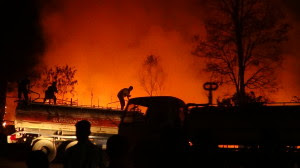
A fire broke out in Zone B Section 4 and 5 at Mae La Refugee Camp on the Thai Burma Border in Thailand’s Tak Province at March 24 around 9.30pm.


Mae La Fire March 24 (Photo: KIC)

A Karen News reporter, at the camp spoke to a camp resident, Saw Hla Win, who was close to the fire when it broke out.

“We were asleep. Most people were in bed. We heard the camp announcement and people screaming. We just grabbed the baby and ran,” Saw Hla Win said.

Saw Hla Win noted that flames had quickly ripped through the bamboo refugee homes.

“It started near the main road. It’s hard to estimate how many houses are burning, but I guess it’s at the very least 30 houses are destroyed”

Eyewitnesses also said there is a possibility a warehouse storing materials for refugees may have been partially destroyed by the fire.

By 10.10 pm the camp residents and a local Thai fire truck had the fire under control.

According to Thai environmental officials Tak Province is currently one of the worst affected regions plagued by forest fires.

Fires have been a constant and recurring danger in Thailand’s nine refugee camps, where almost 130,000 refugees live. The homes of camp residents are made of wood or bamboo and roofs are covered with dry leaves.

In February 2012 a fire in Umpiem Mai refugee camp destroyed more than 1,000 homes affecting 4,400 refugees, while in December 2013 a fire destroyed approximately 120 homes in Thailand’s largest refugee camp, Mae La, leaving 600 refugees homeless. Later that year, in March, a fire in Ban Mae Surin refugee camp killed 37 refugees.


Nineteen huts were razed to the ground and 31 demolished to prevent a fire from spreading at a refugee camp on the Thai-Burmese border on Monday night, a camp official has confirmed to DVB.

According to Saw Tha Khe of the Mae La camp committee, no casualties have been reported.

“The fire broke out in Zone B at 9pm due to a candle,” he said.

Fire engines arrived 30 minutes later and the fire was under control around 10 pm, he said.

Nearly 300 people are now homeless and are taking shelter with relatives and friends in the camp, which is mainly made up of ethnic Karen refugees.

With thousands of wooden and bamboo huts situated in close proximity, Mae La is no stranger to fires. Blazes have caused fatalities and damage in April 2012 and December 2013.

Mae La refugee camp is the largest of the nine official refugee camps along the Thai-Burmese border with nearly 40,000 residents.

UNHCR offices in Malaysia neglecting Pakistani Christian refugees’ cases

Karachi: March 24, 2014. (PCP) According to reports received by Pakistan Christian Post from Malaysia, the United Nation offices of Human Right and Refugees are providing priorities to cases of Muslims from Myanmar, Syria and from other Islamic countries but causing unnecessary delays in cases of Pakistani Christians who fled from Pakistan after rising violence and persecution against them. 

The report indicates that when Pakistani Christian reach Malaysia, the UNHCR giving them time of two years for first interview to register them as refugee and again two-three years for final interview while Muslims from Myanmar, Syria and other Arab states are given time of months for first interview.

The Malaysian police consider all refugees as un-registered and illegal until they not go through first of initial interview which complete UNHCR registration, so, considering Pakistani Christian as illegal in Malaysia, harass them and make their life miserable.

Dr. Nazir S Bhatti, President of Pakistan Christian Congress PCC has expressed grave concern on handling of cases of Pakistani Christian refugees by offices of UNHCR in Malaysia, Thailand, Singapore, Hong Kong and Sri Lanka.

Nazir Bhatti said “PCC urges Secretary General Ban Ki Moon of UNO to direct UNHCR to adopt same standards to deal with cases of Muslims and Christian refuges in South and South Eastern countries”

PCC Chief also appealed to EU countries to accept Pakistani Christian refugees as they are awarding permanent residencies to Syrians and other Muslim states migrants.

Dr. Nazir Bhatti appealed to International Donor Agencies and NGO,s to step forward to help Pakistani Christian refugees stranded in Sri Lanka, Malaysia, Thailand, Singapore and in Hong Kong who are suffering with their women and children while waiting from years on decision on their cases with UNHCR without any support.

http://www.pakistanchristianpost.com/

Miliband puts focus back on refugees


David Miliband, the former UK foreign secretary and president of the International Rescue Committee, has urged international donors and investors to ensure refugees living in Thailand are not forgotten amid an increase in engagement with the Myanmar government.

Mr Miliband was speaking at the Foreign Correspondents Club in Bangkok on March 19 after a two-day visit to camps on the border. He said it was important that Myanmar people displaced in Thailand, some of whom left the country more than 30 years ago, are not overlooked. He added the choices refugees make about whether they return to Myanmar would “shape the country”.

“Amid all the change in Myanmar, Burma … this woman [in the camp] said to me, ‘Don’t forget about us.’ And that is a really important message to take away. It would be a double tragedy if the people displaced from Myanmar, Burma, who are now here, are forgotten,” he said.

His comments come at a time when funding is being cut to aid organisations working with Myanmar refugees in Thailand, which they say has affected their ability to provide services.

Mike Bruce, a spokesperson for The Border Consortium (TBC), said that in 2013 the consortium had to transition to a “needs-based rations distribution system, driven largely by cuts to funding”.

“These cuts necessitated the restructuring of refugees’ rations whereby the standard monthly rice ration was cut,” he said.

“While TBC was able to ensure that children and the most vulnerable households do not have their rations reduced, most households are having to cope with a reduction in their rations.”

There are currently about 120,000 refugees living on the border.

While observers have reported a “slow trickle” of refugees returning to Myanmar following recent political reforms, people are still arriving in the camps and Mr Miliband said the majority of refugees do not feel it is the right time to return.

He said “each and every one” of the people he met in the camps had expressed “uncertainty” about the future of the country and “to what extent minority rights would be protected”.

“Quite a number of refugees have been back to see how things are but the access to [basic services such as safe drinking water] are very, very challenging in that part of Myanmar,” Mr Miliband added.

Mr Miliband said he believed that humanitarian efforts were as important as political reform and new investment if Myanmar is to progress successfully. He said, “The advocacy I would make is that we need joint programming on both sides of the border.”

While Mr Miliband declined to comment on what the Myanmar government could do in terms of policies to improve the situation for returning refugees, Mr Bruce said there are many areas that need to be addressed.

“[T]here needs to be real progress on security and justice issues in the South East, issues regarding land ownership and seizures needs to be addressed, infrastructure need to be dramatically improved, and land mines need to be cleared,” he asid.

“There needs to be a durable, lasting peace process, and troop movements throughout the region needs to be reconciled. Ultimately, it is important to note that any framework for return emphasises that return is voluntary, and in conditions that ensure dignity and security.”

Mr Miliband said the focus should be on making choices as “open and effective” as they could be for displaced people when it comes to the possibility of voluntary return.