Wednesday, September 3, 2014

Exiled Karen community condemns Thai ‘voluntary repatriation’ plan

Karen refugees, many who fled from the 60-year-long civil war between the Karen National Liberation Army and the Burmese government, may be sent back to their home country with all but one camp being dismantled. Asia-Pacific Journalism reports on the controversial move.

Pacific Scoop:

Report – By Johan Chang

The Karen and other ethnic minorities living in refugee camps provided by the United Nations High Comission for Refugees are facing “voluntary repatriation”.

The current Thai government led by the National Council for Peace and Order (NCPO) after a coup d’état in May and under martial law, are pushing for the removal of refugees.

Thailand’s Ministry of Foreign Affairs has stressed in a statement that the government is “to prepare for a safe return in the future in accordance with humanitarian and human rights principles”.


While the discussion contained no specific timeframe, UNHCR has already drafted planning figures to assist with the repatriation.

Cicilia Dwe, a first-generation Karen-Kiwi, arrived in New Zealand with her family through the UNHCR refugee programme provided in 2001.

She was in the second wave of Karen refugees to be accepted by the New Zealand government.

She believes the Thai government’s proposal is untrue and a violation of human rights.

“They say it’s ‘voluntary repatriation’,” she says.


Cicilia Dwe (front row, third from right) and students from the Refugee Youth Action Network. Image: RYAN

“So if they go against what’s been said, their goals or their rules, then they’re not keeping their promise.”

In a trip to the Tenth Karen Unity Seminar in Thailand held in late May, the 24-year-old came face-to-face with the long struggle for freedom that has held her people in turmoil for the last 60 years.

According to information from UNHCR, the current conditions for voluntary return are not favourable, and the agency has neither put in place a plan for repatriation, nor promoted return.

The refugees, many who flee from the 60-year-long civil war between the Karen National Liberation Army and the Burmese government, are proposed to be sent back to their home country with all but one camp being dismantled.

The series of nine refugee camps currently line the Thailand-Myanmar border, the largest of which is Mae La, home to more than 40,000 refugees and winds along the western Thailand mountain ranges for 184 hectares.

It is estimated that about more than 120,000 Myanmar refugees reside in these camps, which were first established in 1980.

Refugee camps
Considered by refugees to be the last bastion of safe haven in the region for ethnic minorities within Myanmar, it is mostly populated by refugees from the Kayin (Karen) state.

According to statistics from the UNHCR, some 66.5 percent of the refugees are Karen.

The camps provide medical and educational services, as well as providing a stable living situation that allows them to raise their families in relative peace.

For Dwe, it provided a fond multicultural experience, interacting with other children of the various minorities there, but the over-arching threat of oppression loomed.

“I didn’t experience much [oppression], fortunately for me,” she said.

“Obviously my sister, my older siblings, and mom and dad have a different experience to mine.”

Dwe was quickly moved by the UN with her family to New Zealand, in the second wave of Karen refugees that landed in Auckland in 2001.

Yet camps such as Mae La are not as promising as many refugees had hoped. While many, under a United Nations initiative, have been relocated to partner countries, more have been there for all their lives.

Some of the refugees have lived in these camps for as long as the camps have been operational. Many have grown up as children within the compounds, and are now married with their own children and are still there.

Furthermore, travel restrictions have been put in place, making those who seek to supplement their income outside of the camp fearful of their future.

Basic necessities such as rations are becoming increasingly scarce as donor funds dwindle, and without more income they may face the possibility of starvation.

Yet to travel outside of the camp can mean trouble for the refugees if they are caught, as refugees fear they will be either deported or losing their refugee status.

Inside Myanmar
For many of the Karen who have come to the camps, going back in to Myanmar would be their worst nightmare.

Reports from UNHCR has shown in January 2014 there were 372,000 internally displaced persons within Myanmar. “People are very afraid for their lives,” Dwe says.

“They have no homes . . . they experience more suffering. There’s no help or support. Nothing education-wise or health clinics.”

In a short documentary called Against All Hope, produced in 2009, many of the subjects interviewed told of forced labour and sexual slavery carried out against the Karen.

One interviewee spoke of workers who were chained during the middle of the night to prevent them from running away; those who do were shot on sight, and most were worked to their deaths.

“I can name it. Forced relocation, forced labour, child soldiers, using rape as a weapon, and using all sorts of persecution against the Karen people,” one man said.


Kyaw Hsu Mon … atrocities have decreased. Image: Del Abcede/PMC

Yet such atrocities have decreased, according to Kyaw Hsu Mon, a senior journalist with The Irrawaddy.

“Around that Thai-Myanmar border, the numbers of refugees are getting less. The government and the Karen have come to a ceasefire agreement,” she said.

Kyaw believes that the decrease of violence has come with a change in government strategy, and the opening up of the country to the world.

However, Dwe believes differently. As the current negotiations are for the possibilities of a ceasefire, she thinks it’s just a political move from the Burmese for show.

“We’ve been fighting 60 years to finally get to a ceasefire negotiation,” she says.

“They said, ‘when we sign the ceasefire, we’ll leave the boundaries’ (of the Karen State). But that’s not true – they’re still there.

“We are not free.”

Johan Chang is a Postgraduate Diploma in Communication Studies student journalist on the Inclusive Journalism Initiative (IJI) programme at AUT University. He is reporting on the Asia-Pacific Journalism course.

Lankans among refugees in Thailand

674525

Sri Lankans are among thousands of refugees in detention in Thailand, Human Rights Watch (HRW) said in a report released today which details how Thailand’s use of immigration detention violates children’s rights, risks their health and wellbeing, and imperils their development

HRW says child migrants and asylum seekers are unnecessarily held in squalid immigration facilities and police lock-ups due to their immigration status or that of their parents.

The 67-page report “‘Two Years with No Moon’: Immigration Detention of Children in Thailand” says the Thai government should stop detaining children on immigration grounds.

“Migrant children detained in Thailand are suffering needlessly in filthy, overcrowded cells without adequate nutrition, education, or exercise space,” said Alice Farmer, children’s rights researcher at Human Rights Watch and author of the report. “Detention lockup is no place for migrant children.”

Human Rights Watch interviewed 41 migrant children and 64 adults who had been detained, arrested, or otherwise affected by interactions with police and immigration officials. In addition, Human Rights Watch interviewed representatives of international and nongovernmental organizations, migrant community leaders, and lawyers.

Immigration detention practices in Thailand violate the rights of both adults and children, Human Rights Watch said. Migrants are often detained indefinitely, and they lack reliable mechanisms to appeal their deprivation of liberty. Indefinite detention without recourse to judicial review amounts to arbitrary detention, which is prohibited under international law.

Prolonged detention deprives children of the capacity to grow and thrive mentally and physically. Yanaal L., a migrant detained with his family in Bangkok’s immigration detention center for six months, told Human Rights Watch: “My [five-year-old] nephew asked, ‘How long will I stay?’ He asked, ‘Will I live the rest of my life here?’ I didn’t know what to say.”

The International Organization for Migration reports that there are approximately 375,000 migrant children in Thailand, including children of migrant workers from neighboring countries, and children who are refugees and seeking asylum. The largest group of child refugees living in Thailand are from Burma, many of whom fled with their families from Burmese army attacks in ethnic minority areas, and from sectarian violence against Rohingya Muslims in Arakan State. Other refugees are from Pakistan, Sri Lanka, Somalia, Syria and elsewhere.

Migrants from the neighboring countries of Burma, Cambodia, and Laos tend to spend a few days or weeks in detention after they are arrested and then are taken to the border to be formally deported or otherwise released. However, refugee families from non-contiguous countries face the choice of remaining locked up indefinitely with their children, waiting for months or years for the slim chance of resettlement in a third country, or paying for their return to their own country, where they fear persecution. They are left to languish indefinitely in what effectively amounts to debtors’ prison.

Immigration detention conditions in Thailand imperil children’s physical health, Human Rights Watch found. The children rarely get the nutrition or exercise they need. Parents described having to pay exorbitant prices for supplemental food smuggled from the outside to try to provide for their children’s nutritional needs. Immigration detention also harms children’s mental health by exacerbating previous traumas and contributing to lasting depression and anxiety. By failing to provide adequate nutrition and opportunities for exercise and play, Thai immigration authorities are violating fundamental rights enumerated in the Convention on the Rights of the Child, which Thailand has ratified.

Children in immigration detention in Thailand are routinely held with unrelated adults in violation of international law. They are regularly exposed to violence, and can get caught up in fights between detainees, use of force by guards, and sometime get physically hurt.

Severe overcrowding is a chronic problem in many of Thailand’s immigration detention centers. Children are crammed into packed cells, with poor ventilation and limited or no access to space for recreation. Human Rights Watch interviewed several children who described being confined in cells so crowded they had to sleep sitting up. Even where children have room to lie down, they routinely reported sleeping on tile or wood floors, without mattresses or blankets, surrounded by strange adults.

“The worst part was that you were trapped and stuck,” said Cindy Y., a migrant child held from ages 9 to 12. “I would look outside and see people walking around the neighborhood, and I would hope that would be me.”

None of the children Human Rights Watch interviewed received formal education while in detention, even those held for many months. By denying migrant or asylum-seeking children adequate education, Thai immigration authorities are depriving children of social and intellectual development. The Convention on the Rights of the Child says that all children have the right to education without discrimination on the basis of nationality or migrant status.

Under Thai law, all migrants with irregular immigration status, even children, can be arrested and detained. In 2013, the United Nations Committee on the Rights of the Child, the body of independent experts charged with interpreting the Convention on the Rights of the Child, has directed governments to “expeditiously and completely cease the detention of children on the basis of their immigration status,” asserting that such detention is never in the child’s best interest.

“Amid the current human rights crisis in Thailand, it is easy to ignore the plight of migrant children,” Farmer said. “But Thai authorities need to address this problem because it won’t just disappear on its own.”

Besides ending the detention of migrant children, Thailand should immediately adopt alternatives to detention that are being used effectively in other countries, such as open reception centers and conditional release programs. Such programs are cheaper than detention, respect children’s rights, and protect their future, Human Rights Watch said.

In an August 14, 2014 response to a letter from Human Rights Watch sending out findings and recommendations, the Thai Ministry of Foreign Affairs denied that the detention of migrants was carried out in an arbitrary manner, and stated: “Detention of some small number of migrant children in Thailand is not a result of the Government’s policies but rather the preference of their migrant parents themselves (family unity) and the logistical difficulties.” The government’s seven-page response is included in the report’s annex.

Thailand faces numerous migration challenges posed by its location and relative prosperity, and is entitled to control its borders, Human Rights Watch said. But it should do so in a way that upholds basic human rights, including the right to freedom from arbitrary detention, the right to family unity, and international minimum standards for conditions of detention.

“Thailand’s immigration detention policies make a mockery of government claims to protect children precisely because they put children at unnecessary risk,” Farmer said. “The sad thing is it’s been known for years that these poor detention conditions fall far short of international standards but the Thai government has done little or nothing to address them.”(Colombo Gazette)

Thailand's Children in Detention Lose Health and Hope, Says Rights Report


By Human Rights Watch Media Release
Tuesday, September 2, 2014

BANGKOK: Thailand holds thousands of migrant children in detention each year, causing them physical and emotional harm, Human Rights Watch said in a report released today. 

Child migrants and asylum seekers are unnecessarily held in squalid immigration facilities and police lock-ups due to their immigration status or that of their parents.

The 67-page report, 'Two Years with No Moon: Immigration Detention of Children in Thailand,' details how Thailand's use of immigration detention violates children's rights, risks their health and wellbeing, and imperils their development. 

The Thai government should stop detaining children on immigration grounds, Human Rights Watch said.

''Migrant children detained in Thailand are suffering needlessly in filthy, overcrowded cells without adequate nutrition, education, or exercise space,'' said Alice Farmer, children's rights researcher at Human Rights Watch and author of the report. ''Detention lockup is no place for migrant children.''

Human Rights Watch interviewed 41 migrant children and 64 adults who had been detained, arrested, or otherwise affected by interactions with police and immigration officials. 

In addition, Human Rights Watch interviewed representatives of international and nongovernmental organisations, migrant community leaders and lawyers.

Immigration detention practices in Thailand violate the rights of both adults and children, Human Rights Watch said. 

Migrants are often detained indefinitely, and they lack reliable mechanisms to appeal their deprivation of liberty. 

Indefinite detention without recourse to judicial review amounts to arbitrary detention, which is prohibited under international law.

Prolonged detention deprives children of the capacity to grow and thrive mentally and physically. Yanaal L., a migrant detained with his family in Bangkok's immigration detention center for six months, told Human Rights Watch: ''My [five-year-old] nephew asked, 'How long will I stay?' 

''He asked, 'Will I live the rest of my life here?' I didn't know what to say.''

The International Organisation for Migration reports that there are approximately 375,000 migrant children in Thailand, including children of migrant workers from neighboring countries, and children who are refugees and seeking asylum. 

The largest group of child refugees living in Thailand are from Burma, many of whom fled with their families from Burmese army attacks in ethnic minority areas, and from sectarian violence against Rohingya Muslims in Arakan [Rakhine] State. Other refugees are from Pakistan, Sri Lanka, Somalia, Syria and elsewhere.

Migrants from the neighboring countries of Burma, Cambodia, and Laos tend to spend a few days or weeks in detention after they are arrested and then are taken to the border to be formally deported or otherwise released. 

However, refugee families from non-contiguous countries face the choice of remaining locked up indefinitely with their children, waiting for months or years for the slim chance of resettlement in a third country, or paying for their return to their own country, where they fear persecution. 

They are left to languish indefinitely in what effectively amounts to debtors' prison.

Immigration detention conditions in Thailand imperil children's physical health, Human Rights Watch found. The children rarely get the nutrition or exercise they need. 

Parents described having to pay exorbitant prices for supplemental food smuggled from the outside to try to provide for their children's nutritional needs. Immigration detention also harms children's mental health by exacerbating previous traumas and contributing to lasting depression and anxiety. 

By failing to provide adequate nutrition and opportunities for exercise and play, Thai immigration authorities are violating fundamental rights enumerated in the Convention on the Rights of the Child, which Thailand has ratified.

Children in immigration detention in Thailand are routinely held with unrelated adults in violation of international law. 

They are regularly exposed to violence, and can get caught up in fights between detainees, use of force by guards, and sometime get physically hurt.

Severe overcrowding is a chronic problem in many of Thailand's immigration detention centers. 

Children are crammed into packed cells, with poor ventilation and limited or no access to space for recreation. 

Human Rights Watch interviewed several children who described being confined in cells so crowded they had to sleep sitting up. 

Even where children have room to lie down, they routinely reported sleeping on tile or wood floors, without mattresses or blankets, surrounded by strange adults.

''The worst part was that you were trapped and stuck,'' said Cindy Y., a migrant child held from ages 9 to 12. ''I would look outside and see people walking around the neighborhood, and I would hope that would be me.''

None of the children Human Rights Watch interviewed received formal education while in detention, even those held for many months. 

By denying migrant or asylum-seeking children adequate education, Thai immigration authorities are depriving children of social and intellectual development. 

The Convention on the Rights of the Child says that all children have the right to education without discrimination on the basis of nationality or migrant status.

Under Thai law, all migrants with irregular immigration status, even children, can be arrested and detained. 

In 2013, the United Nations Committee on the Rights of the Child, the body of independent experts charged with interpreting the Convention on the Rights of the Child, has directed governments to ''expeditiously and completely cease the detention of children on the basis of their immigration status,'' asserting that such detention is never in the child's best interest.

''Amid the current human rights crisis in Thailand, it is easy to ignore the plight of migrant children,'' Farmer said. ''But Thai authorities need to address this problem because it won't just disappear on its own.''

Besides ending the detention of migrant children, Thailand should immediately adopt alternatives to detention that are being used effectively in other countries, such as open reception centers and conditional release programs. 

Such programs are cheaper than detention, respect children's rights, and protect their future, Human Rights Watch said.

In an August 14, 2014 response to a letter from Human Rights Watch sending out findings and recommendations, the Thai Ministry of Foreign Affairs denied that the detention of migrants was carried out in an arbitrary manner, and stated: ''Detention of some small number of migrant children in Thailand is not a result of the Government's policies but rather the preference of their migrant parents themselves (family unity) and the logistical difficulties.'' 

The government's seven-page response is included in the report's annex.

Thailand faces numerous migration challenges posed by its location and relative prosperity, and is entitled to control its borders, Human Rights Watch said. 

But it should do so in a way that upholds basic human rights, including the right to freedom from arbitrary detention, the right to family unity, and international minimum standards for conditions of detention.

''Thailand's immigration detention policies make a mockery of government claims to protect children precisely because they put children at unnecessary risk,'' Farmer said. 

''The sad thing is it's been known for years that these poor detention conditions fall far short of international standards but the Thai government has done little or nothing to address them.''

'Two Years with No Moon: Immigration Detention of Children in Thailand' is available at:

http://www.hrw.org

Rights group: Thousands of child refugees held in Thailand

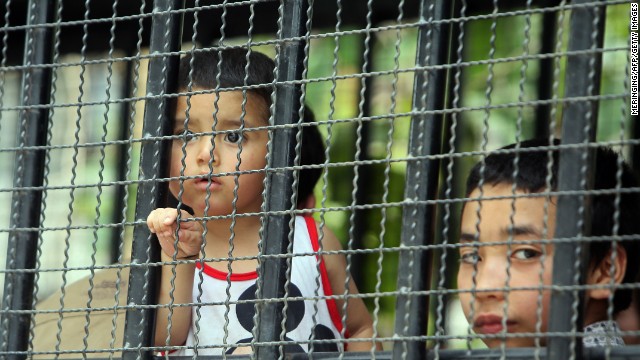
Asylum seekers, including children, are transported by immigration officials to a court in southern Thailand on March 15.

(CNN) -- Thousands of migrant children, including newborn babies, are being locked up in squalid and cramped detention facilities each year in Thailand, enduring serious physical and emotional harm, according to a new report.

The 67-page report from Human Rights Watch (HRW) entitled "Two Years with No Moon': Immigration Detention of Children in Thailand," describes how Thailand is unnecessarily violating children's rights and risking their welfare because of their immigration status or that of their parents.

"Migrant children detained in Thailand are suffering needlessly in filthy, overcrowded cells without adequate nutrition, education, or exercise space," said Alice Farmer, children's rights researcher at HRW and author of the report.


"Detention lockup is no place for migrant children. The sad thing is it's been known for years that these poor detention conditions fall far short of international standards but the Thai government has done little or nothing to address them."

Held indefinitely

The report, which was based on interviews with 41 children and 64 adults who were all detained or arrested by immigration officials, said those affected -- often from neighboring countries such as Myanmar, Cambodia and Laos -- can be held indefinitely with little or no legal support, in violation of international law.

One migrant mentioned in the report described how he and his family were kept at a detention center in Bangkok for six months. "My [five-year-old] nephew asked, 'How long will I stay?' He asked, 'Will I live the rest of my life here?' I didn't know what to say."

The rights group also said several children described being confined in cells so crowded they had to sleep sitting up. Others reported sleeping on tile or wooden floors, without mattresses or blankets, and surrounded by strange adults.

"The worst part was that you were trapped and stuck," Cindy Y., a migrant child held from the age of 9 to 12, told HRW. "I would look outside and see people walking around the neighborhood, and I would hope that would be me."

According to Thai law, any migrant with an irregular immigration status, even a child, can be arrested and detained.

Military crackdown

In recent months, tens of thousands of migrant workers, particularly from Cambodia, have fled Thailand amid rumors of a crackdown on undocumented workers by the country's new military rulers.

Thailand has a very low unemployment rate of 0.9%, according to the National Statistical Official of Thailand. Many of the foreigners work low-paying jobs that Thais are unwilling to do, but they are often vulnerable to police harassment and exploitation, advocates say.

But the Thai military has claimed it doesn't have a policy of arrest as has been widely reported, rather it says it has encouraged undocumented workers to "seek employment through proper channels."

The International Organization for Migration (IOM) estimates there are 370,000 to 380,000 migrant children in Thailand, with the largest number coming from Myanmar where they have fled sectarian persecution against ethnic groups such as the Rohingya Muslims in western Rakhine state.

Migrant children detained in Thailand are suffering needlessly in filthy, overcrowded cells without adequate nutrition, education, or exercise space.
Alice Farmer, report author

According to HRW, the problem of overcrowded detention facilities is worsening, as the country sees more refugees and asylum seekers coming from further afield, such as war-torn Syria, or Christians fleeing persecution in Pakistan.

Meanwhile, an event being held to discuss the human rights situation in Thailand in the wake of this year's military coup has been canceled following pressure from the authorities. Police officers arrived at the Foreign Correspondent's Club of Thailand (FCCT) in Bangkok on Tuesday afternoon to deliver their order, according to Pawinee Chumsri of Thai Lawyers for Human Rights.

She said police told her the event would violate an order from the National Council for Peace and Order (NCPO) banning political gatherings.

"We regard this action as a human rights violation to families and people who are entitled to receive justice," she said.

The Thai authorities have yet to comment on the allegations by Human Rights Watch.


Sunday, August 31, 2014

NGO’s say Aid Cuts Pressure Refugees on Thai-Burma Border to Return Home Prematurely


A group of Burma-focused international NGO’s have voiced grave concern that refugees on the Thai-Burma border are being forced to return to Burma prematurely due to deep cuts in international aid.

In a joint statement, the European Burma Network said: “The international community, and in particular the European Union, is pursuing policies which could in effect force refugees from Burma back into the country before it is safe for them to return, and without the support they will need.”

The European Burma Network represents 15 human rights advocacy groups in Europe, including the European Karen Network; Burma Campaign UK; and Christian Solidarity Worldwide.

“Reforms in Burma, including the peace process, have not progressed to a degree where it is safe for refugees to return. Even where ceasefires have been signed, full codes of conduct for the ceasefires have not been agreed,” the statement said, adding that “The Burmese Army is increasing, rather than decreasing, its presence in ethnic states. Human rights violations by the Burmese Army and associated forces, although reduced in some areas, are still taking place. Political dialogue which could lead to a lasting peace has still not begun, and there is little prospect of genuine dialogue starting in the foreseeable future.”

The European Burma Network also slammed the European Union for putting the lives of refugees at risk, saying that “By using cuts in aid to try to force refugees back to Burma, donors such as the European Union are putting refugees at risk of being subject to human rights abuses, landmines, and living in extreme poverty.”

Rations in the refugee camps have been cut recently by The Border Consortium (TBC)—a coalition of NGO’s that has administered aid to the camps for over two decades—as part of its “staged assistance plan.” The latest funding cut in December resulted in rice rations being cut for certain refugee households classified as “self-reliant,” while other households classified as “standard,” “vulnerable,” or “most vulnerable” will not have their rice rations reduced.


The rice rations of “self-reliant” households have been reduced from 12kg per month to 8kg at Umphiem and Mae La, two of the largest camps which collectively house 56,000 refugees. At other refugee camps, TBC reduced the rice rations of “self-reliant” households to 10kg per month. However, rice rations for all households at Ban Don Yang camp will remain at 2013 levels.

TBC recently introduced its “staged assistance plan” for rice rations in order to direct more resources from its dwindling budget towards “livelihood programs,” which are designed to increase the self-sufficiency of refugees. However, the European Burma Network’s recent statement criticized TBC’s “livelihood programs,” claiming there isn’t enough funding for the programs to be effective.

“These programs are so underfunded they do not come close to providing adequate programs. It is also wrong for funding to be diverted from providing essentials such as food and shelter. Funding for these programs should be additional to, rather than instead of, providing essentials for survival.”

The European Burma Network also noted that issues such as the return of confiscated land; the de-militarization of eastern Burma; and the clearance of landmines have not been solved yet.

“Many refugees want to return to their home villages, not be forced into special economic zones as the Burmese government proposes. They don’t want to be [used as] cheap labor in factories.”

TBC’s latest figures from March this year noted that 119,000 refugees were currently living in the nine refugee camps located along the Thai-Burma border— 10,000 less than in March 2013. Yet TBC has denied that its programs were designed to force refugees back into Burma.

“TBC wishes to emphasize that these changes are in no way intended to encourage refugees to return to Burma/Myanmar prematurely. TBC, The Union Government of the Republic of Myanmar, the Royal Thai Government, and TBC’s international partners all agree that conditions do not yet exist for the organized return of refugees,” a spokesman from TBC said in an email to Karen News after the most recent ration cuts.

Karen Women’s Group Condemns Aid Cuts to Refugees on Thai-Burma Border


In an exclusive interview with Karen News, the Secretary of the Karen Women’s Organization (KWO)—an NGO which represents female refugees on the Thai-Burma border—slammed the recent cuts in humanitarian aid and other forms of assistance to refugees on the border. The KWO Secretary’s comments follow a host of similar statements by other NGO’s condemning the funding cuts by international donors.

“Our refugee community feels it is under pressure to return to Burma. If there is not enough food, not enough health services and not enough shelter [then] sensible people will feel the need to move and go to another place where they find these things. That is just common sense,” KWO Secretary Naw K’nyaw Paw told Karen News.

The KWO is a community-based organization of Karen women who facilitate development and provide relief services in refugee camps on the border. The organization also provides similar services to internally displaced persons inside Burma. In total, KWO says it has a membership base of over 49,000 Karen women.

“As the situation in Burma is not yet ready or safe for refugees to return – we expect to see lots of people trying to find other places to go. That might be within Thailand. This again places us in danger, as we are liable to be arrested and deported [since refugees aren’t permitted to live or work outside the camp area],” said Naw K’nyaw Paw, adding that refugees are now struggling to feed their families because funding reductions have led to rationing of essential items such as rice, and that families now have little choice but to…consider their options, despite the lack of viable alternatives.”

“Refugees may also decide to try to return to places in Burma that are not yet safe and this also puts them in grave danger. We have also heard NGO’s and donors talking about a thing they call ‘incentivizing return.’ This seems to us to be a fancy new jargon for forced repatriation,” said Naw K’nyaw Paw.

The KWO’s concerns come as a growing number of internationally-based Burma human rights NGO’s have condemned the recent aid cuts to refugees. In a joint statement released two weeks ago, the European Burma Network—which represents 15 Burma-focused human rights NGO’s in Europe, including the European Karen Network, Burma Campaign UK, and Christian Solidarity Worldwide—said that the cuts endangered the lives of refugees.

“By using cuts in aid to try to force refugees back to Burma, donors such as the European Union are putting refugees at risk of being subject to human rights abuses, landmines, and living in extreme poverty,” the network said.

Rice rations in the refugee camps have been cut by The Border Consortium (TBC)—a coalition of NGO’s that has administered aid to the camps for over two decades—as part of its “staged assistance plan.” The latest funding cut in December resulted in rice rations being cut for refugee households classified as “self-reliant,” whereas households classified as “standard,” “vulnerable,” or “most vulnerable” will not have their rice rations reduced.

TBC introduced its “staged assistance plan” for rice rations in order to direct more resources from its dwindling budget towards “livelihood programs,” which are designed to increase the self-sufficiency of refugees. However, the European Burma Network’s recent statement criticized TBC’s “livelihood programs,” claiming there isn’t enough funding for the programs to be effective.

The statement said “These programs are so underfunded they do not come close to providing adequate programs. It is also wrong for funding to be diverted from providing essentials such as food and shelter. Funding for these programs should be additional to, rather than instead of, providing essentials for survival.”

During her interview with Karen News, KWO Secretary Naw K’nyaw Paw said she has been overwhelmed with reports of refugees finding it difficult to cope with the ration cuts.

“We have received many reports from many women and men about the problems they are facing because of the cuts in rations and other service. If you cut an adult rice ration from 15 kilos per month to 8 kilos per month, [as] TBC has had to do in December 2013, you would expect to see problems emerging. The rations in the past were enough to keep people alive. Now they are not – assistance for bamboo and wood for our houses has also been drastically cut, as have support for health and education services. All of this throws a bigger burden onto families to provide for themselves.”

The KWO has found that funding cuts have put pressure on refugees to find work outside the camps in order to survive, meaning that children and young people are left at home alone inside the camps without proper parental supervision. Naw K’nyaw Paw also expressed concern that refugees seeking work outside the camp are vulnerable to economic exploitation and abuse, citing the recent murder of two refugees by their Thai employer.

“Those who leave [the camps] to work are open to abuse by employers. They are not protected by Thai laws, so they can be easily exploited. In a recent case, certainly an extreme case, a refugee couple from Mae La camp worked for three months for a corn farmer not far from Mae La camp. When they asked to be paid he killed them both with an axe in front of their two children. [The employer] fled the scene and has not been found.”

Underscoring the dilemma faced by refugees on the border, Naw K’nyaw Paw also listed some of the problems confronting people who are considering going back to Karen State instead of remaining in Thailand.

“Landmines; a much increased Burmese army presence near Karen villages; not enough food and services for the locals (let alone many new refugees); lack of livelihood opportunities; not full and proper ceasefire agreements. [Furthermore,] many new big economic development projects are swarming into Karen state [and] with no proper regulations to control what they do and how they do it, we see this as another form of abuse of our people and of our land.”

Similarly, the European Burma Network noted that refugees still can’t return to Burma safely because issues such as the return of confiscated land; the de-militarization of eastern Burma; and the clearance of landmines have not been solved yet. In its statement, the network also said that “Many refugees want to return to their home villages, not be forced into special economic zones as the Burmese government proposes. They don’t want to be [used as] cheap labor in factories.”

Refugees have experienced a series of cuts to their rations and services in the camps over the last two years. The latest funding cut, implemented in December 2013, saw rice rations provided to “self-reliant” households reduced from 12kg per month to 8kg at Umphiem and Mae La, two of the largest camps which collectively house 56,000 refugees. At other refugee camps, TBC reduced the rice rations of “self-reliant” households to 10kg per month. However, rice rations for all households at Ban Don Yang camp will remain at 2013 levels.

TBC’s latest figures from March this year noted that 119,000 refugees were currently living in the nine refugee camps located along the Thai-Burma border— 10,000 less than in March 2013. Yet TBC has denied that its programs were designed to force refugees back into Burma, implying that the reduction in refugee numbers is actually attributable to refugees moving to other parts of Thailand—especially in view of the risks and dangers associated with returning to Burma.

“TBC wishes to emphasize that these changes are in no way intended to encourage refugees to return to Burma/Myanmar prematurely. TBC, The Union Government of the Republic of Myanmar, the Royal Thai Government, and TBC’s international partners all agree that conditions do not yet exist for the organized return of refugees,” a spokesman from TBC said in an email to Karen News after the most recent ration cuts.

TRAINING BURMESE REFUGEES FOR WESTERN LIVING


Thailand’s largest refugee camp, Mae La, is a dense, overcrowded city of over 43,000 people on the country’s border with Burma. Bamboo huts sprawl over hills, their dirt-floor interiors containing few possessions beyond NGO-issued goods like bags of rice and toothbrushes. Most refugees subsist on rice and pungent fish paste, but with declining concern from international donors over the civil war in Burma, the food rations in the camps have recently been cut, causing several riots. It’s the kind of place you only want to live in if you’re on your way to someplace better.

On one hill sits a hut that doesn’t quite fit in. Its roof, like the thousands around it, is made of thatched grasses and leaves, but its walls are gray-painted wood. Inside is what looks like a small but tidy bachelor pad that could be in London or Berlin or Milwaukee: appliances, an oven, a window, a bathroom, a fridge full of fruits, vegetables, and eggs. But the food is all plastic, and the toilet doesn’t work, and no one is really supposed to live here—it’s a simulator apartment, designed to get Mae La refugees accustomed to the modern-day amenities of Western living before they finally immigrate to any of a dozen countries that take in people fleeing Myanmar, including the US, Australia, Denmark, and Canada.

My guide to the apartment was a man I’ll call Saw Norman*, a 52-year-old Karen refugee who’s a member of one of the many ethnic groups whose rebel fighters spent decades at war with the government in Burma. Norman has been fleeing the conflict since he was eight—his parents moved from region to region, town to town. In 2006, by then with a family of his own, he braved the jungles and the minefields and fled across the border into Thailand. He's lived in Mae La ever since.

Norman moved around the simulator pointing out the different devices and how they work. For the tour, he was dressed in his finest; standing in the small kitchen in his crisp pink shirt, you'd never guess he was a refugee. But back at his bamboo hut, Norman and his family cook over an outdoor fire, fueling it with wood or charcoal; among their cooking staples are NGO-issue rice and fish paste.

“We call this a 'sink,' to wash the plates and then after we wash the plates, we dry the plates and we arrange them on the plate shelf,” he told me.

Despite his enthusiasm, Norman has never used many of the apartment’s devices in real life, and likely won’t get a chance to. Despite his English skills and a strong desire to move his family to a country where his children can get a good education, Norman won’t be eligible for resettlement in the foreseeable future. The year before he arrived in Mae La, the Thai government largely stopped registering any new arrivals from Burma, and registration is a prerequisite for resettlement.

Sally Thompson, the head of the Border Consortium, an NGO that supports refugees in the nine camps along the Thailand-Burma border, told me that Thailand has been generous with the hundreds of thousands of refugees it has taken in over the decades from Burma, Cambodia and Vietnam. But she added that leaving people like Norman and his family unregistered makes their situation all the more precarious.

“Any new arrival who came into the camps since 2005 is not even registered in a database with the Thai government,” she said. Refugees like Norman have no legal status and, as nonpersons, are much more likely to be deported back to Burma. The Thai government can get away with not registering refugees because it never signed the United Nations Refugee Convention.

Walking through camp away from the simulator apartment, Norman and I met another Karen refugee, Saw Wah*, who's on track for resettlement. Wah has family in Winnipeg, Canada, and he's waiting expectantly for his resettlement application to work its way through both the Thai and Canadian bureaucracies. If he's lucky, he'll soon begin prepping for life in Canada. He may even get a training session in the simulator apartment.

As Norman listened, I wondered how hard it is for him to bear the other man's enthusiasm for the future. The only hope for Norman's family to get out of Mae La safely would be the end of Burma’s civil war, which has been raging for more than 60 years. The government and the rebels are currently holding complex ceasefire talks, but there is still fighting in some parts of the country, and the Burmese army remains deployed in the southeast of the country, in and around many Karen villages. Thompson told me that until the troops withdraw the refugees won’t feel safe enough to return to their homeland.

Even if Norman had the choice, he wouldn't return to Burma anyway. If he could, he'd move to the West so his three children could get a good education. But for now, Mae La is home, and the simulated apartment is just a fantasy.

As he walks me toward the entrance of the camp, where I will leave him behind the barbed wire, we pass the apartment again. I ask Norman how he feels when he sees it. “It makes us sad,” he says. “Because our life, to have a chance like that, we dream of that.”

*Names of refugees in this article have been changed at their request.

UNHCR Says Won’t Shield Crooked Refugees From Law


PETALING JAYA: Refugees or asylum-seekers registered with the United Nations High Commissioner for Refugees (UNHCR) are not immune to prosecution if they have committed a crime.

While the organisation offers protection to those in need of international protection, it does not extend to those who have committed serious crimes or actions contrary to the tenets of the United Nations.

UNHCR spokesman in Kuala Lumpur, Yante Ismail, said a detailed and thorough examination would be carried out in such instances.

“Though it is our policy to not comment publicly on individual cases, we take these issues seriously,” she said in reference to the recent arrests of three suspected militants carrying UNHCR cards.

“The refugees are responsible to conform to the laws and regulations of their country of asylum, as well as to abide by measures taken by the authorities to maintain public order.”

Yante said the UNHCR had a legal and thorough procedure in determining a person's refugee status under the Refugee Status Determination process.

She said this would include a detailed interview and investigation by trained personnel before someone obtained refugee status.

“Due to the thoroughness, particularly in high-profile and complicated cases, this process would usually take some time,” she said.

“The procedure involves assessing whether a person is in need of protection and also, when required, whether their conduct would exclude them from protection.”

As long as the refugees have been forced to leave their homelands due to armed conflict, persecution, and serious human rights abuses, Yante said there was no expiry date on their refugee status until a long-term solution was found.

She said a refugee had the right to safe asylum and would not be forced to return to a country that would put the refugee's life or freedom at risk.

“The international protection includes more than physical safety as the refugees deserve to receive at least equal rights and basic help as any other legal foreign resident of a country.

“However, since Malaysia is not a state party to the 1951 Refugees Convention and its protocol, Malaysian law makes no distinction between refugees and undocumented migrants, because it does not have an asylum system to regulate the status and rights of refugees,” she said.

Yante said while refugees in general should have basic civil, economic, and social rights as others, this did not apply in Malaysia.

Refugees here are unable to work legally and are at risk of arrest or detention for immigration offences.

However, she said Malaysia did continue to cooperate with UNHCR in addressing refugee issues on humanitarian grounds.

“This is particularly so in preventing the arrest, detention, and deportation of refugees, and enabling NGOs and the refugee community to provide welfare assistance programmes to them,” she said.

“We cooperate with various government bodies, NGOs and volunteers to assist refugees in different areas and also to support durable solutions, such as resettlement to third countries including Australia, Canada and the United States.”

Yesterday, Malay Mail reported three men were detained in raids in Petaling Jaya and Klang on May 15. They were believed to be members of the Liberation Tigers of Tamil Eelam (LTTE).

The trio, who were arrested for suspected terrorist activities in the country, had been in the country since 2004, and had used UNHCR cards to stay and avoid action.

As at last month, there were 144,300 refugees and asylum-seekers registered with UNHCR in Malaysia.


-The Malay Mail

The Sedona Group’s S.O.A.R. Scholarship Winner Came To Q.C. As A Refugee


There are five students in the Quad City area who are “soaring” tonight thanks to a scholarship from The Sedona Group and the help of WQAD.

On Thursday, May 29th, 2014, News 8’s Angie Sharp surprises the fourth of five winners – a student who is motivated by her past to succeed in the future.

Van Par grew up in Chin State Burma. However, a few years ago, she and her family were forced to flee to Malaysia after being persecuted for ethnic and religious reasons. Van spent two years in a refugee camp before coming to the U.S. at the age of 16.

“My goal is to have peace here and have a successful life and be a part of America,” she says.

Four years alter, Van is about to graduate from Rock Island High School. During one of her classes, WQAD and The Sedona Group surprised her with a $1,000 scholarship.

“I was shocked,” says Van. “I’m really scared and I’m shaking because I can’t believe it.”

Van says when she moved to the Quad Cities, she didn’t speak any English. She says she stayed after school most days to practice and get better. To Van, that defines success.

“Success doesn’t have to be winning a million dollars or like having a lot of money,” she explains. “I think success is being proud of myself that I speak English.”

Van is also staying true to herself and helping others do the same. On Sundays, Van teaches a classroom full of children at the Quad Cities Chin Baptist Church. She uses a story from the bible to give them a lesson about their own language so they never forget their past.

“Some who grow up here don’t know their own language – Chin Burmese so I teach them English, Burmese, and Chin,” says Van.

Van also spends her free time taking people from the Chin community to the grocery store, doctor appointments, or the bank. She acts as a transporter and a translator.

“Chin people live here and they are a part of their community and they are a part of family as well,” says Van. “I want everyone to know that.”

In the fall, Van plans to go to Illinois College. She says she wants to become a surgeon and participate in cancer research.

“When I saw little children suffering from cancer, I felt really bad so I want to do it for them so they can have a wonderful life and they can have the opportunity to enjoy the world.”

The Sedona Group’s S.O.A.R. Scholarship stands for Strength, Opportunity, Achievement, and Resolve. The $1,000 scholarship is given away every year to five area high school seniors.

Source :http://wqad.com

The plight of Cincinnati's refugee population


Greater Cincinnati is home to as many as 25,000 refugees. They come from such countries as Bhutan, Burundi, Congo, Ethiopia, Somalia, Burma, Vietnam, Russia and Iraq, but all experienced severe persecution in their homelands that forced them to flee. They also share the struggle to create fresh lives, overcome the language barrier, learn a new culture and integrate into American society.

Steven Thang landed at Louisville International Airport on Aug. 25, 2008. His wife and her family had been resettled in Louisville from Burma a few months earlier. After escaping the hostile regime in Burma then waiting nearly four years as a refugee in Malaysia, Thang had finally gotten United Nations approval to start a new life in the United States. He saw the U.S. as a gate to his dreams, unlocked at last.

“I was really excited because America is a free land,” he says, “a place where if you really try, everything can be.” These were his thoughts as he waited outside the airport for a ride from local refugee services.

A Hard Start

Thang is from Chin, a state located in western Burma. Chin persecution goes back to the 1960s military takeover in Burma, when Burmese troops and officials began a project of forcible conversion of all minorities to Buddhism. The Chin had converted to Christianity during World War II under British occupation and held that faith ever since, even in the face of torture, forced labor and extra-judicial killings.

Thang was 22 and just about to take his final exams for a university degree in philosophy when it became unsafe for him to continue living in Burma. A refugee agent hid and connected him with a group that would escape to Malaysia via Thailand. The move was sudden, and he didn't have a chance to see his family, nor has he since.

By foot, boat and occasionally car, Thang and a group of 30 men, women and children pushed their way through the southeast Asian forests of Thailand, crossing the border into Malaysia illegally nine at a time while nearly suffocating in the covered bed of a truck.

In Malaysia, Thang and a few of his university classmates lived out of one room in a three-bedroom apartment provided by the UN. They volunteered as teachers for the young Chin refugees, using the living room and two other bedrooms for classes.

Thang and his group were safe from Burmese troops, but life was far from easy. They had barely enough resources to get by, and the Malaysian government was inhospitable. For teachers, the threat of arrest was always present. The UN provided identification forms and letters of protection, but it didn't make a difference to the Malaysian police. Just before Thang arrived in Malaysia, a group of Chin teachers had been arrested and executed for unknown reasons.

Despite the danger and cramped conditions, Thang waited. And waited. Getting the UN call for resettlement can be something of a lottery. There are 60 countries that accept refugees, and more than 15 million refugees currently registered with the UN. Resettlement is limited by how many refugees a nation can accept at a given time, where communities have already been established and what ties, if any, a refugee may have in a potential host country. Refugees have waited in camps as long as 20 years.

The waiting didn't stop Thang from moving forward with his life, though. He married a fellow Chin refugee who had waited in Malaysia even longer than he had. His break came when she was selected for resettlement with cousins in Louisville. Since Thang had become part of that family, too, the UN approved his resettlement, and four months later he was on a plane bound for Kentucky.

The Big Move

Once a refugee is selected for resettlement by the United Nations High Commission for Refugees (UNHCR), their case is piped down through several organizational tiers before finally reaching a settlement destination. In the U.S., they arrive with an I-94 form, a unique status among all classes of immigrants. Refugees receive a social security card upon entry to the U.S. and are eligible for social services, food assistance, Medicaid coverage and most services that citizens qualify for. They can apply for a green card within a year, and are eligible for citizenship after five years of residence.

For Thang, ties to his wife and her family were enough to move him through the pipeline directly to Louisville. Kentucky Refugee Ministries (KRM) handles resettlement cases for that region, and is responsible for acclimating refugees once they arrive, providing airport pickup, housing, medical examinations, job assistance, cultural integration and language courses.

Having already studied English at university allowed Thang to begin working at his wife's cousins' sushi restaurant right away, but that’s not the norm. Many refugees arrive with little or no education and job skills that may not translate to the U.S. Moving to a new country can be bewildering, but it's all the more so for refugees suffering from PTSD and who have lived for years in camps without electricity, running water or even reliable food sources.

“They don't make the move because they want to. Applying for resettlement means they cannot return home again for fear for their lives,” says Dabney Parker, KRM resource coordinator. “When they first get here, they're extremely excited to be in a safe place. But then daily realities set in, and it's hard. There's an emotional roller coaster for a while.”

Settling In

Resettlement agencies like KRM in Kentucky, and its northern counterpart, Catholic Charities Southwestern Ohio, try to make that roller coaster ride as smooth as possible. The first step is cultural orientation classes taught or interpreted by agency staff who speak the refugees' native language. These cover fundamentals like opening a bank account, enrolling children in school, accessing public transportation, abiding by U.S. laws and getting a job. These classes are coupled with English courses to provide refugees an overall crash course in America.

“Some refugees arrive here signing with just an 'X' because they have never needed a signature before,” says Alisa Berry, director of refugee resettlement at Catholic Charities Southwestern Ohio. “Ease of adjustment depends on where the refugee is coming from. For those from camps, it's a big change. Many have never been to a grocery store, never seen a bus or paid rent. Just being in a home with running water, electricity, heating, a refrigerator and a stove can be quite an adjustment.”

KRM's target is to have refugees become self-sufficient in six to nine months. That comes with job placement assistance at the end of the course, typically involving entry-level positions in hospitality, hotels and food service, as well as manufacturing for those with intermediate English abilities.

Levi and Club Chef are significant employers of Chin refugees in Northern Kentucky. About 300 Chin live in the region, most of them close to the factories. It's hard for them to go anywhere else, as most don't drive. Although the drivers license test is translated into many language, Chin is not one of them. And once a refugee starts working, it's very difficult to attend resettlement agencies' free daytime English classes.

“When we were talking with the refugees, that came up over and over again: We want to learn English but there are no classes we can make it to,” says Kelly Birkenhauer, chair of RefugeeConnect, a Junior League of Cincinnati project.

Getting Connected

RefugeeConnect officially launched in 2013 as a support network to bridge the gap between initial refugee services and the later struggles these immigrants face as new Americans. In March, the project worked with Thang and other Chin community leaders to organize weekly evening English classes at a church within walking distance of a large number of the Chin refugees. Volunteers teach the classes, and each week one or two dozen Chin who wouldn't otherwise be able to fit the studies into their work schedules attend.

The broader goal is sustainable improvement of refugees' lives in Cincinnati through a strategy of “Ambassadors, Community and Events.” This involves the training of volunteer English and citizenship tutors, community collaboration, and events that increase cultural awareness and advocacy. Beyond the language barrier, one of the most widespread problems is that refugees and social service organizations are not often aware of one another.

“We're building those community connections that people who are not from here may not have,” Birkenhauer says. “That can be hard to navigate even if you are from here. Our goal is to create a supply system where we can plug refugees into the different agencies.”

New Neighbors

Outside of support services, community integration and awareness are critical for the wellbeing of Cincinnati's refugees. Thang learned quickly that the escape from violence and persecution in his home country didn't mean the end of hardship. He is educated, has a high proficiency in English and has worked his way into ownership of two sushi franchises in Cincinnati, but he still experiences prejudice and backlash from the local community.

“Most people don't understand who refugees are, or what their status is in the U.S.,” Birkenhauer says. “Many think refugees are here illegally. But in reality, refugee status means you've been invited here by the U.S. government in order to become a citizen. It's about as opposite of illegal as you can get.”

Refugees are often turned away when they show I-94 status papers to banks and landlords. The forms are unfamiliar, and people assume they're illegitimate or undesirable. Even with proof of residence and an ability to show income, Thang has struggled for months with banks that are unwilling to grant him a home loan.

“A hard thing is when I think about my future,” Thang says. “As a refugee, you have to work and use your energy twice as much as other people.”

But problems don't stop at the bank or work. Thang has been stopped by police or security guards and searched on suspicion of theft several times. On one occasion, he was browsing at a furniture store and noticed the cashier watching him. He visited the restroom, and when he came out, there were police officers waiting to escort him outside and search him.

“I thought, 'Why are you doing this to me?'” he says. “I'm not a criminal. That day I cried.”

For this reason, Thang works tirelessly to improve conditions for his family and community. He is the president of the Chin Baptist Church USA, which has 74 member churches throughout the nation. He is also his church's worship leader, vice president of the youth group and president of the Chin Literature and Culture Community, which teaches and preserves the Chin language, writing, literature and culture for future generations in the U.S. Beyond his church activities, Thang finds time to be the Chin Community Secretary, too.

“My community first needs knowledge, and second to learn how to change and integrate their lives with the community,” he says. “When I feel happy is when I see my people enter the U.S., grow up, go to school and finish university.”

Thang's ambition to finish his own degree has taken a backseat to community work, supporting his family and studying for the citizenship exam. Once he becomes a citizen, he can bring his mother, father, brother and sister over from Burma; he hasn't seen them since he left, and they've never met his son, who turned 2 in May.

“Any of the groups will tell you that it's very difficult,” Birkenhauer says. “But at the same time, they're excited for their children. It's a similar experience that any immigrant group faces. Looking back through Cincinnati's history, first generation immigrants may not have learned English or had jobs that they liked. But there is hope to improve things for the next generation.”

Tenasserim to allot land for refugees, officials say

About 130,000 refugees from Burma still live in camps along the Thai border. (PHOTO: Reuters)

Government officials of Tenasserim Division [Tanintharyi Region] claimed that refugees residing in a camp in Thailand would soon be able to return to Burma as they are scouting for land for their resettlement.

The camp in question is Tham Hin, located in Thailand’s Ratchaburi province bordering Burma, which houses about 6,000 refugees. Karen Ethnic Affairs Minister Saw Harry visited the camp and said that 75 percent of the refugees wish to return home, so the divisional government is now looking for plots of land in Tenasserim Division to accommodate them.

“We thought one plot near Maw Taung in Tanintharyi Township’s border gate and one to the east of Myittar in Tavoy would be good places,” Saw Harry said. “We are still searching for the exact places.”

He added that a resettlement committee will be there to assist the refugees.

“If they come back, we would ask for assistance from one of the NGOs and prepare rations,” Saw Harry said.

Regional government secretary Tin Thein claimed that land would be given to the refugees when they return, though there are no plans to build houses yet.

“When they come back to stay, we have plans to give them the land. Most of them may have families in their respective villages,” Tin Thein said. “When they get back to their villages, we will help them together with the NGOs.”

“We cannot build the houses without them coming back first,” he said.

Saw Ramond Htoo, Tham Hin refugee camp committee chairman, said that refugees have no immediate plan to return.

“We are not going back now,” Saw Ramond Htoo said, adding that refugees mistrust whether the government’s land offer is legitimate. “They came and took the land before and there was no land for us.”

Thailand currently hosts nine refugee camps where more than 130,000 refugees from Burma reside, having escaped armed and ethnic conflict from their home states.

While the Thai and Burmese governments haveexpressed the desire to repatriate refugees from Thailand’s nine refugee camps, aid agencies, including The Border Consortium, have said that theconditions are not right for refugees to return yet.

Regional officials emphasised that they are only in a scouting stage and no decision has been reached about where and when repatriation might be possible.

The Tide Is Turning for Burmese in Thailand, But Which Way?


Thailand’s migration and refugee policies have shifted since the military’s coup d’état in May. The Thai junta has initiated a policy of labor reforms, including a crackdown on undocumented migrant workers to allegedly combat corruption and human trafficking.

Most of the 2.2 million registered migrant workers in Thailand are Burmese, but labor rights activists estimate there are an additional 3 million workers who are undocumented. The majority of these migrants work in the construction and fishing sectors and many, including those with legal rights to work, report exploitation by their employers. A recent report by the Guardian explained how Burmese workers were sold by traffickers and forced to work on fishing boats, without being allowed to return to the mainland for years. But there have also been stories of abuse and mistreatment of migrants by the police. It is no wonder that when rumors spread of the Thai junta’s crackdown, more than 200,000 Cambodians fled back home, fearful of violence towards them.

The junta’s policy shift may also be affecting Burmese refugees living along the border, who have received mixed signals regarding their repatriation. Since the beginning of June, movement restrictions have been more strictly enforced for the Burmese refugees living in camps. They are banned from leaving the camps, confined to their homes from 6pm to 6am, and threatened with deportation if they don’t comply.

In July, the Thai junta pledged to send back to Myanmar about 100,000 of the 130,000 refugees living in the border camps – some of whom have been there for more than two decades. From August 1 to August 3, Thai and Burmese authorities met in the Burmese town of Mergui to talk about these plans, and a Thai army source told the Irrawaddy newspaper that the junta aimed to “send back all of them [the refugees] and close down all nine camps to end chronic security problems posed by the refugees.” Despite these actions, Thai authorities have reportedly assured the UN Refugee Agency (UNHCR) that the return of the refugees will be voluntary, dignified, and safe, and that no time frame has been set.

Although the situation in Myanmar has improved over the last two and a half years, organizations such as the UNHCR state that the country is not ready for a sustainable, safe, and organized refugee return. Challenges include the absence of a permanent ceasefire in eastern Myanmar; the presence land mines and unmarked minefields; insufficient infrastructure and jobs for returnees; and a lack of safeguards on issues such as citizenship, land rights, security, identity documents, and healthcare.

According to the Bangkok Post, the Thai government has divided the refugees into those who want to return to Myanmar, those who wish to resettle in another country country, and those who were born and wish to remain in Thailand. There have been no decisions about what will happen to refugees who are unable or unwilling to repatriate or resettle in a third country, and there are no indications that local integration will be offered as a long-term solution. Meanwhile, Thai authorities have begun conducting a census of Burmese refugees at the country’s largest camp, which some refugees fear could lead to their immediate repatriation.

While we await further developments in Thailand, the world should remain vigilant. Though the Thai government has given assurances concerning the voluntary, safe, and dignified nature of any refugee returns to Myanmar, it will be important for the humanitarian community to monitor the situation closely and ensure that refugees are not pressured to return prematurely.

Leticia Isasi is an intern at Refugees International.

 http://www.refintl.org