Monday, October 6, 2014

Reacting to reforms in Burma, donors leave refugees high and dry


A family at a refugee camp in Thailand, where there are still 150,000 UN-recognized refugees unable to return home to Burma. (Photo by Mikhail Esteves)

A lot has changed in Burma over the last four years.

The country, also known as Myanmar, has transitioned from military junta to elected government, from closed economy to booming foreign investment, and from non-existent foreign relations to a historic visit from President Obama.

But the refugee crisis that compelled Seattleite and Evergreen alumnus Garrett Kostin to found the Burma Study Center (BSC), a free community school and library for Burmese refugees in Chiang Mai, Thailand, still remains a reality.

Thailand alone still hosts nearly 150,000 UN-recognized Burmese refugees in camps along the Thai-Burmese border, with more than two million additional unregistered refugees and migrants living in urban areas.

Having fled Burma for reasons ranging from political persecution to ethnic discrimination to armed conflict, these refugees cannot yet go home.

Kostin, having lived and worked in Thailand since 2003, saw a clear need for action back in 2010 when he founded the center.

“The more knowledgeable I became about the oppressive military dictatorship that led Burma to becoming a refugee-producing nation, the more I felt I would be remiss if I didn’t do what I could to help,” Kostin said.

Today, BSC (where I am lucky enough to volunteer as a grant writer) offers free classes to refugees and migrants from Burma, and hosts a library of materials in English, Burmese, Shan, Karen, and Thai. The center conducts research on issues affecting refugees, and provides assistance to refugees facing medical and personal emergencies. Two partner libraries in Burma — in Shan State and Sagaing Division — offer similar services.

Taking advantage of its urban location in Thailand’s second largest city, BSC in Chiang Mai also focuses on raising community awareness.

“What was important was a center that could educate both the privileged and the under-privileged, and work from there,” Kostin said.

Garrett Kostin (left) helps Burmese students browse resources in the digital catalog at the Burma Study Center. (Photo courtesy Burma Study Center)

Soon after Kostin opened BSC, Burma commanded international attention with (at least nominally) democratic elections after decades of military rule. The newly elected government of former military commander Thein Sein released thousands of political prisoners, and ended civil society leader Aung San Suu Kyi’s 15 years of house arrest. The press saw harsh restrictions relaxed, and ceasefire talks with armed ethnic groups made encouraging progress. 

Since this hopeful moment, however, Burma’s reforms have veered from the expectations of both foreign observers and the Burmese public. As commentators like activist Zin Linn have cautioned, it seems “the [military] regime just changes its clothes” in the transition from a military to a civilian government.

Violent conflict remains a reality throughout the country, and negotiations for a nationwide ceasefire agreement with armed ethnic groups are uncertain. In a shock to the media, five journalists were arrested and imprisoned last July. And the Rohingyas, a Muslim minority group in the western Rakhine State, continue to suffer blatant human rights abuses.

With a parliamentary system that ensures the continued primacy of military members, necessary reforms to the flawed 2008 constitution are unlikely before the upcoming 2015 elections.

Most critical for BSC, the number of Burmese refugees in Thailand has not decreased significantly since 2010. Instead, foreign aid for Burmese refugee organizations has steadily fallen.

“It has become more difficult to generate support for refugees from Burma because many countries would like to believe that support is no longer necessary,”Kostin said.

The EU, for example, halved support for refugee camps in Thailand between 2008 and 2012 in order to shift its attention to civil society groups within Burma. This so-called “livelihoods strategy” prioritizes aid efforts within Burma in the hopes that they will support reforms and pave the way for refugees’ return.

But as long as millions of refugees remain, sudden withdrawals of funding do little to serve their outstanding needs before they are prepared to go back.

“The misconception is that all resources and investments should now be directed inside the country to encourage further reforms,” Kostin said. “In fact, there is still a tremendous need to assist individuals from Burma who have been compelled to flee their country and who have not yet returned.”

Recent research conducted by BSC confirms this need.

The multilingual, anonymous study surveyed over 100 Burmese refugees in northern Thailand. Three-quarters of respondents saw little to no significant improvement in Burma since the 2010 elections. Only 3 percent of respondents thought the situation had improved considerably. Although 83 percent of refugees indicated a desire to go back to Burma, few believed it would be safe to do so in the foreseeable future.


Burmese opposition leader Aung San Suu Kyi with then Secretary of State Hillary Clinton in 2010. After almost 15 years under house arrest by the military junta, Suu Kyi was elected to Burmese Parliament in 2012. (Photo via US State Department)

“We would like to eventually see BSC’s operations outside of Burma become redundant,” Kostin said. “It would be wonderful if we were able to relocate all of our programs inside the country, but as long as migrants and refugees remain in Thailand, we are committed to continuing to offer them educational, health, and social welfare support.”

Until then, BSC and organizations like it must do more with less to serve Burmese refugee and migrant communities.

This weekend, BSC is launching its “One Evening for Burma” fundraising and awareness campaign. The campaign calls on people to donate an amount equal to what they would spend on a typical evening out with friends and family — that is, to pledge “one evening for Burma”—to support BSC. Donations can be made via PayPal. (See this page for more detailed instructions.)

For those in Seattle, the center is hosting a “One Evening for Burma” event with food, performances, and speakers on Saturday, September 13. Contact info@burmastudy.org for more information and resources, and visit BSC’s website and Facebook page.

Myanmar Relies on Foreign Investments to Draw Migrants, Refugees


Myanmar authorities are banking on foreign investments to generate jobs in a bid to woo back some of the country’s nearly 10 million migrant workers from neighboring countries.

Senior officials from three ministries—home affairs; labor, employment and social security; and foreign affairs—held discussions with legislators last week to help check the current lack of employment opportunities for returning migrant workers and refugees.

Htin Aung, deputy minister of the Ministry of Labor, Employment and Social Security, told RFA’s Myanmar Service that his ministry has discussed the problem with foreign investors.

He believes employment opportunities will arise from the Thilawa, Dawei and Kyaukphyu special economic zones (SEZs) currently under development.

The Thilawa SEZ—the largest of the three special economic zones—is a joint venture between the governments of Myanmar and Japan and private consortiums. It is situated about 23 kilometers (14 miles) southeast of Yangon in Thanlyin-Kyauktan.

The Dawei SEZ, a joint venture between the Myanmar and Thailand governments, is in the country’s southern Tanintharyi region, and the Kyaukphyu SEZ is located in Rakhine State in western Myanmar.

About 2 million Myanmar citizens work in Thailand, while about 1.5 million work in Malaysia, Htin Aung said.

There are about 200,000 Myanmar refugees in Thailand as well, he said. Many of them fled to the country during the decades of brutal military junta rule before a nominally civilian government was formed after the 2010 general elections.

Special economic zones

Legislators enacted a Special Economic Zone (SEZ) Law in January to allow foreign investors to invest in export-oriented industries in the zones so that Myanmar could generate jobs and improve its socioeconomic situation, reports have said. 

Aung Soe Longlon, a legislator from Myanmar’s Tanintharyi region in the southernmost part of the country, told RFA’s Myanmar Service that about 80 percent of young people in his constituency worked in Thailand, Malaysia and Singapore.

“Although we have the Dawei Special Economic Zone in our division, we haven’t still created jobs for local people yet,” he said.

Thein Nyunt, chairman of the New National Democratic Party who represents Yangon’s Thingangyun township in the lower house, told RFA that the issue of migrant workers returning home was related not only to the lack of jobs, but also to the lack of peace in the country.

“We can’t solve this problem by providing job opportunities from the Thilawa and Dawei special economic zones for about 10 million migrant workers,” he said. 
“We have to build our country based on the development of a democratic system to provide job opportunities for these migrant workers.”

A survey conducted by the Chang Mai, Thailand-based nongovernmental organization Burma Study Center in March and April found that the majority of the more than 100 migrants from Myanmar currently living and working in northern Thailand indicated that they had a strong desire to return to their homeland.

But many were either afraid that it would not be safe for them to return now or did not believe that the situation in Myanmar had improved since the 2010 general election.

Almost 20 percent of those surveyed cited Myanmar’s low levels of development as the most important issue they wanted to see changed before returning home. 
Nearly 17 percent pointed to a lack of peace or freedom, and 14 percent said improvements to the education system were needed.

Reported by Myo Thant Khine for RFA’s Myanmar Service. Translated by Khet Mar. Written in English by Roseanne Gerin.

Karenni refugee students use Heywire to connect with the Australian public


Kle Wah was seven-years-old when he walked from Myanmar to Thailand, seeking safety in a refugee camp.
Kleh Wah was seven years old when he walked from Burma to Thailand, seeking safety in a refugee camp. His mother died on the way. Now in Australia, he is sharing his story through the ABC Heywire competition.


The trek took a month. His mother didn’t make it. She died in the forest.

"Burmese soldier come and burn our house," he said.

"If you don’t run they get killing our people."

Short, loaded sentences like this are all the information Kle Wah, now 19, can articulate in English, but he and other young Karenni refugees want to share their stories with Australia.

The Karenni are from east Myanmar and have been at war with the Myanmar Government for decades, with 10s of thousands fleeing by foot to Thailand.


Thai camps brought their own problems and many Karenni have settled in Australia including a group of about 200 in the regional South Australian city, Mount Gambier.

Kle Wah’s father and older sister are still living in a bamboo hut, without electricity or running water, in a Thai camp.

Meanwhile he is trying to settle into a foreign life of technology, shopping centres and wealth in his new Australian city.

About a dozen students studying an intensive English language course at Tennison Woods College entered the ABC Heywire competition, which asks rural youth to share their stories and ideas.

As their English improves, teacher Scott Dickson gains more insight into the students’ past.

"In amongst their stories is the heartbreak of what they’ve gone through and we knew broad brushstrokes of that … but quite often when they’re trying to explain it in English it’s not really clear," he said.


"Now with workshopping the entries you say, ‘well what does this mean?’
"And they’ll say ‘that was when my dad died’."

Naw Em Mui’s story recounts fires that destroyed her family’s bamboo home, not in Myanmar but in the Thai refugee camp.

It was 2013 and the 17-year-old was preparing for a school test.

"At 3pm I hear someone say the house become fire burn and I get out," she said.

"When I be to the river I saw the children cry because fire burn the house and looked very scared.

"At the fire burn day 37 people are death and everything we have building anew."

The fires prompted Naw Em Mui’s move to Australia.

"I’m so happy and everything is safe for our family," she said.

"I’m so happy that to came to college because I’m getting better at speaking English.

"I would really like to say big thank you to Australia Government and Australia people."


Lah Yu, 18, and her four brothers and sisters were born in the same refugee camp.

She describes the Thai camp as her ‘home’.
"I miss my friends and my country," she said. 

"It’s hard to make friends (in Mount Gambier) because we can’t speak English very well, so I just study.

"I want to do hairdressing … I’m so happy to live here, I’m safe here."

Mahdalay, also 18, attends two church services in Mount Gambier every Sunday – one that’s delivered in English and the other in her Karen dialect.

"It’s very important to keep our Karenni culture," she said.

"Because we from different country and we want to show other people our culture."

Earlier this year four Myanmar refugees faced Mount Gambier Magistrates Court for possessing the carcasses of three koalas and 14 possums.

The case sparked public outcry on social media, with much support on a Facebook page that called for the accused to be jailed.

It was just one example of the cultural misunderstandings Karenni refugees face in the south east city; in Thai camps food was sourced from the forest or the river, so hunting native animals was not questioned in Australia.

Teacher Scott Dickson hopes the students’ stories will foster support from the wider community.

"With greater understanding comes greater knowledge and responsibility," he said.

"And I think that’s one of the things we’ll be able to share with a lot of people when we finish this project."

www.abc.net.au

Speaker to push Malaysia on murders


Upper house speaker U Khin Aung Myint has promised to send a letter to his counterpart in Malaysia expressing concern at the number of Myanmar citizens who have been killed in the country in recent years.

Workers who returned from Malaysia with the help of Kanbawza company wait at Yangon airport in October 2013. (Boothee/The Myanmar Times)

U Khin Aung Myint said he would send the letter after receiving a report from the Amyotha Hluttaw. The Human Rights Committee will compile a report on those who have been killed, as well as the apparent attempt to assassinate two prominent Rakhine MPs in February.

The committee should seek the help of the Ministry of Home Affairs, the Ministry of Labour and other government departments to compile the report, he said.

U Khin Aung Myint made the comment in response to a question from U Khing Maung Latt, the Amyotha Hluttaw representative for constituency 6 in Rakhine State, who asked how the government was responding to attacks on Myanmar nationals in Malaysia.

In February a pro-democracy activist was killed in Kuala Lumpur just a day before two gunmen on a motorcycle shot at Rakhine National Development Party boss U Aye Maung and Arakan League for Democracy chair U Aye Thar Aung. The two later blamed the attack on “Islamic terrorists.”

In June 2013 a number of Myanmar migrants were killed in Malaysia following a spike in violence between Buddhists and Muslims. The killings were believed to have been sparked by the communal violence in Myanmar. Malaysia is home to both a large number of migrant workers and refugees from Myanmar, with the refugees mostly Muslim and Christian.

Myanmar Buddhists allege there is at least one killing per month, typically a stabbing, and complain that Malaysia's Muslim-dominated police force has not solved any of them.

But Deputy Minister for Home Affairs Brigadier General Kyaw Zan Myint said Myanmar had to respect Malaysia’s national sovereignty.

“Crimes that happen in another country should be punished by the law of that country. There needs to be awareness that we have no right to interfere with their investigation or judicial processes,” he said.

In regard to the attack on the Rakhine politicians, Brig Gen Kyaw Zan Myint said Myanmar police are cooperating with their counterparts in Malaysia to apprehend the gunmen.

Translation by Zar Zar Soe

Thai PM sends signals by visiting Myanmar first, says Bangkok daily


The decision by Thailand's junta leader and Prime Minister General Prayuth Chan-ocha to visit Myanmar on his first official overseas trip is significant for many reasons, says an analysis in a leading Bangkok English-language newspaper, The Nation.


Gen Prayuth might not have intended to send any signals when he decided to travel to Myanmar for his first visit to a foreign country, "but his choice says a lot", says the analysis by Supalak Ganjankhundee in the daily on September 17.

"From a Thai perspective, Prayuth's visit to Myanmar is a signal that the political development model in Myanmar might perhaps also fit for Thailand," the analysis says.

"Indeed, Myanmar's army commander [Senior General] Min Aung Hlaing said that Thailand had taken the 'right path' and praised the Thai junta during a visit in July," it said, referring to the May 22 coup d'etat that ousted Gen Prayuth's elected predecessor, Ms Yingluck Shinawatra.

The visit is due to occur in the coming weeks and the analysis lists issues involving a shared border, the presence in Thailand of refugees and migrant workers from Myanmar and the troubled Dawei project as among the reasons why Gen Prayuth has chosen to put Nay Pyi Taw first on his overseas travel itinerary.

"Prayuth's trip to Myanmar ... signifies that Nay Pyi Taw is important to Thailand in many ways," the analysis says.

It says the neighbours share a land and water border of 2,401 kilometres (1,491 miles), of which only 59km (36 miles) have been demarcated and there are many overlapping territorial claims.

Border issues have long been at the core of bilateral relations, says the analysis, adding that many "grey" activities take place along the border, including trafficking in narcotics, arms and people.

A big border issue concerns the 120,000 Myanmar refugees living in camps just inside Thailand, some whom left their homeland 30 years ago to escape civil war in ethnic minority areas.

"Governments in the past have talked to Myanmar from time to time on how to repatriate them to their place of origin. This has been a major concern in bilateral meetings over past years and it will continue to be such in the future," the analysis says.

It says the refugee issue is sometimes mixed up with that of Myanmar migrant workers seeking better lives in Thailand. "Millions of them are now in the country, helping to spur the Thai economy, but sometimes also creating problems."

On economic cooperation the analysis refers to the Dawei project and says clear decisions are badly needed on how to move on.

"Prime Minister Prayuth knew this issue very well since former Prime Minister Yingluck, whom he used to serve, talked with Myanmar leaders about this project many times," it says.

"The key problem is how and where capital can be put in the project. It is now Prayuth's decision either to go on with the project or walk away from it."

The analysis also speculates that the coup in Thailand may have influenced thinking in the Tatmadaw about the transition towards democracy in Myanmar.

"Prayuth might not be aware of the consequence of what he has done in Thailand four months ago, but his colleagues in the Tatmadaw - the Myanmar armed forces - likely got impressions that they should not allow any more liberalisation," it says.

Gen Prayuth's forthcoming visit is in line with a tradition in the Association of Southeast Asian Nations for a new head of government to give priority to visiting ASEAN partners as soon as possible after taking office.

The analysis says new Thai premiers have traditionally made Laos their first destination, but that Ms Yingluck travelled to Brunei, explaining that she intended to visit Thailand's ASEAN partners in alphabetical order.

www.mizzima.com

Final 23 Myanmar refugees arrive in Japan on resettlement program


CHIBA – Twenty-three refugees from Myanmar who had fled to Thailand arrived Friday evening in Tokyo, the last group to do so under a Japanese pilot resettlement program begun in fiscal 2010.

The 23, from five families, mostly belong to the Karen ethnic minority. They will take Japanese-language lessons and job training while searching for housing and employment.

The resettlement program has failed to meet the annual quota of accepting 30 refugees, with none arriving in 2012 and only 86 coming over the entire period, which was extended from three to five years.

The government plans to accept Myanmar refugees staying in Malaysia from next year.

The program didn’t go as planned because potential participants had little grasp of the terms of the resettlement and the conditions they could expect in Japan, observers say.

Promoted by the U.N. High Commissioner for Refugees, the third-country resettlement program is designed to help people who have fled their homes to a nearby country resettle in a safe third country.

About 120,000 Myanmar refugees currently live in refugee camps in Thailand. The Thai junta that seized power in May has reportedly agreed with Myanmar to send the refugees back, but no timetable or other details have been announced.

www.japantimes.co.jp

From Burma to the Valley: A Refugee's Story


Nkhai Nang Bu Tang Bau moved to Harrisonburg with her husband in 2010. A refugee from Myanmar, she spent several years in Thailand and Malaysia before being resettled in the United States. Her daughter, Diza, was born after they arrived.

Andrew Jenner

When we talk about immigration, we often focus on the opportunities that attract people to the United States.

Many people, though, come to escape difficult or dangerous circumstances in their home countries. WMRA’s Andrew Jenner has the story of one refugee, and her journey from Myanmar, to the Shenandoah Valley. It's the second installment of WMRA's special series "Becoming American: Pathways to Citizenship in Virginia."

JENNER: Refugees make up a relatively small part of the immigrant population in our area, but they help make it an incredibly diverse one. Nkhai Nang Bu Tang Bau arrived here in 2010, having fled her home in Myanmar, or Burma, several years earlier.

NKHAI: I left Myanmar to Thailand. I stayed in Thailand about seven months, and then I went to Malaysia. And I lived in Malaysia almost three years.

A person comes to the U.S. as a refugee only through a very specific set of circumstances.

JIM HERSHBERGER: It’s usually people who have had to flee their homes because of war and violence in their homes, they’re living in a refugee camp in a second country and they cannot return.

Jim Hershberger is program coordinator for Harrisonburg’s refugee resettlement office, run by Church World Service.

HERSHBERGER: You have to register with the United Nations High Commissioner for Refugees in the various centers around the world. Then, on that basis, the U.N. refers you to the countries – U.S., Canada, Australia and so forth, there are about 12 of them in the world – who will resettle refugees.

After a long screening process, refugees are usually sent to communities where they’ll find others who share their language and culture. More than 1,700 have been resettled in Harrisonburg and Rockingham County over the past decade – primarily from Iraq, Eritrea, Cuba and the former Soviet Union. With state and federal funding, Church World Service helps newly arrived refugees find housing and employment, enroll their children in school and otherwise settle into their lives here. Another local organization, NewBridges Immigrant Resource Center, has a more open-ended mission to serve as a resource for all immigrants, says executive director Alicia Horst.

ALICIA HORST: For different people, cultural adjustment will hit at different levels. For a person who’s a professional, it might be the fact that you can no longer work in your field, and therefore your identity is definitely challenged.

In Myanmar, Nkhai was an X-ray technician. Now she works in food services at James Madison University. Horst says that, regardless of how or why a refugee came, they face some common challenges.

ALICIA HORST: One would be that people have experienced a lot related to potentially witnessing or experiencing violence. So their sense of security and safety has certainly been shaped by that. And also the sense of having to relocate and the timing often being outside of their control.

NKHAI: First when I came to America, I feel very lonely. I always cry at home. I don’t have friends.

Five years later, she’s adjusting, and thinking about her long-term future here.

NKHAI: I feel very happy right now. I love this country, so I want to be a citizen.

This fall, she plans to apply for citizenship, something that refugees have particular incentive to do because many can simply never return home.

VIKTOR SOKOLYUK: Refugees who come, they’re very grateful to the United States that they are given opportunity to start their life.

Viktor Sokolyuk directs Virginia Immigration Services for Church World Service. Originally from the Ukraine, he came to the United States in 1990 as a refugee.

SOKOLYUK: They’re grateful to have a place to live, a place where they can put their children to sleep safely and wake up in the morning alive. And the reason that many refugees are finding Harrisonburg and the Shenandoah Valley as their home is because they feel welcome here.

As Nkhai looks even further ahead, her ambitions sound remarkably American.

NKHAI: I want to buy a house in Harrisonburg in a good place. And then I support my daughter until she gets a degree and she gets a good job and she can do better in the United States. That is my dream. That is my dream.

wmra.org

The Young Refugee Who Won’t Give up Hope


Aung Naing was six years old when he moved to Nu Poe refugee camp in Thailand, leaving conflict-wracked Karen State, in Eastern Burma.

Sitting down in the small compound on the outskirts of Chiang Mai that has been his home for the last 15 months, Aung Naing recalls those first years in the camp.

“My mother and father had gone to Nu Poe camp in 1997, I was too young so I stayed with my Aunt and helped her farm rice until I was old enough to travel in 2001.” Life in Nu Poe was very different from home, “life there was ok, but it could be hard. My father died in the camp in 2006 from tuberculosis, but there were programs and school there to support me and I made many friends.”

Slowly Aung Naing and his family built up a life in the camp; his mother would sell snacks outside their small hut for around 50 baht (US $2) a day. To augment a modest supply of rations, they would also collect fruit and vegetables from the surrounding jungle. Aung Naing would play football with his friends, and enjoyed school.

Yet life took another drastic turn when Aung Naing, now 19, found out he had Hodgkin’s Lymphoma – a form of leukaemia – last year.

“I got a lump on my throat, it went away but another lump resurfaced on my waist. I went to a Thai hospital in Umphang to find out what it was – the doctor said I had cancer – leukaemia – and that I needed treatment in a big hospital in Chiang Mai.”

“I had never heard of leukaemia before, and I was very sad when I found it that it could kill me.”

Aide Médicale Internationale (PU-AMI) an NGO that delivers health treatment to refugees sent Aung Naing and his mother to Burma Children Medical Fund, a non-profit organisation based on the Thai Burma border, that provides life-saving treatment to refugees and people from Burma.

Ms Thornton, the BCMF director, explained how Aung Naing came to their program. “Aung Naing was under the care of PUAMI in Nu Poe camp – he got sick and they referred him to Umphang hospital. The hospital identified that he had leukaemia and needed treatment straight away but PUAMI has no referral program to treat patients with cancer, so they approached us.”

“We saw that Aung Naing’s cancer was at an early stage and that he seemed to be in good health so we said we could help. Then we sent him to Chiang Mai for treatment,” Ms Thornton says, “Unknown to us when we sent him to CM there were another 20 patients at the hospital also with leukaemia – Aung Naing is the only survivor of that group.”

Aung Naing says that adapting to life in Chiang Mai, far away from his friends and family, had been difficult. “My mother came with me here but had to leave after four days to look after my little sister. I haven’t seen them, or my friends, in over a year. But I call them on a phone once a week.”

Keeping Aung Naing in Chiang Mai was vital for his treatment, Ms Thornton explained. “We kept him in our patient house because he is from such an isolated camp, and we were concerned that he could not get back out from the camp for his monthly blood test.”

Aung Naing remembers how at first the chemotherapy made him sick and he lost all his hair, but now he is off the chemotherapy while further blood tests are analysed. “The medicine at first made me very sick, I would vomit and be so tired that I couldn’t even play Ching Lo with my friends here at the BCMF patient house but now I feel stronger and can play,” Aung Naing says, referring to a game played across Burma, where a circle of friends quickly volley a fist-sized cane ball.

Aung Naing says that he was grateful that BCMF was working to save his life, “When I was in Chiang Mai hospital there were 20 other leukaemia patients, Burmese, Karen and Thai. They are now all dead.” Aung Naing says he was lucky to get treatment in Thailand through BCMF, because healthcare in Burma and in the camps is basic. “I admire those looking after me and the people here at this safe house are like a second family to me. We look after each other because we cannot leave this compound unless for special day trips with our Thai minder. I am happy here – it is difficult to stay in just one place but I have to try and cure my disease.”

A Land Without Healthcare

Doctor Vit Suwanvanichkij, a research associate at the Centre for Public Health and Human Rights, Johns Hopkins Bloomberg School of Public Health, is a specialist in health policy issues confronting Southeast Asia, particularly Burma. He painted a stark picture of Burma’s health system today. “Burma’s healthcare system is a disaster, a consequence of decades of mismanagement, corruption, and disinvestment under successive military regimes. Although the government health budget has increased under President Thein Sein, it remains woefully inadequate, with little tangible change on the ground for most of the peoples of Burma, particularly rural, ethnic communities.”

A 2013 analysis of Burma’s budget by UNICEF noted that an 81% increase in the country’s coffers for that year had failed to translate into meaningful spending on health or education. The budget analysis found that in 2012-2013, about 29% of Burma’s budget went to the military, while as a percentage of total government spending, health received 5.7%, or 0.76% of Burma’s GDP.

UNICEF said that while health and education had seen an increase in funds on paper, Burma’s exchange rate unification coupled with long overdue salary increases for the social sector meant that “improvements in terms of additional human and physical resources available to the social sectors for realizing children’s rights were very limited, if at all present.”

Living With Hope

It starts to rain and Aung Naing moves to find cover; leaning against the concrete compound wall, he remembers a low point in his time here. “I had a best friend here, Saw Kayin, he was 17 – not much younger than me. But he died here at the clinic because he was very sick. I feel really sad about that, I miss him.”

“I am not afraid to die – if I die it is my fate, but I want to live. I feel a sense of hopelessness sometimes, but I have to hold on to hope.”

Ms Thornton says that Aung Naing’s health outlook is good and that BCMF will continue to monitor his condition. “At the moment his prognosis is good – he has monthly blood tests to make sure that the leukaemia is not coming back. He will be having these blood tests every month for the next year,” she says.

“He will be able to go back to the camp to see his family in two months time but he will still need those close monitor of his blood in CM every month. Hopefully after this treatment he will be cured – we will not know for sure when his will be cured. We can only hope.”

The rain stops, and Aung Naing gets ready to play ‘Ching Lo’ with some of the other patients at BCMF.

“If I get better I will go back to the camp and join school again. I had to leave when I was in grade 9. I want to become a doctor and create a clinic in my hometown in Karen State, because there is no healthcare there,” he says, cane-ball in hand.

www.bnionline.net

Wednesday, September 3, 2014

Exiled Karen community condemns Thai ‘voluntary repatriation’ plan

Karen refugees, many who fled from the 60-year-long civil war between the Karen National Liberation Army and the Burmese government, may be sent back to their home country with all but one camp being dismantled. Asia-Pacific Journalism reports on the controversial move.

Pacific Scoop:

Report – By Johan Chang

The Karen and other ethnic minorities living in refugee camps provided by the United Nations High Comission for Refugees are facing “voluntary repatriation”.

The current Thai government led by the National Council for Peace and Order (NCPO) after a coup d’état in May and under martial law, are pushing for the removal of refugees.

Thailand’s Ministry of Foreign Affairs has stressed in a statement that the government is “to prepare for a safe return in the future in accordance with humanitarian and human rights principles”.


While the discussion contained no specific timeframe, UNHCR has already drafted planning figures to assist with the repatriation.

Cicilia Dwe, a first-generation Karen-Kiwi, arrived in New Zealand with her family through the UNHCR refugee programme provided in 2001.

She was in the second wave of Karen refugees to be accepted by the New Zealand government.

She believes the Thai government’s proposal is untrue and a violation of human rights.

“They say it’s ‘voluntary repatriation’,” she says.


Cicilia Dwe (front row, third from right) and students from the Refugee Youth Action Network. Image: RYAN

“So if they go against what’s been said, their goals or their rules, then they’re not keeping their promise.”

In a trip to the Tenth Karen Unity Seminar in Thailand held in late May, the 24-year-old came face-to-face with the long struggle for freedom that has held her people in turmoil for the last 60 years.

According to information from UNHCR, the current conditions for voluntary return are not favourable, and the agency has neither put in place a plan for repatriation, nor promoted return.

The refugees, many who flee from the 60-year-long civil war between the Karen National Liberation Army and the Burmese government, are proposed to be sent back to their home country with all but one camp being dismantled.

The series of nine refugee camps currently line the Thailand-Myanmar border, the largest of which is Mae La, home to more than 40,000 refugees and winds along the western Thailand mountain ranges for 184 hectares.

It is estimated that about more than 120,000 Myanmar refugees reside in these camps, which were first established in 1980.

Refugee camps
Considered by refugees to be the last bastion of safe haven in the region for ethnic minorities within Myanmar, it is mostly populated by refugees from the Kayin (Karen) state.

According to statistics from the UNHCR, some 66.5 percent of the refugees are Karen.

The camps provide medical and educational services, as well as providing a stable living situation that allows them to raise their families in relative peace.

For Dwe, it provided a fond multicultural experience, interacting with other children of the various minorities there, but the over-arching threat of oppression loomed.

“I didn’t experience much [oppression], fortunately for me,” she said.

“Obviously my sister, my older siblings, and mom and dad have a different experience to mine.”

Dwe was quickly moved by the UN with her family to New Zealand, in the second wave of Karen refugees that landed in Auckland in 2001.

Yet camps such as Mae La are not as promising as many refugees had hoped. While many, under a United Nations initiative, have been relocated to partner countries, more have been there for all their lives.

Some of the refugees have lived in these camps for as long as the camps have been operational. Many have grown up as children within the compounds, and are now married with their own children and are still there.

Furthermore, travel restrictions have been put in place, making those who seek to supplement their income outside of the camp fearful of their future.

Basic necessities such as rations are becoming increasingly scarce as donor funds dwindle, and without more income they may face the possibility of starvation.

Yet to travel outside of the camp can mean trouble for the refugees if they are caught, as refugees fear they will be either deported or losing their refugee status.

Inside Myanmar
For many of the Karen who have come to the camps, going back in to Myanmar would be their worst nightmare.

Reports from UNHCR has shown in January 2014 there were 372,000 internally displaced persons within Myanmar. “People are very afraid for their lives,” Dwe says.

“They have no homes . . . they experience more suffering. There’s no help or support. Nothing education-wise or health clinics.”

In a short documentary called Against All Hope, produced in 2009, many of the subjects interviewed told of forced labour and sexual slavery carried out against the Karen.

One interviewee spoke of workers who were chained during the middle of the night to prevent them from running away; those who do were shot on sight, and most were worked to their deaths.

“I can name it. Forced relocation, forced labour, child soldiers, using rape as a weapon, and using all sorts of persecution against the Karen people,” one man said.


Kyaw Hsu Mon … atrocities have decreased. Image: Del Abcede/PMC

Yet such atrocities have decreased, according to Kyaw Hsu Mon, a senior journalist with The Irrawaddy.

“Around that Thai-Myanmar border, the numbers of refugees are getting less. The government and the Karen have come to a ceasefire agreement,” she said.

Kyaw believes that the decrease of violence has come with a change in government strategy, and the opening up of the country to the world.

However, Dwe believes differently. As the current negotiations are for the possibilities of a ceasefire, she thinks it’s just a political move from the Burmese for show.

“We’ve been fighting 60 years to finally get to a ceasefire negotiation,” she says.

“They said, ‘when we sign the ceasefire, we’ll leave the boundaries’ (of the Karen State). But that’s not true – they’re still there.

“We are not free.”

Johan Chang is a Postgraduate Diploma in Communication Studies student journalist on the Inclusive Journalism Initiative (IJI) programme at AUT University. He is reporting on the Asia-Pacific Journalism course.

Lankans among refugees in Thailand

674525

Sri Lankans are among thousands of refugees in detention in Thailand, Human Rights Watch (HRW) said in a report released today which details how Thailand’s use of immigration detention violates children’s rights, risks their health and wellbeing, and imperils their development

HRW says child migrants and asylum seekers are unnecessarily held in squalid immigration facilities and police lock-ups due to their immigration status or that of their parents.

The 67-page report “‘Two Years with No Moon’: Immigration Detention of Children in Thailand” says the Thai government should stop detaining children on immigration grounds.

“Migrant children detained in Thailand are suffering needlessly in filthy, overcrowded cells without adequate nutrition, education, or exercise space,” said Alice Farmer, children’s rights researcher at Human Rights Watch and author of the report. “Detention lockup is no place for migrant children.”

Human Rights Watch interviewed 41 migrant children and 64 adults who had been detained, arrested, or otherwise affected by interactions with police and immigration officials. In addition, Human Rights Watch interviewed representatives of international and nongovernmental organizations, migrant community leaders, and lawyers.

Immigration detention practices in Thailand violate the rights of both adults and children, Human Rights Watch said. Migrants are often detained indefinitely, and they lack reliable mechanisms to appeal their deprivation of liberty. Indefinite detention without recourse to judicial review amounts to arbitrary detention, which is prohibited under international law.

Prolonged detention deprives children of the capacity to grow and thrive mentally and physically. Yanaal L., a migrant detained with his family in Bangkok’s immigration detention center for six months, told Human Rights Watch: “My [five-year-old] nephew asked, ‘How long will I stay?’ He asked, ‘Will I live the rest of my life here?’ I didn’t know what to say.”

The International Organization for Migration reports that there are approximately 375,000 migrant children in Thailand, including children of migrant workers from neighboring countries, and children who are refugees and seeking asylum. The largest group of child refugees living in Thailand are from Burma, many of whom fled with their families from Burmese army attacks in ethnic minority areas, and from sectarian violence against Rohingya Muslims in Arakan State. Other refugees are from Pakistan, Sri Lanka, Somalia, Syria and elsewhere.

Migrants from the neighboring countries of Burma, Cambodia, and Laos tend to spend a few days or weeks in detention after they are arrested and then are taken to the border to be formally deported or otherwise released. However, refugee families from non-contiguous countries face the choice of remaining locked up indefinitely with their children, waiting for months or years for the slim chance of resettlement in a third country, or paying for their return to their own country, where they fear persecution. They are left to languish indefinitely in what effectively amounts to debtors’ prison.

Immigration detention conditions in Thailand imperil children’s physical health, Human Rights Watch found. The children rarely get the nutrition or exercise they need. Parents described having to pay exorbitant prices for supplemental food smuggled from the outside to try to provide for their children’s nutritional needs. Immigration detention also harms children’s mental health by exacerbating previous traumas and contributing to lasting depression and anxiety. By failing to provide adequate nutrition and opportunities for exercise and play, Thai immigration authorities are violating fundamental rights enumerated in the Convention on the Rights of the Child, which Thailand has ratified.

Children in immigration detention in Thailand are routinely held with unrelated adults in violation of international law. They are regularly exposed to violence, and can get caught up in fights between detainees, use of force by guards, and sometime get physically hurt.

Severe overcrowding is a chronic problem in many of Thailand’s immigration detention centers. Children are crammed into packed cells, with poor ventilation and limited or no access to space for recreation. Human Rights Watch interviewed several children who described being confined in cells so crowded they had to sleep sitting up. Even where children have room to lie down, they routinely reported sleeping on tile or wood floors, without mattresses or blankets, surrounded by strange adults.

“The worst part was that you were trapped and stuck,” said Cindy Y., a migrant child held from ages 9 to 12. “I would look outside and see people walking around the neighborhood, and I would hope that would be me.”

None of the children Human Rights Watch interviewed received formal education while in detention, even those held for many months. By denying migrant or asylum-seeking children adequate education, Thai immigration authorities are depriving children of social and intellectual development. The Convention on the Rights of the Child says that all children have the right to education without discrimination on the basis of nationality or migrant status.

Under Thai law, all migrants with irregular immigration status, even children, can be arrested and detained. In 2013, the United Nations Committee on the Rights of the Child, the body of independent experts charged with interpreting the Convention on the Rights of the Child, has directed governments to “expeditiously and completely cease the detention of children on the basis of their immigration status,” asserting that such detention is never in the child’s best interest.

“Amid the current human rights crisis in Thailand, it is easy to ignore the plight of migrant children,” Farmer said. “But Thai authorities need to address this problem because it won’t just disappear on its own.”

Besides ending the detention of migrant children, Thailand should immediately adopt alternatives to detention that are being used effectively in other countries, such as open reception centers and conditional release programs. Such programs are cheaper than detention, respect children’s rights, and protect their future, Human Rights Watch said.

In an August 14, 2014 response to a letter from Human Rights Watch sending out findings and recommendations, the Thai Ministry of Foreign Affairs denied that the detention of migrants was carried out in an arbitrary manner, and stated: “Detention of some small number of migrant children in Thailand is not a result of the Government’s policies but rather the preference of their migrant parents themselves (family unity) and the logistical difficulties.” The government’s seven-page response is included in the report’s annex.

Thailand faces numerous migration challenges posed by its location and relative prosperity, and is entitled to control its borders, Human Rights Watch said. But it should do so in a way that upholds basic human rights, including the right to freedom from arbitrary detention, the right to family unity, and international minimum standards for conditions of detention.

“Thailand’s immigration detention policies make a mockery of government claims to protect children precisely because they put children at unnecessary risk,” Farmer said. “The sad thing is it’s been known for years that these poor detention conditions fall far short of international standards but the Thai government has done little or nothing to address them.”(Colombo Gazette)

Thailand's Children in Detention Lose Health and Hope, Says Rights Report


By Human Rights Watch Media Release
Tuesday, September 2, 2014

BANGKOK: Thailand holds thousands of migrant children in detention each year, causing them physical and emotional harm, Human Rights Watch said in a report released today. 

Child migrants and asylum seekers are unnecessarily held in squalid immigration facilities and police lock-ups due to their immigration status or that of their parents.

The 67-page report, 'Two Years with No Moon: Immigration Detention of Children in Thailand,' details how Thailand's use of immigration detention violates children's rights, risks their health and wellbeing, and imperils their development. 

The Thai government should stop detaining children on immigration grounds, Human Rights Watch said.

''Migrant children detained in Thailand are suffering needlessly in filthy, overcrowded cells without adequate nutrition, education, or exercise space,'' said Alice Farmer, children's rights researcher at Human Rights Watch and author of the report. ''Detention lockup is no place for migrant children.''

Human Rights Watch interviewed 41 migrant children and 64 adults who had been detained, arrested, or otherwise affected by interactions with police and immigration officials. 

In addition, Human Rights Watch interviewed representatives of international and nongovernmental organisations, migrant community leaders and lawyers.

Immigration detention practices in Thailand violate the rights of both adults and children, Human Rights Watch said. 

Migrants are often detained indefinitely, and they lack reliable mechanisms to appeal their deprivation of liberty. 

Indefinite detention without recourse to judicial review amounts to arbitrary detention, which is prohibited under international law.

Prolonged detention deprives children of the capacity to grow and thrive mentally and physically. Yanaal L., a migrant detained with his family in Bangkok's immigration detention center for six months, told Human Rights Watch: ''My [five-year-old] nephew asked, 'How long will I stay?' 

''He asked, 'Will I live the rest of my life here?' I didn't know what to say.''

The International Organisation for Migration reports that there are approximately 375,000 migrant children in Thailand, including children of migrant workers from neighboring countries, and children who are refugees and seeking asylum. 

The largest group of child refugees living in Thailand are from Burma, many of whom fled with their families from Burmese army attacks in ethnic minority areas, and from sectarian violence against Rohingya Muslims in Arakan [Rakhine] State. Other refugees are from Pakistan, Sri Lanka, Somalia, Syria and elsewhere.

Migrants from the neighboring countries of Burma, Cambodia, and Laos tend to spend a few days or weeks in detention after they are arrested and then are taken to the border to be formally deported or otherwise released. 

However, refugee families from non-contiguous countries face the choice of remaining locked up indefinitely with their children, waiting for months or years for the slim chance of resettlement in a third country, or paying for their return to their own country, where they fear persecution. 

They are left to languish indefinitely in what effectively amounts to debtors' prison.

Immigration detention conditions in Thailand imperil children's physical health, Human Rights Watch found. The children rarely get the nutrition or exercise they need. 

Parents described having to pay exorbitant prices for supplemental food smuggled from the outside to try to provide for their children's nutritional needs. Immigration detention also harms children's mental health by exacerbating previous traumas and contributing to lasting depression and anxiety. 

By failing to provide adequate nutrition and opportunities for exercise and play, Thai immigration authorities are violating fundamental rights enumerated in the Convention on the Rights of the Child, which Thailand has ratified.

Children in immigration detention in Thailand are routinely held with unrelated adults in violation of international law. 

They are regularly exposed to violence, and can get caught up in fights between detainees, use of force by guards, and sometime get physically hurt.

Severe overcrowding is a chronic problem in many of Thailand's immigration detention centers. 

Children are crammed into packed cells, with poor ventilation and limited or no access to space for recreation. 

Human Rights Watch interviewed several children who described being confined in cells so crowded they had to sleep sitting up. 

Even where children have room to lie down, they routinely reported sleeping on tile or wood floors, without mattresses or blankets, surrounded by strange adults.

''The worst part was that you were trapped and stuck,'' said Cindy Y., a migrant child held from ages 9 to 12. ''I would look outside and see people walking around the neighborhood, and I would hope that would be me.''

None of the children Human Rights Watch interviewed received formal education while in detention, even those held for many months. 

By denying migrant or asylum-seeking children adequate education, Thai immigration authorities are depriving children of social and intellectual development. 

The Convention on the Rights of the Child says that all children have the right to education without discrimination on the basis of nationality or migrant status.

Under Thai law, all migrants with irregular immigration status, even children, can be arrested and detained. 

In 2013, the United Nations Committee on the Rights of the Child, the body of independent experts charged with interpreting the Convention on the Rights of the Child, has directed governments to ''expeditiously and completely cease the detention of children on the basis of their immigration status,'' asserting that such detention is never in the child's best interest.

''Amid the current human rights crisis in Thailand, it is easy to ignore the plight of migrant children,'' Farmer said. ''But Thai authorities need to address this problem because it won't just disappear on its own.''

Besides ending the detention of migrant children, Thailand should immediately adopt alternatives to detention that are being used effectively in other countries, such as open reception centers and conditional release programs. 

Such programs are cheaper than detention, respect children's rights, and protect their future, Human Rights Watch said.

In an August 14, 2014 response to a letter from Human Rights Watch sending out findings and recommendations, the Thai Ministry of Foreign Affairs denied that the detention of migrants was carried out in an arbitrary manner, and stated: ''Detention of some small number of migrant children in Thailand is not a result of the Government's policies but rather the preference of their migrant parents themselves (family unity) and the logistical difficulties.'' 

The government's seven-page response is included in the report's annex.

Thailand faces numerous migration challenges posed by its location and relative prosperity, and is entitled to control its borders, Human Rights Watch said. 

But it should do so in a way that upholds basic human rights, including the right to freedom from arbitrary detention, the right to family unity, and international minimum standards for conditions of detention.

''Thailand's immigration detention policies make a mockery of government claims to protect children precisely because they put children at unnecessary risk,'' Farmer said. 

''The sad thing is it's been known for years that these poor detention conditions fall far short of international standards but the Thai government has done little or nothing to address them.''

'Two Years with No Moon: Immigration Detention of Children in Thailand' is available at:

http://www.hrw.org

Rights group: Thousands of child refugees held in Thailand

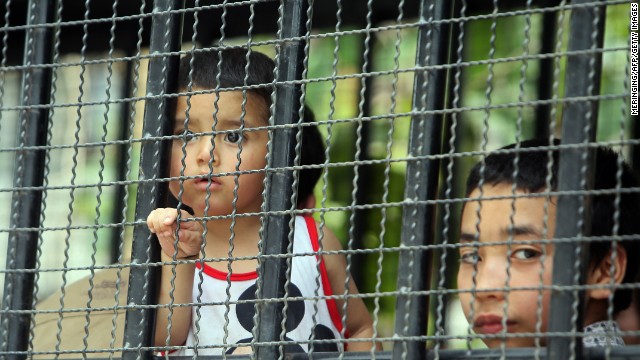
Asylum seekers, including children, are transported by immigration officials to a court in southern Thailand on March 15.

(CNN) -- Thousands of migrant children, including newborn babies, are being locked up in squalid and cramped detention facilities each year in Thailand, enduring serious physical and emotional harm, according to a new report.

The 67-page report from Human Rights Watch (HRW) entitled "Two Years with No Moon': Immigration Detention of Children in Thailand," describes how Thailand is unnecessarily violating children's rights and risking their welfare because of their immigration status or that of their parents.

"Migrant children detained in Thailand are suffering needlessly in filthy, overcrowded cells without adequate nutrition, education, or exercise space," said Alice Farmer, children's rights researcher at HRW and author of the report.


"Detention lockup is no place for migrant children. The sad thing is it's been known for years that these poor detention conditions fall far short of international standards but the Thai government has done little or nothing to address them."

Held indefinitely

The report, which was based on interviews with 41 children and 64 adults who were all detained or arrested by immigration officials, said those affected -- often from neighboring countries such as Myanmar, Cambodia and Laos -- can be held indefinitely with little or no legal support, in violation of international law.

One migrant mentioned in the report described how he and his family were kept at a detention center in Bangkok for six months. "My [five-year-old] nephew asked, 'How long will I stay?' He asked, 'Will I live the rest of my life here?' I didn't know what to say."

The rights group also said several children described being confined in cells so crowded they had to sleep sitting up. Others reported sleeping on tile or wooden floors, without mattresses or blankets, and surrounded by strange adults.

"The worst part was that you were trapped and stuck," Cindy Y., a migrant child held from the age of 9 to 12, told HRW. "I would look outside and see people walking around the neighborhood, and I would hope that would be me."

According to Thai law, any migrant with an irregular immigration status, even a child, can be arrested and detained.

Military crackdown

In recent months, tens of thousands of migrant workers, particularly from Cambodia, have fled Thailand amid rumors of a crackdown on undocumented workers by the country's new military rulers.

Thailand has a very low unemployment rate of 0.9%, according to the National Statistical Official of Thailand. Many of the foreigners work low-paying jobs that Thais are unwilling to do, but they are often vulnerable to police harassment and exploitation, advocates say.

But the Thai military has claimed it doesn't have a policy of arrest as has been widely reported, rather it says it has encouraged undocumented workers to "seek employment through proper channels."

The International Organization for Migration (IOM) estimates there are 370,000 to 380,000 migrant children in Thailand, with the largest number coming from Myanmar where they have fled sectarian persecution against ethnic groups such as the Rohingya Muslims in western Rakhine state.

Migrant children detained in Thailand are suffering needlessly in filthy, overcrowded cells without adequate nutrition, education, or exercise space.
Alice Farmer, report author

According to HRW, the problem of overcrowded detention facilities is worsening, as the country sees more refugees and asylum seekers coming from further afield, such as war-torn Syria, or Christians fleeing persecution in Pakistan.

Meanwhile, an event being held to discuss the human rights situation in Thailand in the wake of this year's military coup has been canceled following pressure from the authorities. Police officers arrived at the Foreign Correspondent's Club of Thailand (FCCT) in Bangkok on Tuesday afternoon to deliver their order, according to Pawinee Chumsri of Thai Lawyers for Human Rights.

She said police told her the event would violate an order from the National Council for Peace and Order (NCPO) banning political gatherings.

"We regard this action as a human rights violation to families and people who are entitled to receive justice," she said.

The Thai authorities have yet to comment on the allegations by Human Rights Watch.