Monday, July 18, 2016

COULD THIS MAN BE THE MOST ‘SUCCESSFUL’ REFUGEE IN MALAYSIA?


Malaysian police arrested Zafar for illegal entry, and deported him back to Thailand, where he was arrested…for illegal entry… and sent to jail before being deported back to Myanmar (again). Knowing that he faced death back in Myanmar, he managed to convince the boatman to….send him back to Malaysia instead. After much struggling (including one more arrest, deportation, and prison sentence), he finally made his way to Kuala Lumpur through an agent.

But although he made it to Malaysia, Zafar tells us that he was deported, not once or twice, but…

He was deported from Malaysia for a total of… 12 times!

Yes, in the span of 7 years (1996-2003), less time than most of us take to finish primary school, Zafar was arrested, deported, and made it back to Malaysia 12 times, an average of 1.7 times a year. Every single time he was deported, he was sent to Thailand, and he made his way back via a human trafficking operation which he had to pay (prices varied from RM1200 – RM2150, depending on the trafficker).

If they had no money? Well…

“If we didn’t have money, they would beat us. In some cases, they even shot to death some of us with a pistol. They would threaten us to pay them all we had, or they would send us back to Myanmar.” – Zafar

In addition to risking his life just to pass the Thailand-Malaysian border, he also had to risk his life travelling from the border to KL, including hiding in the backs of trucks and being stuffed into car boots where he almost suffocated to death. He couldn’t stay in Thailand because it was too close to Myanmar, and Malaysia was his only hope for survival, enough for him to risk his life every single time to make it back into Malaysia.

He asked the UN for help when he was in Malaysia, but wasn’t acknowledged as a refugee

Zafar continued the fight for his fellow Rohingyans by establishing the Myanmar Ethic Rohingya Human Rights Organization Malaysia (MERHROM) in 1998. In the year 2000, Zafar approached the Malaysian chapter of the UNHCR for help and to request for Refugee status.

After listening to his story, UNHCR refused to acknowledge Zafar as a refugee because he couldn’t sufficiently prove that he was deserving of refugee status.

To be fair, it’s not that the UNHCR doesn’t like him or anything. There is actually an application to be recognized as a refugee, and Zafar failed the application process the first time because he failed to produce the necessary documents for registration (birth cert, IC, passport, etc). This requirement is especially troublesome for Rohingyans as the Myanmarese government revoked their IDs and documentations. However, after appealing to the UNHCR to review his application, he finally got himself registered as a refugee. But that’s not the end of his problems…

Unfortunately, because he’s a refugee, Zafar cannot own any property, business, or vehicle, secure a legal job, and has no access to basic amenities such as government healthcare or schools, even though he legally married a Malaysian wife. (His wife, his father-in-law, and himself had to beg the Registration Department with tears in their eyes multiple times in order to get married, and after being constantly rejected, a kind-hearted Perak mufti finally agreed to legally marry him and his wife under Islamic law, making their marital status legal).


In fact, a doctor friend from a local gov hospital told us a heartbreaking story about the plight of refugees in Malaysia who are not part of the “privileged class”:


“I have seen pregnant women who are already in the beginnings of labour being turned away from government hospitals because they couldn’t afford to pay and were not eligible for government facilities when they had no proper documentations.

I’ve overruled the medical staff multiple times and told them to get the OT (operating theatre) ready so I could save the mother and child. As to who was going to pay, that was not my primary concern.”- Anonymous doctor friend

This makes Mr. Zafar’s story all the more amazing. As an unrecognized refugee, he managed to set up MERHROM, have an income through a kedai runcit and gerai makanan (both under his wife’s name), bring attention the ASEAN and UN leaders as to the plight of the refugees, and even managed to help Malaysians when they needed it. (Fun fact: MERHROM raised and donated RM25,000 worth of goods to the Kelantan flood victims of 2015!) His efforts has also been internationally recognized, with organizations from Hong Kong, Korea, UK and the US inviting him over to give him awards, but he is unable to attend and receive such awards(and speaking engagements) because he doesn’t have travel documents.

There are more than 154,000 refugees currently in Malaysia, most of whom live without basic rights and protection. While most of us think it can lead to increased crime rates, this is actually not true. In fact, the UNHCR actually makes it a point to screen all asylum-seekers before accepting them into the country, and that those who commit crimes are not eligible for refugee status, so there is a huge incentive for refugees to follow the law in Malaysia.

In fact, according to our Deputy Home Minister Datuk Wan Junaidi Tuanku Jaafar, only 1% of all crimes in Malaysia are committed by them, though he did also say that we shouldn’t make the issue worse by hiring them, sheltering them, or renting properties out to them. 

Mr. Zafar disagrees however:


“We’re not asking for sympathy or for donations. All we ask if that we be given a legal identity, so that we can find work to provide for ourselves, for our children to go to schools, and for us to build a life."

We have a lot that we want to contribute to Malaysia, and we love Malaysia, because she has provided for us a hope and a life again. I ask that Malaysians and the Malaysian government just give us a chance.“


What can we do then?

Well, we could write to our MPs to bring the matter of Malaysia’s treatment of refugees up to Parliament, andlobby our government to formally sign the UN Convention of Refugees. Additionally, you could also donate to organizations like the UNHCR or MERHROM (they need money and supplies like rice, toiletries, etc); contact themhere to set up a donation time that is appropriate. If you own a business, perhaps you could consider giving refugees a chance to be fairly employed in your organization as well. Together, we can work to make Malaysia a welcoming second home to those who have unfortunately lost theirs.


Three Burmese Migrants Killed in Malaysia


Three Burmese migrant workers were killed and one was wounded early this morning in Malaysia’s northern Penang state, according to local sources.

“They shouted for help when they saw robbers trying to burglarize a neighbor’s house, and then the robbers went into their house and killed them,” said Maung Zaw, a member of Penang’s funeral service organization.

He said that the three workers were killed at 6:30 a.m. When the funeral service team went to see the bodies, police informed them they would be unable to hold a funeral while there was an ongoing investigation.

Sources said the four victims, who were from Mandalay Division’s Pyawbwe Township, were stabbed in Penang’s industrial zone.

Hundreds of Burmese migrant workers live in Penang’s industrial zone, many of them illegal migrants, asylum seekers and refugees who work dangerous jobs in factories and on construction sites. Due to lack of proper documentation, they often face arrest, detentions and deportation by the Malaysian authorities.

An official from the Burmese Embassy in Malaysia who asked to remain anonymous told The Irrawaddy that the embassy would investigate the incident and issue a statement later this evening.

The official added that the killing was not prompted by religious tension, after it had spread on social media that the attack might have been related to strain between Burma’s Buddhist and Muslim communities.

Many hundreds of Burmese Refugees and Migrants have been killed in Malaysia for the past 15 years. 


After 20 years in a refugee camp, Burmese family starts new life in B.C.


A group of residents from Qualicum Beach, B.C. spent several hours at Vancouver International Airport on Thursday evening anxiously awaiting the arrival of the Burmese refugee family they had privately sponsored. 

Sitting on the ground at the arrivals gate the group of volunteers knew little about the people they were about to meet. 

"We know that there is eight people — five children and three adults. We know that they're coming from a refugee camp in Thailand and we know that they wanted to come to Canada. That is all we know," said Carol Doering, one of the volunteers.


Interpreter Hserchri Trawgaye explains to the refugee family what is happening and where they will go next. (Tina Lovgreen/CBC)

"We're here wondering what they'll be like and they're probably thinking what we are going to be like" said Doering. 

"I feel apprehensive, nervous, excited and curious about what will happen next and concerned for the family that this will be such an overwhelming process for them," said Chris Ferris, another volunteer and Qualicum Beach resident. 


The youngest in the family is 4 years old and could not stop smiling after receiving a Canadian flag and stuffed animal. (Tina Lovgreen/CBC)

The Burmese refugee family of Karen ethnicity had spent 20 years living at Mae La refugee camp in Thailand. The children aged four to 16 were all born inside the camp.

The camp was established in 1984 after thousands of villages were burned to the ground during an armed conflict and ethnic persecution by the Burmese government. 

"The children will have no experience outside of a jungle camp. Never seen much in terms of vehicles, airplanes, concrete buildings, glass towers, people," said Doering. 


The children hold a banner that reads 'Welcome to Canada' in the refugee family's language (Tina Lovgreen/CBC)

Finally, the refugee family walked through the gates and soon enough the nerves from both sides were replaced with hello's and introductions. 

The volunteers introduced themselves through an interpreter and handed Canadian flags and stuffed animals to the children. 

Speaking through interpreter Hserchri Trawgaye — who is also from Burma and lived in a refugee camp in Thailand — the mother of the young children said they are very happy to be in Canada.

When asked what it was like to fly on an airplane, she described it as being in a house that is flying. 
What to do in Qualicum Beach? 

The refugee family will spend the night in Vancouver before taking a ferry over to Qualicum Beach, a town located on Vancouver Island with a population of almost 9,000 people. 

"I think they will feel at home there," said Doering. 

Qualicum Beach is a smaller community that is not often a go-to place for refugees and it also the oldest population of any community in Canada. 

"Definitely they're coming to a community that is known for its retirement scene," she said. 

Hserchri Trawgaye lives in Vancouver but is originally from Burma and also lived in a refugee camp in Thailand. She will follow the family to Qualicum Beach to help them settle in. (Tina Lovgreen/CBC)

But Doering hopes the green scenery of the town will make the family feel at home. 

After the family has settled in, the focus will be on teaching them English and helping them adjust to life in Canada, which may include anything from teaching them how to use a stove or go grocery shopping. 

"I hope they just try and be a family. Walk around, feel a sense that there is no barbed wires. You can walk the streets, you're safe," said volunteer Anna Grieve. 

The children will be attending school come September and the parents will be given an opportunity to work at a Thai restaurant or work on a farm, as they have in the past. 
It all started with a house

The entire journey began in January, when the town of Qualicum Beach put out a request for ideas on what to do with a former RCMP station that was sitting empty. 


Chris Ferris and her husband came up with the idea to use the house for a refugee family. (Tina Lovgreen/CBC)

"We were out walking by the house and thought, maybe the town would be interested in giving that house to refugees," said Chris Ferris, who came up with the idea with her husband one night. 

After a town meeting was held the plan was approved and the sponsorship process began. 


Volunteers and residents of Qualicum Beach get the house ready for the refugees to move into once they arrive. (Qualicum Refugee Sponsorship Group/Facebook)

But the volunteer group was expecting a Syrian refugee family, not a family from Burma, also known as Myanmar. 

"I think that was everyone's expectation because that's what was in the news and you didn't hear about other families," said Doering, adding that the group wasn't really concerned about where the family would be from. 

The refugee family will be able to live at the house rent free for 18 months, with the volunteer group covering the cost of utilities.

http://www.cbc.ca/

UN Conducts Last Call for Burmese Refugees Hoping to Resettle in US


RANGOON — The United Nation’s (UN) refugee agency, the UN High Commissioner for Refugees (UNHCR), is conducting a “last call” resettlement initiative for Burmese refugees living in Thailand who wish to resettle in the United States.

The initiative will allow unregistered refugees to reunite with their immediate families in the United States. Typically, refugees who have not registered with the UNHCR are not eligible for third country resettlement.

“This is a one-time exercise taking place only in July,” said UNHCR senior field coordinator Iain Hall.

“It is a last chance for a previously identified group of individuals who had already indicated interest in joining their immediate families in the US,” he said.

The initiative is being carried out in nine camps in Thailand where an estimated 120,000 Burmese refugees live. The UNHCR will prepare a submission to the Thai government for their consideration; however, this initiative is not part of the refugee repatriation process, according to the agency.

Hall said that the purpose of this activity was to reconfirm their intention to resettle, but the process does not guarantee their registration by the Thai government and therefore does not guarantee resettlement.

Eligible unregistered refugees are those whose immediate family members—such as spouses or minor children—were registered refugees who resettled in the US group resettlement program that ended in 2013.

Vivian Tan, a UNHCR spokeswoman, told The Irrawaddy that registered refugees could still apply for resettlement, but that interest in third country resettlement had declined in this group over the years.

http://www.irrawaddy.com/

MEF: Employment for refugees - comprehensive study and framework needed


KUALA LUMPUR: Any proposal to allow refugees to work in this country requires a comprehensive study and framework as it has the potential of giving rise to new problems.

Malaysian Employers Federation (MEF) executive director, Datuk Shamsuddin Bardan said if refugees were allowed to work legally in the country, it might result in more refugees coming here.

Thus, he said, an inclusive solution to address the issue of refugees' employment was needed without compromising the humanitarian aspects.

"We are worried, if we allow them (refugees) to work here legally, it will contribute to the influx of refugees and migrants into this country, and it will surely create new problems," he told Bernama when contacted today.

Currently, there are some 151,560 refugees and asylum-seekers registered with the United Nations High Commission for Refugees (UNHCR) in Malaysia.

Malaysia is not a state party to the 1951 Refugee Convention and its Protocol, thus the country does not recognise the refugees' status including the right of working.

"Based on the existing law, it is an offence for an employer to employ any refugee and legal action can be taken against the employer," said Shamsuddin.

"They (refugees) are productive and disciplined workers. That is why we see many companies willing to hire them.

"We understand that if the refugees are not given the chance to work, they will opt to work illegally and this will create new social problems and of course we don't want this ... that is why a solution is needed fast," he said.

Universiti Malaya's Department of Development Studies senior lecturer, Dr Lee Hwok Ann said if the refugees were not allowed to work formally in the country, it could drive them to illegal and undesirable activities.

He said employment of refugees would bring benefits to the economy of the country and help fill vacancies, especially jobs that the locals shunned.

"Employing refugees can generate significant benefits like new skills and knowledge, add diversity and at the same time, contribute to the national income," he said. — Bernama

TBHF donates $150,000 to support Rohingya, Iraqis


SHARJAH: The Big Heart Foundation (TBHF) a Sharjah-based global humanitarian charity dedicated to helping refugees and people in need worldwide, has donated Dhs550,000 ($150,000) to support Rohingya refugees in Malaysia and displaced people in Iraq.

Distributed by the United Nations High Commission for Refugees, UNHCR, the funds will be used to help overcome the recipients’ challenging circumstances and difficult living conditions.

Approximately $82,000 of the donation will go towards helping displaced people in Iraq, with $68,000 given to assist Rohingya refugees in Malaysia. Coinciding with Eid Al Fitr, the organisers of THBF’s humanitarian contribution say that it is being given to help inspire optimism and hope in those who have been forced to leave their homes through conflict or persecution and to share with them the blessings of Eid.

"TBHF's cash donations are made in line with the vision of the wife of the Ruler of Sharjah, Her Highness Sheikha Jawaher Bint Mohammed Al Qasimi, Chairperson of the Big Heart Foundation, and UNHCR Eminent Advocate for Refugee Children, to improve the living conditions of refugees worldwide and enable them to lead a life of dignity. We sought through this donation to support these vulnerable people living under extremely difficult circumstances and to share the joy of Eid with them," said Mariam Al Hammadi, Director of Salam Ya Seghar, a TBHF initiative to improve the welfare of refugee children.

Speaking about Rohingya refugees in Malaysia, Al Hammadi said: "The Big Heart Foundation is committed to alleviating the suffering of Rohingya refugees who are living under extremely challenging conditions. This is not the first time that the foundation has made a donation towards them. 

In July 2015, The Big Heart Foundation donated Dhs1 million to support UNHCR's efforts in assisting these displaced people, following the rise in the number of Rohingyas leaving Myanmar because of violence and persecution."

She continued: "Sheikha Jawaher has reiterated her commitment to closely following up the issue of Myanmar refugees, especially children, who according to UNHCR data account for 20 percent of the total refugees in Malaysia. She also underlined the need to reunite children who have been separated from their parents, in addition to urgently providing them with education and healthcare."

During the visit of His Highness Dr Sheikh Sultan Bin Mohammed Al Qasimi, Supreme Council Member and Ruler of Sharjah, and Sheikha Jawaher Al Qasimi to UNHCR's Harmony Refugee Learning Centre in the Malaysian capital Kuala Lumpur in May, Her Highness pledged through the Big Heart Foundation and in coordination with UNHCR to explore new mechanisms and expand the scope of services provided to refugees, so as to ensure their fundamental rights.

With respect to Iraq, Al Hammadi highlighted that there are nearly 120,000 internally displaced persons living in 12 camps in Dohuk Governorate and cited reports that indicate that the capacity of these camps is not sufficient to host all the internally displaced people. She stated that outside of these camps, the majority of displaced persons are scattered in hundreds of informal slum dwellings that lack basic standards to provide for decent living, which only adds to the ordeal they have already endured.

In June 2015, Sheikha Jawaher launched TBHF to coincide with World Refugee Day. It followed the decision issued by her to transform what was then The Big Heart Campaign into a global humanitarian foundation. The move was aimed at redoubling efforts to help refugees and people in need worldwide, with the new foundation adding significantly to the UAE's rich portfolio and long record of humanitarian initiatives regionally and globally.

http://gulftoday.ae

Tuesday, June 21, 2016


The Human Rights Commission of Malaysia (Suhakam)  


The Human Rights Commission of Malaysia (the commission) aligns itself with others in expressing serious concerns over the exacerbating global refugee crisis. In the wake of escalating violence, turmoil and armed conflict plaguing many parts of the world, millions of people, many of whom are women and children, are adversely affected and become refugees.

They are forced to flee their homes and cross international borders and deep seas, risking their lives in pursuit of safety and survival. Thousands of them die in the process.

In commemorating World Refugee Day, which falls on June 20, the commission pays tribute to the courage and determination demonstrated by refugees and asylum seekers all over the globe. The trials and tribulations endured by them to escape persecution and life-threatening circumstances in their home countries are unspeakable, and their strength and perseverance in overcoming such difficult situations deserve recognition.

However, recognition alone will do very little to improve the plight of refugees. Concrete actions must be taken not only to mitigate the predicaments faced by them but also to safeguard their human rights and to address the root causes that lead to their unfavourable situation in the first place.

According to the Office of the United Nations High Commissioner for Refugees (UNHCR), there are some 154,140 refugees and asylum seekers registered with UNHCR in Malaysia, as of April 2016. UNHCR Malaysia states that 139,780 are from Myanmar comprising mainly Rohingyas and Chins, while 14,370 are from other countries including Sri Lanka, Pakistan, Somalia, Syria, Yemen, Iraq, Afghanistan and Palestine.

The commission observes that refugees and asylum seekers are among the most vulnerable to human rights abuses in the country. They also face discrimination and ill-treatment on a regular basis. As Malaysia is not party to the Convention and Protocol relating to the Status of Refugees, the government does not officially recognise the status of refugees, rendering them without any legal or immigration status.

As a result, refugees and asylum seekers, in particular those who are not yet registered with UNHCR, remain vulnerable to arrests for immigration offences and may be subject to repeated detention and charges, which may carry sentences of imprisonment and/or whipping. Even more alarming is the detention of refugee children including unaccompanied minors in immigration detention centres.

In addition, the enjoyment of their right to education, healthcare and employment are often impeded due to their lack of status, among other factors, leaving many of them destitute and trapped in the cycle of poverty. While refugees holding the UNHCR card have access to public healthcare services at a discounted fee, many still cannot afford the services on account of their low, and at times, irregular wages.

Positive steps

The commission acknowledges some positive steps taken by the government in addressing the refugee issue in the country including the administrative arrangement established between the government and UNHCR, under which a directive has been issued to provide guidance to the authorities on the handling of refugees in Malaysia.

In 2015, the government announced its proposal to allow Rohingya refugees to seek employment through a pilot project, which will focus on certain market sectors. Furthermore, the government also announced in December 2015 that it would accept 3,000 Syrian refugees over a period of three years and offer them shelter, employment and access to education for the children while they reside in Malaysia temporarily.

In this regard, the commission recommends that access to shelter, employment and education are not granted exclusively to a certain group of refugees only but are extended to other refugees as well. The commission stresses the need for the government to attach greater importance to the refugee situation in the country and adopt a more receptive stance towards ensuring that the fundamental human rights of refugees and asylum seekers are protected and fulfilled.

To this end, the commission repeats it’s urging for the government to accede to the 1951 UN Refugee Convention.

Finally, in support of the UNHCR’s ‘Stand #WithRefugees’ campaign, which will be launched on June 20, 2016, the commission encourages the Malaysian public to sign the #WithRefugees petition. The petition, which will be presented to the UN Headquarters in New York ahead of the UN High Level Meeting on Refugees and Migrants on Sept 19, requests governments to:

i. Ensure every refugee child gets an education.
ii. Ensure every refugee family has somewhere safe to live.
iii. Ensure every refugee can work or learn new skills to make a positive contribution to their community.

UNHCR’s new refugee card has holograms, bar codes


A sample of the new UNHCR card.

KUALA LUMPUR: A new identity card issued by the United Nations High Commissioner for Refugees (UNHCR) can be verified with a smartphone.

The verification can be done with any Android or iPhone via the Secure Quick Response (SQR) code.

The new card includes a number of enhanced security features, including 3D holograms and bar codes.

It is supported by enhanced biometric data collection at the UNHCR office.

“The card we started using today probably has highest level of inte­grity of any card we use globally,” said UNHCR Malaysia representative Richard Towle during the card’s launching yesterday.

He hoped the card would see a new level of cooperation between UNHCR and the Government.

All newly-registered refugees will receive the new card. Old cardhol­ders will migrate to it when their card renewal date comes up. A card is valid for one to three years.

The first card was issued yesterday in front of officials from go­vernment agencies and media outlets.

Towle stressed that the card was issued on the basis of need.

“They have to be able to show us that they have a real need for protection against persecution if they go home,” he said.

As of last month, there were 151,560 refugees and asylum seekers registered with UNHCR in Malaysia.

More than 90% of them are from Myanmar while the rest are from Sri Lanka, Pakistan, Somalia, Syria, Iraq, Yemen, Palestine and Iran.

The United Nations High Commissioner for Refugees (UNHCR) has begun issuing new identification cards with enhanced security features for refugees in Malaysia in a bid to combat identity fraud and the use of counterfeit documentation.

UNHCR’s representative to Malaysia, Richard Towle, told Anadolu Agency on Tuesday that the new cards come with a card verification application and advanced features such as 3D holograms and barcodes and a large Secure Quick Response (SQR) code.

"The card [is] also supported by an enhanced biometric data collection at the UNHCR office," he said.

"UNHCR has launched an application named UNHCR VERIFY-MY, to enable law enforcement authorities or others engaged in UNHCR's protection and assistance work to scan the SQR and verify a card's authenticity," he added.

The introduction of the cards comes at a time when several media reports have exposed syndicates offering fake UNHCR cards to illegal immigrants in Malaysia, especially those from Bangladesh, Pakistan and Indonesia.

The syndicates were reportedly operating in capital Kuala Lumpur and other major cities across the country, selling fake cards for up to 170 ringgit ($42) each.

Malaysia currently hosts one of the largest urban refugee populations in the world.

As of 2014, some 146,020 refugees and asylum seekers had been registered with the UNHCR in Malaysia, of which the vast majority -- 135,000 -- are from Myanmar.

The vast majority of them are ethnic Chin, Rohingya and other Myanmar Muslims.

Malaysia had stressed its unwillingness to become party to the UN’s 1951 Convention relating to the Status of Refugees and its 1967 Protocol.

The country has remained steadfast against inking the convention, while expressing its commitment to continue extending assistance to refugees from the Middle East and the Rohingya Muslim minority who fled Myanmar.

Myanmar nationals make up eighth-largest refugee group: UN


Nearly 1 million Myanmar citizens were forced from their homes, or remained displaced, in 2015, according to a UN report released yesterday.

Refugees from Myanmar made up the eighth-largest refugee group in the world last year.

More than 451,000 people who fled Myanmar were without permanent homes and another 451,000 were displaced within the country by the end of last year, the UN refugee agency’s report “Global Trends Forced Displacement in 2015”.

“Most of the refugees are the result of conflicts between different [armed] groups,” said President’s Office director U Zaw Htay. “The new government is focused on the peace process … and fixing the refugee situation is a very important part of the peace process.”

Thousands were displaced after fighting broke out in northern Shan State in February and March, according to a report from the UN earlier this year.

More refugees from Myanmar than from anywhere else in the world were resettled to another country in 2015, the UN report said.

Last year, 19,500 Myanmar refugees were resettled across the world. Malaysiatook on the bulk of those refugees. South Korea allowed 22 Kayin refugees, who had been living in camps in Thailand, to join their country last year, according to a United Nations report released in December. Other Myanmar refugees have resettled in the United States Australia, and elsewhere.

In the Asia and Pacific region, only Afghanistan saw more people displaced (2.7 million) last year, according to the report, which combines the UN’s data with information supplied by governments and partner agencies.

On the same day the UN’s report was released, Myanmar state media ran a story about incidents of human trafficking occurring in displacement camps set up in Laiza, Kachin State, along the Chinese border. Internally displaced persons (IDPs) living within the Kachin Independence Army-controlled area often cross into China looking for work. But about five times a year these refugees, mainly girls and women, are captured by human traffickers, sold, and then forced to have children and to work all day, the state-media account said.

Muslim refugees from Rakhine State left in record numbers last year, taking to overcrowded boats moored by human traffickers. The UNHCR estimated over 33,600 people travelled the well-worn smuggling route from the Bay of Bengal to the Andaman Sea in 2015, a 34 percent rise from the previous year. More than 370 people died along the journey.

Last year was the worst year for displacement in recorded history, according to the UN report. More than 65 million people worldwide were forced from their homes by the end of 2015. The war in Syria was the world’s leading cause of displacement.

http://www.mmtimes.com/

Myanmar refugees face tough choices in Thailand


MAE LA/THAILAND, 20 June 2016
The aroma of roasting coffee beans filters through Jladdy’s hut, nestled into a jungle-covered hill in the Mae La refugee camp in northern Thailand. Crouched over the roasting tin, he laughs when he recalls his arrival more than 20 years ago.

“I thought we would stay here for a week, not years,” says Jladdy, who fled across the border in 1994 when government soldiers arrived in his ethnic Karen village in Myanmar.

He is one of 105,261 refugees from Myanmar that the UN refugee agency, UNHCR, says remain in nine camps in Thailand after escaping the ethnic wars that have bedevilled their home country for six decades. Their long stay in Thailand may now be coming to an end.

Myanmar’s new government has told IRIN it will soon announce a plan to repatriate the refugees in Thailand. This plan is timely as international donations and resettlement spots in other countries are drying up due to other refugee crises around the world.


Zaw Htay, a spokesman for the office of President Htin Kyaw, said the plan will be made public after Foreign Minister and Nobel Peace Prize laureate Aung San Suu Kyi visits the refugee camps later this week “to find out more about their issues, difficulties, and concerns”.

“Wait for Daw Aung San Suu Kyi to visit, and we will announce more after that,” he told IRIN.

Big changes, little trust

Aung San Suu Kyi is likely to discover that the refugees do not want to go home – at least not yet.

The past few years have seen historic changes in Myanmar. After almost half a century of unbroken military rule, the generals running the country initiated sweeping political and economic reforms in 2011. Once persecuted and imprisoned for their struggle against the military, Aung San Suu Kyi and her National League for Democracy party swept elections last November and now run the government.

The reforms have their limits, however. The constitution drafted by the military in 2008 grants a quarter of parliamentary seats to serving officers, as well as control over key ministries. 

The military also retains leadership over the peace process, which is meant to resolve conflicts with about two dozen ethnic armies. Only eight of the 15 groups invited to sign a “nationwide ceasefire agreement” last October did so, while scores were excluded. Fighting still rages in many ethnic areas where government troops are accused of committing abuses against civilians.


“I cannot trust what Aung San Suu Kyi says, as the military also has power,” said Jladdy. 

The Karen National Union, which fought the ethnic Bama-dominated military, did sign the ceasefire agreement, and fighting has stopped in Jladdy’s homeland of Karen State. But that provides little reassurance in the long term.

“In my opinion, in the future there will be more war,” he said. “It won’t be better.” 

David Doyle/IRIN
Jladdy outside his home in Mae La camp for Myanmar refugees in Thailand

Many refugees share that scepticism, according to a survey carried out by UNHCR in 2014. Most respondents said they did not want to return to Myanmar, instead preferring to stay in Thailand or be resettled to a different country.

“Words alone won’t encourage people,” said Sally Thompson, executive director of The Border Consortium, one of the largest NGOs working across the nine camps. 

“They need to see real change on the ground. They fled from the military and suspicions still run deep.”

Fewer options

But the refugees are running out of options.

The Border Consortium has seen international donations fall from 820 million Thai baht (about $23 million) over 2015 to an estimated 605 million Thai baht for 2016 – a fall of 26 percent. One consequence of reduced support is that the refugees now receive less food: rice rations have declined from 16 kilograms per person each month to nine kilograms.

“If we reduced it any further then we would have nutritional concerns, health concerns,” said Thompson.

Faced with an unprecedented global refugee crisis, donors are directing funding to other areas and resettlement spaces are running out for Myanmar refugees, especially in light of the recent reforms.

With ongoing conflicts in countries including Syria, Yemen, and Afghanistan, global displacement has hit a record high, UNHCR said in an annual report today. There are 65.3 million people displaced worldwide, of whom 21.3 million are refugees. The rest are displaced within the borders of their home countries. There were also more new asylum claims in 2015 than in any previous year.

“In a situation where there are only a certain number of resettlement places available, countries have to examine factors such as humanitarian need, and then they have to prioritise,” explained David John, a senior regional programme coordinator with the International Organization for Migration in Thailand.

After Afghanistan, Myanmar is the second-largest source of refugees and internally displaced people in Asia, with almost one million in total, according to the UNHCR report. And yet, due to the political progress in their home country, Myanmar refugees are now less likely than ever to have their asylum claims accepted.

The United States, which refers to Myanmar by its former name, Burma, has taken in 85,000 refugees over the years. But a State Department spokesperson told IRIN that it is winding down its resettlement programme.

“We have reached the natural conclusion of the programme that has specific eligibility criteria for Burmese refugees,” said the spokesperson.
Discover More


Tough choices

At IOM’s resettlement processing centre, south of Mae La, refugees boarded a double-decker bus, the first leg of their journey to a new life in the US. 

“Burma does not feel like home; the camp does not feel like home,” said Doh Htoo. “We will go to America and try to make this our home.” 

He and his family were lucky enough to have been registered as refugees in 2005 and processed for resettlement. But they are among the very last who will have that opportunity.

Instead, refugees who remain in Thailand have two options: stay in the camps as funding and services dry up, or return to Myanmar and face an uncertain future.

www.irinnews.org

Refugees from Myanmar seek hope through resettlement in S. Korea


By Choi Soo-hyang

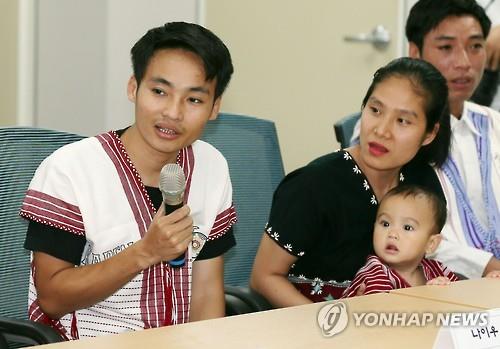
YEONGJONGDO, South Korea, June 20 (Yonhap) -- When 35-year-old Myanmar refugee Nei Oo arrived in South Korea with his wife and three sons in December, his top priority was to educate his kids in a better environment.

Since his family moved into the Korean Immigration Reception Center in Yeongjongdo, 40 kilometers west of Seoul, he has added more to his wish list.

"I want to work if there are any good jobs open, not only to afford an education for my children but also to live well here with my family," Nei Oo said Monday during an interview celebrating World Refugee Day.


Nei Oo, a Myanmar refugee who came to South Korea in December 2015 from a Thai refugee camp, answers questions during a press conference held at the Korean Immigration Reception Center in Yeongjongdo, 40 kilometers west of Seoul, on June 20, 2016. The United Nations High Commissioner for Refugees resettlement program transfers refugees living in temporary camps in an asylum country to another country that has agreed to admit them. (Yonhap)

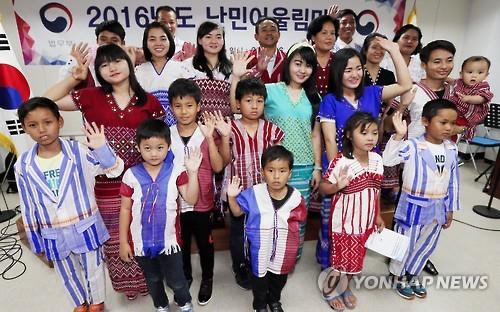
Nei Oo is one of 22 ethnic Karen refugees from Myanmar that arrived in South Korea last year as the first beneficiaries of Seoul's new resettlement program.

The refugees, four different families, previously stayed at refugee camps in Thailand to avoid oppression in Myanmar before coming here.

Most of the families said education, among other factors, led them to choose South Korea as their third country.

"Life back in Thailand was too harsh," Day Nya said, adding she could not work outside nor send her kids to school. "Now they all go to school here and we have hope."

The immigration reception center where the refugees are staying is a state-run organization that provides adjustment programs to refugees and asylum applicants.

"We are now providing vocational education so that the refugees can find their interests and capabilities before leaving this center," said Park Jin-soo, director in charge of the refugees' education.


A group of Myanmar refugees who arrived in South Korea in December 2015 poses during an event celebrating the World Refugee Day at the Korean Immigration Reception Center in Yeongjongdo, 40 kilometers west of Seoul, on June 20, 2016. (Yonhap)

A total of 51 people, including the four Myanmar families, are currently living at the center.

The center said it will start integrating the families into local communities starting September with the goal of finishing the procedure by the end of this year.

South Korea introduced the refugee program last year to accept up to 30 refugees every year until 2017 on a trial basis, granting them with F-2 visas.

It plans to decide whether to formally keep the refugee program after close analysis.

"They (refugees) are people like us," said Naveed Hussain, the chief of the Korean branch of the United Nations High Commissioner for Refugees (UNHCR). "The only difference is that we have a home to go and they don't have a home."

He said it is an obligation of the international community to provide them protection until they get back on their feet.

Kim Woo-hyeon, the chief of the Korea Immigration Service, also vowed to put efforts into changing paradigms in supporting refugees in the country and embracing them into society.


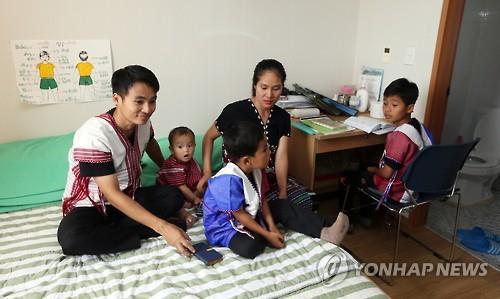
Myanmar refugee Nei Oo and his family give a tour of their room at the Korean Immigration Reception Center in Yeongjongdo, 40 kilometers west of Seoul, on June 20, 2016. Nei Oo's family, along with three other Myanmar families, arrived in South Korea as part of the United Nations High Commissioner for Refugees resettlement program. The program transfers refugees living in temporary camps in an asylum country to another country that has agreed to admit them. (Yonhap)

http://english.yonhapnews.co.kr

Myanmar will be ready to take back refugees soon, source claims


MYANMAR will soon be ready to take back over 100,000 refugees from nine shelters in Thailand, as the country moves towards democracy, an informed source claimed yesterday.
Details were revealed during the launch of a "World Refugee Day" event at Ban Umpiem Mai shelter in Phop Phra district in Tak province, which currently houses about 20,000 refugees. 

Shutaro Omura, the political affairs representative at the Japanese Embassy in Thailand, presided over the launch, which was also witnessed by Phop Phra district chief Prasong La-on and local Thai officials, plus representatives of the UN High Commissioner for Refugees, and staff from non-government groups. 

The source said a team from UNHCR had earlier visited the city of Hpa-An in Myanmar to negotiate with authorities there for repatriation of the refugees.

However, the head of The Border Consortium (TBC), the group that funds food and support for the border camps, said yesterday it was unlikely that refugees in camps in Thailand were about to be repatriated to Myanmar.


TBC executive director Sally Thompson said: "Our understanding is that no policy on refugee return has been outlined by the NLD [government] as yet. 

"To date, the message from all sides is the [new] Myanmar government has said it's not yet ready for refugee return. And Thailand has said they're waiting for the Myanmar government to say they're ready.

Close watch on Panglong II talks

"Refugee return is not a priority issue in Myanmar at present," Thompson said.

The NLD government, headed by State Counsellor Aung San Suu Kyi and President Htin Kyaw, is said to be focused on a major meeting between the government, military and ethnic groups at Panglong II forum- to try to thrash out big issues such as demilitarisation and political |participation that could lead to a more meaningful peace agreement than the deal brokered with eight ethnic groups by the Thein Sein government just prior to the election late last year. 

Panglong II refers to the ambition of many ethnic groups to reconvene the Panglong conference held in the Shan State township in 1947 between some ethnic groups and national hero General Aung San to talk about their |political future after Myanmar became independent. 

The outcome of those talks will be closely watched by Myanmar people both in and outside the country. If there is significant progress toward peace in various areas, a policy on refugee repatriation of the 100,000-plus refugees on the Thai border may then be considered, many sources have said. 

Suu Kyi is due to visit Tham Hin camp in Ratchaburi on Saturday morning, as part of her three-day visit to Thailand, which starts on Thursday.

http://www.nationmultimedia.com/

Employing refugees a win-win solution

Today — June 20 — is World Refugee Day. It is a time for us all to join in solidarity with the millions of refugees around the world who have been forced from the security of their homes by war and persecution. It is also a time to acknowledge their courage and resilience in the face of appalling challenges and insecurity. Over 65 million people worldwide have been forced to flee their homes — the highest number since the end of the Second World War. One in every 113 humans — or more than twice the population of Malaysia — is affected by conflict or serious human insecurity. In an increasingly globalised and interconnected world, no country is unaffected by this human tragedy. 

Malaysia, like other countries in the region, has been host to thousands of refugees over the past 50 years. Many people fleeing the Indochinese conflicts of the 1970s and 1980s found sanctuary and safety in Malaysia whilst the United Nations High Commissioner for Refugees (UNHCR) and the international community looked for more durable solutions for them, usually by resettlement to other countries. And today, although Malaysia has not signed the 1951 Refugee Convention, more than 150,000 asylum seekers and refugees — mostly from Myanmar — are seeking the protection of UNHCR in this country. Refugees in Malaysia have no legal status and are considered, by law, to be illegal migrants. This means that they have no lawful means to earn a living or to support themselves and their families. Their children are not permitted into the national school system and they face daily challenges in securing accessible and affordable healthcare. 

Many are forced into the informal market economy where they face discrimination and exploitation. This deepens the profound sense of insecurity and dislocation that accompanies their forced displacement. It also prevents them from making a meaningful contribution to Malaysia during their stay in exile. In confronting these challenges, Malaysia has a unique opportunity to look at solutions for refugees that have not been available in the past few decades. The changing situation in Myanmar means that many refugees from that country can start to contemplate a more positive future in their home country. With UNHCR’s support, countries in the region can better support some refugee communities as they consider the gradual transition from a life in exile to a future at home. Other refugee communities, for whom no immediate solution is in sight, need better protection and assistance, particularly those who are most vulnerable. Separated or unaccompanied refugee children, women and girls and the victims of trafficking or sexual abuse and violence need our special care and support. They ought not be excluded from our sympathy and care simply because of their “unlawful migration” status. UNHCR believes that a new compact of solidarity and support can be built for refugees in Malaysia and in the region. A compact that would allow vulnerable refugees to live and work lawfully in Malaysia would have three important and very positive effects.

 FIRST, a regulated scheme for refugees, that includes the opportunity to work lawfully, would address the legitimate concerns of the government concerning security, law and order, and criminality that currently pervades parts of the unregulated labour market economy. A government-administered registration system, working closely with UNHCR, would provide important biometric data, and verifiable identity documentation, as to who is in Malaysia. Enrolling refugees in a legal work scheme would bring them out of the shadows of the informal economy into a national data management system that can track their identities, location, and activities. This would also extricate refugees from the exploitation of smugglers and traffickers and the criminal market. SECOND, registered refugees, who could work lawfully, would provide a ready source of willing and reliable labour to support the Malaysian economy and increase national productivity. 

The World Bank has shown in its 2015 Malaysia Economic Monitor, that legalised refugee workers would lead to the creation of more jobs in Malaysia, increased wages for Malaysians, and increased Gross Domestic Product. UNHCR estimates that monetary contributions generated by a legalised refugee workforce could amount to RM152 million in annual revenue for Malaysia, based on the same levy rates as legal foreign workers. This means that the cost of hosting refugees in Malaysia would be more than offset by their positive contributions. THIRD, a scheme to allow refugees to live and work legally in Malaysia would be transformational in improving their protection and dignity, particularly for vulnerable women and children. 

Greater self-sufficiency among refugee communities would lead to better health and education and a significantly reduced burden on the host state. At the same time, it would provide a stronger basis for refugees to contemplate their future options, including returning to their home countries with transferable skills to start their new lives. UNHCR is convinced that this new approach would present a compact for closer cooperation with the government. It is a win-win for the people of Malaysia, for its security and economy, and for refugees who live here temporarily. On World Refugee Day 2016, we must all stand together #WithRefugees in solidarity with some of the world’s most vulnerable people. UNHCR is grateful for Malaysia’s solidarity #WithRefugees, on this important day. Richard Towle is UNHCR Representative to Malaysia

Don’t ignore Rohingya’s rights, Syed Hamid tells Asean


Minderjeet Kaur | June 20, 2016

Southeast-Asian grouping needs to be flexible in its non-inteference policy to discuss and manage refugee issue, says former foreign minister.


KUALA LUMPUR: Former foreign minister Syed Hamid Albar said Asean countries need to be more flexible in their non-interference policy, especially in tackling refugee issues.

“Asean countries respect the sovereignty and the non-interference policy adopted by member countries. Due to that, it’s a sensitive issue.

“But the spillover of refugees is no longer a domestic issue in Myanmar. It is a violation of human rights.”

He was speaking to reporters after delivering a keynote address at the UNHCR Expert roundtable discussion, titled “Employing Refugees in Malaysia: A Win-Win for All?”.

Syed Hamid said the Organisation of Islamic Cooperation (OIC) had tried to set up office in Myanmar to look into the root cause of the problem between the people of Myanmar and the Rohingya community.

“But there was strong opposition from extreme groups there.”

He urged Myanmar’s Foreign Minister Aung San Suu Kyi to look into the issue and pleaded with her not to neglect the issue which has since evolved into a humanitarian crisis.

“The Rohingya community are deprived of education and medical benefits. They live in deplorable conditions.”

Last year, thousands of Rohingyas fled Myanmar to Malaysia and Indonesia to seek better lives after years of persecution in their homeland.

Syed Hamid then praised the United Nations High Commissioner for Refugees’ (UNHCR) move to re-issue enhanced identity cards with biometric safety features to refugees and prepare proper documentation of refugees in Malaysia.

The initiative is meant to stop the spread of fake documents after media reports exposed syndicates issuing such cards to illegal immigrants.

Syed Hamid, who also heads HumaniTi Malaysia, an NGO which supports education and humanitarian issues, said he will meet government officials here to allow genuine refugees to work in Malaysia, once the documentation is completed.

“Instead of hiring foreigners, use the existing manpower who are registered with UNHCR to work in sectors Malaysians are not interested in.

“It is a good way of solving labour shortage,” he said, adding that this method will ensure that refugees would not be exploited.

Syed Hamid also said this could allay fears that allowing refugees to work in the country would lead to an influx.

Asean is a 10-member grouping of Southeast-Asian nations comprising Malaysia, Indonesia, Philippines, Singapore, Thailand, Brunei, Vietnam, Laos, Myanmar and Cambodia. Timor Leste is the only Southeast-Asian nation yet to gain full membership in Asean.

UNHCR Malaysia to introduce new identity card for refugees


An Oct 20, 2015 file photo of Rohingya refugees showing their UNHCR refugee cards at the Belantik immigration detention depot in Sik, Kedah. - BERNAMApic
KUALA LUMPUR: The United Nations High Commissioner for Refugees in Malaysia is issuing a new refugee identification card with added security features to help tackle the problem of syndicates offering fake UNHCR cards.

UNHCR representative for Malaysia, Richard Towle said the new enhanced features would help detect fraudulent cards.

The new card is expected to be made available from tomorrow, he said on the sidelines of the UNHCR experts roundtable discussion here today.

As of April this year, 154,140 refugees and asylum-seekers were registered with UNHCR Malaysia, the majority of them from Myanmar, at 139,780.

Meanwhile, former Foreign Minister Tan Sri Syed Hamid Albar, who attended the event, described the new refugee identity card as a good initiative.

"The old card does bring a lot of problems and we hope the new one, which has enhanced security features, will help in the management of refugees in the country," he said.

http://english.astroawani.com

Friday, June 17, 2016

Refugees’ right to work


MALAYSIA is not a state party to the 1951 Refugee Convention and its 1967 Protocol, and so it does not recognise refugee status or provide rights for refugees, including employment rights.

Despite that, refugees have been working in the informal sector all this while to survive, and Malaysian authorities turn a blind eye. They are mostly unskilled labourers who work in 3D sectors. There are also refugees with professional qualifications.

Without employment rights, refugees are often exploited and abused. The issue of employment rights for refugees also affects employers who hire them.

In 2013, the Malaysian Government announced that it would issue work permits and provide training for refugees living in Malaysia, but this plan did not materialise.


Recently, the Home Minister again announced that thousands of Rohingya who have been granted refugee status by UNHCR would be able to take up employment opportunities in sectors that are “appropriate, safe and easily monitored by the authorities” through a pilot project.

There are articles and sections in existing Malaysian laws, and the international conventions and declarations that Malaysia signed, that are supposed to make it legal for refugees to gain employment rights.

Both citizens and non-citizens are entitled to rights enshrined in the Federal Constitution. This includes the right to be engaged in lawful and gainful employment.

Article 8 (1) of the Federal Con­sti­tution says that “All persons are equal before the law and entitled to the equal protection of the law”.

The Industrial Court also agreed in Ali Salih Khalaf v. Taj Mahal Hotel that the equality of UNHCR-registered refugees under the law is also reflected in the Employment Act 1955 and Industrial Relations Act 1967.

Malaysia had temporary residence permits called IMM13, permissible under section 55(1) of its Immigration Act, which states that the Minister can exempt “any person or group of persons from the provisions of the Act”.

Acehnese, Rohingya and Moro refugees were issued with these permits that allowed them to remain legally in Malaysia and engage in lawful employment.

In an amendment of Section 516 of the Anti-Trafficking in Persons and Anti-Smuggling of Migrants Act in December 2015, the Council of Anti-Trafficking in Persons and Anti-Smuggling of Migrants may give permission to any trafficked person who has been granted a Protection Order to move freely or to be employed, engaged or contracted in any occupation.

As some of the refugees, especially Rohingya, were victims of human trafficking, they should be protected and allowed to work under this Act.

Two important aspects mentioned in the Universal Declaration of Human Rights are in Article 14, which is the right to seek asylum from persecution, and Article 23, which outlines the rights to employment without discrimination to everyone. As a member of the United Nations Security Council, Malaysia is supposed to uphold the human rights principles enshrined in this Declaration.

Article 16 in the ASEAN Human Rights Declaration states that “Every person has the right to seek and receive asylum in another State..” while Article 27 (1) states that “Every person has the right to work, to the free choice of employment, to enjoy just, decent and favourable conditions of work and to have access to assistance schemes for the unemployed”.

Malaysia is also a signatory to the Cairo Declaration on Human Rights in Islam Declaration, adopted by the Organisation of Islamic Cooperation, which views human rights issues from the Islamic perspective within the Syariah framework.

Article 12 mentions that “Every man... if persecuted, is entitled to seek asylum in another country”. Article 13 states that “Work is a right guaranteed by the State and Society for each person able to work”.

Being a Muslim world champion, Malaysia needs to show its compassion for human rights by complying with this declaration.

The existing national laws and international instruments in place already provide legal obligations for Malaysia to grant employment rights for all refugees in Malaysia.

The right to work should be extended to all refugees in Malay­sia because no one should ever be discriminated against, based on their ethnicity, nationality or religion.

ASLAM ABD JALIL

Master of Public Policy student

International Institute of Public Policy and Management

Universiti Malaya

http://www.thestar.com.my/

The Picha Project delivers meals to you… made by refugee families in Malaysia

(From left) The Picha Project founders: Suzanne Ling, Lee Swee Lin and Kim Lim. — Pictures by Choo Choy May and courtesy of The Picha Project
(From left) The Picha Project founders: Suzanne Ling, Lee Swee Lin and Kim Lim. — Pictures by Choo Choy May and courtesy of The Picha Project 
KUALA LUMPUR, June 17 — These days, food delivery businesses are a dime-a-dozen. Some offer restaurant-quality meals while others capitalise on the latest health food trends — be it organic, gluten-free or even raw. But how many will offer their customers a chance to help out a refugee family?

Enter The Picha Project, a social enterprise supported by the MaGIC (Malaysia Accelerator Global Innovation Centre) Accelerator Programme, which delivers to customers traditional meals made by families from marginalised groups. The project aims to provide job opportunities to these families by creating a platform for them to cater food to the public.

The Picha Project was founded by psychology graduate Suzanne Ling, musician Kim Lim and former Le Meridien finance executive Lee Swee Lin. While none of them have a business background, they had previously worked together at Hands of Hope, a social project under UCSI University founded by Ling and Lim in 2014 to provide education assistance to children from the marginalised groups, including refugees.

Burmese turmeric chicken and corn salad.

Hands of Hope arranges for volunteers — up to 250 university students — to teach core subjects such as English and Maths to the children of the marginalised groups on a weekly basis. Ling said, “As we worked closely with them, we saw how they are struggling financially. Many of our students had to drop out of school and work at a young age to support their family. We wanted to do something for this community; hence, we started The Picha Project.”

The Picha Project differs from other social enterprises that also help marginalised communities as they utilise the existing cooking skills of several refugee families to create a food catering business. Lim says, “Our customers have a different kind of eating experience as they get to taste authentic traditional cuisine from different cultures and countries. We also have stories of the family who prepared the food on the meal box to create more social awareness of the issues they are facing. Customers get to have food and do good and at the same time.”

Currently, The Picha Project works with three different families from the refugee community — one from Myanmar and two from Syria. Burmese dishes such as beef stew and vegetables, as well as turmeric chicken and corn salad feel familiar yet have a unique flavour to them. Fattet Magdoos (eggplant casserole) and Yalanji (vegetarian stuffed grape leaves) are traditional must-try Syrian dishes.


Fattet Magdoos (eggplant casserole) and Yalanji (vegetarian stuffed grape leaves) are traditional Syrian dishes.Lee says, “All our cooks prepare their authentic traditional food from their homes and the Picha team will pack and deliver the food to the customers. We are also in the process of recruiting more families. We will be meeting a few more families from Palestine, Pakistan and Yemen soon.”

Some of the cooks are families that the founders were already in contact with through Hands of Hope. Others were referred to them by UNHCR (United Nations High Commissioner for Refugees) or other NGOs. Ling explains, “We identify families who can cook and are in need of a job to make ends meet. Prior to recruiting the families, we visit them at their home to understand the overall situation in the family, which includes financial background, physical needs, education of their children, etc.”

The Picha Project aims to cultivate a culture where marginalised people can work and earn their own income, rather than simply offering them direct monetary aid. Lim says, “Even though they have a background that is disadvantageous for them, we believe that through empowerment and guidance, they are able to develop into individuals who can be self-sustainable with certain competencies. It is also important for them to be able to gain confidence and believe that they can actually do something with their life.”

Burmese beef stew and vegetables.

Working with these families, the Picha Project team had many inspiring learning experiences. Lee recalls an anecdote shared by one of the families. “Last Ramadan, they were offered some money by a kind-hearted man. However, instead of receiving the money, the father turned down the offer as he came from a culture which believes that money should be earned with hard work. So many people think that these marginalised groups are most probably lazy and prefer receiving donation, food or money from others. However, that is not the truth.”

Indeed, many of them are more than willing to work hard for a better life for their families, if only they were given an opportunity — the sort The Picha Project is providing today.

Learn more about The Picha Project at www.facebook.com/pichaproject

Syrian chicken biryan

http://www.themalaymailonline.com