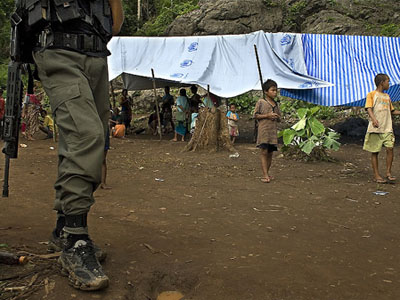
A Thai soldier at a camp for Karen refugees on the Thailand-Myanmar border. Presently, up to 130,000 Burmese refugees are residing in various camps along the Thai borders, with many more undocumented. Photo by: Rusty Stewart / CC BY-NC-ND
Since its former military rulers started easing their grip on power in late 2010, Myanmar has been continuously engaging in various economic and development efforts with the rest of the world, including a peace initiative aimed to unify local groups in the conflict-ridden border areas that is now in danger of shutting down operations.
The Norwegian-led Myanmar Peace Support Initiative, which started almost two years ago at the request of the Myanmar government, is likely to end soon — a huge decision but not surprising, as the program was actually put in place on a short-term basis, according to an insider.
“The initiative was always intended to be short-term, in order to build trust and confidence in — and, most importantly, to test — the peace process in Myanmar,” Ashley South, one of MPSI’s foreign consultants, told Devex. “When we started two years ago, the expectation was that MPSI would probably wind down after about a year, so in fact, we have stayed on longer than originally anticipated.”
MPSI came under the spotlight early last year, after the Peace Donor Support Group, a larger platform supporting the peace process in the country, released an internal review of the initiative a year after its launch. The report revealed that numerous challenges remain despite the efforts done by the initiative including lack of confidence in the peace process with local groups expressing their views regarding these programs as “buy[ing] peace” in support of the goals of the national government.
The report stated: “As a result [of minimal confidence in the political process], some non-state armed groups viewed large-scale humanitarian and development projects as attempts to ‘buy peace’ in support of the government’s political, social and economic goals.”
Not donor, nor implementer
These reported incidences of conflict not only increased the number of refugees especially in the border area of Myanmar and the neighboring nation of Thailand but also dragged the country’s development progress following its democratization. Presently, up to 130,000 Burmese refugees are residing in various camps along the Thai borders, with many more undocumented.
Some of the projects under the MPSI program include assistance to internally displaced communities in conflict-ridden areas in the country, infrastructure rehabilitation and services including water, sanitation and hygiene, and cultural preservation and educational programs, among others. But whether these efforts are successful or not remains a topic of debate.
South said the peace initiative is “neither a donor nor an implementing organization” as it only facilitates information and project guidelines for the local groups to implement.
“Everything we do is designed and implemented by local actors, with MPSI playing a facilitating role, linking local needs and peace process to international donors,” he explained.
The internal review stated this is precisely one of the challenges in making MPSI effective, after revealing that local organizations and even the non-state armed groups find it hard to articulate their needs, and even more so implement effectively the kind of projects they were struggling to write and propose to begin with.
In a previous op-ed published in the Myanmar Times, South echoed this and wrote that there should have been capacity-building mechanisms done at the local level prior or simultaneous to the implementation of these projects.
This is the tip of the iceberg, as PDSG itself also mentioned other controversies hounding the initiative, including lack of transparency in the process, suspicion over Norway’s economic motives and lack of commitment to the process in terms of project development, among others.
Shutdown unlikely — Norwegian NGO
Meanwhile, Norwegian People’s Aid — one of the international groups supporting MPSI — said the probability for the peace initiatives, as a whole, to be discontinued altogether is minimal, and this may only be a next step towards Myanmar’s long-term peace process.
“We trust that the MPSI’s activities will not be discontinued in any short term. It is possible and a current matter of discussion to integrate the MPSI within other initiatives coordinating the international support to the peace process,” Claudio Feo, NPA adviser for Southeast Asia, told Devex.
He added: “NPA believes that, should the peace process reach significant positive turning points, then it would be understandable to revise also the support mechanisms to the peace process.”
Details regarding the decision — or non-decision — will be laid out soon, according to South, that may affect the progress of Myanmar’s peace process.
“MPSI is planning to hold an event fairly soon, to share some of the lessons we have learned during two years of supporting and testing the peace process in Myanmar,” he concluded.

