Tuesday, June 26, 2012

Midland adapts to growing refugee community

  Burmese Chin Family

Burmese Chin Family

After a year of waiting, Burmese Chin refugees Zung and Biak Thang stand outside their new Midland home June 14, with children Gary, 7, and Livingstone, 3. Chaney Mitchell/Reporter-Telegram

 It feels like a dream, said Biak Chhungi Thang and her husband Zung Lian Thang while sitting in their living room. Two months ago, the couple and their two children invited friends over to celebrate their move into a three-bedroom house in south Midland. They cooked food from their homeland and displayed a large banner with the words of Psalm 34:08 written in their native tongue: "Taste and see that the Lord is good; blessed is the one who takes refuge in him."
The Thangs are refugees from the Chin State in western Myanmar, formerly known as Burma. Tens of thousands of Chin have fled the country since 1988 because of a "highly authoritarian military regime" responsible for human rights abuses based on religion, ethnicity and political beliefs, according to a 2010 Human Rights Report on the country by the U.S. Department of State.
Individuals who are granted refugee status overseas by the U.S. are brought back for resettlement by the Department of State, which partners with local resettlement agencies to provide any resources the refugees might need upon arrival. The nearest resettlement agency to Midland is in Abilene, but Chin still come in droves to Midland as they hear about the availability of jobs.
"I think Midland is attractive from a job perspective," said Midland city councilman John James. "And that's great because we are starving for workers."
The International Rescue Committee, which has regional resettlement offices in Abilene and Dallas, realized the growing need in Midland for refugee services, and established a satellite program earlier this year to provide ESL and basic skills classes. Other literacy programs in town have found the need in recent years to add Burmese Chin-targeted ESL classes to their schedules.
An increasing amount of Chin like the Thangs have found their own versions of the American dream in Midland by quickly obtaining jobs, houses and cars, thanks to the local booming economy. Biak Chhungi Thang works at T&T Donuts in the morning, and Zun Lian Thang stocks the shelves at H-E-B in the evenings. They both found work after moving to Midland from Jacksonville, Fla. in 2009 to live with Zun Lian Thang's uncle. They were referred to Casa de Amigos, and Biak Chhungi Thang instantly bonded with intake specialist Ida Fletcher. Fletcher taught the woman to drive, complete applications and work with Midland Community Development Corporation's housing counselor to buy a house of their own.
"They're hard-working," said Fletcher, who since has become the organization's community services coordinator. "They follow through on anything we talk about to benefit the family. I don't feel like their caseworker. They're my friends."
In their own backyard
Visiting Thailand on a mission trip in early 2008 was an eye opening experience for First Presbyterian Church member Kelli Sherman. The group traveled at one point to the country's border with Myanmar to visit a refugee camp and saw the desperate situation first hand.
"You go on this trip, and you think, 'Wow, how can I help?'" she said. "It's just heartbreaking and you think, 'Now I go back to my life that's so wonderful, so easy.'"
The group left on a plane days later, not sure what they could do from thousands of miles away. The answer came when the woman who had led the mission team, Margaret Purvis, was shopping at H-E-B and recognized the face and language of a man behind the sushi bar. She had found someone from Myanmar in her own town.
The man, Duh "Louie" Luai, said there were around 30 Burmese Chin in Midland who were receiving help from a local Pentecostal church and meeting for worship services in his apartment. He had become overwhelmed with the amount of needs of his community, Sherman said, so First Presbyterian members jumped in to help. Sherman helped Chin individuals make appointments, register kids for school and fill out applications.
It was like fighting fires, Sherman said, almost in a literal sense. The complex where Luai held worship services was engulfed in flames in 2008, destroying 16 units, two of which belonged to Burmese families. First Presbyterian helped raise money to replace the lost equipment, and the growing Chin continued to worship.
"As things came up we tried to deal with things as we could," Sherman said. "It was a learning process; every day it seemed like multiple things were new."
The Chin population continued to grow, and is growing at such a rapid pace that there is no official number for how many Chin refugees are in town. Those who work with the three established Chin-focused Christian churches around town say attendance suggests the current population to be around 600.
"It's just grown and grown and grown as more people have come into the country and they realize they have family here and there's jobs," Sherman said.
Neighborhood norms
Traditional brick houses line the block of Imperial Avenue just north of Lee High School. Nestled between the earth-toned facades is a starkly bright symbol of the increasingly changing neighborhood; a house painted baby blue with red trim. Similar in color to brightly-painted houses in Malaysia, where many Burmese refugees go after fleeing their country, the house has become a visual symbol of neighbors' struggles to maintain neighborhood norms in the midst of changing cultural dynamics.
The Chin family-owned house, along with allegations of violations of the city code and neighborhood norms, was the subject of "intense" phone calls and emails being circulated among the neighborhood and community leaders this spring in reference to new Chin neighbors, according to James. The councilman agreed to facilitate a town hall-style meeting for the neighborhood that involved leaders of the local Burmese community.
"There's a broad interest, and I share it, in being the welcoming community that Midland is," James said. "There is this similar interest, just as broad, in saying, 'And here's the way you behave in neighborhoods.'"
Older neighborhoods like the one on Imperial Avenue are called "neighborhoods in transition" from a planning perspective, according to James. While some in the neighborhood still have deep roots in the homes where they raised their kids, others are just moving in to vacant homes whose previous owners have moved on to more expensive neighborhoods.
"You have this mix of people who have been there a long time and this mix of new folks," he said. "Sometimes they don't have the same appreciation for the neighborhood."
The contrast and misunderstandings are even more stark with the Burmese, James said, because they are trying to adjust to so many cultural norms at once. One Chin family once kept a live chicken in the yard before preparing it for dinner, and soon realized their neighbors found the accompanying loud noises unacceptable. Another church leader in the Chin community said he tries to let his neighbors know when he's having large meetings so they know more cars may be parked on the street.
"My sense is that by people coming together and having these conversations and talking you get more accomplished, especially when there's nothing illegal at play, you have to talk to your neighbor," James said.
Many Burmese quickly make the move to Midland for the availability of jobs once arriving in the U.S., and miss the benefits of acclimating in an official resettlement location that provides resources and classes in regard to local driving, laws and social norms.
"They come and they get jobs immediately, so they ended up not going through those courses," James said. "They may settle slightly in Abilene but find out there are jobs in Midland and immediately come working 60 to 70 hours. They never go though the process -- it's voluntary -- but that would complete their assimilation training, for lack of a better term. When you start talking about parking issues and neighborhood issues, that's all foreign to them."
James hopes one answer to the neighborhood's struggles will be to arrange for long-time neighbors and newcomers to meet at a house in the neighborhood to share food and fellowship in an event similar to "National Night Out." The next step will be to build a system where the leaders of the Burmese community can help ensure others are going through a program involving code enforcement and basic skills to help them understand city codes and neighborhood norms.
Leading a community
"They don't know my culture; they never see my culture. If they saw my culture, they would understand," said Solomon Kham, 31, while sipping on a soda in the cafeteria at H-E-B.
The Chin refugee crosses his arms.
"In my culture, this means I respect you," he explained. "Some people don't know that."
Kham is considered a leader in the Chin community for both his proficiency in English and his role as president of Midland Chin Baptist Church. He's helped dozens of recently arrived refugees find work, housing and other resources to help them acculturate in their new community. Many people don't understand they need to build up credit before buying a house, he explained, and others don't even have proper identification papers yet. He receives an occasional call late at night from Chin who unknowingly run into trouble with the law and have no way of communicating with law enforcement. He and leaders from the two other Chin congregations in town are in the process of arranging a presentation to take place on Aug. 5 for the refugee community about American culture and laws.
"I like to help people," he said. "Is it overwhelming? Yeah."
After spending time in Maryland and Amarillo Kham moved to Midland in 2009 at the insistence of his girlfriend, who had moved to Midland with her family. There was a small Chin community here, she said, about 30 to 40 people, and there were a lot of jobs. He immediately found work at TOMCAT USA, then began working at Century Graphics & Signs, where he now serves as a supervisor. He is now married to his former girlfriend, and together they have a 1-year-old son.
Kham graduated from Midland College in May with an Associate of Applied Science Degree in petroleum technology, and is continuing his studies at the University of Texas of the Permian Basin in petroleum engineering. Being able to continue his education defines the American dream for Kham, who was forcibly recruited into the Burmese Army before fleeing the country in 2003. His parents still live there, and he hopes to bring everything he's learned back home someday.
"I believe when my country gets good, I'll go back to Burma," he said.
Sara Higgins can be reached at shiggins@mrt.com.

Burmese refugees trying for a start in the auto industry

This Refugee Week we wanted to share a positive story from Mission Australia’s Employment Solutions team in Brisbane. It’s about two young refugees from Burma who are making a go of it in their new home.
Over the past 12 months, the team has been working with Keh Doh, 19, and Mah Let, 18, who both arrived in Australia in 2009 after each spending over a decade living in refugee camps in Thailand.

They have made great strides in the past year. Both have completed Language, Literacy and Numeracy Program classes and their English has now progressed to the point where they are ready, willing and able to work.

After discussing their career goals with one of our Chermside Employment Solutions Advisors, Christine Stevenson, they decided they both wanted to be mechanics.
They are now working towards that goal thanks to HELP Enterprises, an organisation Mission Australia works with in Brisbane to provide early school leavers with accredited training.

Both young men recently completed a Certificate II Automotive Mechanical and Keh Doh received a taste of working life through a one-week work placement.
Keh Doh came to Australia with his parents, brother and sister. Before this, the family had been living in a Thai refugee camp for almost 11 years.
“He is extremely enthusiastic and is going very well. He’s currently learning to drive and is going for his P-plates next Thursday – which is a big step,” said Ms Stevenson.
“His trainer, Peter, has told me that whenever there is tidying up to do or putting tools away – Keh Doh never ever questions anything but just does it, and quickly!”

Mah Let is also very keen to learn and carve out a new life in Australia after a rough start. This young man left Burma when he was two years old. He travelled on foot with his parents and five siblings, and spent 13 years in a refugee camp in Thailand.
“Both of these young people have had very tough existences,” said Ms Stevenson. “I am very impressed by their commitment and would love to see a positive outcome for both young men, who really do deserve a new start.”

Both Keh Doh and Mat Leh would love to work with cars. If you know someone in the auto industry who could provide them with start in the North Brisbane area, please email Ms Stevenson on stevensonch@missionaustralia.com.au.

Art With Heart : A Refugee Art Project

Many of us live our lives oblivious to what’s happening around us. How often do we remind our kids how fortunate they are when there are other less fortunate kids out there who some, don’t have the luxury of cuddling with their loved ones, or have a formal education or just have a childhood?
The United Nations Refugee Agency Malaysia (UNHCR)  is mandated to safeguard the rights and well-being of refugess and asylum-seekers worldwide and they have been working to protect and assist refugess in Malaysia since 1975.

These refugees are not criminals nor are they parasites.   Their intention is not to take away the jobs in the country.   They are courageous people with strength and determination to move on and build new lives for themselves with hopes that one day, their country will be safe for them to go back to and if not, they just want to have a chance to have a life – like everyone else. There are not only men and women involved but also children – who’s only hope is to have a normal childhood with lots of love and an education. 13,800 refugee children in Malaysia are of school-going age and less than 40% of them have no access to formal education. Those that do have access  to a formal education attend classes that are run by UNHCR and NGOs  or community-based education classes that are organized by refugee communities themselves. However, these children are no as lucky as our children. They have classes in cramped, rented shop houses or flats where the rooms are converted into classrooms and are mostly lack of basic teaching facilities and qualified teachers.
UNHCR seeks long term solutions for refugees including finding them new homes in third countries or helping them return home voluntarily when it is safe to do so. While they are seeking temporary protection in Malaysia, UNHCR works with partners to create a safe and secure environment for them where their basic needs are met.

In the spirit of spreading the word about the Refugee Camp, GIN & JACQIE™ threw an art contest for the children and called it Art with Heart : A Refugee Art Project.
The children were provided with all the necessary materials which included the theme – ‘Happiness’.
Mary, a 15 year old refugee child from Myanmar was chosen out of hundreds of children. Her piece was an ode to her mother whom she had lost recently.
 ”I painted love,” said Mary, “When my mother passed away, I was scared. But I know her love is always with me. And that makes me happy.”
GIN & JACQIE™ printed her artwork onto canvas bags, and these bags are  available for purchase from here starting 20th June  2012.  All proceeds will go to the aid of education for the children, which includes basic needs, books, and stipends for teachers.
If you would like to be a volunteer or just find out more about the refugees in Malaysia and what UNHCR is doing to help them, log on to www.unhcr.org.my.
Spread the word on how we can support the refugees in Malaysia. Do your bit in giving back to the society.
 
Source : http://www.mom2ashley.com


Protect Refugees And Asylum Seekers In Malaysia

                           PRESS STATEMENT


                                             20 June 2012 WORLD REFUGEE DAY

ACCORD THE RIGHT TO WORK FOR REFUGEES AND ASYLUM                                            SEEKERS   IN   MALAYSIA


In conjunction with World Refugee Day, we call for the Malaysian government to accord the right to work for refugees and asylum seekers in Malaysia.

There are 98,100 refugees and asylum-seekers registered with United Nations High Commission for Refugees (UNHCR) in Malaysia, 92% of which are from Burma’s different ethnic groups. 8,200 are from Sri Lanka, Somalia, Iraq, Afghanistan and other countries.Refugees and asylum seekers are considered “illegal immigrants” under Malaysian law, specifically the Immigration Act 1959/63 (Act 155). Unable to work legally in the country, they survive by working in the informal and often unregulated work sectors, performing ‘3-D work’(dirty, demanding, dangerous) without legal protection.  This increases their vulnerability to forced labor and human trafficking and its negative consequences for ill-health.


This is evidenced in Health Equity Initiative’s research report Forced Labor, Human Trafficking and Forced Labor: The Experiences of Refugees and Asylum Seekers in Malaysia. This research revealed a high prevalence of forced labor and mental health distress whereby 61.2% of refugees and asylum seekers in the 1,074 study population who had worked full time had experienced forced labor. About 70% of the respondents showed symptoms of Depression and 68%showed signs of Anxiety. In-depth interviews revealed practicesof deception and fraud, withholding of wages, physical confinement, non-payment of wages, threats of denunciation to authorities, induced indebtedness, physical violence, and sale into ownership by their employers.


The social and legal factors contributing to the mental ill health in this population living and working side by side with Malaysians needs to be urgently addressed. We t therefore call on the Malaysian government to:

(1)     Accord refugees and asylum seekers the right to work

(2)     Recognize refugees and asylum seekers and ratify the 1951 United Nations Convention relating to the Status of Refugees and its 1967 Protocol Regulate the
labor sector to prevent and protect against exploitation and forced labor

(3)     Ensure that all persons who have experienced human trafficking and forced labor, regardless of their legal status,  have access to appropriate legal, medical
and  protection services and that they will not be refouled

Health Equity Initiatives
 
Source : http://www.abim.org.my

Support Refugee Education with Gin&Jacqie Bag!

Support Refugee Education with Gin&Jacqie Bag!!


Buy a specially designed Gin & Jacqie bag, and 100% proceeds will go towards refugee education programmes in Malaysia!

A specially designed ‘Gin & Jacqie’ bag will be on sale from 20 June 2012 in support of refugee children in Malaysia under a fundraising initiative called “Art With Heart: A Refugee Art Project”. 

This was launched at Bangsar Village shopping complex here today in conjunction with World Refugee Day on 20 June. 

This fundraising project is a collaboration between bag designer ‘Gin & Jacqie’ and UNHCR in Malaysia. 

The bags are available at www.ginjacqie.com and Cziplee (Bangsar) at the price of RM24. 

The initiative is supported by corporate donors Cziplee (Bangsar) who sponsored the art materials for the art competition, and Bangsar Village as the venue sponsor for the launch of the bag and exhibition on the artworks in conjunction with World Refugee Day.

Source : http://www.unhcr.org.my/News

Chin: Family Speaks about Struggle


Following World Refugee Day 2012, a Chin family, who sought refuge in Australia, speak out about the abuse they were subjected to in Burma as a result of the government’s persecution of minorities and religious groups.

Below is an article published by The West Australian:

The army stole his possessions and his land but Lian Neakngen, one of Burma's Chin minority, feels safe - and grateful to have escaped persecution.
"More safety, more secure and peace," was his description in halting English of life in Perth.
His 12-year-old daughter Ester had her say: "We all like it here. We find the life is easy."
That was no so in Kalaymyo, in Burma's north-west.
Most of the 1.5 million Chin are Christians, mainly Baptists like the Neakngens, and up to 100,000 are reported to have fled to India.
Mr Neakngen said persecution drove him from Burma to Malaysia, where he spent six years. His family joined him later.
In 2007, four years after applying, he arrived in Australia with pregnant wife Ngin and their two children.
Lian and Ngin were among 18 refugees from nine countries who pledged allegiance yesterday [20 June 2012] to the country that gave them a home in a citizenship ceremony in Perth on World Refuge Day.
They came from Eritrea, Sierra Leone, Sudan and other war-scarred regions and arrived under Australia's humanitarian program.
Many dressed proudly in national costume for yesterday's ceremony.

The astonishing work of female NGO workers

By LOUISA LIM
star2@thestar.com.my


Forget Wonder Woman. These women prove that real-life superheroines do exist, and they’re not necessarily dressed in a tiny red bustier and star-speckled shorts.
THESE women visit disaster zones as the residents flee, alleviate the suffering of thousands, and inspire others with their compassion and graciousness.
Female NGO workers’ contributions are phenomenal, but they hardly ever make the headlines. There’s also an often-untold aspect about this line of work: the personal costs endured by these women. Only last year, NBC’s Ann Curry was in Mogadishu with a humanitarian aid worker from the World Food Programme. “How do you come out of that, come out of looking at that, without just wanting to cry?” she asked.
“I don’t — I don’t,” the aid worker replied.
Because the work is fraught with anxiety (and danger, at times), many NGOs often face difficulties in recruiting more women. However, Star2 managed to find four astonishing women in humanitarian work who forge on with perseverance and conviction. We want to know why — and how — they do it.
Walking into disaster
Jessica Wong, 27, programme officer, Mercy Malaysia
Getting into Mindanao, the Philippines, after a severe tropical storm has just hit would probably be unthinkable for many people. But for 27-year-old Jessica Wong, it was just another day at work.
Putting others first: Jessica Wong registering refugee children for vaccination clinics in Malaysia. She developed an interest in the humanitar ian field a fter she began volunteering at local community centres, student societies and non-governmental organisations.
As programme officer in Mercy Malaysia’s relief operations department, she provides medical relief, sustainable health-related development and risk-reduction activities for communities in both crisis and non-crisis situations.
“Apart from coordinating health-related projects for Malaysia and abroad (in countries such as Afghanistan and Sri Lanka), I am also deployed for disaster relief operations when the need arises,” she says.
Wong, who started out in the banking sector, says she developed an interest in the humanitarian field after she began volunteering at local community centres, student societies and non-governmental organisations.
“The resilience of the human spirit is something that never ceases to amaze me,” she says. “I hope the projects we carry out for the communities we serve will go a long way towards building local capacities and resilience in responding to disasters. Seeing communities thrive after a project has been completed is most rewarding.”
One such project was reconstructing and re-equipping a divisional hospital for the local health authorities in Jaffna, Sri Lanka. The hospital has since been successfully handed over.
“It was the culmination of nearly a year’s hard work by our volunteers, staff and local partners. The hospital now serves approximately 10,000 people from the surrounding areas,” she says.
Nonethless, Wong claims that the general public often have a distorted view of humanitarian aid in Malaysia, which makes her work more difficult.
“Often, there is a misconception that money and goods will fix problems but what is more important is for the assistance to match the beneficiaries’ needs and for that help to be sustainable,” she says.
There is also a limit to what aid organisations can do, says Wong.
“More often than not, the lifespan and sustainability of aid programmes are contingent on funding, which is usually unpredictable. Of course, given the opportunity, I would like to do more but I do realise there are intricacies involved that result in limitations. I have learnt to accept that.”
Rich in good deeds
Anrie Too, 29, fundraising manager, National Cancer Society
‘There is so much more in life than just money. Aside from the fact that I get to meet and work with amazing people with an incredible sense of selflessness, I get to take home with me the sense of having contributed to the betterment of the society, albeit in a small way,’ says Anrie Too.
Most people are probably familiar with the 29-year-old Anrie Too and her role as a ditzy pageant contestant in Joe Hasham’s Malaysian Girls and countless other local productions. However, mention her other job with the National Cancer Society of Malaysia and all you’re likely to get is blank stares. But working for an NGO has always been on her life’s to-do list, and when an opening in the society became available, she jumped at it.
“I get to tell myself every day that whatever I accomplish for that day, regardless of how small, it will impact the life of someone else in possibly a big way,” she says.
When people think of humanitarian workers, they picture disaster responders handing out water, food and first-aid kits. However, as fundraising manager for the National Cancer Society of Malaysia, Too’s work takes place mostly in an office.
At first, her decision to join the society drew surprised reactions from those around her. “People asked me if I’m going through a phase in life. They asked me if I was making an emotional decision. But it was none of those,” she says, adding that, although no one close to her had suffered the Big C, she has witnessed first-hand the toll it took on her friend when his mother was diagnosed with cancer.
“The ultimate goal of any NGO should be its own demise, because when an NGO becomes redundant, that basically means its vision has been accomplished. Thus essentially, working for an NGO is working against societal normalcy. But anything in life that is worth having, is worth working for. So, I say, just go for it,” she explains.
Although she is not earning top money, Too finds that her job fulfils her in a different way.
“There is so much more in life than just money,” she says. “Aside from the fact that I get to meet and work with amazing people with an incredible sense of selflessness, I get to take home with me the sense of having contributed to the betterment of the society, albeit in a small way.”
She has, however, suffered one or two disappointments during the course of her work. One project, in particular, left a huge impression on her because of her inability to fulfil the dream of a cancer patient.
“She passed away before I had the chance to rectify the situation. This incident has disappointed me in so many ways – but mainly, knowing that sometimes, I can’t get everything right,” she says.
Too often dreams that, one day, she would meet a person who would tell her that what she’s been doing made a difference in their life. That’s why one of her most memorable moments happened when she was presenting a cheque to a cancer patient’s daughter.
“She rewarded me with the most gracious and sincerest thank you,” says Too.
In all humility
Vizla Kumaresan, 32, clinical psychologist
Ask Vizla Kumaresan why she chose to become a clinical psychologist in Health Equity Initiatives, an NGO that provides free mental health consultations to marginalised communities in Malaysia, and she’ll probably shrug her shoulders.
“It seems like I fell into it,” says Vizla, 32. “From the time I returned to Malaysia after studying overseas, I had been working or volunteering with NGOs. It also showed me a different way of working – by feminist principles, respecting and practising democracy, and with an understanding of and respect for human rights.
Vizla Kumaresan says her work has shown her a different way of working — by feminist principles, respecting and practising democracy, and with an understanding of and respect for human rights.
“When I completed my degree in Clinical Psychology, I thought long and hard about what kind of work I wanted to do, and I felt more and more inclined to remain in a similar environment.”
The most rewarding aspect of her job, she explains, is to be able to work with “some of the most generous, giving, intelligent, funny and selfless people” that she would not otherwise have the chance to meet.
There are, however, numerous challenges to contend with. Vizla claims the public is often to blame for this, because they tend to label and mistreat her clients, most of whom are refugees, homosexuals, transgenders and those suffering from mental illness.
“These groups of people have come to accept that disrespect and violence is a fact of life, through everyday interactions with people, right up to the way they are treated by public institutions and those in power,” says Vizla, adding that she hopes more people will come to understand the needs of these people and see that they are no different from anyone else.
It’s difficult for Kumaresan not to be emotionally affected by these sad stories. Two-and-a-half years into her job, she suffered a burnout. “I took off to India for a much-needed holiday. I haven’t gotten much of a rest because it’s easy to neglect your personal well-being,” she says.
She has since taken on a different role – as Coordinator of Mental Health Services – and is now responsible for coordinating a unit and supervising a team of clinical psychologists. “It’s less stressful this way,” she says. “I’m also more in tune with what I’m feeling and thinking.”
But there’s also a more profound lesson to her story.
“We’re people, too, and we have issues like everyone else. That’s why it’s important for a practitioner to grow – both personally and professionally – by engaging in therapy ourselves,” she says.
For those who want to follow in her footsteps, Vizla has this to say: “People need to realise that the job is not just about the glamour, or the power or authority that comes with the qualifications.” One needs a high degree of humility in the field. You shoulder a lot of responsibility.”
Part of the change
Nabila Nasir, 26, Regional Resource Mobilisation Officer, International Planned Parenthood Federation (IPPF)
Nabila Nasir, 26, counts her blessings when she wakes up every morning.
Nabila Nasir believes her work with the Intern ational Planned Parenthood Federation makes a difference in people’s lives.
“Recently, I was lucky enough to visit a project in the Pacific called ‘Sistas Savve’ which loosely translates to ‘Girls Can’ in English – an ongoing 10-week programme for young and single mothers in the Solomon Islands,” says Nabila who works for an NGO that is part of a global network of family planning associations.
Apart from increasing access to comprehensive health services as well as sexuality education, she assists IPPF in advocating for policies that promote and defend sexual and reproductive health. They also promote gender and women’s rights and self-esteem, livelihood and financial literacy, and poverty reduction.
“In a small facility centre, I spent half a day with the local girls, learning about family planning and making cloth sanitary pads,” she says.
“Out of the 20 participants, only one was able to converse in English. Her name was Lauren and she told me that most girls do not receive education beyond primary school, and they also marry early. They do not know the risks of HIV or that they can decide when to have children, if they choose to have kids. So, being a part of the programme gave them opportunities they would never otherwise get.”
This short visit caused her to feel thankful for simple privileges that she and her peers sometimes take for granted, like education, food and running water or access to services.
But it’s not just doom and gloom. In a field where she sees so much inequity, she also feels a lot of love.
“Before I left, I hugged Lauren and thanked her for sharing her experiences with me. Her big friendly smile is one that I will carry with me forever!” she says.
Nabila first got to know about IPPF while attending a conference on reproductive and sexual health in KL several years back. Its humanitarian arm, which rolls out training and programmes in disaster-affected communities, was what drew Nabila to IPPF.
In Mongolia, they provide mobile services to those living in rural steppes, a vast countryside of temperate grasslands where healthcare is not easily available. In the Philippines, they became one of the first to respond in the aftermath of Typhoon Sendong, ensuring mechanisms were in place so that pregnant women were not neglected. In Thailand, they consult sex workers on encouraging condom use via peer education.
These days, she works with men, women, and young people from all walks of life, including sex workers, people living with HIV, refugees, and survivors of gender-based violence. Seven out of 10 of them are poor and marginalised.
She says: “I feel motivated when I see what the organisation is doing to contribute towards humanity and I’m really happy I got to be part of that change.”

Source : TheStar

Australians Mark World Refugee Day with Anger

Australians marked World Refugee Day on Wednesday with protests and calls for government intervention on behalf of Australia's growing stateless population.
The refugee issue, particularly those involving people who arrived by boat organized by human smugglers, has become a flashpoint for Australian public opinion with passionate opinions on both sides.
The 2011 Global Trends Report of the United Nations High Commissioner for Refugees (UNHCR), now simply known as United Nations Refugee Agency, published this week says 17,700 unaccompanied children sought asylum worldwide in 2011.
In an interview with Xinhua, Senator Sarah Hanson-Young, Greens' immigration spokesperson, said that none of these children should be in detention and the laws must be changed so children are no longer detained as a matter of first resort.
"We agree with the UNHCR that Australia should do more to work closer with its Southeast Asian neighbors to boost protection options and reduce the need to board dangerous boats," Hanson- Young said.
Last month around 160 unaccompanied children were detained in Australia, prompting activists and refugee supporters to vent their anger and frustration on the Australian government.
Ian Rintoul from the Refugee Action Coalition, who led a march in Melbourne, told Xinhua that the government has focused its attention on human smugglers and this has elicited strong public opinion against the refugees.
"The hysteria about the role human smugglers played and their supposed business model simply do not fit the facts. At least four boats this year carrying Tamil asylum seekers have come directly from Sri Lanka with no human smugglers involved," Rintoul said.
"Anti-human smuggling laws do nothing but make an already dangerous situation, more dangerous. They were introduced by successive governments for domestic political purposes. That's why these human smuggling laws should be scrapped." Rintoul added.
Over 2,000 protesters took to the streets in Melbourne, Brisbane, Perth, Adelaide and Canberra on the weekend of June 17.
The rallies highlighted the fact this year is the twentieth anniversary of the introduction of the policy of mandatory detention.
Today thousands of stateless refugees languish in detentions centers across the country, often in extreme conditions, according to refugee advocates. Before 1992, those who arrived in Australia for asylum were assessed without detention.
Marcus Hampson of the Refugee Rights Action Network has said that for the last two decades, there has been a "hate campaign and fear campaign conducted by successive Australian governments against the refugees with the assistance of the commercial media."
"But for those twenty years, we've also had refugee rights advocates and activists fighting against this racism, fighting to uncover the truth, to correct the myths and to smash racism," Hampson told protesters. 

Source : http://english.cri.cn

Remembering the refugees among us

United Nations bring asylum seekers' plight to light through art
Thursday, June 21, 2012 - 14:21
Location: 
IPOH

pg8June21
AGAINST ALL ODDS: The winners of the art competition with Vernon (second from left) and Henry (right) holding up the canvas bag printed with Mary's painting

AT 12, he was forced to flee his homeland. His only link to his father now is one precious phone call a month.

All Zein Iapipd wants is for his country Palestine to be at peace so that he can return home.

Having called Malaysia home for the last five years, Zein was one of many refugee children who attended the United Nations High Commissioner for Refugees' (UNHCR) World Refugee Day event at Bangsar Village 1 yesterday.

He was one of the participants in an art competition organised for the refugee children, whose winning artworks would be displayed at the mall.

He won a consolation prize for his piece, which featured a painting of a bird framed by a heart.

"I want my country to be free like a bird. I want a future for my family where we can all live in peace and love each other."

UNHCR celebrated World Refugee Day yesterday to recognise and raise awareness on their plight. Among the guests were former Miss Universe Malaysia and refugee rights advocate Deborah Priya Henry.

UNHCR representative Alan Vernon hoped the event would encourage Malaysians to step forward and help in their own capacity.

The art competition this year was held in collaboration with local bag designer Gin & Jacqie.

Gin & Jacqie designed and sponsored canvas bags printed with the artwork of first prize winner, 15-year-old Mary Mang Hou Cing. The bags went on sale yesterday.

All profits from the sales will be donated to refugee education programmes in Malaysia.

The bags will be available at www.ginjacqie.com and Cziplee, Bangsar for RM24.

Mary, from Myanmar, painted a picture in memory of her mentally-ill mother who died a few years ago.

Mary said while her mother struggled with fleeing the violence of her own country and battling her unstable mental condition, she never failed to ensure Mary felt loved, even in the most difficult times.

Mary received the first prize for her art piece titled "Love" and will have her art printed on the canvas bag to be sold under a fundraising initiative called "Art With Heart: A Refugee Art Project".

She has been living in Malaysia for three years and aspires to be a fashion designer.

As of April, there are 98,100 refugees and asylum seekers registered with the UNHCR in Malaysia.

Out of these are 20,000 children below the age of 18 who do not have access to formal education and a nurturing environment.
 
Source : http://www.mmail.com.my

World Refugee Day 2012

World Refugee Day 2012

World Refugee Day is celebrated worldwide on 20 June each year to recognise the courage of refugees in rebuilding their lives despite the horrors they have faced, and to create awareness and garner public support for creating a humanitarian space for refugees.

Activities this year:
Visit Bangsar Village 1 Shopping Complex, on the Ground Floor, for a World Refugee Day Exhibition, from 20 June 2012 - 1 July 2012.

1. “Art With Heart” Bags in Support of Education for Refugee Children

In conjunction with World Refugee Day, a specially designed ‘Gin & Jacqie’ bag will be on sale from 20 June 2012 in support of refugee children in Malaysia under a fundraising initiative called “Art With Heart: A Refugee Art Project”.

For a limited time only, proceeds from the sales of these bags will go towards refugee education programmes in Malaysia under the UN Refugee Agency (UNHCR). This fundraising project is a collaboration between ‘Gin & Jacqie’ and UNHCR in Malaysia.

The bags will be publicly launched in conjunction with World Refugee Day, and are available at www.ginjacqie.com and Cziplee (Bangsar) at the price of RM24.

The exclusive ‘Gin & Jacqie’ bag features a stunning artwork made by a refugee youth and carries with it the story of the artist. The artist is 15 year-old Mary, a refugee whose family fled from Myanmar due to human rights issues they faced in the country. Mary is an orphan, now living with her grandparents in Malaysia. She lost her mother a few short months ago, and her pain inspires her art.

Her art work features bold splashes of vibrant colours with a red heart in the center.

“I painted ‘love’,” said Mary. “When my mother passed away, I was so scared, but I know her love is always with me. That makes me happy.”

The artwork was selected from nearly 100 paintings submitted by refugee youths in Malaysia in an art competition organised by UNHCR for this purpose.

There are over 96,000 refugees and asylum-seekers registered with UNHCR in Malaysia. 19,600 of them are refugee youths and children who have no access to formal education. Instead, many of them attend learning centres set up by the refugee communities themselves. In spite of support from UNHCR and other partners, these learning centres are run under resource-scarce settings.

“Funds raised from this project will aid these learning centres in areas of basic needs including school books and stipend for refugee teachers,” said Yante Ismail, UNHCR spokesperson in Malaysia. “This is vital in helping refugee children have access to the best possible quality of learning while they are here in Malaysia.”

‘Gin & Jacqie’, a strong supporter of art and children’s education, conceptualised “Art With Heart” to bring together youths, UNHCR and the public in a common cause in supporting refugee education.

“Art With Heart” defines Gin & Jacqie’s undertaking in encouraging artistic talents of children, while creating awareness on the need for greater support for education,” said Jacqueline Ng, owner of ‘Gin & Jacqie’. “Children are the future and their development affects all of us. “Art with Heart” is but a stepping stone to a bigger picture.”

The initiative was supported by Cziplee (Bangsar) and Bangsar Village mall.

2.Refugee Youths Art exhibition

 20 shortlisted artworks from refugee youths will be on display at the Ground Floor foyer of Bangsar Village 1. These were artworks submitted for consideration for the "Art With Heart" project. The winning design by 14-year old Mary can be seen at this exhibition, together with other beautiful pieces.

http://www.unhcr.org.my/News_Views-@-World_Refugee_Day_2012.aspx

Press Release: Recognise their dignity, give refugees access to lawful work


Wednesday, 20 June 2012 08:59am
ImageToday, the Malaysian Bar will host a briefing on refugee-related issues for members of the Dewan Rakyat, at Parliament House.  We hope to inform, and engage with, Parliamentarians in order that they can be more sensitised and aware of the situation facing refugees and asylum seekers in Malaysia.  We welcome this opportunity, and acknowledge the participation of the Office of the United Nations High Commission for Refugees (“UNHCR”) in Kuala Lumpur.

The main focus of civil society and non-governmental organisations working with refugees and asylum seekers in Malaysia this year is access to lawful work and officially-recognised employment.  According to the UNHCR, there were 98,100 refugees and asylum seekers registered with UNHCR as at the end of April 2012.  This figure includes some 20,000 children. 

As the Malaysian Government does not provide any financial assistance, refugees and asylum seekers have to fend for themselves.  Having fled their respective home countries with few possessions and little (if any) money, refugees and asylum seekers in Malaysia have to eke out a subsistence-level existence by taking informal or unofficial work.  Whatever money they earn needs to support not only themselves, but also their families.  Often this work is dirty, difficult and dangerous, and, without proper supervision and protection, highly risky.  They are susceptible to exploitation and abuse by those who have hired them.  They often have to work for very little pay, and have no job security and legal protection against being cheated of their low wages. 

On this World Refugee Day 2012, the Malaysian Bar renews its call to the Malaysian Government to set aside Parliamentary time to introduce and implement refugee-protection legislation in Malaysia, which must include express provisions on the unhindered and unrestricted access to lawful work and officially-recognised employment.  The Government has given selected groups of refugees and asylum seekers permission to work before, so this will not be a new policy.  What will be new is to establish legal provisions to give refugees and asylum seekers access to lawful work and officially-recognised employment. 

As it is, individuals and companies in Malaysia already employ migrant workers from some of the same countries from which these refugees and asylum seekers come.  Extending to them the ability to access lawful work and officially-recognised employment will not pose any additional risks.  Instead, it will reduce in part the need to import more foreign workers.  This simple change of policy will, however, enormously improve the living situation for refugees and asylum seekers in Malaysia.  It would also reduce, if not eliminate, the risk that refugees and asylum seekers will end up as victims of human trafficking and forced labour. 

The Malaysian Bar once again calls upon the Government to also take immediate measures to announce a definite timetable for the ratification of the 1951 United Nations Convention relating to the Status of Refugees and the 1967 Protocol.  As a responsible nation in the international community, and as a member of the United Nations Human Rights Council, the Government must live up to its international obligations. 
 
Lim Chee Wee
President
Malaysian Bar

20 June 2012
 
http://www.malaysianbar.org.my

Refugee family find peace

Mark Irving, The West Australian Updated June 21,

Ngin and Lian and their children Mosie, Peter and Ester Neakngen. Picture: Sharon Smith/The West Australian

The army stole his possessions and his land but Lian Neakngen, one of Burma's Chin minority, feels safe - and grateful to have escaped persecution.
"More safety, more secure and peace," was his description in halting English of life in Perth.
His 12-year-old daughter Ester had her say: "We all like it here. We find the life is easy."
That was no so in Kalaymyo, in Burma's north-west.
Most of the 1.5 million Chin are Christians, mainly Baptists like the Neakngens, and up to 100,000 are reported to have fled to India.
Mr Neakngen said persecution drove him from Burma to Malaysia, where he spent six years. His family joined him later.
In 2007, four years after applying, he arrived in Australia with pregnant wife Ngin and their two children.
Lian and Ngin were among 18 refugees from nine countries who pledged allegiance yesterday to the country that gave them a home in a citizenship ceremony in Perth on World Refuge Day.
They came from Eritrea, Sierra Leone, Sudan and other war-scarred regions and arrived under Australia's humanitarian program.
Many dressed proudly in national costume for yesterday's ceremony.

Thailand: school offers hope to refugee children


Thailand: school offers hope to refugee children | Thai Children's Trust,Maw Taw, Archbishop VIncent Nichols
Along a hot dusty track some 30 kilometres outside the Thai-Burma town of Mae Sot some 120 children make the most of their surroundings – an improvised football goal on hard, bumpy ground; cramped living conditions in dark boarding houses, scruffy outbuildings. This is Maw Taw Lu school.
Being close to the border but inside Thailand, it is a safe and stable location for children inside Burma to be able to come over and have an education; not being forced by soldiers into the army.
Other children live in the surrounding area where their parents will be labouring long hours in the hot sun for $2 dollars a day. Their parents cannot always be close by because they follow the different crops to different locations.
The children, like any others in the world, have hopes and ambitions for the future. They want to be teachers and doctors. One thing stands in their way – hunger. Without nutritious food they cannot learn. Yet an education can save them from the sweat shops and from being drawn into sex tourism. It can give them self-worth and independence. Please help us to save them from this vicious circle by giving whatever you can afford. To have one nutritious meal a day will make a difference to a child’s life.
The Thai Children's Trust, whose patron is Archbishop Vincent Nichols,  is supporting a programme to feed 1,000 refugee children. Just £3 will provide a child with lunch for a month. 

Click here to see a video about the school and learn how you can support this project:


Source : http://www.indcatholicnews.com

iPad2 Video Production in a Burmese Refugee Camp

 
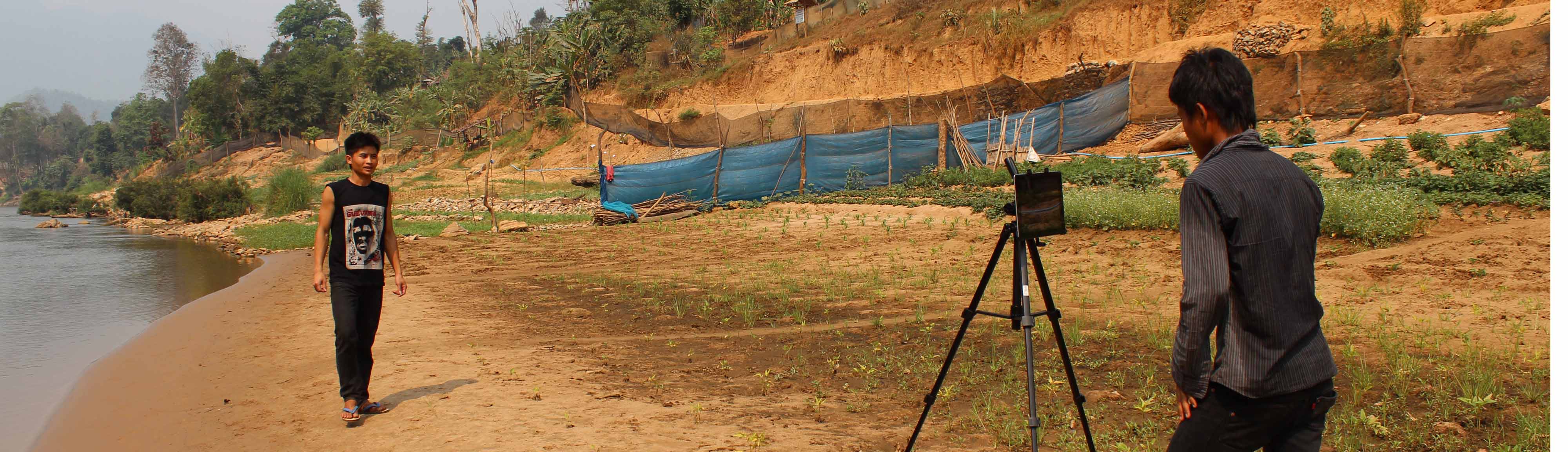
At the inception of my Traveling Teacher project, a core motivation was to see just how far mobile technologies could reach. If an iPad2 can hold a battery charge for 10 hours, is it possible to conduct iPad video workshops in remote villages where there was no electricity? Could the iPad and a little technology education be all that was needed to provide people living in remote regions of the world an opportunity to tell their own stories to the world, to add their voices to the Global Discussion? In late March, I was given the opportunity to find out: I was invited to travel to the far north of Thailand to the Mae La Oon Burmese refugee camp. After a week of preparations, I had secured a camp pass, hired a driver, and found myself staring out the dusty window of a Toyota 4WD, looking out at the scrub covered dry earth, pondering, once again, how many different experiences people in this world have. And how many different stories they have to tell…. 
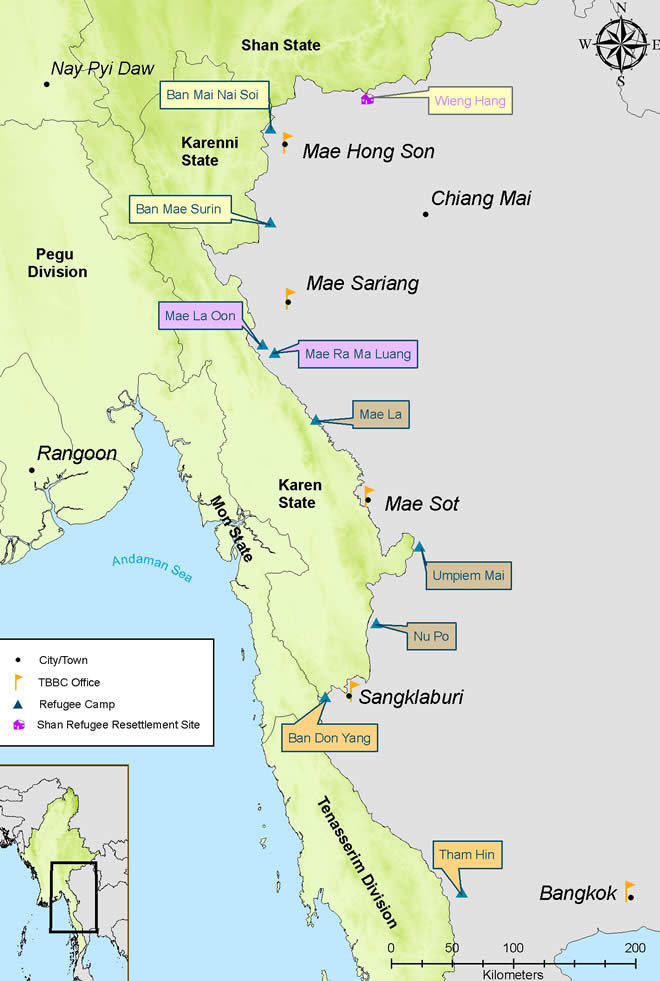
credit: www.tbbc.org
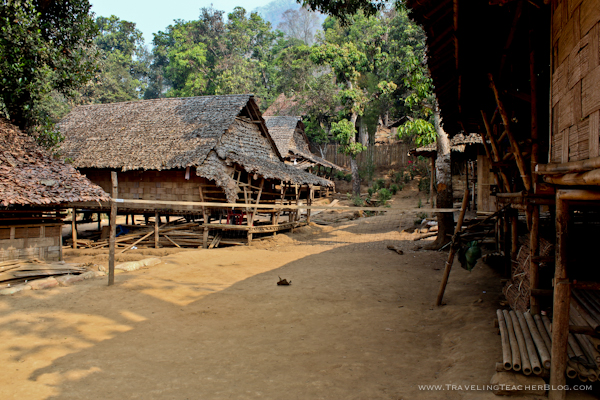
Prior to March of 2012, I had little understanding of the refugee situation along the Thai-Burma border. Since 1991, Myanmar (formerly known as Burma) had been under military rule : Fighting in many of the ethnic states forced over 800,000 Burmese to seek refuge in Thailand, Malaysia, and other countries. There are currently 160,000 refugees living in Thailand. Mae La Oon is just one of the refugee camps. located 2 km from the Thai-Burma border, a 4 – 6 hour drive via 4WD vehicle from Mae Sariang, Thailand. Electricity is only available for 3 hours in the evening, generated solely by gasoline generators. Cell phone reception is non-existent. The one internet shop offers intermittent, dial-up connection and a landline phone.
After 6 hours, I arrived to the KLMTC School.
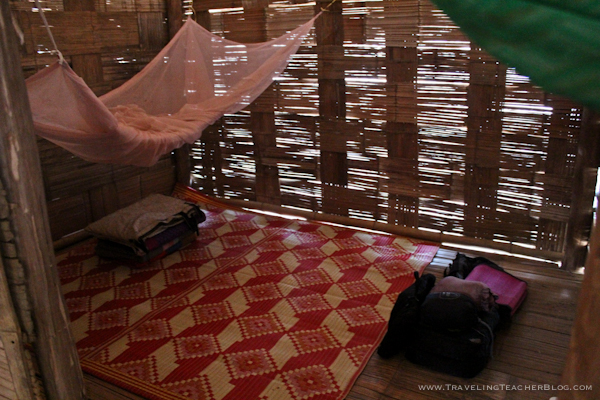
We arrived late in the evening, and I was dropped off at the Karen Leadership and Management Training School entrance. I carried my two small bags into the bamboo school office building, where I was given a small room with wool blankets and a mosquito net.
My room during the TYOS workshop.
Ordinarily, the first thing I do upon arrival in a new location, after emailing family and friends that I’ve arrived safely, is to unpack and set up a charging station for the iPad, iPhone, laptop and cameras. Instead, I turned off my phone, laid the blankets out to form a bed, tucked my flashlight into my pocket, and went to go see the space we would use for the workshop that would begin the next morning.
That evening was the graduation celebration for the school. Using the gasoline powered generator, the students lit up the outdoor stage, plugged in microphones, and spent 3 hours playing music and singing for each other. I was introduced to the six students who had been selected to participate in the project. Several more asked, in their shy English, if it were possible to also join. With only one iPad and one MacBook Air, I had to, with a heavy heart, tell them no. I made a promise to myself then, to try to find more iPads for these workshops.
The next morning, after a breakfast of rice and greens provided and prepared by the students, we began the workshop with Brainstorming. The irony of these two events would become evident by the end of that day’s class.
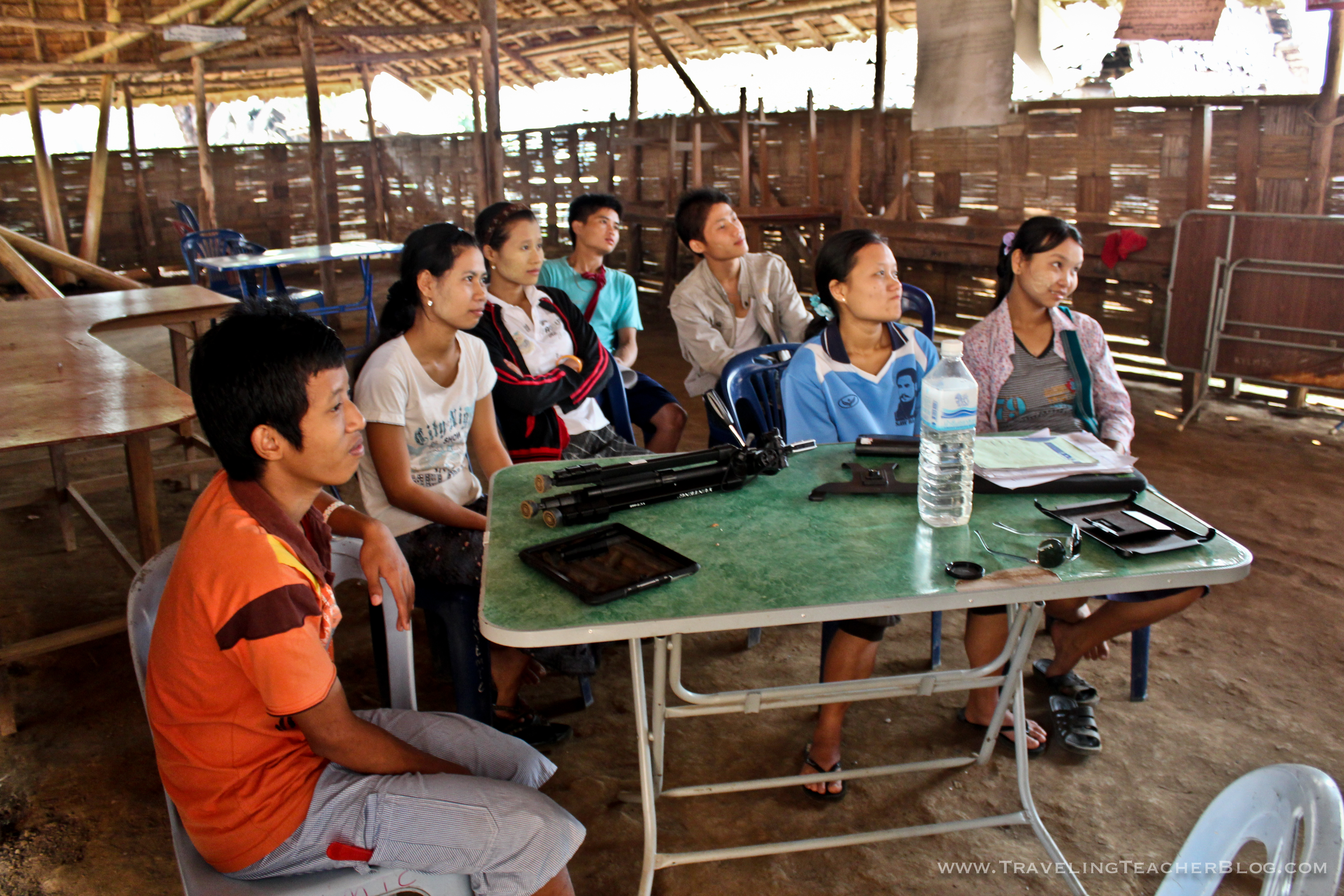
The Students on Day 1 of the Workshop. Most had no computer experience.
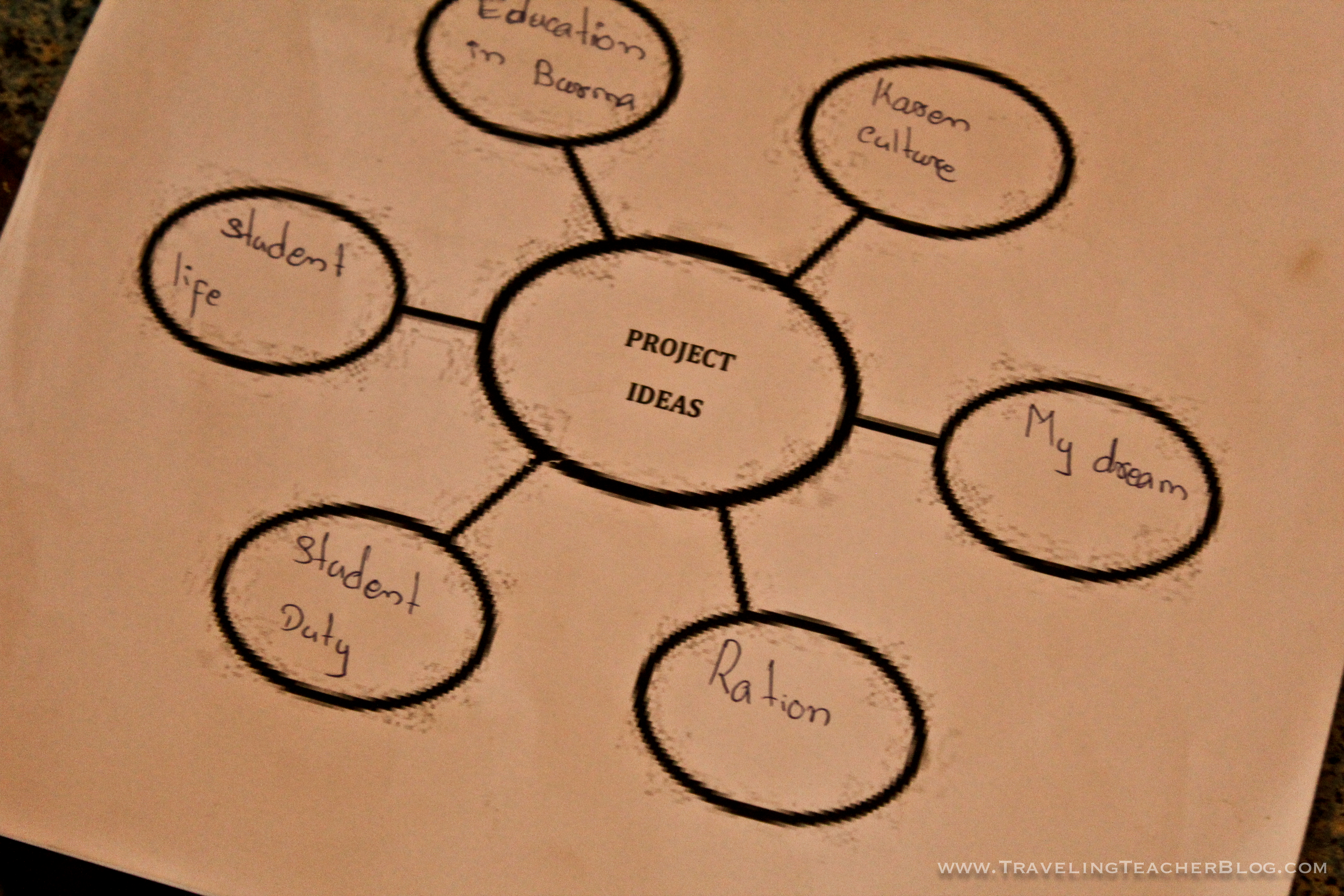
 After watching the Water Wells in My Village, Proud to Be Burmese, My Future Dreams, and A Day in the Life of Nary from previous Tell Your Own Story Project participants, the women chose to make a “Day in the Life Of” video. The men struggled a bit more with choosing their topic, but finally, a small idea stuck out: and it was then that the irony of them cooking and sharing their food with me became apparent:
“Ration”.
As it often happens during the brainstorming sessions, one word stands out from the rest. My co-facilitator Paul was instrumental in pulling the story out from the students. It was a far-reaching issue. They were not sure they could tell it: due to the rising global food prices, food rations provided to the refugees by the Thai Burma Border Consortium had to be reduced during the past year. There simply is not enough funds to feed the increasing number of refugees.
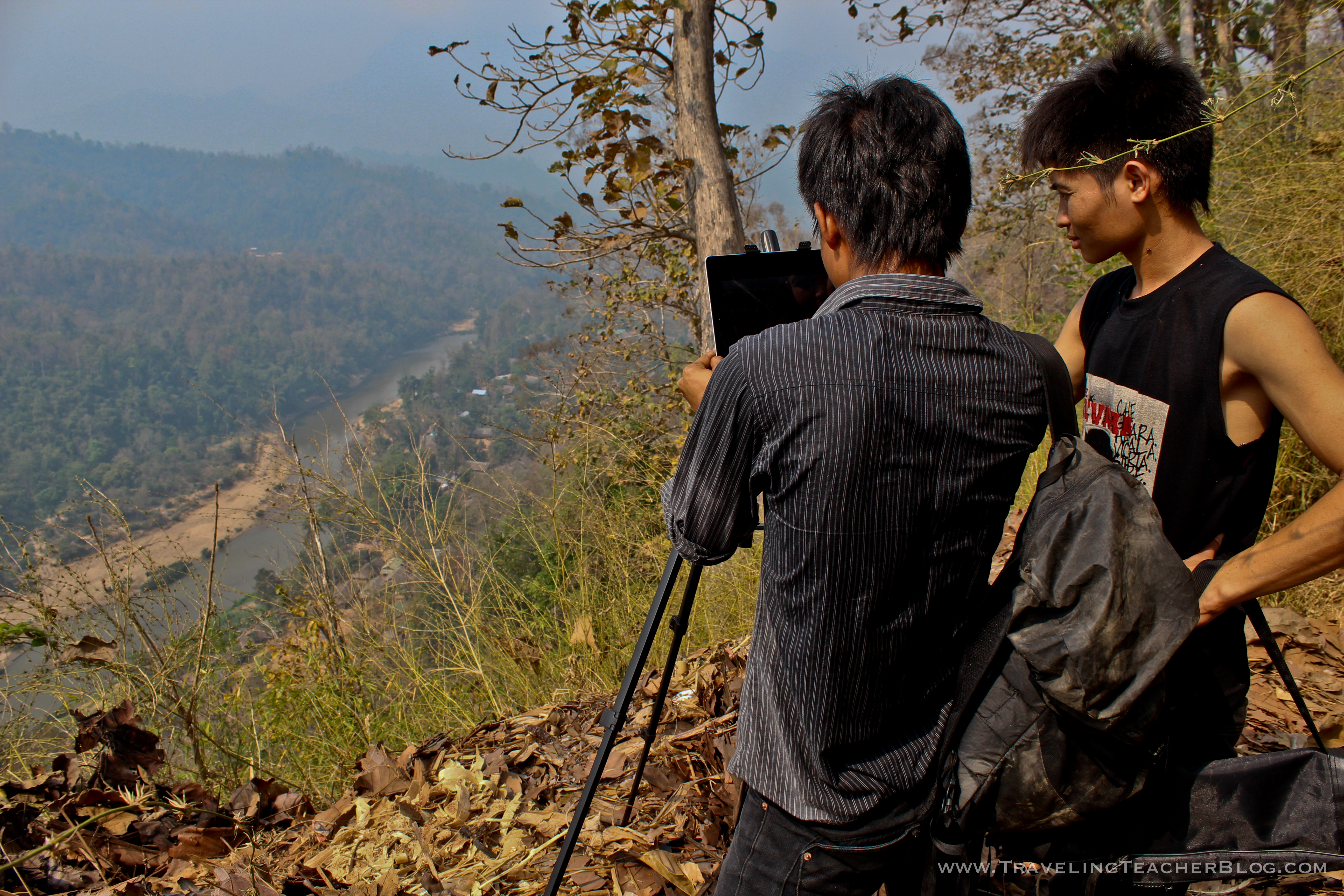
After discussing the various facets of the issue, we began to brainstorm how the students could visually SHOW the problem. “Where and when do you go to collect the food rations,” I asked. The answer to that simple question unlocked the solution. The men quickly set about writing their script and then hurried out to begin capturing video on the iPad. They went alone. And returned with footage that only people who are living the story can tell. They literally put their sweat into this project, climbing the largest mountain in the camp on a 38+ celsius degree day in order to capture birds eye footage of the sprawling camp.
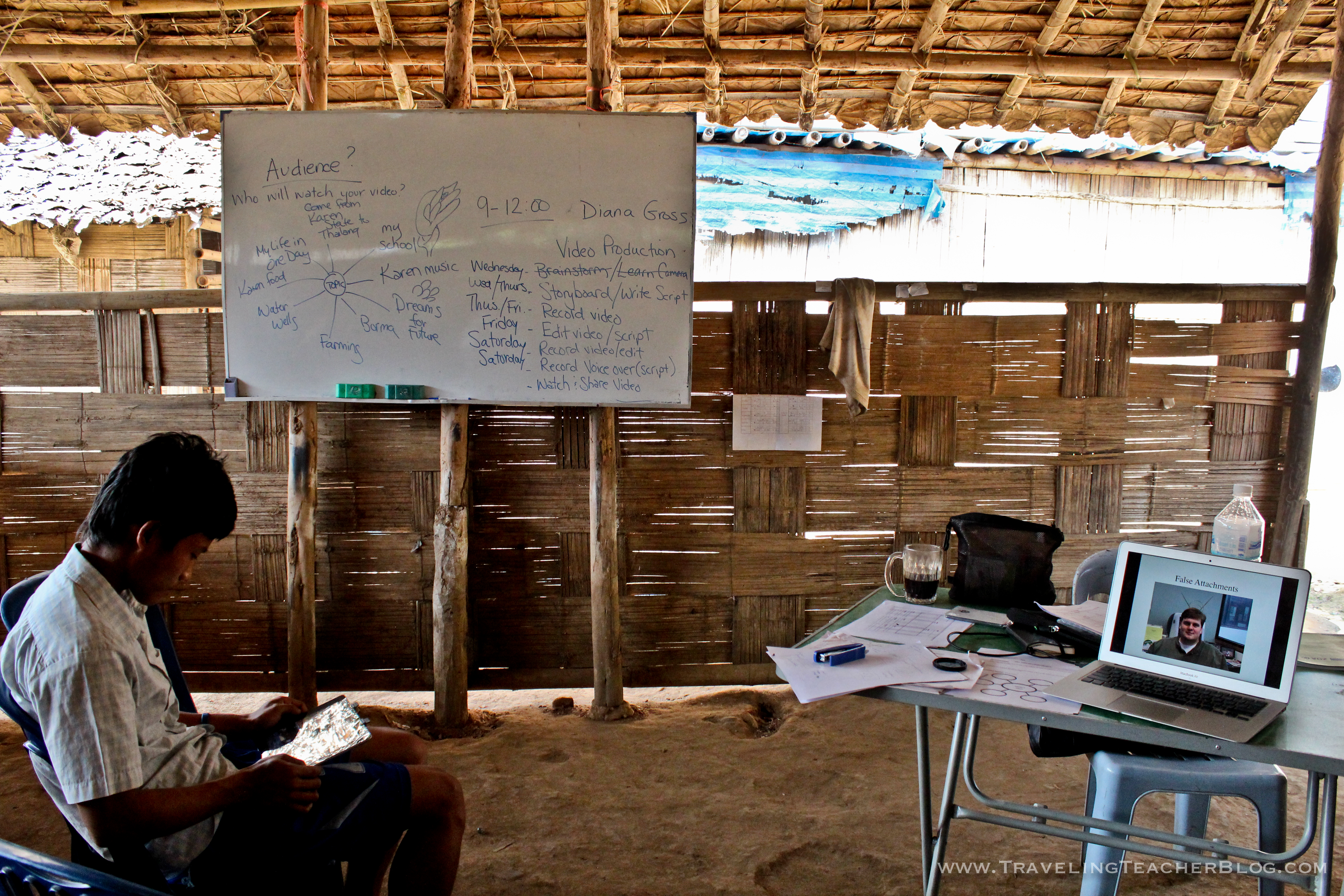
Writing the Script. Sunlight enters into the classroom. No Electricity Needed.
The iPad2 is light and small enough to fit in a bag for hiking to the top of mountains.
In order to tell this important story, the students worked with the iPad2 which we charged in the evenings for three hours while the generator ran. They conceived the idea and wrote the script on paper in a bamboo classroom constructed to allow in the sunlight. We reviewed footage and revised the script while a drinking instant coffee in a local shop that provided boiled water to anyone passing by.
Post Production in the Local Shop; no electricity but plenty of Birdie Instant Joe.
If ever there were a situation that confirmed my beliefs that an iPad2 is the tool for providing marginalized communities to tell their stories to the world, Mae La Oon refugee camp was it. These students worked despite the overwhelming obstacles to produce a compelling video of the reality of life in a refugee camp. And during the entirety of the workshop, they graciously prepared and shared their food rations with me. I would return to Mae La Oon in a heartbeat, hopefully with an entire fleet of iPads. There are so many stories to be told.

http://travelingteacherblog.com

Burmese Mark World Refugee Day

Ethnic Karen and other Burmese refugees await the arrival of Aung San Suu Kyi on June 2 at Mae La refugee camp on the Thai-Burmese border. (Photo: The Irrawaddy)
“Every minute, eight people around the world are forced to flee their homes due to war and persecution. No one chooses to be a refugee.”

Those were the words of UNHCR’s special envoy Angeline Jolie in a videotaped public statement to mark World Refugee Day 2012 on June 20.
The UN estimates no less than 43 million refugees exist throughout the globe, and Burma accounts for a disproportionately high number: 145,000 registered refugees on Thai soil, and an estimated 500,000 displaced persons within Burma. In addition, some 70,000 people from Burmese refugee camps have been resettled in third countries in recent years.
Most are ethnic Karen, but all the ethnic nationalities of Burma can be found at the nine refugee camps dotted along the Thai-Burmese border. Some are political dissidents; some belong to outlawed groups; many are ex-soldiers; some are landmine victims; a huge percentage are children—a new generation of Burmese growing up in a jungle camp without ever knowing his or her own homeland. With few exceptions, they all share one distinction—they all fled their homes in fear of their lives.
Accepting her belated Nobel Peace Prize in Oslo at the weekend, Burma’s pro-democracy icon Aung San Suu Kyi said, “When I met Myanmar migrant workers and refugees during my recent visit to Thailand, many cried out: ‘Don’t forget us!’ They meant: ‘Don’t forget our plight! Don’t forget to do what you can to help us! Don’t forget we also belong to your world!’”
Suu Kyi promised the thousands who turned out to greet her at Mae La refugee camp on June 2 that she would not forget them. In Oslo she called on foreign powers to increase aid to the refugees at the Thai-Burmese border.
“Can we afford to indulge in compassion fatigue?” she asked world leaders. “Is the cost of meeting the needs of refugees greater than the cost that would be consequent on turning an indifferent, if not a blind, eye on their suffering? I appeal to donors the world over to fulfill the needs of these people who are in search, often it must seem to them a vain search, of refuge.”
Following on from Suu Kyi’s speech in Oslo, and coinciding with both World Refugee Day and Suu Kyi’s visit to London, the Burma Campaign UK issued a call to the British government’s Secretary of State for International Development Andrew Mitchell urging him to increase funding to the Thailand Burma Border Consortium—the umbrella group that distributes aid to the 145,000 refugees—by 100 percent.
The issue of humanitarian aid to the refugees is one that looms large, and presents a dilemma for foreign governments eager to get involved with the new opportunities they foresee in Burma, while at the same time calling for an end to the civil war and respect for human rights.
Many government donors and INGOs have pulled their funding from the border-based groups and are instead investing in projects that can be coordinated from Rangoon or other sites inside Burma. A recent plan unveiled by the Norwegian government calls for refugees to be repatriated to “model villages.”
Writing in The Bangkok Post on Wednesday, Burmese activist Khin Ohmar questioned the policy. “Myanmar is changing, and change has brought with it talk of refugees returning. However, one should pause for a moment and seriously consider whether the reasons these people fled their country have disappeared? Can they finally find a safe refuge in their homeland?”
The question is clearly rhetorical—war continues in eastern Burma, the land is peppered with landmines, and no one can guarantee that the Burmese military will abandon its systematic policy of grossly abusing ethnic villagers.
On Wednesday, back at Mae La, those same refugees that mobbed Suu Kyi turned out again in their thousands to commemorate World Refugee Day. Many dressed in traditional Karen costume for the event, which included speeches, song and dance, and a football match.
“On 20th June each year, the world is reminded of the plight of refugees,” the Karen Women’s Organization said in a statement to mark the occasion. “They are encouraged to maintain or increase the humanitarian aid for refugees so that refugees can try to live in dignity.”
In Chiang Mai, northern Thailand, the exile group the Women’s League of Burma (WLB) organized a petition signed by 17,063 people from Burma, mostly internally displaced persons (IDPs), refugees and migrant workers. In an open letter the WLB said, “At present, we are so worried about the increased number of war refugees in Kachin State, and the fighting continues despite some reforms taking place; now the number has increased to almost 80,000 IDPs.
“In Rakhaing [Arakan] State, there is also a fierce crisis where thousands of people are now refugees; in particular it is women and children who are greatly facing a humanitarian crisis. The government must take full responsibility for the safety, including urgent arrangement on food and shelter for these people.”
The UNHCR would appear to have its hands full at Burma’s borders—its official figures may include the 145,000 registered civilians sheltering at refugee camps, but do not account for the hundreds of thousands of IDPs within Karen, Mon, Shan and now more recently Kachin State.
On World Refugee Day in Shan State, a build-up of troops and the prospect of renewed conflict between the Shan and the Wa armies alerted the Thai army to the high risk of another influx of refugees. In addition, a grave racial conflict may be on the verge of boiling over in western Burma, and access to neighboring Bangladesh is invariably denied to those seeking refuge.

http://www.irrawaddy.org