Showing posts with label UNHCR News. Show all posts

Sunday, October 11, 2015

UN, World Bank announce new funds for Mideast refugee crisis


October 11, 2015


LIMA: The UN and World Bank said Saturday they will increase financing for the Middle East and North Africa to help countries there deal with millions of refugees and rebuild after conflicts.

They did not put a dollar figure on the initiative, but said it would ramp up resources to deal with the “enormous humanitarian and economic toll” that conflicts in Syria, Iraq, Yemen and elsewhere are taking on the region.

“The world today is witness to… the highest level of forced displacement since the Second World War,” UN Secretary General Ban Ki-moon said in a statement.

“To address the scale and the nature of the conflicts, we need new approaches. It is important that the World Bank, as a close partner to the UN, and other international financial institutions, mainstream and actively invest in conflict-affected states.”

The new loans will come in two forms, said the organizations, which are also collaborating with the Islamic Development Bank on the plan.

Under the first mechanism, guarantees from donor countries will be leveraged to issue special bonds, including Islamic sukuk bonds, which are specially structured to comply with the Koranic prohibition on charging interest.


In the second, donor country grants will be used to extend low-interest loans to the countries hosting the bulk of the more than 15 million refugees who have fled the region’s conflicts in the past four years.

“Strong global partnerships and innovative financing are essential to meet the scale of the need in these hard-hit countries,” said World Bank president Jim Yong Kim.

“It is our collective responsibility to support the Middle East and North Africa region at this critical time, and this requires significant resources — more than any one country or organization is able to provide on its own.”

The initiative was agreed on the sidelines of the annual meetings of the World Bank and the International Monetary Fund in Lima, Peru this week.

The organizations have set up a working group and asked it to finalize the details of the new financing mechanisms, as well as develop an implementation roadmap by February 2016, they said.

– AFP

Saturday, October 10, 2015

The new access challenge is for refugees, says UNHCR

University access for refugees has become a major challenge for countries in Asia, which like Europe, are seeing an influx of more educated and aspirant refugees.


Unlike previous waves of refugees in Southeast Asia, refugees are arriving with higher levels of education, particularly from countries such as Syria and Iraq.


However their qualifications are not comparable qualifications to those required to access higher education in their country of asylum, a major conference on Global Access to Post-Secondary Education, or GAPS, heard last week. 


Receiving countries were so far unprepared for the influx of such refugees, according to Niaz Ahmad, programme officer in Malaysia for the United Nations High Commission for Refugees, or UNHCR. Speaking at the GAPS conference held in Kuala Lumpur from 5-8 October, Ahmad said host countries had a problem of collecting data on refugees in their country, and therefore often had not begun to tackle the issue of providing education access. 


For example, it was not discovered that of a total of 152,700 ‘population of concern’ – a term used to describe refugee and displaced children – in Malaysia, only 15% were in school. This was in part because refugee children in Malaysia cannot attend publicly funded schools, he said. “We need better data on the refugee population so that we can understand their needs,” he said. 


UNHCR said refugees typically did not bring educational certificates with them, and often could not access public examinations in the receiving country for language and other reasons, and were therefore held back in their education. 


Refugees from countries in the Middle East “are well educated and want access to tertiary education, as their lives have been disrupted”, said Mimi Zarina Azmin, education associate at UNHCR’s education unit in Malaysia, a country with the second-highest number of refugees globally in an urban setting, according to UNHCR. 


Malaysia’s large refugee burden includes 100,000 refugees from Myanmar registered last year, and others from Sri Lanka and Bangladesh as well as the Middle East. 


“We are trying to encourage countries and institutions to provide scholarships,” Ahmad said.


Higher education institutions in Malaysia, including foreign branch campuses have granted access and scholarships to refugees, Ahmad told the conference. 


UNHCR in the past year had signed a memorandum of understanding, or MOU, with the University of Nottingham Malaysia Campus, International University of Malaya-Wales and the private Limkokwing University of Creative Technology – all of twhich provide instruction in English – to provide higher education access for young refugees, the first time this had been done in Malaysia.


“They not only granted access but also scholarships,” Ahmad said. Some 50 refugees will now be able to access higher education in Malaysia under this scheme, he said.


Malaysia earlier this month said it would accept some 3,000 Syrian refugees over the next three years, with an emphasis on professional and semi-skilled people. But UNHCR said it was precisely such people that needed access to universities for further study and for their families. 


Ahmad said the MOU’s with the universities in Malaysia could serve as a model for other countries to provide access to refugees.

Thursday, October 1, 2015

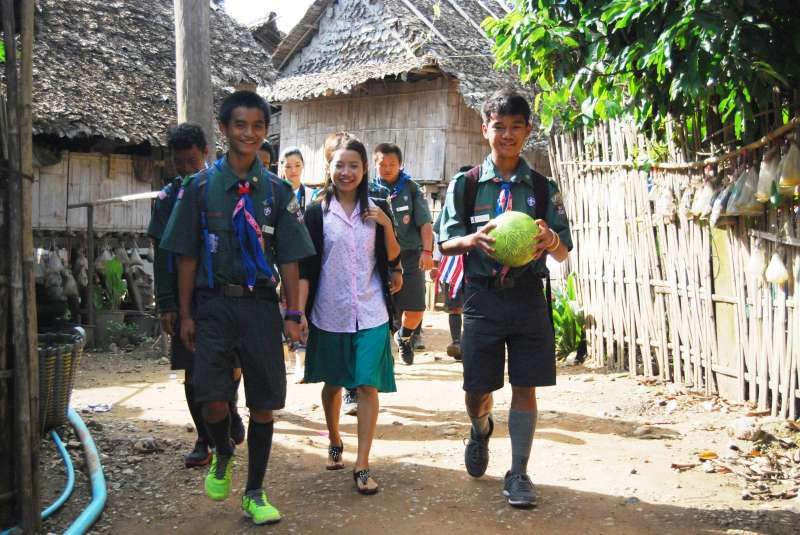
For these scouts, "camping" means coming home


29 September 2015

© UNHCR/K Suntayodom

Reunited after seven years, resettled refugees Lwel Say (left), Lwel Gay Htoo and their aunt Tha Dah Wah stroll through Mae La camp where they were born and bred.

MAE LA CAMP, Thailand, Sept 29 (UNHCR) – They live by the motto, Be Prepared, as members of the Utah Boy Scouts of America Troop. But nothing could have prepared them for the rush of emotions that greeted them in Mae La refugee camp.

The 18 Myanmar refugee boys had flown with their scout leader from Salt Lake City in the United States to Japan for the World Scout Jamboree before arriving in Bangkok for a seven-hour bus ride to reach this camp in western Thailand's Tak province. They were visibly tired but excited as they scoured the crowd for familiar faces – loved ones they had not seen since leaving the camp in UNHCR's resettlement program almost 10 years ago.

The faces of Brothers Lwel Say, 16, and Lwel Gay Htoo, 14, lit up when they found their aunt, Tha Dah Wah, 24. "I'm very excited, very happy and I want to cry," she said. After seven years apart, the boys were now taller than her, but the younger one still clung to her hand as they walked through the camp.

The brothers have come a long way – not just in terms of distance but also experience. Born in exile, Mae La camp was the only world they knew. Daily life revolved around school, play and evening lessons with their teacher-mother. They wore old clothes full of holes and considered themselves lucky to wear flip flops where other kids ran around in their bare feet.

"We used to ask our parents – how will our future be? They always said they didn't know," said Lwel Gay Htoo.

Back then, ethnic conflict in south-eastern Myanmar seemed intractable and the refugees faced the prospect of spending a lifetime in Thailand's camps. In 2005, UNHCR started a group resettlement program to give some of them a new lease on life.

"My parents decided to register for the resettlement program because they hoped for better education for me and my brothers and sisters, so we would have better lives," said Eh Nay Ler, 17, another member of the visiting team.

© UNHCR/P Tonjunpong

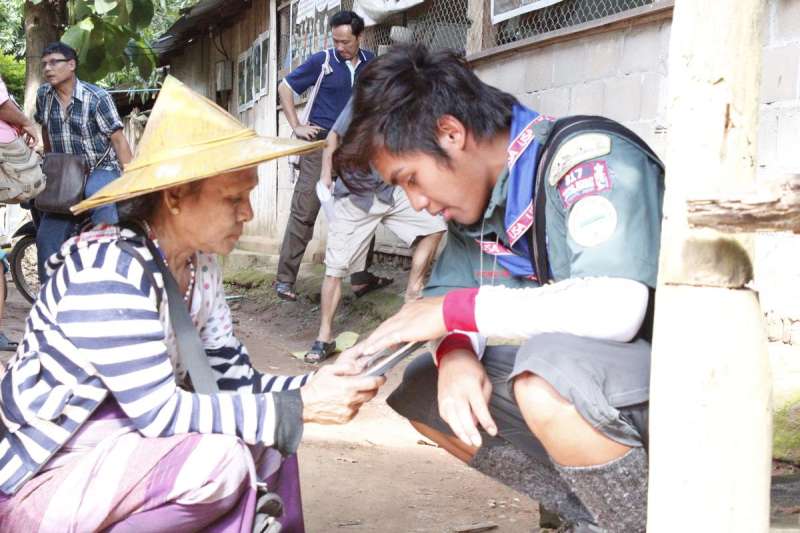
Resettled refugee Eh Nay Ler shows his grandmother in Mae La camp photos of his life in the United States.

Life in the United States was not easy at first. Many struggled with the new environment, culture and language. The Lwel brothers improved their English by watching cartoons while Eh Nay Ler persisted by listening to his teachers. These young men eventually joined the Utah Boy Scouts – comprising some 100 resettled Myanmar refugees – through which they volunteer weekly and help the homeless in their new community.

"Resettling in America gave is a new, fresh start in life. It's given us freedom, rights, better education and welfare that would have been impossible if we still lived in the camp. Without the resettlement program, I could have married early or gone bad," said Lwel Say, who admitted to being "totally stubborn" and "spoilt" in the past.

Eh Nay Ler agreed: "I am very thankful for the life I've been given. Without support from UNHCR, the resettlement country and donors, I would probably be picking corn for a living with my grandmother."

Despite their gratitude, the boys clearly missed the relatives they left behind, including grandparents who felt they were too old to travel and extended family members who had either opted to stay or were unregistered and thus not eligible for resettlement under Thai regulations.

The Lwel brothers' aunt chose to stay for a university scholarship in Thailand, after which she plans to teach in the camp.

This spirit of giving back is not lost on the resettled boys. Lwel Say hopes to come back to Mae La to be a teacher when he graduates from high school in two years.

Fellow Scout Hay Soe, 16, waxed nostalgic when he visited his old school in the camp: "One day I will come back here and be a teacher. I will teach math or science because I love these subjects and I want to work for refugees in Thailand."

Nearly 100,000 Myanmar refugees have been resettled to third countries such as Australia, Canada, Denmark, Japan and the United States since 2005. Some 110,000 remain in nine camps along the Thailand-Myanmar border.

By Korapin Suntayodom & Pathamawan Tonjunpong,

In Mae La camp, Thailand

Sources : UNHCR

Sunday, September 27, 2015

Are elections enough to bring about a true democracy?

Francis with San Suu Kyi in the Vatican on 28 October 2013

On 8 November, Myanmar is due to hold a general election. Cardinal Charles Bo raises questions regarding key issues such as human rights, economic inequalities and social and religious discrimination

PAOLO AFFATATO, ROME

Everyone agrees that it will be a decisive step in the country’s history: the general election in Myanmar, which have just been announced for November 8th, will be the first since the country moved from military dictatorship to civil government in March 2011. 

This coming autumn’s election represents an important step along the country’s journey towards democracy and could definitively do away with the “generals in civilian clothes” who, as capable transformists, have stayed in power until now.

There are a total of 1,100 seats that need to be filled, including those of the two-chamber National Parliament and those of the provincial assemblies. The new Parliament will have the task of electing the President of the nation. 

There are two main contending parties: the Union Solidarity and Development Party (USDP) which is currently in power and full of former members of the military and the National League for Democracy (NLD), headed by Nobel Peace Prize winner, Aung San Suu Kyi. The two parties are the same ones that came head to head in the last democratic elections the country held in 1990. Aung San Suu Kyi won with an overwhelming majority but the military junta nullified the election result.

The Catholic Church shares in the view that this is a “historic moment” for the Burmese people. In a majority Buddhist country, there is a small approximately 500,000-strong community of Catholics who form 1% of Myanmar’s population.

The Church asks one fundamental question: are elections sufficient in defining a democracy and determining how democratic a country is? It answers by highlighting how essential the following principles are amongst others: human rights, religious freedom, inter-denominational harmony, respect and peaceful co-existence with ethnic minorities, equal opportunities and fighting against poverty and economic and social inequalities.

On behalf of the Catholic Church, Burmese cardinal Charles Maung Bo, esteemed Archbishop of Yangon and an influential public figure who speaks frankly, raised doubts and offered hints for collective reflection and the common good of the country.

In a shrewd analysis of the situation, Bo mentioned “seven swords that pierce the nation’s heart”: a nepotistic capitalism, where a few families possess most of the wealth; a refusal to resolve conflicts through dialogue, opting for violence instead; unfair laws that continue to deprive farmers of their land; a criminal economy of drugs and human trafficking; discrimination against ethnic minorities; the destruction of natural resources and scarce educational and occupational opportunities for the poor.

With this in mind, the cardinal sent out a heartfelt appeal to political leaders, inviting them to be “good parents to the whole nation”. “In accordance with our traditions, as ‘parents of the people’, our political leaders have the right and duty to promote the wellbeing of everyone,” he said in a message published by Vatican news agency Fides.

The Archbishop of Yangon recalled the expectations of the Burmese people, with 50 years of dictatorship at an end and a democratic transition in full swing. Bo pointed to the hair-raising figures of the latest census: 40% of the Burmese population lives under the poverty line and in some states, such as Chin and Rakine, poverty levels reach 70%. And poverty generates the migration phenomenon: there are over 200,000 displaced people within the country and thousands more Burmese refugees in neighbouring countries.

The cardinal clearly stated that “political leaders did not fulfil our expectations: they have become the guardians of a nepotistic capitalism in an economy that is purely motivated by profit,” putting the interests of the élites above all else.

Another sore spot: leaders have been unable to control widespread acts of hatred and intolerance committed by extremist religious groups, for example, the violent “ethnic cleansing” campaign promoted by the nationalist Buddhist fringe against Rohingya Muslims. The conflict with ethnic minorities - given the nation’s mosaic of ethnicities - is another key question that has led to the hypothesis of a federal state being considered as a solution.

Bo raised some serious questions: “Will political leaders manage to avoid discriminating against citizens on the basis of ethnicity or religion? Will they be able to accept equality and build a united nation?”

Principles such as respect for the human rights of everyone, unity and equality are at the root of democracy. This is the message that the Church is trying to get across ahead of an electoral competition that could mark the start of a new era in Myanmar.

http://vaticaninsider.lastampa.it

Thursday, August 27, 2015

Eyes Wide Shut: The challenge of humanitarian biometrics

The use of biometrics clearly has a role to play in humanitarianism. The challenge, says IRIN columnist Paul Currion, is to protect the disadvantaged, whose identities may be vital for accessing government services, while preventing powerful states and private companies who may seek to experiment or exploit.
By Paul Currion 


An Afghan policeman looks into a biometric eye scanner

BELGRADE, 26 August 2015 (IRIN) - Biometrics, for those of you who haven't spent the last 10 years swearing at the automated passport gates at Heathrow, is the use of human measurements for identification. The most familiar biometrics are fingerprints, but the computer-powered scanning of eyes and faces is being implemented in a growing range of contexts. The origins of modern biometrics lies in the identification of criminals, but it was the war on terror that turned biometrics into the $13.8 billion industry it is today.

As a result the technology has leapt ahead in recent years – and leapt into some surprising places. You might use your fingerprint to access your smartphone, but everybody gets fingerprinted now, including schoolchildren. Facebook can recognise you even if it can’t see your face, but even music festival organisershave decided that facial recognition technology is a good bet. Despitelongstanding concerns about privacy, biometrics clearly have their uses, and a growing range of sectors have been implementing them – including the humanitarian industry.

Biometrics in the humanitarian context are ostensibly focused on preventing identity fraud, but the basic dynamic was captured in this 2006 report from the UN’s refugee agency, UNHCR, in Malaysia:

“Nang Piang, a refugee from Myanmar, placed his finger tentatively on the biometrics scanner... ‘I don't know what it is for, but I do what UNHCR wants me to do,’ he said... ‘This is an important step for UNHCR Malaysia as we strengthen the security of our registration system to prevent fraud,’ said Volker Türk, head of UNHCR in Malaysia, ‘Such a security measure will certainly enhance the credibility of UNHCR's registration system in the eyes of the Malaysian government...’”

This statement makes clear that biometric registration is driven by the interests of national governments, technology companies and aid agencies – in that order. 

UNHCR's biometric system was initially funded by the EU and the US (specifically recommending funding “for early UNHCR use of mobile fingerprint technology developed by [the Department of Homeland Security]”). A number of companies have since been involved, including PA Consulting, who previously helped the UK government develop its border control biometrics, and one of whose former employees now works for the UN, overseeing global deployment of the system.

Critics of the industry focus on two concerns. Security is one: in 2008, for example, PA Consulting lost 84,000 biometric UK prisoner records – not through an act of cyber-crime, but because they were left on an unencrypted USB stick in an unlocked drawer in an unsecured office. Privacy, the second issue, is sometimes even more critical from a humanitarian perspective, because the privacy of vulnerable communities and individuals – many of whom may already be fleeing conflict or persecution – may be critical for their protection.

UNHCR has argued that biometric registration improves protection for refugees, but the question is clearly not settled. A recent study by Katja Lindskov Jacobsen pointed out that – while biometric registration may help to mitigate some vulnerabilities – the creation of the “digital refugee” may also create new vulnerabilities. These arrive precisely because this data can be shared between different actors for more than one purpose; to address problems faced by refugees, yes, but in a different context to frame refugees as the problem.

Government assurances of privacy are no guarantee. The European Commission promised that its EURODAC database of asylum applications would be protected, right up until 2012 when it agreed to allow Europol and other law enforcement agencies access to it. UNHCR expressed concerns about this, but the Commission went ahead anyway. UNHCR plunged on towards a global and centralised Biometric Identity Management System (BIMS) while only adopting adata protection policy in May 2015 – a policy that explicitly states that UNHCR “may transfer personal data [of refugees] to third parties.” That policy has safeguards built in, but the security of your data is only as secure as the weakest link in your chain – and, as noted above, that link might simply be somebody who forgets their USB stick.

This fits with a wider and more worrying pattern in the field of biometrics: it'smarginalised groups who are used as guinea pigs for new biometric applications, always with claims that it's for their own benefit. Privacy International has identified that in countries where democratic processes – such as parliamentary oversight and the rule of law – function more effectively, biometric schemes have been repeatedly challenged and rolled back by informed citizens. The real issue here is accountability – or lack thereof – precisely because humanitarian biometrics are being implemented in countries where those factors are weak to non-existent.

For example: one of the earliest uses of humanitarian biometrics dates back to 2003, helping UNHCR to establish that only 0.5% of Afghan returnees from Pakistan were trying to game the Afghanistan refugee return programme. Current President Ashraf Ghani promoted biometrics as the foundation for his country's social policy in his 2006 book “Fixing Failed States”, and the Afghan authorities have made it their goal “to fingerprint, photograph and scan the irises of every living Afghan.” This has made Afghanistan the most biometrically identifiable country in the world – although UNHCR and the Afghan government have both invested heavily in biometric databases, the US military has been the real driving force.

The use of biometrics clearly has benefits. The Centre for Global Development has given cautious and context-specific support to the broader principle of incorporating biometrics to bridge what they refer to as the identity gap – on the basis that the vulnerable and marginalised are usually required to submit to biometric registration to enable them to access government services. TheColumbia Human Rights Law Review comes down on the side of the legality and efficiency of biometric ID cards for refugees, if privacy concerns are fully addressed.

Photo: J. Ose/UNHCR Ethiopia
A member of a Somali family is fingerprinted by UNHCR staff

Yet it seems obvious that the individuals being registered are unlikely to be fully aware of the implications: a UNHCR article quotes Congolese refugee Olivier Mzaliwa saying: “I can be someone now. I am registered globally with the UN and you’ll always know who I am.” Even assuming that Olivier has been well-informed about the possible downsides of his registration (which seems doubtful, since it's not clear that UNHCR field staff themselves will be aware of these issues), he no longer has any control over this data about himself – and it is doubtful he has any means to regain that control, or even to find out how the data is being used. There is still a massive accountability gap.

Depending on where you lie on the political spectrum, registration of your identity is either an invaluable tool in the fight against poverty or an additional chapter in Seeing Like A State – although it’s probably both. Either way, the use of biometrics is only going to increase, particularly as we move towards mainstreaming cash distribution, where registration and verification are critical to ensure effective targeting and monitoring. Given this trend, we have an obligation to avoid using the bodies of the poor as experimental subjects, subject to an implicit assumption that they are all criminals – if not now, then at some unspecified point in the future.

We’ve seen in this article how biometric systems design has privileged the point of view of humanitarian organisations or national governments. Is it possible to develop a new design approach for managing identity, one that isn't a second-hand solution from companies looking to expand their market?

World Vision has explored one alternative in developing its Last Mile Mobile Solutions, making its concerns about biometrics clear. Building on this and other efforts, and incorporating the principles of participatory design, our starting point should be designing from the point of view of refugees, rather than our own organisations. Unfortunately the humanitarian community consistently fails to engage with that perspective, but this debate is more critical than ever, and not just for biometrics. The debate around design imperialism has died down, but it hasn’t disappeared, and digital design is becoming increasingly important.

So next time you’re swearing at the biometric passport scanner at the airport, remember that although your passport gives you the freedom to travel, that freedom is subject to surveillance and control. You might have more in common with refugees like Olivier Mzaliwa than you think; but unlike Olivier, at least you can choose your queue at the airport.

Sources : http://www.irinnews.org

Sunday, January 4, 2015

More action needed to tackle IDP issues: UN

Special to Myanmar Eleven January 5, 2015 1:00 am

More action is needed to deal with internally displaced persons (IDPs) in Myanmar, particularly in Rakhine, Kachin and Shan states, said the United Nations High Commissioner for Refugees (UNHCR).


In its updated operations profile for 2015, the UNHCR said fresh displacement was witnessed in 2014, with continued clashes between the Myanmar national army and non-state groups in Kachin and northern Shan states.

A crucial source in humanitarian aid to the people, the agency noted that significant numbers of IDPs in Kachin and Rakhine states continue to live in camp settings. 

In the coming year, the agency will focus its attention on people without citizenship, IDPs, refugees, returnees and host communities.

In 2012, violence in Rakhine State forced around 140,000 people to flee their homes. The majority live in government-designated IDP camps near the state capital, Sittwe, and in surrounding townships.

In Kachin State and northern Shan State, more than 100,000 IDPs are displaced and in need of continued humanitarian assistance. They are living in camps in both government-controlled areas and those under the control of non-state actors.

In Rakhine State, space in IDP camps is severely limited, and efforts to provide basic relief services have met severe challenges. The situation for most IDPs deteriorated in 2014, particularly in the areas of health coverage and non-food items distribution. The premises and warehouses of the UN and many other international NGOs were attacked and ransacked in early 2014.

"The inter-agency response in Rakhine State has repeatedly emphasised the need for durable solutions for IDPs. At present, there is a continued policy by the government to physically separate the conflicting communities, which limits reconciliation efforts and space for supporting coexistence," the agency noted.

Rakhine State is home to a large Muslim community. Tensions between Buddhist and Muslim communities have affected hundreds of thousands of families since violence between the two erupted in 2012.

Meanwhile, more than 100,000 IDPs live in Kachin State and northern Shan State. The UNHCR has seen the budget for its operations rise since 2012, when a ceasefire between the Myanmar army and the Kachin Independence Organisation (KIO) broke down.

"Continued clashes between the Myanmar national army and non-state actors in Kachin and northern Shan states in 2014 led to more displacement and a need for an emergency response. The inter-agency response relies on permission from the Myanmar government to access IDPs in areas under the control of the Kachin Independence Organization (KIO). As a result, only ad hoc missions are undertaken to these areas, limiting the response," the agency said.

It added that protection activities would continue for both Kachin and Rakhine states this year, depending on the conditions of the operational areas, particularly the level of access.

Home returning 

The agency is now working on sending refugees back to Myanmar. 

"In the southeast of Myanmar, UNHCR continues to perform return monitoring to identify the destination of refugees settling back in Myanmar. The aim is to build a profile of areas where interventions can be planned if the scale of returns increases, enabling the Office to respond once spontaneous returns increase. Planning for return is ongoing, including consultations with Myanmar refugees on the Thai border," the UNHCR said.

Residents of Kayin State fled to the Myanmar-Thailand border and overseas due to clashes between the Myanmar government troops and the Karen National Union (KNU). At present, there are about 100,000 refugees. Most of them live in any of the nine refugee camps along the Myanmar-Thailand border built by the UN and INGOs.

"We have to clear land for their living, and the relocation process will go forward only if the programmes to support them are planned. There are civic and social organisations involved, but we still need to include organisations related with the army," said Pahdo Saw Hla Tun, a central committee member of KNU.

Following the military coup in Thailand, there was a move to repatriate up to 120,000 Myanmar refugees living in temporary camps in Thailand. Many of the refugees have been in the camps for years, and an entire younger generation was born and raised in them.

General Prayuth Chan-o-cha, chief of Thailand's National Council for Peace and Order (NCPO), said that returning the refugees was one of the issues discussed during his meeting with Myanmar Armed Forces chief Senior General Min Aung Hlaing on July 4 in Bangkok. 

The UNHCR noted that increased interest among refugees in returning to Myanmar requires budget estimates that cover potential activities, should conditions be deemed conducive.

"Significant financial support may be needed in 2015 to support shelter repair and maintenance in Rakhine and Kachin states. Given the above, the 2015 budget for Myanmar is set at US$67.8 million," the agency said. 

The agency is planning support for around 20,000 potential returnees in 2015, although conditions are not yet sufficient to support any organised voluntary return.


Planning figures in 2015 

Type/origin/January/December 

Returnee arrivals (ex-refugees) /Myanmar/10,050/40,500

Internally displaced/Myanmar/587,000/514,000

People in IDP-like situations/Myanmar/35,000/35,000 

Returnee arrivals (ex-IDPs)/Myanmar/55,000/78,000

Stateless/stateless/810,000/810,000

Total/ 1,497,050/1,477,500 

Source: UNHCR

Wednesday, August 1, 2012

Be The One To Empower Refugees ( 4 )

From Editor’s Desk

Dear readers,

It’s amazing to know the various skills refugees bring into this country, especially delicious ethnic culinary, beading and embroidery skills, and unique handicrafts.

SPF recently initiated a skills-exchange programme with YWCA-VTOC. Refugee women taught the art of fruit and vegetable carving to 19 VTOC students, and beading to 15 other VTOC students. In exchange, VTOC trainers provided baking lessons to 40 refugee women.

YOUTH COLLECTIVES

“We want a platform to discuss, share and decide on issues concerning refugee youths”, says Andrew, the newly elected chairperson of Youth Collectives (YC). YC is a new initiative
by SPF to foster sustainable youth teams from diverse refugee groups.

Currently the YC comprises Sri Lankan, Myanmar and Somali refugee youths. They have enlisted members aged 14 to 25 years regardless of their gender, ethnicity, or religion. There are now 26,910 refugees youths aged between 14-25 years registered with UNHCR.

Refugees from Myanmar and Afghanistan for instance, still preserve their traditional skills which are slowly dying in an increasingly modern world. Those are skills that are highly valued.

Refugees are willing to teach, if Malaysians are willing to learn. Skills and knowledge exchanges will help to foster peaceful co-existence among refugees and local communities. And it is greatly empowering for both sides.
Be the one to initiate it! Contact SPF to
learn how you can help.

The group’s vision is to unite refugee youths, provide learning opportunities
for them and establishing PEACE between local and refugee youths.

At the YC elections held on 21 June 2012, and attended by 55 youths, 13 executive committee members were elected. They have taken responsibility to implement four projects – peer counseling support, advance IT course, fundraising through cultural night and outreach for membership.

It’s very fulfilling to see young people interacting with each other despite
cultural and language barriers, for a common, good cause.

REFUGEE EMPOWERMENT TRAINING

by SPF Team

When they stepped off the bus at the Skytrex Adventure Park that Sunday morning on 8 July, none of the community project coordinators ever imagined that the empowerment training they were about to undergo would include them wearing a harness, being blindfolded, and made to walk backwards on pipes suspended 20 meters above the ground!

Guided by two volunteers from the Netherlands, Cynthia and Roderick, the project coordinators spent the day learning teamwork on a whole new level, with fresh perspectives. The first half was spent brushing up on their theoretical knowledge.

After a quick lunch, they then spent the afternoon completing the practical training component, which included devising ways to ensure an egg stayed intact after a 2-meter drop!

Then came time to cast aside any fear of heights and test their agility when they got to walk, crawl, glide and swing from tree to tree to complete the aerial challenges.

Needless to say, the project coordinators thoroughly enjoyed the experience. They left Skytrex feeling empowered, motivated and eager to put their newly-acquired skills to good use in managing their SPF projects.

Rohingya children on par with local kids!

by Soraya Alkaff-Gilmour, Soroptomist International Johor

The Kulai School children did their first ever performance at Taman Sutera Mall on 14 July. The school was opened on the 2 May, and now they have shown and given themselves a chance to prove that they are "on par" with our local children.

Three student interns from AIESEC - Jam (Vietnam), Pamela (China) and Joanne (Hong Kong) managed in 3 weeks to organize different ethnic songs and dances. With the great help of our teachers, Mary and Elizabeth, the children were dancing and shaking along with Bollywood music, with two solo singers who put P. Ramlee to shame!!

The good news is that the Management of Taman Sutera Development Sdn Bhd has kindly promised to look into helping the school in response to our “very long wish list". They contributed to the purchasing of costumes for the 22 children who participated in the event. They also treated the kids to a great meal at KFC after the performance.

We wish to say a special thank you to one of the parents, Mr. Aziz, in helping us get a free bus to shuttle the children.

For those who missed the performance - we have another show at 1.00pm on 4 August at the same place. We sincerely hope to see you all there!

Our best wishes to Soroptomist International Johor, for their tireless contribution to refugees, especially for the Rohingya refugee community.

Source : SPF, UNHCR Malaysia

Sunday, July 22, 2012

High Commissioner for Refugees wraps up mission to Myanmar, Thailand

Source: Content partner // UNHCR 

BANGKOK, Thailand, July 13 (UNHCR) - UN High Commissioner for Refugees Ant�nio Guterres has concluded a five-day trip to South-east Asia with agreements in both Thailand and Myanmar that refugees should only return home voluntarily, in safety and in dignity - and should be able to stay home when they do go.
"We don't want the refugees of today to become the irregular migrants of tomorrow," he said.
Meeting Thai Prime Minister Yingluck Shinawatra, he thanked Thailand for its generosity in hosting tens of thousands of Myanmar refugees for more than two decades. The two reached "a solid agreement" that refugees should only go home when they choose to do so.
Earlier in Myanmar, Guterres told President Thein Sein and other senior officials that UNHCR supports peace-building in the south-east (the area from which refugees fled to Thailand) through assistance to displaced people.
"We are ready to help prepare for returns, which should be voluntary and carried out in safety and dignity, both of those displaced within the country and from the nine refugee camps in Thailand," he told the president and other authorities.
Both in Myanmar and in his meeting in Bangkok with the secretary general of Thailand's National Security Council, Wichean Potephosree, all sides agreed that the return of many of the 150,000 refugees now in nine camps in Thailand must be sustainable.
All sides also agreed to work together to create security, economic and social conditions on the ground to make returns successful and ensure that refugees will be able to make a living when they go back. "No one wants refugees to go home, only to have to flee again," Guterres said, "Or, worse yet, become displaced within their own country."
Less encouraging were recent disturbances in Myanmar's western Rakhine state, but there UNHCR has been delivering - and will continue to deliver - humanitarian aid to both displaced communities, Rakhine and Muslim, without discrimination.
"We believe that this can be a factor for reconciliation between communities and we hope that a situation will be established in Rakhine state with the rule of law prevailing, with a human rights-based approach," Guterres said.
The High Commissioner also expressed concerned for the status of the 800,000 stateless Muslims of northern Rakhine state.
He told President Thein Sein and the Myanmar government he hoped that - independently of possible improvements in the nationality law - nationality would be granted to the members of the Muslim community who are entitled to it under the present legislation.
"Others should receive a legal status that would grant them the full enjoyment of rights required to develop a normal life in the country," he added.
On Friday night, the High Commissioner was to travel to Ethiopia for the Africa Union summit and for a field mission on Monday to see conditions for refugees from Sudan's Blue Nile State.
By Kitty McKinsey in Bangkok, Thailand

Top UN Official Offers Ideas to Quell Ethnic Strife in Burma

Lisa Schlein
GENEVA — The U.N. High Commissioner for Refugees, Antonio Guterres, is offering to help the Burmese government reconcile the Buddhist and Muslim groups in sectarian-torn Rakhine State.

Guterres, who is on a mission to Thailand and Burma, also known as Myanmar, has presented proposals to the Burmese president and other officials for bringing the two communities closer together.

The U.N. refugee agency reports a tense calm has returned to Rakhine State, a remote region in western Burma.  In May, violence between Buddhists and Muslims in Rakhine flared after three Muslims were detained following the rape and killing of a Buddhist woman.  More than 60 people were killed and thousands of homes destroyed in sectarian clashes that followed.

U.N. refugee spokeswoman Melissa Fleming says the UNHCR continues to view the unstable situation in Rakhine with concern.  She says Guterres conveyed these concerns to Burmese officials along with his offers of help.

“We would like to state that in Rakhine State we remain absolutely committed to delivering humanitarian assistance to both populations, the Rakhine and the Muslim without any discrimination," Fleming said. "We believe that this can be a factor for reconciliation -- this aid between the communities -- and we hope that the situation will be established there, with the rule of law prevailing and a human-rights based approach.”

At the peak of the ethnic fighting, hundreds of Rakhine Muslims fled across the Naf River to Bangladesh. Their efforts to seek refuge were frustrated when Bangladesh closed its borders.

Security forces reportedly pushed back refugee boats when they arrived on their territory, leaving hundreds of people adrift in the Naf River.

UNHCR spokeswoman Fleming said the situation of people fleeing across the border is no longer acute.

“We are absolutely monitoring this and hopeful that things will return back to normal and that relations between the two communities can be re-established," she said. "But, one of the festering problems is, of course, the statelessness situation, As the nationality law stands, it is based on ethnicity and it does exclude certain groups including the Muslim Rohingya population.”

Fleming says the UNHCR believes nationality should be granted to members of the Muslim community who are entitled to have it according to the present legislation.  And, others, she says should receive a legal status that would grant them the rights required to develop a normal life in the country.

On another issue, she says Guterres asked Burmese officials to clarify why 10 local U.N. and non-governmental aid workers were arrested last month, allegedly on criminal charges. The high commissioner also asked for access to three UNHCR staff being detained. 
 
Source : http://www.voanews.com

Tuesday, June 26, 2012

Art With Heart : A Refugee Art Project

Many of us live our lives oblivious to what’s happening around us. How often do we remind our kids how fortunate they are when there are other less fortunate kids out there who some, don’t have the luxury of cuddling with their loved ones, or have a formal education or just have a childhood?
The United Nations Refugee Agency Malaysia (UNHCR)  is mandated to safeguard the rights and well-being of refugess and asylum-seekers worldwide and they have been working to protect and assist refugess in Malaysia since 1975.

These refugees are not criminals nor are they parasites.   Their intention is not to take away the jobs in the country.   They are courageous people with strength and determination to move on and build new lives for themselves with hopes that one day, their country will be safe for them to go back to and if not, they just want to have a chance to have a life – like everyone else. There are not only men and women involved but also children – who’s only hope is to have a normal childhood with lots of love and an education. 13,800 refugee children in Malaysia are of school-going age and less than 40% of them have no access to formal education. Those that do have access  to a formal education attend classes that are run by UNHCR and NGOs  or community-based education classes that are organized by refugee communities themselves. However, these children are no as lucky as our children. They have classes in cramped, rented shop houses or flats where the rooms are converted into classrooms and are mostly lack of basic teaching facilities and qualified teachers.
UNHCR seeks long term solutions for refugees including finding them new homes in third countries or helping them return home voluntarily when it is safe to do so. While they are seeking temporary protection in Malaysia, UNHCR works with partners to create a safe and secure environment for them where their basic needs are met.

In the spirit of spreading the word about the Refugee Camp, GIN & JACQIE™ threw an art contest for the children and called it Art with Heart : A Refugee Art Project.
The children were provided with all the necessary materials which included the theme – ‘Happiness’.
Mary, a 15 year old refugee child from Myanmar was chosen out of hundreds of children. Her piece was an ode to her mother whom she had lost recently.
 ”I painted love,” said Mary, “When my mother passed away, I was scared. But I know her love is always with me. And that makes me happy.”
GIN & JACQIE™ printed her artwork onto canvas bags, and these bags are  available for purchase from here starting 20th June  2012.  All proceeds will go to the aid of education for the children, which includes basic needs, books, and stipends for teachers.
If you would like to be a volunteer or just find out more about the refugees in Malaysia and what UNHCR is doing to help them, log on to www.unhcr.org.my.
Spread the word on how we can support the refugees in Malaysia. Do your bit in giving back to the society.
 
Source : http://www.mom2ashley.com


Remembering the refugees among us

United Nations bring asylum seekers' plight to light through art
Thursday, June 21, 2012 - 14:21
Location: 
IPOH

pg8June21
AGAINST ALL ODDS: The winners of the art competition with Vernon (second from left) and Henry (right) holding up the canvas bag printed with Mary's painting

AT 12, he was forced to flee his homeland. His only link to his father now is one precious phone call a month.

All Zein Iapipd wants is for his country Palestine to be at peace so that he can return home.

Having called Malaysia home for the last five years, Zein was one of many refugee children who attended the United Nations High Commissioner for Refugees' (UNHCR) World Refugee Day event at Bangsar Village 1 yesterday.

He was one of the participants in an art competition organised for the refugee children, whose winning artworks would be displayed at the mall.

He won a consolation prize for his piece, which featured a painting of a bird framed by a heart.

"I want my country to be free like a bird. I want a future for my family where we can all live in peace and love each other."

UNHCR celebrated World Refugee Day yesterday to recognise and raise awareness on their plight. Among the guests were former Miss Universe Malaysia and refugee rights advocate Deborah Priya Henry.

UNHCR representative Alan Vernon hoped the event would encourage Malaysians to step forward and help in their own capacity.

The art competition this year was held in collaboration with local bag designer Gin & Jacqie.

Gin & Jacqie designed and sponsored canvas bags printed with the artwork of first prize winner, 15-year-old Mary Mang Hou Cing. The bags went on sale yesterday.

All profits from the sales will be donated to refugee education programmes in Malaysia.

The bags will be available at www.ginjacqie.com and Cziplee, Bangsar for RM24.

Mary, from Myanmar, painted a picture in memory of her mentally-ill mother who died a few years ago.

Mary said while her mother struggled with fleeing the violence of her own country and battling her unstable mental condition, she never failed to ensure Mary felt loved, even in the most difficult times.

Mary received the first prize for her art piece titled "Love" and will have her art printed on the canvas bag to be sold under a fundraising initiative called "Art With Heart: A Refugee Art Project".

She has been living in Malaysia for three years and aspires to be a fashion designer.

As of April, there are 98,100 refugees and asylum seekers registered with the UNHCR in Malaysia.

Out of these are 20,000 children below the age of 18 who do not have access to formal education and a nurturing environment.
 
Source : http://www.mmail.com.my

Sunday, October 4, 2009

United Nations High Commissioner for Refugees, Malaysia

By Jacob Zenn

During the summer of 2009 I interned with the United Nations High Commissioner for Refugees in Kuala Lumpur, Malaysia. My work at UNHCR was aimed at determining who fit the international law definition of a refugee and then providing assistance to refugees under the mandate of UNHCR. Other NGOs could also provide assistance to refugees in need of support, but UNHCR has legitimacy from UN and very few organizations can exert pressure on domestic governments like UNHCR. During my internship at UNHCR, I performed various tasks. Much of my work was performing research for the Refugee Status Determination Unit office on Country of Origin information for refugees from Myanmar to determine whether they warranted a presumption of eligibility (POE). Those groups of refugees who received a POE would have an expedited status determination procedure and have their eligibility for protection available with immediacy. I also interviewed refugee applicants from Myanmar, such as ethnic Burmese or Arakanese people, who did not warrant a Presumption and made recommendations on their refugee status to the Deputy Representative of UNHCR Malaysia. I also interpreted Chinese language refugee applicant interviews from mainland China and I visited Myanmar for one week and presented the findings from my trip to the Refugee Status Determination Unit.

However, my favorite part of the summer outside of work was experiencing life in Kuala Lumpur. I learned Malay language before starting the internship which allowed me to fully immerse in the society. Kuala Lumpur has an interesting demographic balance with the majority of the people Malay ethnicity and significant minorities of ethnic Chinese and Tamil Indians. There is also an evident presence of immigrants, both legal and illegal, and refugees. During my free time I would meet with Myanmar refugees and migrant workers and study Burmese language with them. This helped me understand the psychology of the refugees with whom I interviewed at the UNHCR office. I had to be careful though not to allow my relationships with Myanmar refugees prejudice my work.

I will follow up with this experience by gaining the credits to satisfy the Certificate for Refugee and Humanitarian Emergencies and attempting to work for UNHCR or a similar organization after I graduate.

Monday, September 14, 2009

Myanmar refugees weave together self-reliance and hope

14 Sep 2009 15:12:20 GMT
Source: UNHCR

Reuters and AlertNet are not responsible for the content of this article or for any external internet sites. The views expressed are the author's alone.
FARUK PARA, Bangladesh, September 14 (UNHCR) – Kil Cer, a shy, petite 34-year Chin refugee from Myanmar, can be found every morning weaving blankets along with five other women in the village community centre in this remote lush green village in the Chittagong Hill Tracts.

But they're not just turning out the colourful traditional blankets their mothers and grandmothers have always made. In their own quiet way they've woven together a small-scale economic revolution in the settlement of 700, liberating their families from debt and dependence on handouts.

"I am happy now," says Kil Cer. "Before, it was a difficult struggle." Largely because of Kil Cer's weaving skills, her community has paid back all their debts. They are able to take care of their families without UNHCR's support and have invested money in other businesses, such as banana plantations, that also employ the local Bangladeshi host community, known as the Bawm.

"We speak almost the same language as they do and they have been very good to us," Kil Cer, a mother of two, says about her hosts.

Behind the success is a new UNHCR approach to developing self-reliance as part of UN High Commissioner for Refugees António Guterres's focus on refugees living outside camps. Learning from earlier projects that gave grants to refugees who did not have the proper skills or business education to use the money properly, UNHCR began relying on the expertise of local businesses to develop the skills of refugees in Bangladesh living outside camps.

Eight months ago, Kil Cer and other refugees in the village were heavily in debt after many of their projects – small rice mills, grocery shops and farming – failed. For many years, they had relied on UNHCR to pay their rent and give them money for basic commodities. Even when Kil Cer tried to support herself with weaving, she was only able to earn US$2 per blanket – hardly enough to cover her expenses.

"Like many girls in Myanmar, I was taught to weave by my mother in Myanmar when I was 15 years old," she says. In Bangladesh, she began weaving blankets and passed on the skill to a few other young women, both refugees and Bangladeshis.

The turning point came when UNHCR introduced her to Samantha Morshed, chief executive officer of Hathay Bunano, a company that was already employing rural Bangladeshi women and other disadvantaged people to make soft toys for the international market under fair trade rules. She provided free professional advice to Kil Cer and her team on improving their products and marketing them, to make best use of a UNHCR start-up loan of US$250.

Today their offerings include shawls, scarves, ponchos, baby blankets, picnic blankets, bedspreads and bags marketed under Expression in Exile, a brand that is becoming popular with the urban elite in the Bangladeshi capital, Dhaka. Within a month, they made a profit of US$800, a substantial amount for the residents of Farak Pura, and today demand is outstripping supply.

"I was excited when I first saw the blankets from Expression in Exile and am happy to give the group a little direction in terms of colours, sizes, pricing and raw materials," says Morshed. "I see no reason why these blankets cannot achieve mainstream export sales in the near future."

Now that her daily needs are taken care of, Kil Cer is already looking to a future she could scarcely have dreamed of a year ago. "I want to invest the money in my children's education," she says. Her 19-year-old colleague, Siang Khin Par, has similar high hopes: "I do this because I would like to be self-reliant. I would like to learn computing and English."

UNHCR Representative in Bangladesh Saber Azam says the programme is paying benefits not only for the refugees but for Bangladesh as well.

"Ensuring that refugees are able to take care of themselves and their communities is often a more humanitarian activity than giving them free hand-outs for years," he says. "Kil Cer has also demonstrated how refugees can help their Bangladeshi hosts rather than being a burden on them."

By Jelvas Musau in Faruk Para and Arjun Jain in Dhaka, Bangladesh

UNHCR news